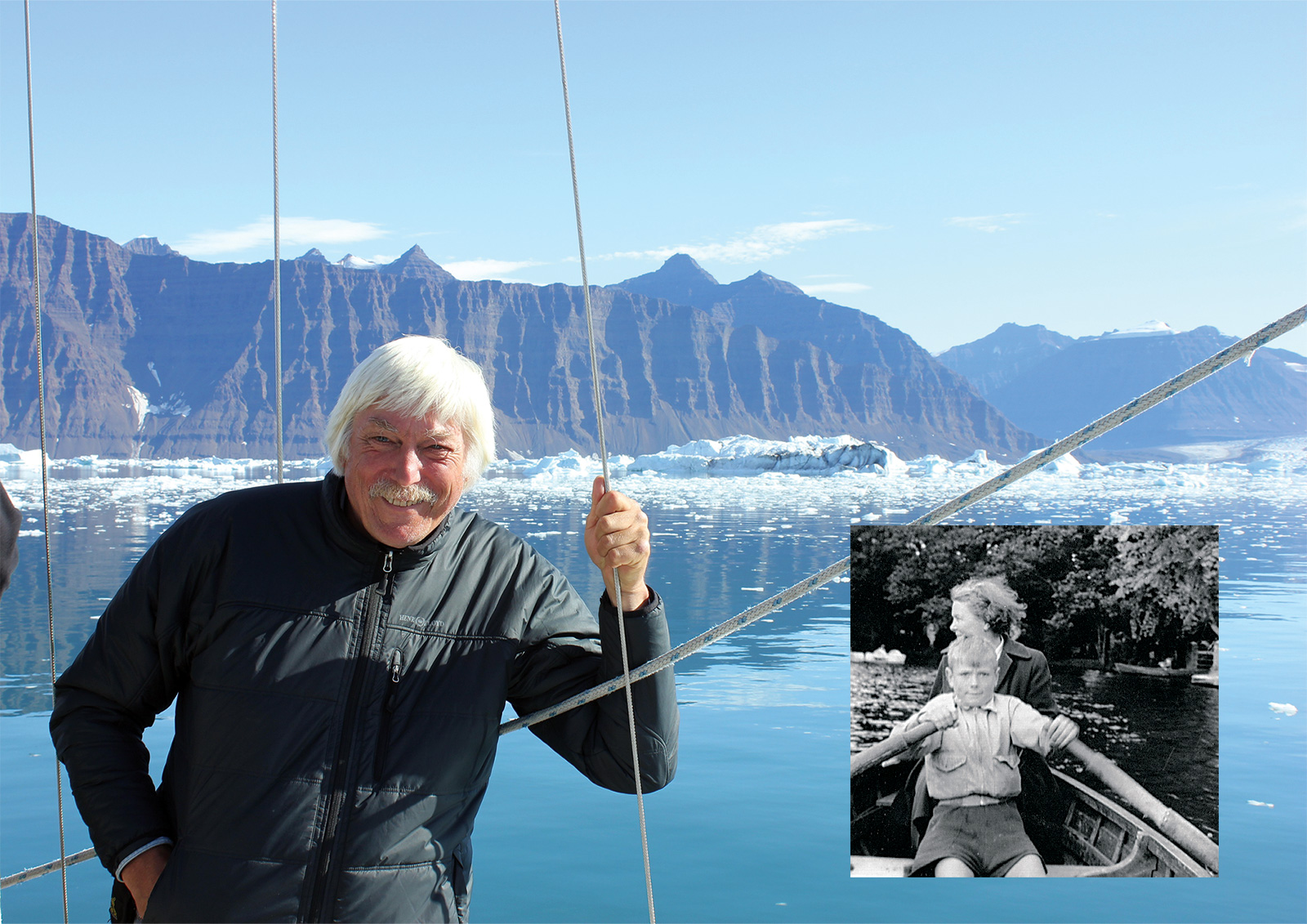
Tom Cunliffe in Greenland.Tom And Ros Cunliffe (both)

Tom Cunliffe took up writing in the mid-1980s to fund his passion for old wooden boats; he’s now written 30 books on subjects ranging from histories to sailing manuals and cruising pilots, penned numerous magazine articles, and appeared in television documentaries. Although he failed to reach Greenland in his pilot cutter HIRTA in 1983, he returned in a friend’s boat in 2013. Inset—An early attempt at rowing.

We had to leave Rio de Janeiro, and we had to leave quickly, but we had no chronometer and no charts because they had all been stolen. All we had was a chart of the Atlantic Ocean and the coordinates for Barbados. My proposition was to sail north until we passed 13 degrees North and then to turn left and run down the line of latitude until we got to Barbados. At the last minute, a friend gave me his Bulova Accutron watch, which would have given us longitude, but that went overboard at Cabo Frio, so we had no longitude again. So, there we were in the middle of the Atlantic Ocean, and we didn’t know where we were to within 200 miles. And it didn’t matter. It was not important because we knew that we were safe and we knew that we were going the right way.”

I’m sitting in Tom Cunliffe’s “den” next to his home in a quaint village outside Salisbury in South West England. The pretty cottage where he and his wife, Ros, live and the converted outbuilding are all quintessentially English, as is the 1949 Bentley in which he picked me up from the station. But the stories he tells me conjure up another world, one of stormy seas, leaky boats, exotic locations, and curious characters. His stories are told with the characteristic mix of high drama, acute technical know-how, and great humor that has turned him into something of a celebrity in the British sailing world.

Since Tom took up writing in the mid-1980s to fund his addiction to old wooden boats, he’s written about 30 books on subjects ranging from histories to sailing manuals and cruising pilots, as well as hundreds of articles for British and American sailing magazines. He’s featured in three BBC series about the sea and has become a regular fixture on the boat-show and yacht-club speaking circuits, where he’s guaranteed to raise a laugh. In recent years, he’s taken to the Internet, with more than 40,000 subscribers to his YouTube channel and 1,000 subscribers to his online private members club, The Sea Chest. Most recently, he’s written his first novel, a tale of corruption, murder, and love in the Caribbean, based on his experiences of sailing among the islands over several decades.

It occurs to me that I’m very lucky to have, for a full five hours, the undivided attention of a man with such a remarkable CV. He tells me about his event-packed life, including the six wooden boats that shaped him as a person and helped to make him famous.

1925 William Hand schooner HINDU.Tom And Ros Cunliffe

Tom learned the ropes in the 1925 William Hand schooner HINDU, in which he served as crew in the late 1960s.

HINDU, a 75′ Gaff Schooner

Tom did not come from a family of sailors, but they did pass along other skills that would serve him well in later life. His maternal grandfather was a Methodist minister, active in the early days of the Labour party and a campaigner for worker’s rights. Tom’s mother followed in her father’s footsteps, organizing women’s conventions and being involved in both party and church. Tom’s father also qualified as a Methodist lay preacher at age 14, before going on to read classics at Cambridge University and eventually becoming a judge in Manchester and Liverpool. Coming from such a fearless, civic-minded background instilled in Tom a clear sense of purpose and an admirable ability to speak in public. Watching Tom talk with his characteristic zeal about surviving a storm on a 32′ yacht, it’s not difficult to imagine him speaking from the pulpit about the blood of Christ with equal passion.

“They were all speakers and wordmongers,” Tom says. “And I’ve got no chance to be anything else.”

But Tom did not become a preacher. Instead, he, too, followed in his father’s footsteps and studied law at Liverpool University. He was all set to become a barrister when something happened that would change his life forever. Even as a boy, he had been inspired by books of sailing adventures by authors such as Bill Tillman, Joshua Slocum, and, most influentially, Bill Robertson, whose book Deep Water and Shoal he believes “every young man should read.” Seeing his interest in sailing, his parents arranged for Tom and a friend to hire a gaff-rigged cruiser on the Norfolk Broads for several years in a row to teach themselves how to sail. Tom pursued this interest at university, racing Fireflies on the marine lakes at Southport and West Kirby, on the northwestern coast of England.

Then, in the third year of his law degree, Tom booked a flight to the United States on the British Universities North America Club (BUNAC) scheme, which supports working holidays in the United States. It was the late 1960s, and he enjoyed his first real taste of freedom to the fullest. But his most significant experience was working as a deckhand on the 72′, 1925 William Hand–designed schooner HINDU, one of the first whale-watching boats working out of Provincetown, Massachusetts.

“She was a lovely boat and very well run in those days by a chap called Justin Avellar,” Tom remembers. “He’d been on the Banks and was a proper seaman. I learned quite a lot from him. I’d turn up at six o’clock in the morning, polish the brass, and get everything rigged up. People would arrive, and off we’d go. And that was magnificent because at the end of that, I realized I could get paid for doing what I really liked doing, which was going sailing. And I thought, why am I struggling on with this academic career when I’m really not cut out for it? I really want to be a sailor. I want to have adventures.”

Tom’s first boat was the 22′ centerboard sloop, LEIHANETom And Ros Cunliffe

Tom’s first boat was the 22′ centerboard sloop, LEIHANE, designed by Alfred Westmacott and built of teak and mahogany on oak.

LEIHANE, a 22′ Bermudan Sloop

Back home in England, Tom struggled for another year with his law degree before giving up and deciding to become a sailor. But, of course, there were no jobs on ships in Liverpool in the late 1960s, and he ended up driving trucks instead. Eventually, he spotted an ad in Yachting Monthly magazine that said: “Hands wanted for refitting a 90-ton trading ketch with a view to sailing to the West Indies.” The boat turned out to be the ex-Baltic Trader JOHANNE, which would go on to become famous under the ownership of Edward and Clare Allcard, who wrote numerous books about their voyages. When Tom joined the vessel, she was a semi-wreck moored on the Hamble River and needed some intense activity to get her going ahead. It was gruelling work, but he was at last embarked on the career that would absorb him for most of his adult life. What’s more, it was while working on JOHANNE that he met Ros.

Tom didn’t make it to the West Indies in JOHANNE; instead, he jumped ship in Madeira and hitched his way home to be with Ros. An aspiring adventurer he might have been, but he also knew when he was on to a good thing. And so the couple rented a house in Salisbury and Tom got a string of jobs doing boat deliveries and whatever else came his way, including selling perms and wigs for the hairdressing brand Clynol, while Ros finished her secretarial training. One of his jobs at this time was delivering a Miller Fifer motorsailer down to the Mediterranean and skippering her from her base in the south of France for a few months. For full disclosure, I should mention that this was when the Compton family first met Tom. We were living aboard our 48′ Silver motor yacht in St. Jean Cap Ferrat when Tom appeared and impressed my parents no end with his dogged enthusiasm. In return, Tom says, my father taught him how to predict a mistral better than the local forecasters. I was nine years old at the time, so must admit I have no memory of him.

It was while Tom was working as a sales rep that he and Ros bought their first boat. It was a modest 22′ centreboard sloop with “full crawling headroom,” according to Tom. LEIHANE was designed by the legendary Alfred Westmacott and built by the Woodnutts boatyard on the Isle of Wight in 1932. They bought her for £600 and sailed her locally around The Solent and across the Channel to France. The experience convinced them they needed a bigger boat.

1903 Colin Archer pilot cutter SAARI.Tom And Ros Cunliffe

Tom’s first transatlantic passage was in the 1903 Colin Archer pilot cutter SAARI, seen here in Bahia, Brazil, on her way to Rio de Janeiro.

SAARI, 32′ Gaff Cutter

The plan was to buy a house, work for a couple of years to pay the mortgage, then sell the house and buy a boat with the profit. The plan almost worked, although they lost patience towards the end and had to get a bridge loan to cover the difference between their savings and the price of their new boat.

The object of their impatience was a 32′ double-ended Scandinavian beauty imbued with a Viking spirit. The boat’s provenance was a puzzle. According to Lloyd’s Register (which only ever published the information provided by an owner) she was built at the Åbo Båtvarf in Finland in about 1920 for a former Finnish pilot. When they visited the yard years later, however, there was no record of the boat in their books. After a great deal of research, Tom and Ros ended up at the Colin Archer archive in Oslo, where they found the exact plans of their boat. It turned out that SAARI had been built by Colin Archer in 1903 for the Finnish pilot service, in which she served until 1920, when she was sold off during a push toward motorization. She had then been taken to the Åbo Båtvarf and converted into a yacht. By the 1960s, she had ended up in the United Kingdom under the ownership of Chris Waddington, a prominent member of the Old Gaffers Association.

One of the curious aspects of SAARI’s conversion from pilot boat to yacht involved an extension of the coach roof aftward to increase the accommodation; one of the original full-width deckbeams had been left in place, presumably to maintain the hull’s integrity. That meant one had to duck under a very low beam to get from the galley and navigation area to the saloon, a small detail that made perfect sense structurally but also made her very hard to sell, despite her impressive performance at sea.

“She sailed like a witch,” Tom says. “Which was just as well, because the engine wasn’t any good. It was constantly breaking down and was just useless. But she was a pretty boat. Flawless, really. Usually, there’s always some angle that lets a boat down, unless it’s a Fife. And there wasn’t with SAARI. She was perfect from every angle, in or out of the water. It was just the headroom that was no good. I’m 6′6″, but when I was 25, I didn’t care about that. Everybody else did, so we got the boat cheap.”

This was the early 1970s, when fiberglass ruled. Wooden boats were regarded as anachronisms, even more so those equipped with four-cornered sails. The main reason to buy wooden boats was because they were cheap. But Tom had good reason to put his faith in a 70-year-old piece of floating history. He had tried both modern and traditional boats, and the experiential difference was startling.

Tom and his wife, Ros, began living aboard SAARI.Tom And Ros Cunliffe

In 1976, Tom hauled SAARI at Frenchy’s Slip in Grenada. Inset—Tom and his wife, Ros, began living aboard SAARI in the early 1970s.

“I remember when we were living on board SAARI; I was teaching sailing to pay her off,” he says. “My teaching tool was a Sparkman & Stephen–designed S&S 30, which had just cleaned up in the Half-ton Cup. She was very fast, a good sailing boat. But I remember very clearly one day when we were coming out of the Hamble River in SAARI for a weekend away, some clown came past us in a motorboat and produced a big wash. I’d been sailing the other boat all week, and it was a revelation the way SAARI went through that sea compared with the race boat. The difference in comfort was just mind-boggling.”

While they paid off the boat debt, Tom and Ros lived aboard SAARI on so-called “debtor’s jetty” on the Hamble River near Southampton, where there was a lively community of like-minded people. One fellow wooden-boat dweller was the aspiring yacht designer Nigel Irens, who had yet to design his first boat. A lifelong friendship was forged which many years later would result in an unlikely collaboration. And it was at the legendary Jolly Sailor pub on the Hamble that Tom was introduced to a random stranger who offered him a job skippering a boat in Rio de Janeiro. The stranger even offered to fly him out there, but Tom had a better idea: to sail SAARI across the Atlantic on what would be the Cunliffes’ first major boating adventure.

They spent nearly a year in Rio, while Tom skippered what he describes as a “not particularly distinguished” Charles E. Nicholson ketch, but legal complexities of being in Brazil were heating up, which drove them to leave in a hurry—with or without charts and a timepiece, as described earlier. In the event, Tom managed to get a time check via radio and was able to take a sight and calculate their position. After a 42-day passage to Barbados, they got a job delivering “a quarter ton of bikinis” to an island off the coast of Venezuela before proceeding on to the east coast of the United States. They landed in Charleston, South Carolina, and, after getting the engine fixed with the help of a retired U.S. Navy mechanic, headed up the Intracoastal Waterway toward New York. To make ends meet, Tom took a job longlining for cod off Nova Scotia for a few weeks, after which they decided to return to England. It was on this crossing they encountered probably the worst storm (as opposed to “gale”) of their lives, described in glorious detail in Tom’s second-most popular YouTube video (@TomCunliffeYachtsandYarns).

The MARISHKA, an 1895 Loch Fyne skiff.Sandeman Yacht Company

The “lovely MARISHKA,” an 1895 Loch Fyne skiff derivative that Tom and Ros bought while living in Devon, England. She was extensively rebuilt by a subsequent owner in 2022.

MARISHKA, a 28′ Gaff Cutter

Back home in England, Ros soon became pregnant, and it was apparent that SAARI would be too small for three. Despite the boat’s low headroom, they sold her for a good price and with the proceeds bought a cottage in Devon and their third yacht: a 28′ gaff cutter built in Sandbank, Scotland, in 1895, making it even older than their previous two boats. Based on the lines of a Loch Fyne skiff, a type of Scottish fishing boat, MARISHKA was designed by Daniel Fyfe (cousin of the more famous William Fife) and owned by Noel Guinness of Guinness brewery fame in Dublin for the first few years of her life.

Tom remembers the boat fondly, describing her as “lovely MARISHKA. What a grand little sailing boat she was. She used to bustle along. She had an old Coventry Victor diesel, which went, ‘Pop, pop, pop, pop.’”

With a baby on the way, the couple decided it was time to settle down and earn some money. Following a spell on the bridge of a commercial coaster, Tom duly got a job as yachtmaster instructor at the National Sailing Centre in Cowes. They moved to the Isle of Wight and bought a Jacobean farmhouse, which Ros ran as a bed-and-breakfast. Their daughter, Hannah, was born in 1978, and it seemed as if they might live happily ever after in their sweet English idyll.

Ros, however, had other ideas. Her father had been a fighter pilot in World War II, so she “grew up at the end of a runway,” moving across Europe from base to base. Settling down wasn’t in her blood. Tom was also soon burnt out, teaching countless aspiring yacht skippers and having to sit back and watch as they set off on their own adventures. After just four years of living what seemed a perfect life, they decided it was time to move on, and for what they had in mind they would need a bigger boat.

“We got very interested in the discovery of North America in the 10th century,” Tom says. “We read all the sagas in some depth and formed our own conclusions about where people had been and what had happened. So, we bought our next boat with the intention of sailing to America.”

HIRTA, a 50′ cutter.Winkie Nixon (both)

Left—Tom and Ros’s 15-year ownership of HIRTA, a 50′ cutter, began in 1982. Right—In Mystic, Connecticut, the following year, they repaired the stern.

HIRTA, 50′ Gaff Cutter

Their search for an ocean-worthy cruiser eventually took them to Scotland to look at an exquisite 1930s William Fife gaff cutter, which was the epitome of the classic yachts that would become extremely fashionable in the 1980s and ’90s. But Tom and Ros were looking for a long-legged cruising yacht and turned her down. In desperation, the yacht broker suggested looking at an old pilot cutter on the other side of Loch Fyne. After a long drive up and down winding Scottish roads, they reached Tarbert. It was a life-changing moment.

“We came over the hill, and she was moored in the middle of the harbor, like a set piece really,” Tom says. “We just looked at her and said, ‘We’ll have her.’ We hadn’t even been aboard, but she looked just right, dead right. And so she proved to be.”

The boat in question was the 50′ Bristol Channel pilot cutter HIRTA, which would dominate the couple’s lives for the next 15 years. Built in Polruan, Cornwall, in 1911, and then named CORNUBIA, she worked as a pilot cutter until 1913. She was sold in around 1920 and was converted into a yacht. During World War II, she was used as a sail-training vessel by sea cadets on the Firth of Clyde in Scotland, until she was bought by Adam Bergius in 1958 and used as a family boat for the next 23 years. Under the Cunliffes’ ownership, she would become famous around the world and not only transform their fortunes but, perhaps more important, advance the cause of gaff rig generally. For, even though gaff rig was still regarded as eccentric when Tom and Ros bought HIRTA in 1982, by the time they sold the boat 15 years later the concept had re-entered the mainstream, and there’s no question they played a large part in that transformation.

First, however, they had to get out of Loch Fyne.

“As we beat down the loch, we had headwinds and we found that she was leaking quite prodigiously,” Tom remembers. “So, we pulled into Campbeltown and I rang up the [previous] owner and said, ‘Look, we’re leaking quite a bit of water here.’ And he said, ‘Yes, you’ll find that she will make some water. It’s never too much. And it keeps the bilge clean.’ He was an excellent man, who’d been a bit of a hero as a submariner in World War II. And it wasn’t for me to criticize anything he said, so I went along with it.

“So, for the 15 years that we had the boat, she leaked continuously at sea. We couldn’t stop it. I spent all my substance and most of my hard labor trying to fix her. But nothing would stop it. And what we discovered was that so long as you were confident, you could pump it out a lot quicker than it was coming in. So, there was really nothing to worry about. As long as the equation was in your favor, you weren’t going to sink.

“And it led me to the conclusion that the modern world has developed a very bourgeois attitude towards leaky boats. People can’t take it. They can’t take a joke.”

Tom and Ros’s daughter, Hannah (right).Tom And Ros Cunliffe

Tom and Ros’s daughter, Hannah (right), grew up sailing aboard HIRTA; she has been the director of National Historic Ships UK since 2017.

After making a couple of small changes to the rig, Tom and Ros set off from Scotland with four-year-old Hannah and two friends on May 1, 1983. They sailed up to Bergen, Norway, and from there retraced the route the Vikings are thought to have taken across the North Atlantic to North America, via Iceland and Greenland, where ice prevented a landing. They finished the crossing at L’Anse aux Meadows, Newfoundland, where Leif Erikson is thought to have landed late in the 10th century.

From there, they headed down the East Coast of the United States to Newport, Rhode Island, and witnessed a peak moment in yachting history as AUSTRALIA II became the first non-American boat to win the AMERICA’s Cup. They then headed to Mystic Seaport Museum and on to New York, where HIRTA was chartered to act as committee boat for the Mayor’s Cup schooner race. All went well until the end of the race when the 128′ three-masted schooner VENDREDI TREIZE (skippered by Jean-Yves Terlain in the 1972 OSTAR) rammed into HIRTA as she crossed the finish line. The repairs were costly, and it took nine months for them to settle the matter through the American courts.

The Cunliffes made many friends while they were in the United States, including journalist Jack Somer, who introduced Tom to the staff of Yachting magazine. And it was while HIRTA was impounded in New York that he wrote his first magazine article for that publication, thereby launching his career as yachting journalist.

Once free of the courts, they sailed south to the Caribbean and across the Atlantic, arriving home in England three years after they had set off. The experience provided the material for Tom’s first book, Topsail and Battleaxe, published in 1988, which won the Best Book of the Sea Award for that year.

Many other adventures followed, including sailing to Leningrad (now St. Petersburg) in the late 1980s—making HIRTA only the third western yacht to visit the Soviet Union since the Russian Revolution of 1917, or so Tom believes. In 1992, he wrote Hand, Reef and Steer, which would become a definitive guide to gaff rig. The book was an important step forward in the development of the rig, not simply wallowing in nostalgia but explaining how to set it up and use it more efficiently, thereby making it relevant to the modern sailor.

HIRTA in Island Race.Ros Cunliffe

HIRTA’s prominent role in the BBC Two TV series Island Race helped to raise the profile of gaff-rigged boats in Great Britain.

Given both Tom and HIRTA’s high profile at this time, it wasn’t surprising that when the BBC was looking to make a TV series about sailing around Britain, they chartered both the boat and the man to lead the expedition. The stars of the show, first aired in 1994, were supposed to be comedian Sandi Toksvig and former Beirut hostage John McCarthy, but any sailor watching knew that the real celebrities were Tom and HIRTA.

The 40′ WESTERNMANLester Mccarthy

Designed by Nigel Irens, the 40′ WESTERNMAN was a “rocket ship,” according to Tom. She’s shown here with mainsail triced to reduce sail area in a blow.

WESTERNMAN, 40′ Gaff Cutter

By the mid-1990s, Tom and Ros were in their 50s, and hoisting 1,400 sq ft of sail singlehanded (as Tom used to do in his younger days) was starting to take its toll. With HIRTA lighting up the nation’s TV screens, there could be no better time to sell her. But what boat could possibly replace such a beloved old friend?

It so happened that Tom’s old friend Nigel Irens, having designed some of the fastest multihulls for some of the best sailors in the world, including Ellen Mac­Arthur’s record-breaking trimaran B&Q/CASTORAMA, was toying with the idea of designing a “modern” lugger for himself. He wanted some advice from Tom, and soon the pair were discussing the idea of a “modern” gaffer too. In characteristic style, Nigel sketched some ideas on the back of an envelope, which were then turned into digital files by Ed Burnett, his right-hand man at the time. Nigel and Ed worked together to tweak the design, then Nigel carved the shape out of wood. And it was in this tactile, handmade form that Tom and Ros first saw their next boat.

“I was very interested in the midship section,” Tom says. “Because I was fancying something like SAARI, with a lovely wineglass section, only a bit bigger so I could walk around. But this boat had a brutal West Country, soft bilge. And I said, ‘What’s all this, Nigel?’ He said, ‘There’s less wetted area than there is if it’s going all the way around. So it’ll go better in light air, you’ll see. And you’ve got all that lovely displacement, which you want.’ I said, ‘I do.’ And he said, ‘You can put things in it and she won’t even notice it. You can carry a ton of water. How does that sound?’ I said, ‘Yeah, that’ll do.’ And so there it was. And I said, ‘Can I have another foot of beam?’ And he said, ‘Well, I like them long and narrow.’ I said, ‘Yeah, of course, but to me this looks like it wants another foot of beam.’ And so he gave me another foot of beam.”

The result was a design that looked as traditional as you like at first glance but took advantage of modern materials, which resulted in repurposing some of that heavy displacement as ballast placed low in the hull. That would allow for a larger sail area, which in turn would result in an overall better turn of speed. Construction was of strip-plank cedar and epoxy, which produced a strong, low-maintenance hull without any risk of developing the “prodigious” HIRTA leaking. Tom, it seemed, had become bourgeois in his middle age.

The Cunliffes called their new boat WESTERNMAN, the name given to the men who once took the pilots out to the ships in any weather in the Bristol Channel. The name was also given to the ensuing class. They entrusted the construction of the boat to the Covey Island Boatworks in Nova Scotia, who would build several other renditions of the same design.

While the boat was being built, Tom and Ros embarked on a long-dreamed-of motorcycle trip across America, Tom on his Harley-Davidson soft-tail BLACK MADONNA and Ros on her Harley-Davidson 883 Sportster BETTY BOOP, complete with leather tassels, buckhorn bars, and shiny drag pipes. The eventual outcome was Tom’s only non-nautical book, Good Vibrations, Coast to Coast by Harley, published in 2000.

WESTERNMAN sailing.Christopher Thornhill

With her high ballast-to-displacement ratio, WESTERNMAN is able to carry a lot more sail than a traditional gaffer. Her rig was designed by Ed Burnett.

WESTERNMAN, launched in summer 1997, proved every bit as fast as Nigel had said she would be.

“She was a rocket ship. Nothing could catch her,” Tom says. “The big difference compared to HIRTA was sail-carrying power. She had a big rig and 7 tons of lead bolted through on the bottom. When the wind blew, you could put more rag on, and she just went faster. And you could not get the covering board in the water. She was so powerful. And that was a two-edged sword, really, because it was great that you could go fast if you wanted and you had plenty of young men with something to prove on board. But if it was you and the lady wife, it made her quite hefty to sail, because the sheet loads were very high.”

Despite the boat being a handful in a blow, Tom and Ros sailed WESTERNMAN extensively over the next 13 years. They returned to North America, and when they sailed once again to Mystic, Connecticut, they found that, amazingly, the iron mainsheet horse they had taken off HIRTA was available and they had it fashioned into a tiller for their new boat. Then they headed back across the Atlantic to England. They had, by then, bought a cottage outside Salisbury, and kept the boat on a mooring on the Beaulieu River some 50 miles away, using her for some gentle summer cruising, such as sailing to the Lofoten Islands in Norway’s Arctic (2,500 miles there and back), North Africa (2,400 miles) as well as Scotland and Ireland. “We just kicked around, really,” Tom says with a chuckle.

Finally, in 2013, they decided to “quit while we were ahead” and, rather than watch WESTERN­MAN slowly deteriorate, they made the momentous decision to sell her and buy their first boat not built of wood. And yet again, their quest took them to America, where they found a Mason 44 designed by the former John Alden protégé Al Mason, at a good price in Miami, Florida. Significantly, this time they had the boat shipped to England rather than sailing it over themselves, since Tom didn’t trust the rigging. It turned out he was right, and the boat had to be completely rerigged on arrival in the U.K.

Tom on a teaching cruise in the Caribbean.Malcolm White

Tom on a teaching cruise in the Caribbean. These days, he is much in demand as a speaker, teacher, and general wise old man of the sea.

There’s no doubt that Tom loves his new boat, which he and Ros have sailed extensively, mostly around Scandinavia. Yet, 15 years on, he still sounds slightly apologetic whenever he talks about her. After all, this is the man who built his entire career on sailing solid wooden gaffers with fearless abandon, showing they could do the job just as well as any of the modern plastic fandangos. The recent obsession with Bristol Channel pilot cutters in particular can at least partly be traced back to his well-publicised adventures on HIRTA. Which doubtless explains why he sounds so nostalgic when talking about these boats.

“WESTERNMAN was very much making a statement: don’t forget the lessons of history. This boat will sail as well as any of your fiberglass boats. See how much more beautiful it is. See how much more skill it requires to do it, and therefore how much more satisfaction for the people who are sailing it. Just go in that saloon and look what a nice place it is to be, and then have a look at your airport-terminal production yacht. Because there is something nice about being in a wooden boat, knowing that it’s grown from an acorn in the forest and that in the end—after you’ve had your time in it, after all the skill that’s gone into converting from a tree into this marvellous artifact—that in the fullness of time it will return to where it came. And you’ve been in it for part of its life. I like that feeling. It’s easy to forget it, but it’s unwise to forget it.”  Article ends.


Tom Cunliffe’s first novel, Hurricane Force, is available from Amazon or, during winter months, order signed copies at www.tomcunliffe.com.

Nic Compton is a regular contributor to WoodenBoat.