
 Author Collection
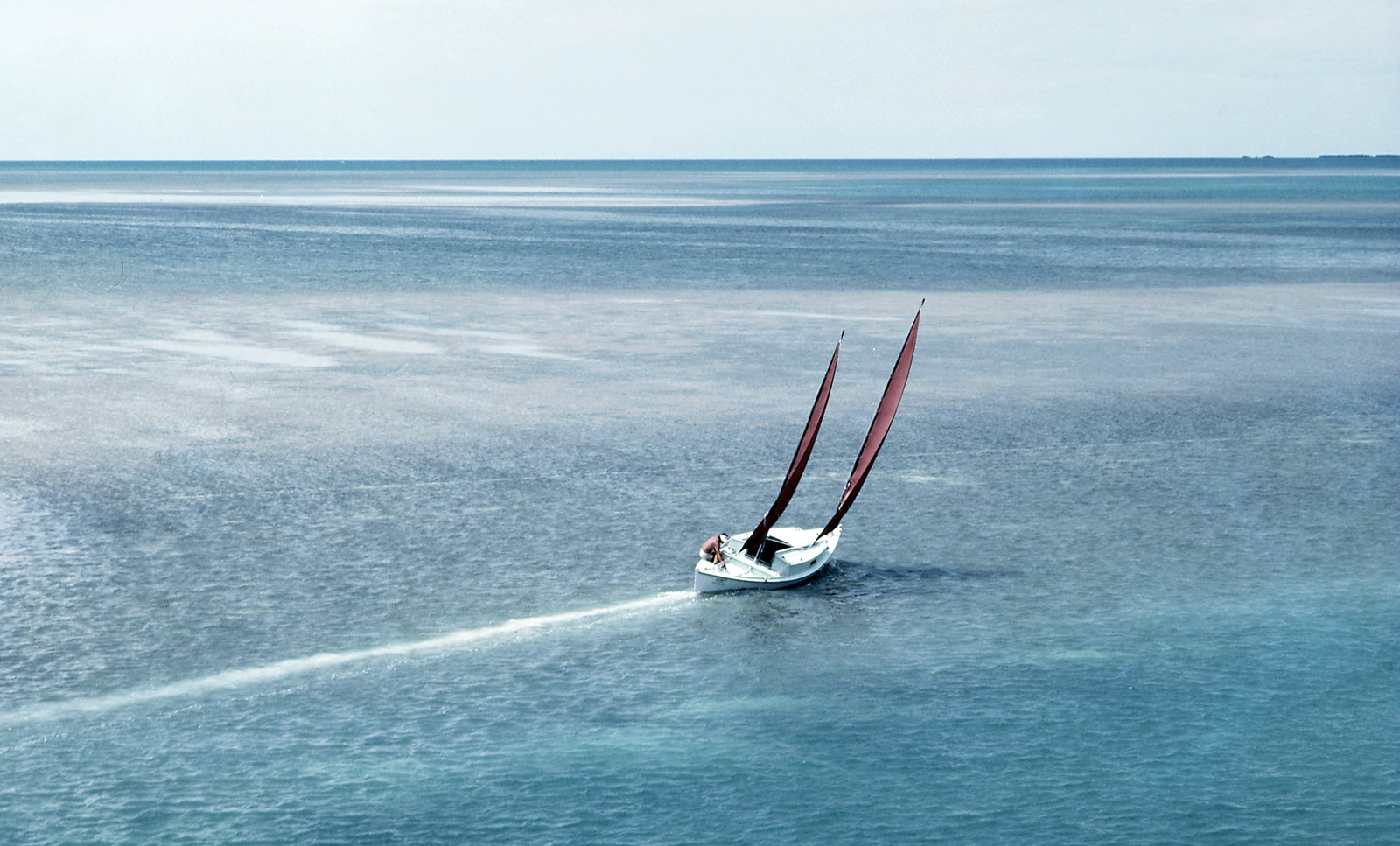
The sharpie ketch EGRET, designed in 1886 by Commodore Ralph Munroe, was instrumental in the settlement of Miami, Florida. Here, the author’s EGRET interpretation, with its 8″ draft, skims backcountry flats in the Florida Keys nearly 100 years after the launch of the original. Her forward and aft centerboards left a barely discernable track, unlike the lasting propeller scars in the turtle grass beyond.
EGRET is moving too fast. The ocean bottom is 2,000′ below the sharpie’s flat bottom as successive seas rise 10′ high astern, too steep and too close for comfort above the open, shallow cockpit where I sprawl, legs braced, one hand on the mainsheet cleat, the other on the tiller, one eye forward and one eye aft, as sapphire rollers carry us in sun-spangled slaloms of amazing speed toward the east coast of Florida.
The Gulf Streamers rise in hypnotic rhythm…a towering crest approaches…elevates the stern…engulfs the hull…and sends us downhill…fast…faster…surfing…20, 30 yards in a burst.
EGRET glides through the foaming trough. Another looms immediately.
Minute by anxious minute, then hour by mesmerizing hour, we’d sped off these indigo crests, enveloped in a conveyor of kinetic energy, nonpareil sleighrides, the white ash tiller quivering as the balanced rudder vibrated in the slipstream off the rear centerboard, fully extended, or we would surely have broached hours earlier.
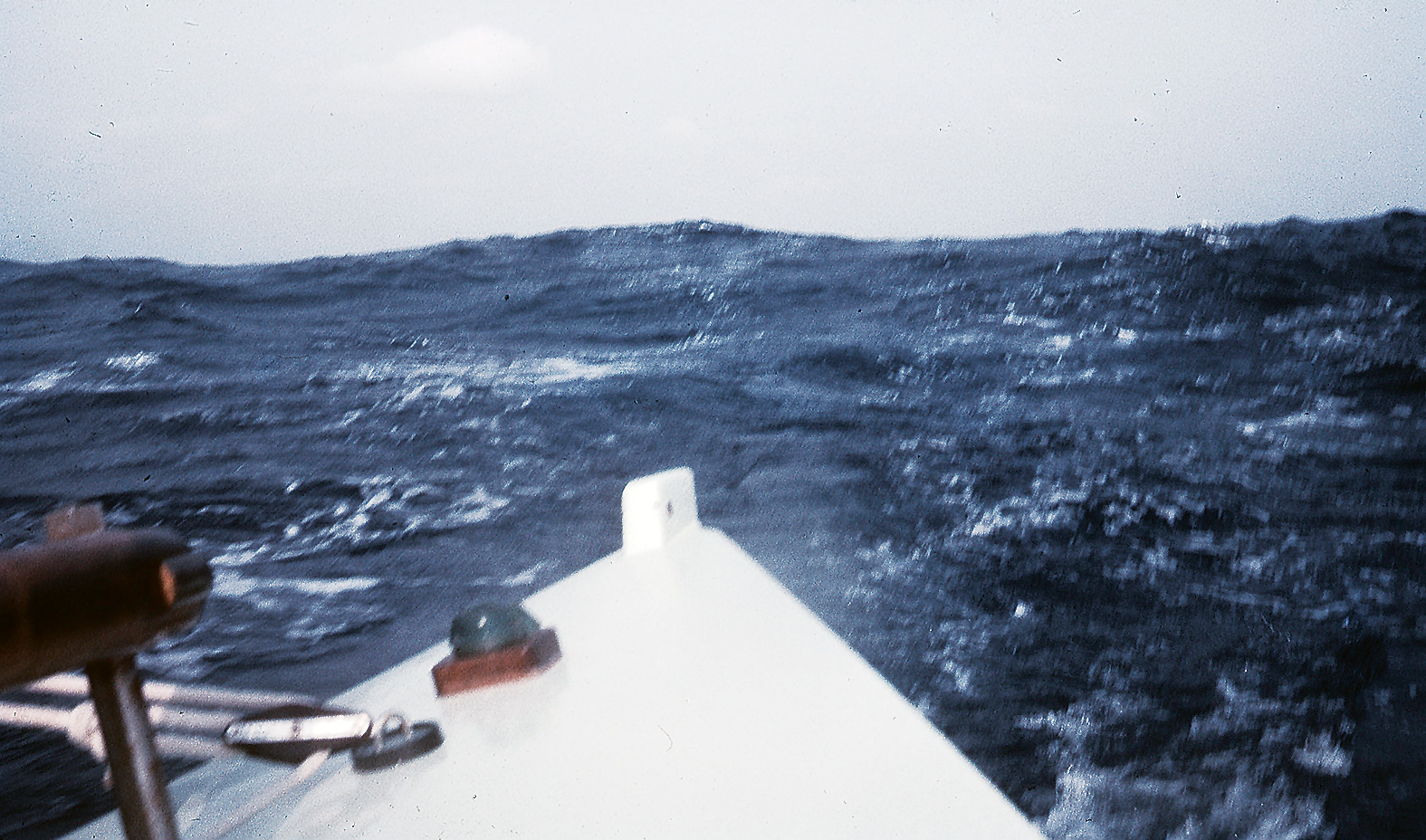
As sun and wind rose in tandem, my old Nikonos snapped the day’s only Kodachrome, looking astern. Now off soundings, there was no returning to the town of West End on Grand Bahama Island. We were into it. By noon my early anxiety became guarded exhilaration. I realized EGRET was running for home with a bone in her teeth and a mind of her own, and there wasn’t a thing I could do about it. We had an all-day freebie on one of Mother Ocean’s interminable water-park rides.
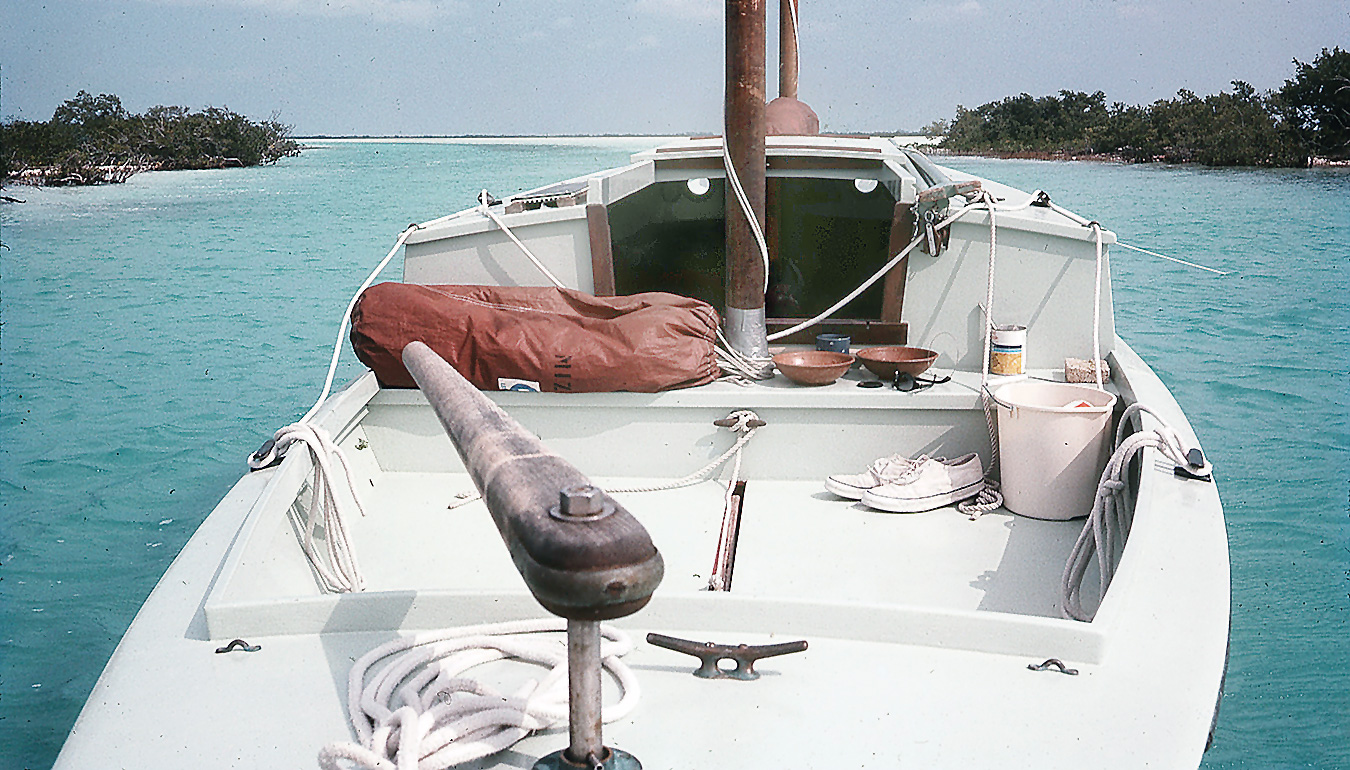
EGRET, a 28′ cat-ketch, carried two centerboards aligned fore-and-aft, one in a sealed 5′ trunk forward in the cabin, and the other in a 5′ trunk in the cockpit, its top open at the cockpit sole like a long scupper. A taut lanyard led from the trailing edge of the aft centerboard forward to a cleat on the face of the bridge deck.
Adjusting the depths of each centerboard on varying points of sail allowed balance under the mainsail and the smaller mizzen—and dependable self-steering on all points but a dead run. Tacking was her greatest virtue. EGRET never missed.
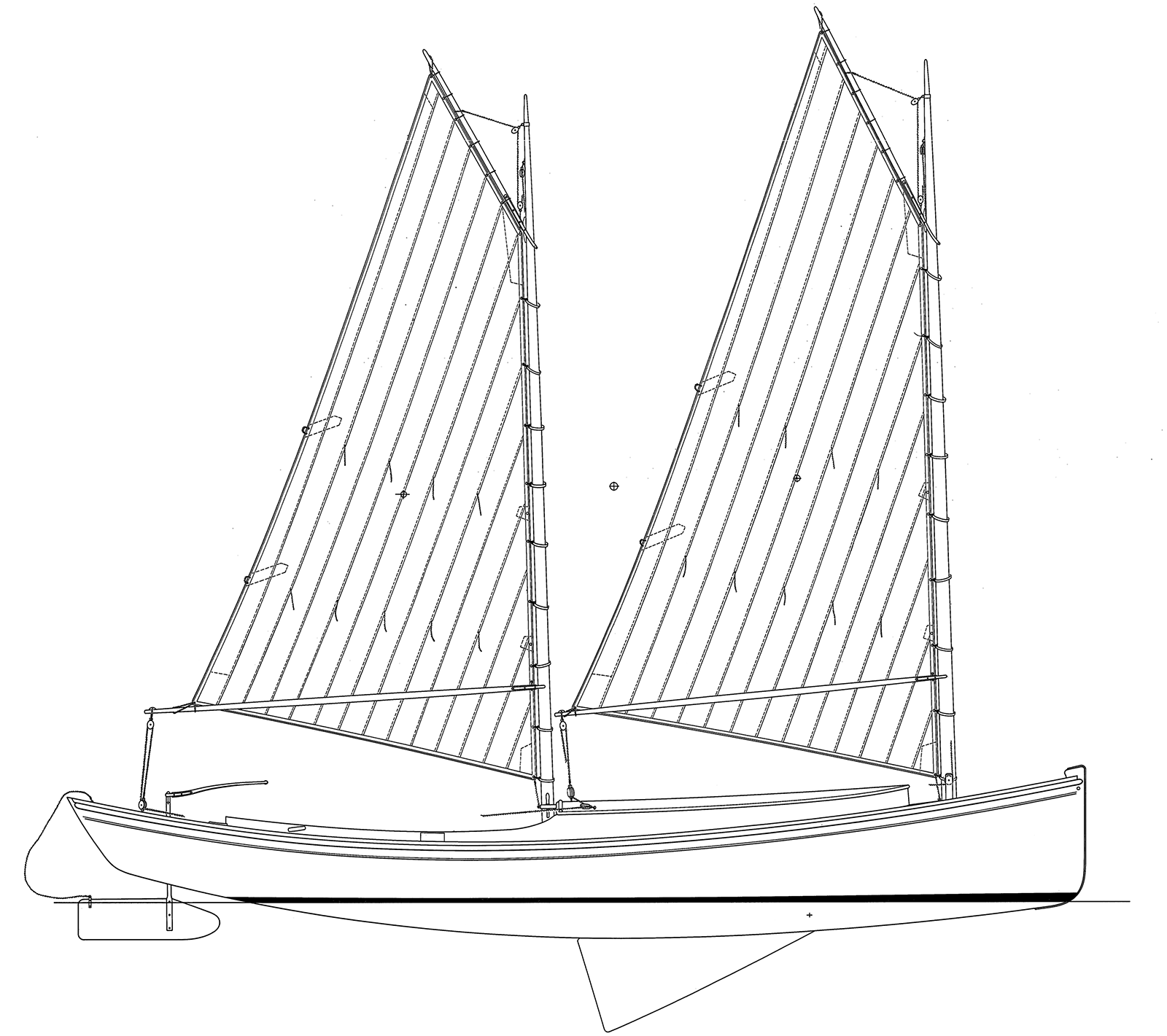
Commodore Munroe’s EGRET had a Yankee oyster sharpie’s single centerboard.
But there was no need for tacking on April 8, 1982. We were off the wind and headed to Florida—60 miles. My hand on the tiller made only slight corrections as she tracked like a torpedo. With the forward board snug in its trunk, our flight was under the control of that tiny aft centerboard, like the fin of a surfboard, 5′ in length and 18″ high, and the balanced rudder, 4′×10″, a kind of horizontal stabilizer, the two in tandem providing 90 percent or more of the hull’s directional stability. There was pitch and roll, but no yaw. They brought the center of lateral resistance so far aft that EGRET could only advance; rounding up was out of the question with the forward board raised. Because a man-overboard drill was also out of the question, my butt was stuck to that cockpit sole like an acorn barnacle as I anxiously watched the tip of the main sprit skimming tossing wavetops in occasional rolls.
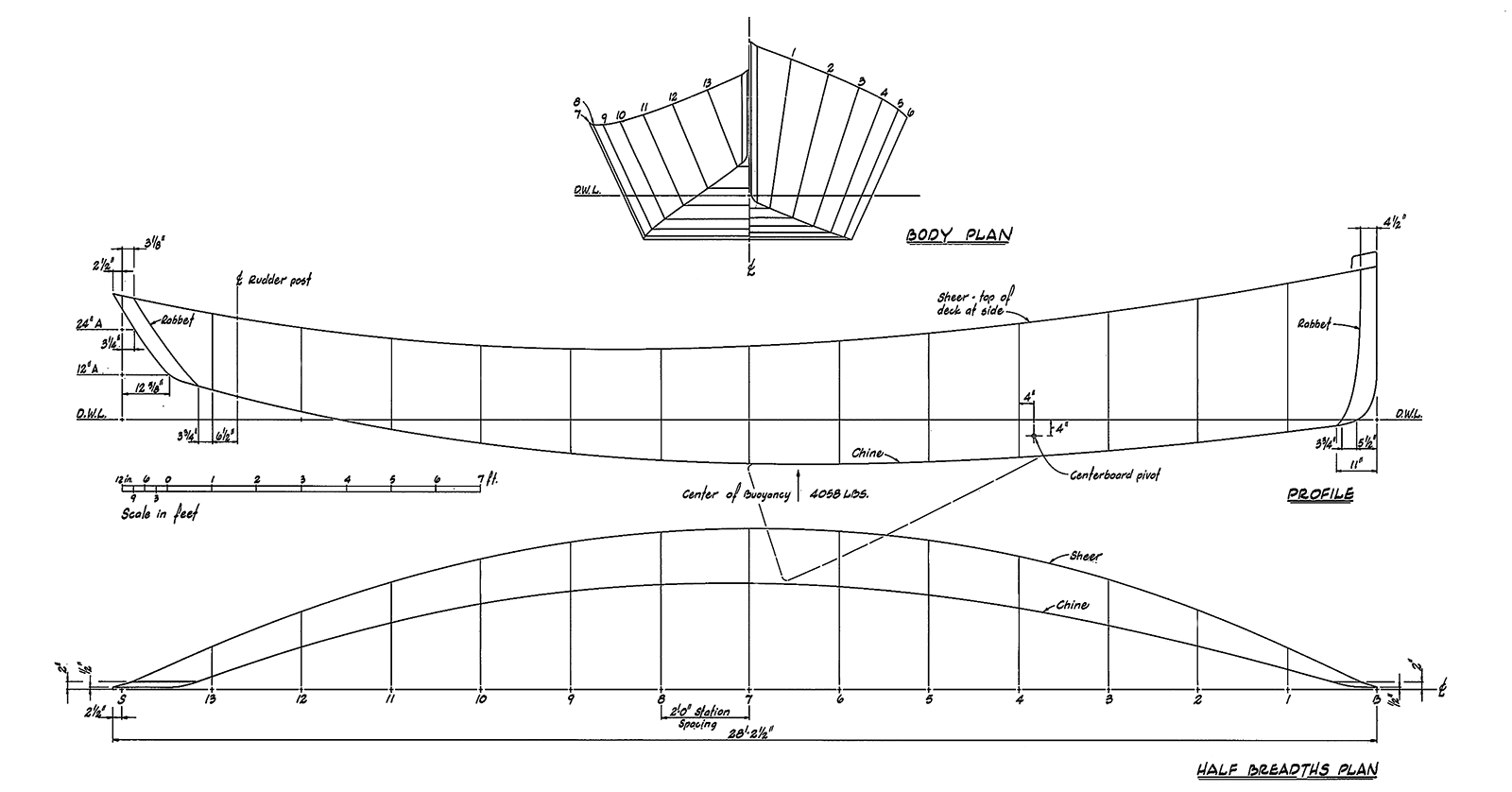
EGRET types carry their sternposts high and dry—almost equal to stem height—for following seas and breakers, mandatory for these double-enders.
EGRET (see WB No. 56) was a double-ended sharpie of fir marine plywood, epoxy, bronze, and “Vectra” polypropylene fabric set in epoxy. She shipped unstayed masts of Sitka spruce, the main 26′ and the mizzen 24′, and sprit-rigged sails 130 sq ft full, or 95 sq ft with both reefed.
Both were reefed on that day, discretion being the better part of valor. I was in control as long as these conditions held, enveloped in the sail of a lifetime with a long way to go, where one wrong move might wash us up at Hatteras…or Hamilton. That northeast wind, only 15 knots—not north, not east, but northeast—was the “perfect slot” in this arena where ancient forces of wind and water converge. The Gulf Stream, flowing from the Yucatan Peninsula a thousand miles southwest with the volume of a thousand rivers, arrives in the narrow canyon between the western edge of the Little Bahama Bank and eastern seaboard of Florida, bottle-necked in opposition to stratospheric northeasterlies spinning off the southern escarpment of the vast springtime Bermuda High. Many a vessel larger than EGRET has vanished out here.
It had been blowing northeast for two weeks, and I was now solo, my winter’s companion of two months having flown from Abaco to Palm Beach, in transit to her family’s yacht in the Leeward Islands, long sea miles from a spartan billet in a small sharpie.
We’d met the previous summer in Maine. I was on the waterfront at the Hurricane Island Outward Bound School’s Rockland base, awaiting departure in a motor vessel for Hurricane Island, when two conspicuous young women, outdoor education specialists bicycling the coast, glided in. Fate’s intervention, eye-catching glances, glib introductions, and 20 minutes of amusing chatter sparked mutual allure and I almost missed the boat. But I didn’t miss Janna’s hastily scribbled address. Letters followed over six months and in January she flew from the far northwest to my fashionably funky waterside digs at Big Pine Key, Florida, for a short visit on her way to the Caribbean.
 James Bartick
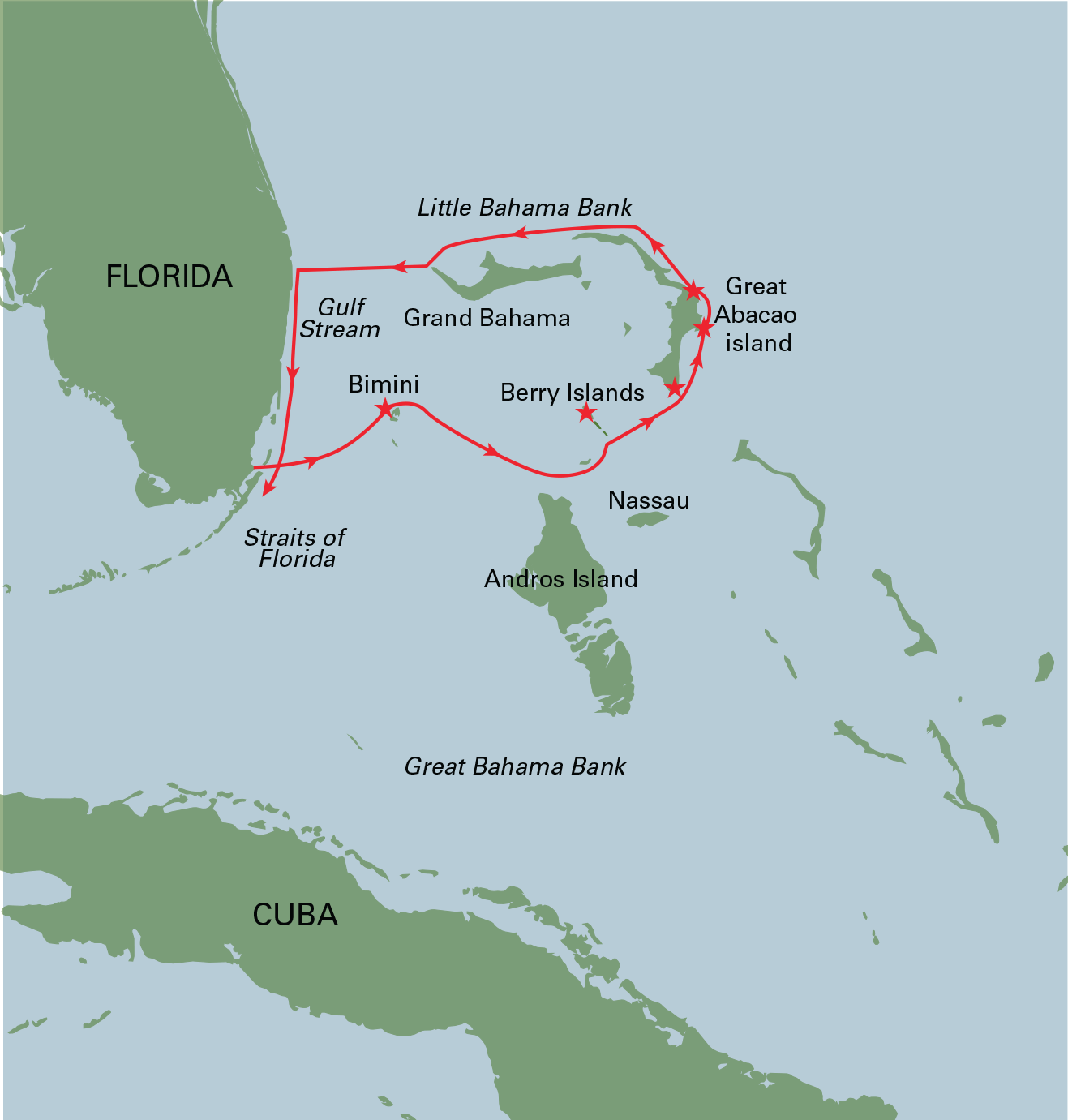
EGRET’s 800-mile journey in 1982 encompassed only the northern Bahamas, leaving the entire Great Bahama Bank’s vastness of endless sounds, sands, and cays stretching hundreds of miles south for future exploration. Beyond Florida’s coast, EGRET sailed 500 miles, half of it off soundings, testing the mettle of sharpies offshore.
Timing is everything. EGRET was finally fit for sea trials. With this adventurous amiga, an expedition followed from the Lower Keys, west 50 miles to the Marquesas Keys for a week, then another across Florida Bay north to Cape Sable and the desolate beaches and mangrove coast of Everglades National Park. EGRET was magical, impelling us into realms of adventure beyond my lofty expectations as Janna learned the ropes fast. She decided to stay for a while.
Late February found us tacking easterly along Hawk Channel toward either inner Florida Bay or Biscayne Bay, fully provisioned for two weeks, with an outside chance for the Bahamas—a chance that had haunted me ever since EGRET’s launch the previous June. After two warm days of quirky doldrums and fickle southerlies, ghosting, drifting, swimming amid brief drenching showers, I poled across grass flats to an Islamorada marina where I got a lucky look at a weather fax. A small dome of Carolina high pressure had crossed Florida’s panhandle. It would cross the Keys that night. As a local weather maven, I couldn’t believe it.
“What a chance!” said the parrot on one shoulder.
“Be careful what you wish for, Billy,” said the parrot on the other. I walked back to EGRET, deliberating: a new boat that I was still learning the ways of, a self-reliant wilderness canoeist, and an epic journey that this boat was in no way designed for. Janna’s life was in my hands. I hardly knew her. Was it fair? A 60-mile night sail on a frontal passage across one of the world’s great ocean currents in a tricked-out flat-bottomed skiff? With no float plan, no motor, no radio, no radar reflector, no dinghy, no life raft, a “hockey puck” hand-bearing compass, a pocket weather cube, a barometer, binoculars, flares, and a 12-gauge Mossberg 500?
But EGRET had a destiny, and I was a 38-year-old Vietnam vet and, of course, bulletproof. I also felt that after sailing for a month together I could depend on Janna’s quick-study competence in any reasonable scenario. And I had Bahamas chart H.O. 5990 “Northwest and Northeast Providence Channels”—small-scale to be sure, but encompassing everything north of Morgan’s Bluff, Andros, plus a 1974 Yachtsman’s Guide to the Bahamas. So I needed only weather, the right stuff.
She sat in the cockpit, barefoot, in baggy khaki shorts and a white T-shirt, writing in her journal, shaded under a broad cotton brim, tanned to clear red cedar, as I walked down the dock on the last day of February. A light but steady breeze wafted in from the reef.
“So, are we outward bound?”
I stepped aboard, sat down, and removed my polarized sunglasses. My eyes sought hers.
“Yeah. For the Bahamas.”
“The Bahamas? You can’t be serious.”
“If we don’t go tonight, we’ll never go.”
There followed an eye-to-eye interlude.
“Really? And you’re all right with this?”
“Yes…I am. There’s a little front coming through tonight—a little bubble of high pressure with a wind shift northwest. These are perfect conditions, even for a small boat like EGRET. But it’s not etched in stone. We’ll have a fair wind, but if it gets dicey we can always bail out and reach with the stream toward Miami. It’s well-lit all along the reef.”
She stared back at me, lips parted. This guy she’d only known for six weeks, but six in an aquatic crucible, sharing mixed emotion and sublime wonder.
“We’re going…out into the ocean?” in mock terror.
“Only for one long night, I promise. I’d love to see EGRET in the Bahamas. She was made for it. And I’d love to take you to the Bahamas. Maybe you were made for it. But, if it’s too much, you can always catch the seaplane back to Miami from Bimini. They fly every day.”
“Well… my friends are on their boat at Marsh Harbor all winter.”
“Really? So, if we don’t drown in the Gulf Stream… we’ll see if we can find Abaco.”
She was certainly game. We agreed to give it a shot if there was a window at sundown. EGRET sailed all afternoon along the reef in light but steady southwesterlies. Then there was little discussion. It was a go.
 Author Collection
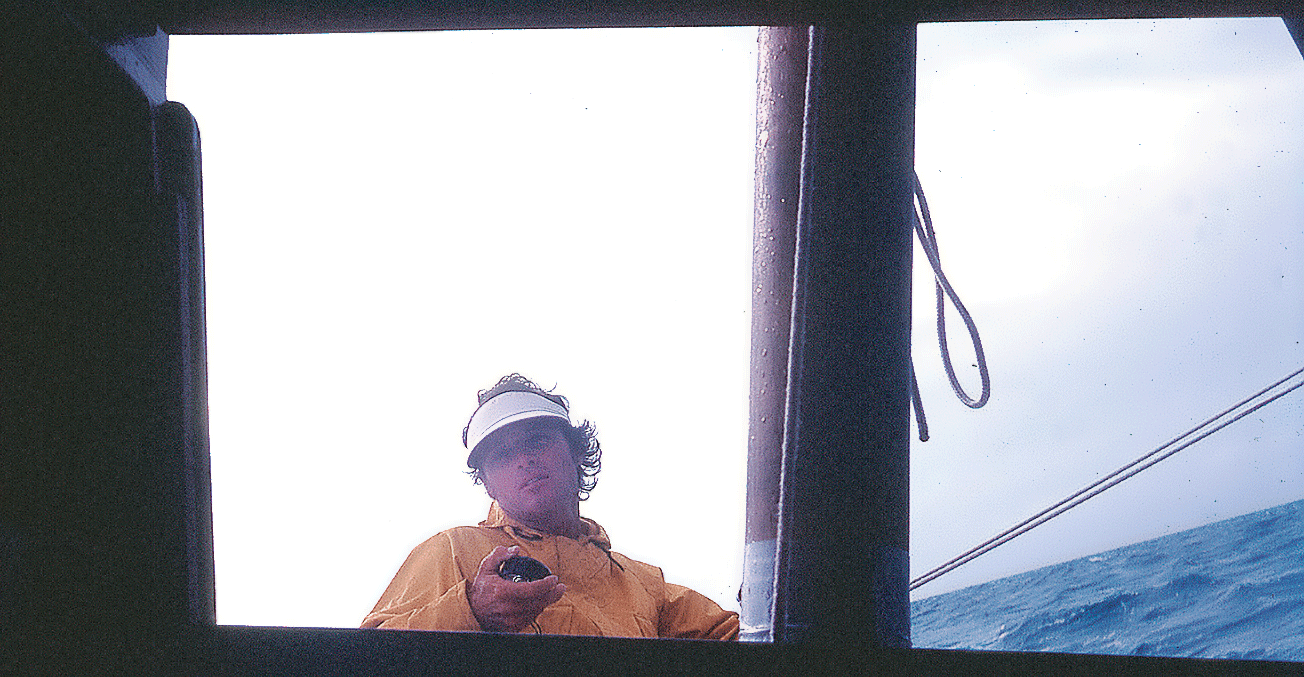
The reliable tritium gas “hockey puck” hand-bearing compass, a vintage KA-BAR sheath knife with spike, and neutral gray polarized sunglasses were the author’s three sailing essentials.
I lashed the Danforth to the foredeck and we tucked a reef into each sail, for prudence. I got out the foul-weather gear, just in case, and set a course for Gun Cay, bearing 090, distance 60 miles, allowing 2 knots for current. EGRET always seemed to make hull speed in light airs, even reefed, and with both centerboards halfway down for tracking I took us into the blue water as Janna primed the Optimus stove below. Soon she brought up coffee and a hearty pasta dinner for two, as the sun set in an azure sky, wind now west at 10, EGRET slipping along on a calm dark sea, running lights bright, a crescent moon dipping toward the horizon.
We dined in twilight while crossing the southbound shipping lane—the Gulf Stream’s narrow inshore counter-current touted in the earliest sailing directions. The young moon set at 2100 as we crossed the broad northbound lane in darkness, eyes right, now locked on the approaching masthead and range lights of great ships steaming down the axis of the Stream for distant ports, totally unaware of our tiny ship.
In that steady breeze I knew we could outmaneuver anything of size, even without an engine. They slid by each quarter hour, side lights bright, deck lights dim, hulls massive, like sea mesas, darker than the night, engines faintly throbbing dum-dum-dum-dum, finally fading to port under stern lights, EGRET riding dissipating wakes easily. Distant lightning flickered far north as Miami sank in a great glow of embers—two million people over there, two over here. Soon we were alone under a starry night, the hull whispering, the Stream deep and dark, little conversation, the night so stunning we delayed setting watches until after midnight.
The dry front passed at 0230 with only a few smoky puffs of low cumulus, a northwest wind shift to 15 knots, and vague white crests on long 5′ seas. The barometer was steady and we now steered on rising Arcturus, as the dipper spun ’round the firmament. The breeze made for a fast crossing—too fast, we soon realized. Janna pinched slowly north while I knelt in the cabin, tardily reading the Cruising Guide for entry at dicey Gun Cay. We finally ran in at first light, bleary-eyed but delighted to be off the Stream and on the Banks, and slipping behind North Cat Cay, anchored at 0730 in 3′ of water, the yellow flag snapping in the breeze after 24 hours underway. A four-hour nap and a hearty brunch followed.
We sailed into the marina where the crisply uniformed, friendly Bahamian customs official showed mild annoyance after I failed to answer his first questions.
“So, you have a 100-ton license, but this vessel is not registered in Florida—your home—and has no documentation papers. Do you have anything to prove that this vessel belongs to you?”
“Uh, no.…” He deliberates, writes owner-builder.
“What is the length?”
“Twenty-eight feet.” He writes 30.
“What is the draft?”
“Ahh, 8″?” He writes 1 foot.
“What is the horsepower?”
“No motor.”
“None?”
“No, sir.” He pauses, writes none.
“What is the net tonnage, captain? The net
tonnage?”
“Yeah, ahh, one half ton?” He writes 1, staring at me.
“Do you have any firearms?”
“Only a shotgun.”
“You understand that tourists cannot hunt in the Bahamas?”
In those days I did not know of a cruising or commercial boat that did not carry at least a shotgun in the Bahamas or Caribbean. “It’s just a safety item, sir.”
“Ahh, yes. Safety. But no motor, no radio….” He smiles. “Let’s go and inspect this vessel.”
We walk to the dock, where he peruses EGRET with curiosity.
“Well, this is a very clean vessel” he concludes while marveling at our lack of equipment. “But don’t you think it a little dangerous to cross in a boat with no motor that only draws a foot of water?”
“Well, I was reefed down and we had a good forecast. And your dinghies have done it….”
He smiles and wishes us the best.
Adventures followed on the stunningly clear Bahama Banks where, reaching at hull speed, I often could not discern depths over wind-riffled water and brilliant white sand—“gin-clear,” to affirm that timeworn truism. But it mattered not with our light draft, and the locals often treated us like crazy royalty. We must have been the anomaly of the winter, sailing and poling in knee-deep water, a white boy on a 12′ sculling oar.
As the weeks passed, I realized what an exceptional little boat I’d assembled from a stack of plywood and fir. I became increasingly confident, noting Janna’s skills increased also, as she remarked after a week on the banks, “She’s really just a big canoe.”
Which was true. Her sharp stern, with the heel of the sternpost a lofty 18″ above the waterline (think pintail duck), was not only grotesque in profile—a design error?—but absolutely essential in following seas. EGRET was as simple as any split rig could be. I had the beach cruiser for all seasons, and whether that was by blunder or brilliance I knew not.
 Author Collection
Steep Gulf Streamers gave EGRET the surf ride of her young life on the longest day to Florida and taxed the author’s seamanship constantly.
When tacking EGRET, in all the years I sailed her, she never once missed stays (well, she had no stays) even in the lightest of airs. With her cat-ketch rig, the wind forward of the beam, and both centerboards down, the hull could do nothing but tack when the rear centerboard was raised, as she was suddenly a weathervane. Significantly, the helm was not put down. Upon “hard alee” the helmsman simply released the tiller, reached down a few inches, and raised the after board by the lanyard. Up came the light plywood board, and the hull, now minus its lateral resistance aft, simply spun on its axis, which was now the forward board, the rudder freely following in concert. As soon as she was through the wind, the after board was dropped and the tiller swung back to center; the helmsman slid across, grabbed the tiller, and we were off on the next tack. It made for some very impressive tacking, the wake a sharp angle, like a wide receiver’s cut, not a loop like a keel boat, allowing me to hold course until the last instant before tacking, and often scaring the wits out of passengers or onlookers aboard windward yachts in light airs. The most expensive often got the closest shave. It should be noted that due to the sharp run of the hull, the aft end of the cockpit centerboard, even when raised, still left a 4″ by 24″ skeg exposed, facilitating tracking without affecting tacking.
With her flat bottom and 20 lead bricks (weighing 440 lbs; the key to her great stability) secured in a track under the cabin floorboards between the centerboard trunks, she drew only 8″ and displaced about 2,000 lbs loaded for cruising—two people, three five-gallon water jugs, a small cooler, dry and canned food in six milk crates stowed beneath the cockpit sole on either side of the aft centerboard trunk and easily accessible from the cabin. A two-burner brass Optimus 535 kerosene stove in a box, a gallon of mineral spirits, two pots, and a skillet served as the galley. We often cooked in the cockpit. The 10′-long cabin below was totally open but for the aft end of the forward centerboard trunk. A matched set of long cushions made for delightful sleeping under a large sliding hatch, often open under balmy breezes.
Minimal clothing was stowed in multi-compartmented “saddlebags,” hung from the sheer clamps port and starboard, his and hers. Janna conceived, cut, and stitched these from the remnants of an old Egyptian-cotton Ratsey & Lapthorn mainsail in a single afternoon, greatly facilitating stowage. A solar panel charged a deep-cycle battery, powering five lights and a Panasonic boombox with cassette deck. Also clamped to the sheer inside was a 12′-long spruce sculling oar and a 15′ fiberglass push pole, on opposite sides, and I was expert with both. EGRET was invigorating to scull in a calm and I once swung that oar all the way from Sandy Key on the edge of Florida Bay to Big Pine Key in a long, physical day—with fair currents, or I’d never have attempted it. You must have solid local knowledge for such antics.
EGRET was my take-off on Commodore Ralph Munroe’s famous eponymous sharpie of a hundred years earlier. The unique boat was instrumental in the settlement of Coconut Grove, on the shores of Biscayne Bay, when May-aimi was just the name of a short, crystal-clear river that drained what old Spanish charts termed “terra Incognita”—the vast eastern Everglades. Munroe, one of the earliest settlers, was in the midst of his shoal-draft Presto yacht designs when he conjured EGRET in 1886. He needed a versatile craft for work on Biscayne Bay that could also make the longshore run 70 nautical miles north to Lake Worth, where he often sailed with weekly mail before roads were cut through the wilderness. EGRET did all that and more, and the commodore kept his pickup boat longer than any others. But there was no record of her ever testing her mettle across the Gulf Stream, and I had a point to prove to myself and some skeptical friends in the Keys who pronounced EGRET only seaworthy “if she had a small hull on each side.”
Broad-reaching in a strong southwesterly along Bimini’s waterfront—hunting for dockage and finding none—I turned to port on a whim, dropped both boards, hauled both sheets, set the sculling oar in its lock, and brazenly sailed through the wide entrance to the Bimini Big Game Club’s crowded marina, Hemingway’s old haunt. There were 50- and 60-footers bow to stern along both the north and south docks, their outriggers sky-high. Ignoring shouted warnings, then frantic arm-waving and cursing, I bore in hard on a port tack to the head of the basin, where I yanked the aft centerboard.
EGRET’s nose spun through the wind instantly as Janna scrambled forward. I caught the tip of the main sprit boom, snapping the shackle free of the clew. With the sprit on the cabin top, the mizzen trimmed, and the mainsail rattling wildly, our momentum carried us forward 50′, where a tweak or two of the sculling oar set us alongside the only open space on that south dock between a pair of big Striker sportfishermen. It was a very slick maneuver, with no margin for error. Janna caught the cleat and made the bow fast. I dropped a fender and tied the stern off as half a dozen bronzed, angry men in gamefish regalia hustled down the dock.
She stood up. “Hi! I’m Janna. Any outdoor showers?” Coiling sheets in the cockpit I could not stifle a grin as I saw them halt in unison. Animosity evaporated like spray on a hot deck.
 Author Collection
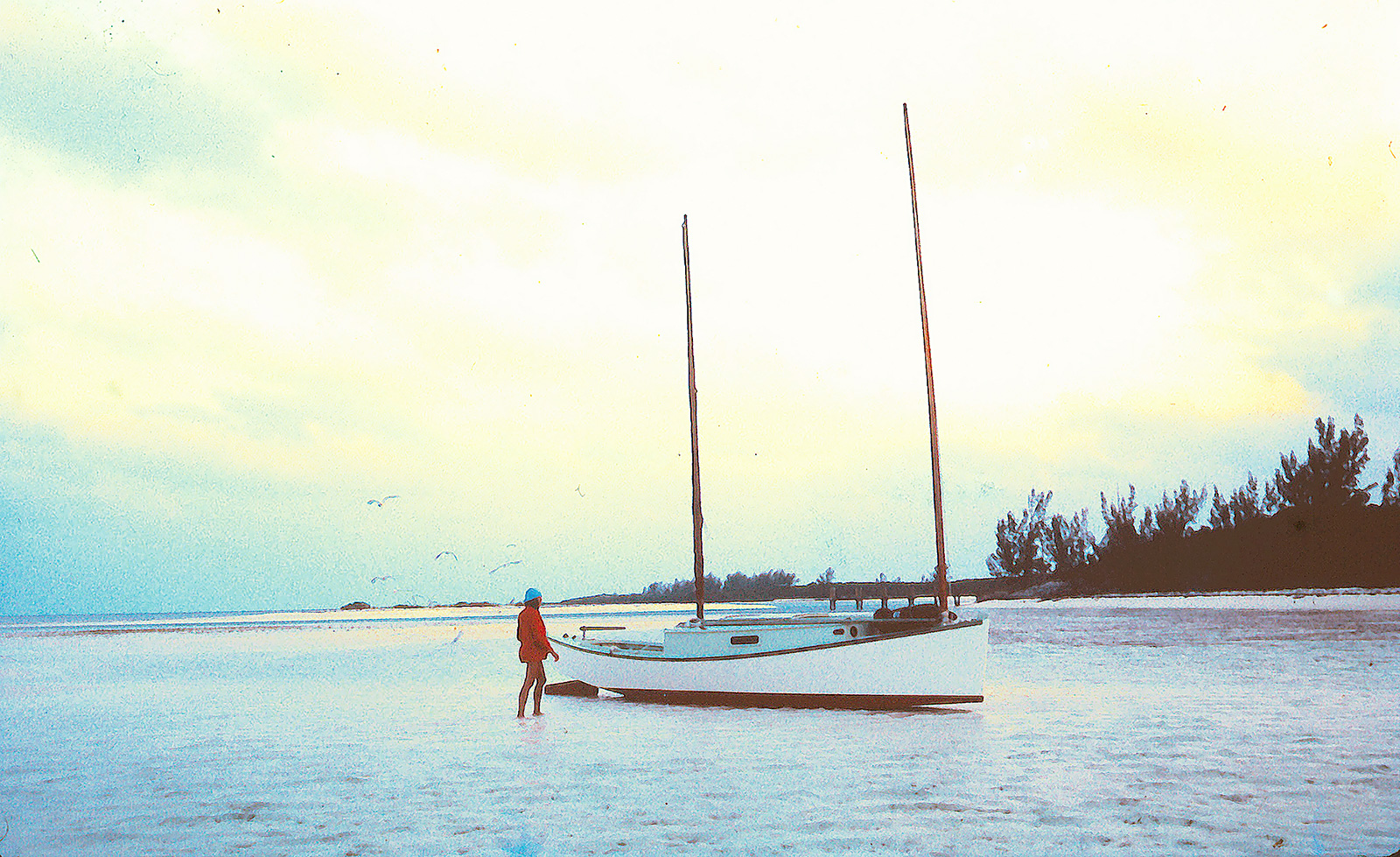
A sharpie’s ultra-shoal draft eliminates the problem of carrying a dinghy, a perpetual cruising dilemma. On evening ebb tides, EGRET was often allowed to dry out; her crew cooked and dined in the cockpit, took moonlit walks over damp sugar-sand, and slept comfortably below in the breeze with no mosquitoes and no need of an anchor watch. (Note bottom of balanced rudder equal to depth of hull.)
We immediately entered a complimentary two-day party mode at Alicetown with shore-bound sport fishermen, whose tuna tournament was on weather delay. There was cold beer, good food, music and dancing, conversation and laughter. It was a diversion we both needed. After a second evening ashore, we were in the darkened cabin as two of the tuna revelers walked by. We overheard one remark, “This is guts, man.”
Guts or nuts, we were soon eastbound toward the Berry Islands. But first we had to get clear of Bimini. The mate on the big sportfisherman from Wilmington told me three things: no one could get a NOAA forecast; Russell light was definitely out; the current on the banks sets 3 knots.
With the wind still southwest at a gusty 15 knots and the sky patchy with low, drifting cumulus, we attempted to sail out the way we’d made our impressive entry, across the vast flats to the east. But with a late breakfast, showers, searching for the Miami Herald’s excellent weather map, seeking Janna’s missing toothbrush, and various bon voyages, we had amateurishly, yet spectacularly, lost the tide. Not a great start for a 75-mile run. The time was now 1100 hours.
What happened next revealed, once again, EGRET’s versatility by virtue of those tandem centerboards. The only other way out was across the bar south of Alicetown, and it was breaking for about a mile and a half as the Stream piled in. Somewhere in that mess was a narrow gutter the big boys traversed to the blue water. A charter boat departing early had soon returned with sea-green sportsmen. It was pretty sloppy out there. By the time EGRET had jibed around the flats and, boards up, tacked back to the harbor, the tide was five hours into the ebb.
“Let’s try the bar,” I said, disgusted. “We can always come back.” It was a beat, but the ebb current favored. Each tack showed progress along the waterfront and after half an hour we finally cleared Bimini’s southern tip. To windward we saw long, surfing combers breaking and billowing along the bar, where beyond the interminable ranks wore crowns of white over indigo along the 100-fathom curve.
It was a stunning and sobering panorama that I evaluated, standing braced at the mizzenmast, Janna at the tiller, hard on the wind. The charter boat MIGRAINE thundered past, soon crossing the bar south of us in tower-high sheets of spray, then bearing north, pitching and rolling heavily in patchy sunlight.
On the port side, barren South Bimini’s forlorn, windswept beach was a long streak of yellow sand with shelves and dark ledges in foaming breakers at the low water’s edge. The broad gutter we’d been spat into was a tossed bottle green and there was a very confused sea running, choppy and crosscut, even inside. I was sailing with a reefed mizzen to reduce weather helm, and a full main for power, both centerboards drawing 3′. EGRET was tossing and taking a slamming on the windward bow, green water thrown high and spattering into the sails. The mainsail was wet halfway up, the boltrope streaming. My polarized sunglasses were useless. It was just, stay in the green water and out of the white.
 Author Collection
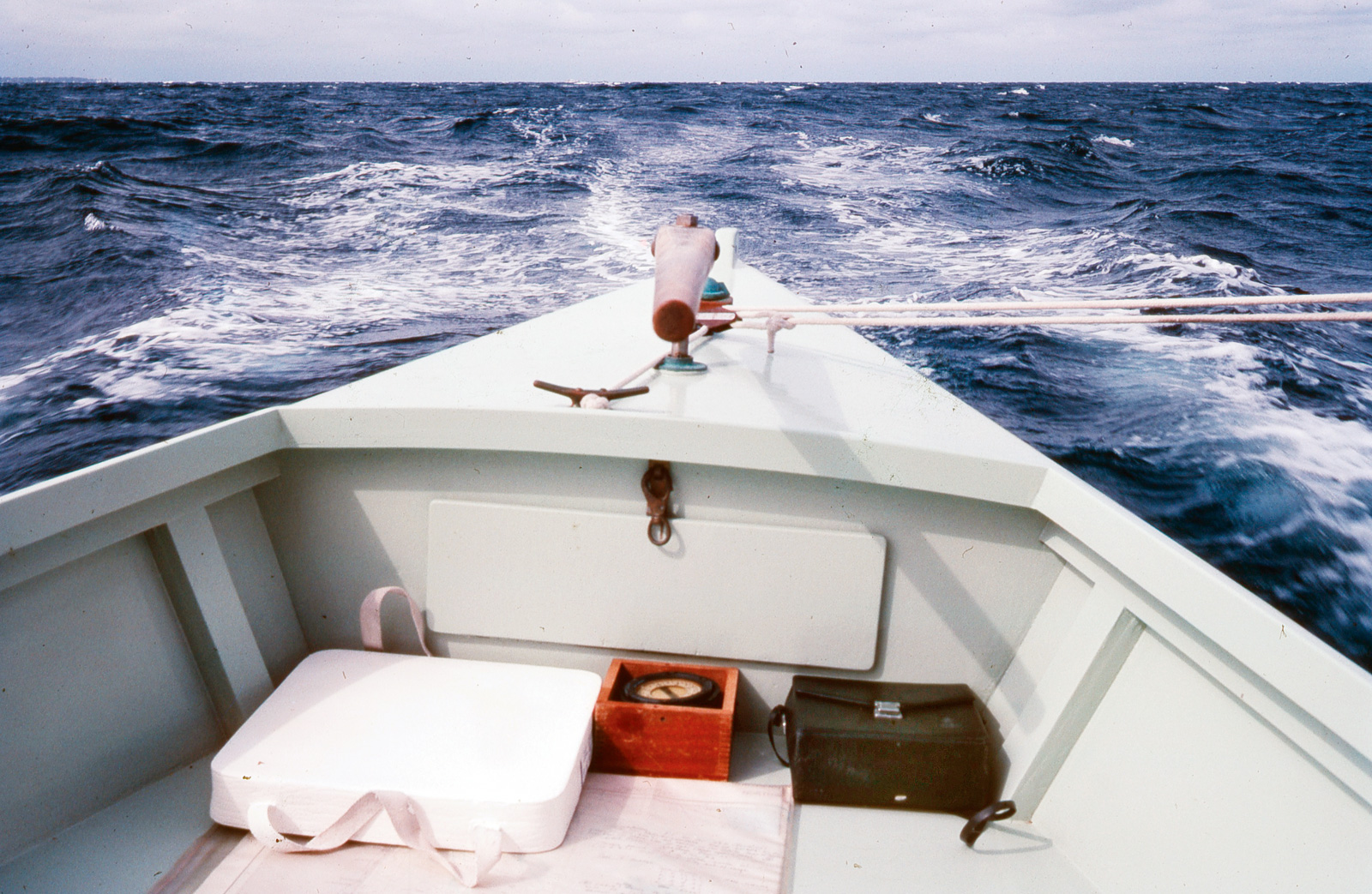
A shape-shifted great wading bird, EGRET flew wing-and-wing down the east coast of Florida in amazing bursts of speed, with no need for the Star box compass gifted to the author by Harry Noble, of Dickie’s Cay (and New Canaan, Connecticut) in gratitude for saving his boat in the 65-knot freak storm that slammed Man O’ War Cay and north Abaco in late March, 1982.
There was a lot of noise in the wind and the sea. The hollow bow boomed each time her nose came through the wind, centerboards clattering, sails slatting. Yanking that aft board with each tack, we worked along the beachfront, five yards and a cloud of spray. Never once did she fail, even with the mizzen reefed. But I backed it often to be sure, and took her close in each time but, not knowing depth, tacked about 50 yards off the beaches, because to be swept onto those ledges would have been fatal to EGRET’s bottom and probably more. We worked along South Bimini behind the breakers, making slow but steady progress, the tide now on the young flood, eventually smashing through the channel between the surf lines, pitching and rolling like a bucking horse. Falling off and starting sheets on a welcome beam reach we rounded the southern tip at 1400, wind finally abaft the beam. I raised both boards, exhaled, and set a course for Northwest Channel light at the Tongue of the Ocean, with Russell, the apparently extinguished six-second flasher, roughly 50 miles on that track.
It was one of those you-hadda-be-there mornings. I can still feel it 40 years later as I ponder the logbook. It was dicey. Outside the envelope. But EGRET, in our quarter-century of travels, always responded intuitively, never balking at any reasonable request.
Janna had mastered tacking in Florida, and this allowed me to trust her while I napped in the cockpit, focused on navigation, or went forward to search for a passage through the flats. But there were no naps today; that float plan for Northwest Channel light drifted away on a strong current that must have set us well south of Mackie Shoal. We sailed all day with nary a marker nor a boat in sight. The weather was unsettled—a cloud-strewn, humid southwesterly at 10 to 15 as a long trough extended from central Cuba across the northern Bahamas. We made good time that afternoon, but as the day waned, and a strange smoky band rose astern, I knew we were in for a night of it—somewhere.
The sun disappeared in a gray bank of yellowed cloud tops, and as thunder rumbled closer I told Janna we’d better anchor for the night. We were in two-and-a-half fathoms. There was still no sign of Russell light.
“Here?” she asked, wide-eyed. But, sometimes discretion is the better part of valor. With miles of sea room ahead, I had no local knowledge of that bank. Figuratively “lost,” I refused to risk an oh-dark-30 nightmare far downwind.
We rounded up in a 3′ chop, and I dropped two high-tensile Danforths, 13 and 10 lbs, 60 degrees apart, on 6′ of ¼″ chain and 60′ of scope. They buried immediately as I wrapped chafing gear. We quickly furled the sails around the masts—one of the reasons I love unstayed masts on sharpies—tied them off tightly with the snotters, and lashed the sprits to the deck. As the rain drifted in, we ate a quick dinner of soup and bread and soon snuggled in for the night.
And I do mean snuggled. We turned in fully clothed, jammed together forward between the starboard side of the centerboard trunk and the tapering hull, literally like sardines, as the first squall blew in. With all that fetch and nothing but open water boxing the compass we rolled and pitched like never before in a posture of platonic intimacy that we laughed over later. I was a bit squeamish about sitting out there like a tiny island with two trees and thought about unshipping the masts, but it would have been a feat of strength and dexterity and probably impossible in that seaway to step them in the morning. Janna was concerned about the lightning, but I assured her I’d been caught in the open before and that the boat and masts were all wood and that (I hoped, fervently) we’d be safe but for the pounding.
The motion was exhausting, as EGRET was pitching and rolling constantly, but thankfully neither of us was sick. Fortunately, the two worst squalls just missed us, passing south and then north, lightning arcing and thunder reverberating. We got very little, if any, actual sleep.
The wind hauled northeast overnight, predictably with a stalled front, and first light found us dazed and grungy and off the anchors with strong coffee and full sail. I held course as yesterday, but now close-reaching, boards down, on a port tack, 15 and gusty, making 4 knots. By noon, intermittent sunshine highlighted whitened clarity as we sailed over vast stretches of sand bores—dunes on the bottom—as though a mackerel sky had dropped into the sea overnight. There was water, water everywhere but no sign of anything—no Russell light, no Northwest Channel light, just an endlessly circling horizon of sea, sky, and wind. We were both enthralled, though, and as the water shoaled and the chop dissipated, our speed increased until finally, far ahead, I saw a tiny green smudge that soon became two.
We skimmed over shoals, centerboards jumping periodically, and were soon at anchor among the Joulter Cays, 10 miles north of vast Andros Island.
After a hearty meal, we turned in, totally protected now and exhausted. It rained and blew all night and was still raining at dawn. There wasn’t much to do but doze, read, and talk until late afternoon brought intermittent dazzling sunshine as the last squalls drifted off. We took a long walk over the sand flats and along Joulter Cay, overlooking the impossibly sapphire blue of the Tongue of the Ocean, with a towel and a bottle of dish soap. Wonderfully sudsy salt-water baths were followed by a freshwater rinse back at EGRET, now in full sunshine.
It dawned clear and warm, the wind finally all the way around to the east. We tacked out of the cut to the edge of the reef, then reached north among coral patches along the Joulter Cays. But with the weather finally clear, we did not want to leave this sandy paradise. So we rounded the last island’s north end and were soon gazing over those endless flats again. We raised both boards, and after a quarter-hour of sliding over soft sands, found a narrow tidal gutter crossing the flats. We followed it maybe half a mile and anchored with what looked like a snowfield drying around us. It was one of the prettiest places I’ve ever seen.
We walked the flats, each step sinking half an inch into the softest sugar-sand imaginable. I snapped a few Kodachromes of my little boat surrounded by miles of dazzling sand, in 2′ of water at low tide. We turned in under a starlit dome of midnight blue, the light breeze now a welcome southeast, low humidity, and slept in relative bliss, awakening to a brilliant sunrise, the first in days.
We crossed the blue water to Chub Cay and explored the rocky southern Berrys for a week, then sailed a long 30-hour close reach, up-current, navigating Northeast Providence Channel—another all-nighter—dodging both inbound and outbound shipping. EGRET finally rounded Hole In The Wall, Great Abaco, starting sheets at midnight. We hung around Little Harbor for another week before sailing north to Marsh Harbor, where we found Janna’s friends aboard their neat pocket ketch. Three days later she decided it was finally time to go to the Leeward Islands, 1,500 miles south.
We had an excellent dinner at Marsh Harbor, where Janna offered a reciprocal invitation to the Caribbean, but I just couldn’t leave EGRET unattended on a whim, and Janna’s time for return with me was constrained due to upcoming work. We parted at the airstrip the next morning, both misty-eyed, having had the adventure of a lifetime together. “Thank you for showing me so many things,” she said as we kissed goodbye warmly, with mixed emotions, on my part at least.
After six weeks on the Bahama Banks, EGRET was near the end of a long counter-clockwise trek: Cat Cay, Bimini, the Joulters, Chub and the Berry Islands, Northeast Providence Channel, the east coast of Abaco, Little Harbor, Man O’ War, Marsh Harbor, Green Turtle Cay and then the long, wild north coasts of Abaco and Grand Bahama Islands. Janna was gone—with her warmth, her dazzling smile, her galley savvy, her stoic competence, her cribbage board, Doris Lessing stories, and Joan Armatrading tapes. With the sun getting higher and hotter each day, it was time for this great EGRET to fly home.
I hung a few days at West End’s lonely commercial marina waiting for a fair wind—anything east of northeast—but it soon became apparent that was a forlorn hope, so on April 8 I got underway after a brief dawn shower in short-lived light airs.
My course intended from West End to Palm Beach, Florida, was 270 degrees for 65 miles, and now, hours into the first day of that solo return, I was a sober sailor in a world of my own, a watery world breezing up in blue.
The big Gulf Streamers were only 10-footers, maybe 12. How do you fix a benchmark when speeding through three-dimensional aquatics? Water sloshing out of the rear centerboard trunk, into the cockpit and out again, forced my center of gravity low as I doubled nylon webbing around my chest and clipped it to a bronze cleat. In the mesmerizing runs, I rode the essence of a long board—maybe not Mavericks Beach, but enough for my sense of surf.
After a morning breezing up to 15 and gusty, we were halfway across when another light rain squall left a brief lull. Still, EGRET rushed on, the downhill racer. Suddenly the wind returned at 10, and soon 15, but southeast. Caught by the lee I made two quick jibes between the peaks, so fast I had no time for anxiety. But I wondered: why the quick change?
I quit wondering by 1400, as it was now due south, 15 and gusty. We were on a beam reach, and I was really in the jackpot as the following seas became crosscut and I had no option but to fall off a point and drop the forward board halfway. Full disclosure here: I didn’t really know where in hell I was headed. Palm Beach Inlet, sure. Playing the part of the fool, now to the max, I had no chart and no coast pilot. Florida was too big to miss, and I’d crossed this way once before, four years earlier (on a Dovekie, no less, a crazy tale for another time) so I thought I had some local knowledge and hoped for an island freighter to guide me to the inlet, like we had last time. But nothing showed all day. It was Good Friday; were they all in church?
 Author Collection
EGRET was the essence of simplicity in cruising. With stops for only water and produce, her crew might have remained “on the loose” for months.
EGRET was under control, but I was constantly correcting, the wind abaft the beam in confused seas. Were they piling higher due to shoaling at the Continental Shelf? The confused seas yawed her, threatening to jibe us continually, the main sprit skipping wave tops at times in the rolls. There was no leisurely fun on the tiller now, and with eyes burning as the sun descended I was nearly exhausted and half-starved, having eaten nothing since breakfast, but slurping water all day from a gallon jug that slid around the cockpit like a wild curling stone. I now wanted out of this before that one hidden flaw—the “unknown unknown”—reared its ugly head as the hours wore on. But, sometimes, Mother Ocean looks after fools and irrepressible dreamers.
We sailed all the way to America.
As we came on soundings, the vast escarpment of urban civilization emerged slowly, like an old Polaroid. Veiled in an odd haze, it spanned the horizon—features vague upon approach. I had no idea where the inlet lay, and after jockeying around in twilight ran north a mile or two, hoping I was south, but knowing I wasn’t. The wind suddenly pooched, leaving a big, lumpy, leftover mess. It was near sundown and cooling. I scrambled below, got a dry T-shirt, fleece jacket, and jeans.
Light southerly airs were warm and humid over that big leftover sea, and it was dark when I went forward to take the reef out of the main, when, without warning, EGRET’s chin was uppercut by a violent sea and I was airborne. As her head snapped to port it seemed like I hung for some seconds—I couldn’t believe this after 65 miles—before dropping alongside in warm salty water. I caught the cockpit gunwale and clambered aboard, wet to the neck, too exhausted for anger, and gave in, dropping anchor just outside the breakers. I furled the main around the mast, dried as best I could, collapsed in the cockpit with my head on a cushion, and dozed until dawn.
I hailed a pompano netter, who pointed south. “It’s rot down theya—’bout two mahles.” So, I’d just missed the sea buoy in the haze. The breeze came up as I tacked down in a suddenly gusty southwester; finding the inlet a dead beat at full ebb, and heavy weekend traffic outbound, I gladly took my only towline ever from a friendly fishermen who took us inside to Peanut Island. I thanked him heartily, dropped anchor, ate half a dozen scrambled eggs, and slept for 12 hours, rocked to somnolence by boat wakes as a low crossed the Gulf of Mexico, followed by the Easter Sunday cold front of 1982.
Awakening early on Sunday in light westerlies and intermittent rain, I ate, made sandwiches, and brewed a thermos of coffee. The front came through around noon, and at 1300 we were at the sea buoy, both sails reefed, with the northwester building as the skies cleared. We squared away on a broad reach with the aft board down and the forward board up and ran as we’d run off from West End two days earlier, but now in the lee of a continent and only 2′ to 4′ following seas.
By mid-afternoon, it was blowing north, with gusts to 25, and I was wing-and-wing and flying, surfing by those condominium cliff-dwellers, passing seacoast towns in impossible minutes—Boynton Beach, Delray Beach, Boca Raton, Deerfield Beach, Pompano Beach—and they came flying out in their Hobies and Windsurfers and yelled at us over the wind, “What is that boat?” soon bearing off as they’d carried too far down. In the surf runs I swear we made 12 knots. There was Fort Lauderdale at sundown, and finally the Miami massif in darkness on the starboard beam, lit up like an instrument panel, and I felt odd sailing by and peering into their private lives from a mile offshore after so many weeks of dark nights. We swung in at Key Biscayne, at the old Cape Florida lighthouse, and at 0030 I anchored in the lee, the same channel that Commodore Munroe’s EGRET had sailed 100 years earlier. I was about as high as you can legally get. We’d made 80 miles in 11 hours, probably half of it in four, licking honey from the razor’s edge.
Dawn came clear and windblown. I thought of sailing to Coconut Grove to see Bill Munroe, the Commodore’s grandson, who a few years earlier had added the final piece to my EGRET research, in the form of the half model, but I was not sure of his whereabouts and I hated to waste this great breeze which whispered and sighed all night through the tall casuarinas alongshore Key Biscayne, as EGRET yawed softly around her anchor in the backdrafts.
We got underway after a hearty breakfast, as Boreas and Euros, in concert, smiled down again with a clear fresh breeze, northeast, and I set full sail. We ran down Biscayne Bay wing-and-wing over the white caps, both boards halfway down, dodging flats and banks, losing an hour slipping through Caesars Creek in a light headwind and shotgun rain, bucking the young flood. It came back northeast at 20 as the squall moved off, and we soon passed inshore of The Elbow, where all this madness had begun six weeks earlier.
EGRET flew westerly, wing-and-wing, like the real thing, the reef to port, the Keys to starboard, surfing in the gusts, past Old Rhodes and Elliot Keys, past Key Largo, Plantation Key, and Islamorada, Alligator Reef Light, Indian Key, the Matecumbes, south and west down Hawks Channel. Two boats hung far astern all afternoon, mountains of Dacron boomed out, but they never caught us. One turned into Windley Key while the other faded as the sun drifted low in the west. There weren’t many boats in the 30′ range that could overtake us that day, and we anchored in Long Key Bight with the sun setting. We’d made 75 miles in 10½ hours—not bad for a flat-bottomed skiff.
I toasted EGRET with a glass of Barbancourt rum splashed on her foredeck, cooked a spaghetti dinner with corned beef, and sat back in the cockpit, enjoying a flat-calm evening, almost home.
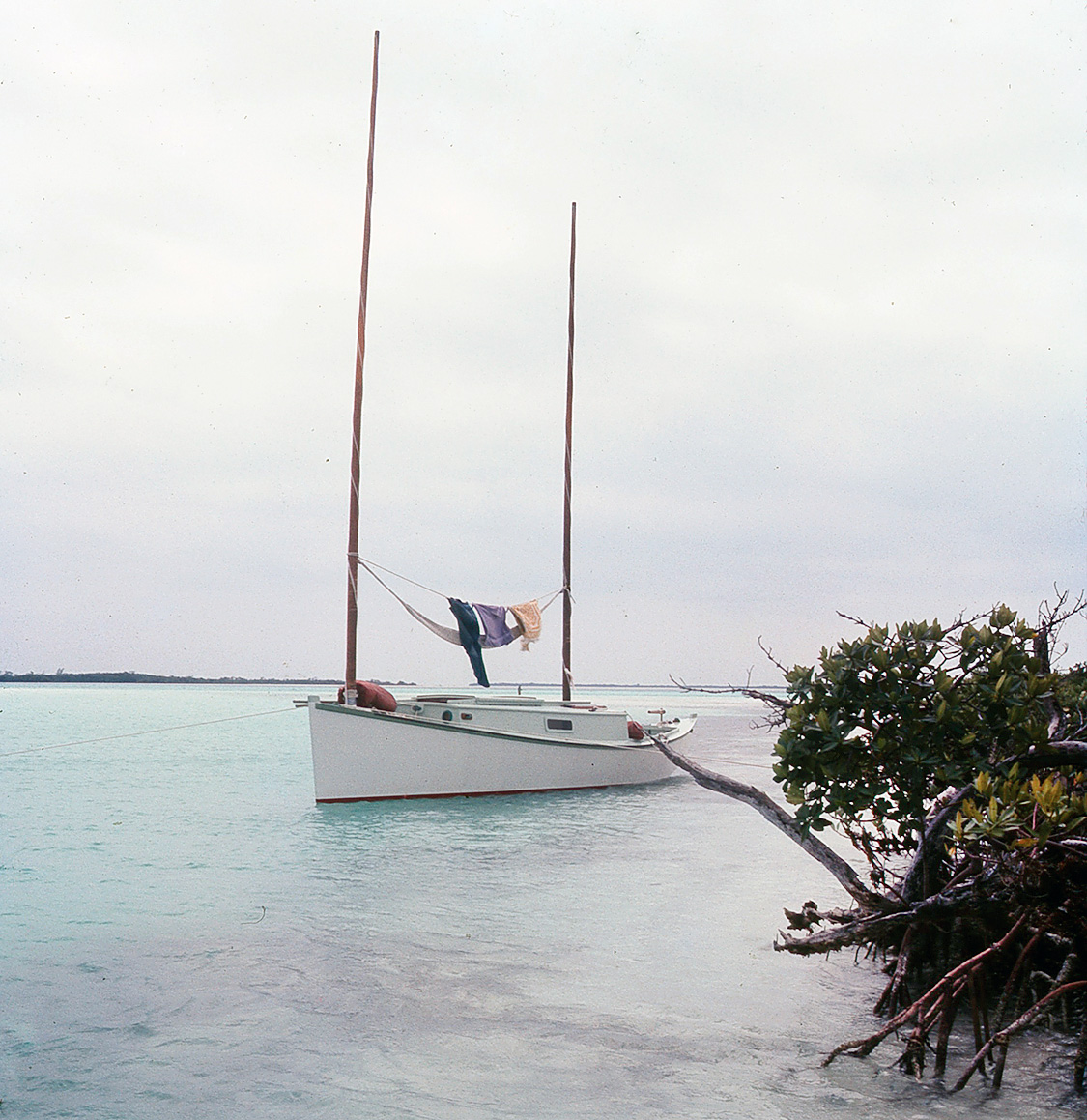 Author Collection
Though bagged in this photo, 6-oz Dacron sails wrapped easily around unstayed masts, leaving the cabin top, hatchway, and cockpit open while at anchor, with views unobstructed by sails, spars, and standing rigging.
The next morning, I wrote everything about the Gulf Stream crossing and these two wild runs into the logbook, and got underway at about noon with a 10-knot east-southeast breeze, relishing an easy 30 miles. We passed Sombrero Reef Light and Marathon, my high-school alma mater, Seven Mile Bridge, the hulking old railroad trestle over Bahia Honda, and finally turned the corner at Sheriffs Island into Newfound Harbor and Big Pine Key, as the sun set in a golden ball. There was no emerald flash and nary a boat on the water ahead.
EGRET close-hauled the channel, ghosting along in 5 knots of relative wind, sails full, boards down, masts upright, self-steering, and hull serene for the first time in many days, so quiet it was eerie, the wake fanning out astern over slick water as strings of ibis flew by on whistling wings to roost on Bird Key among the egrets and white herons standing tall atop the golden-green mangrove.
I sat and thought of Janna and the day we’d left, and what she’d seen with us, and what she’d missed, and wondered how that compared to her Caribbean adventure, and what EGRET’s might have been if I’d gone south from Abaco rather than west from Grand Bahama and opened yet greater adventures. But that first trip across was over, for now. My mind was whirling in images, a Kodachrome kaleidoscope.
It was April 13, and I slipped into Big Pine Key unnoticed and soon lost what little wind remained. There wasn’t a soul around when I sculled up the narrow mangrove canal to the dock at my funky island home. I was both elated and exhausted, knowing this was the end of just the first of many adventures with the sharpie for all seasons. 
Bill Schwicker, a 40-year Florida Keys waterman, is now mastheaded in the Great Smoky Mountains of western North Carolina with the sharpie VIVA, waterdog Dolly, and a million waterlogged memories.