
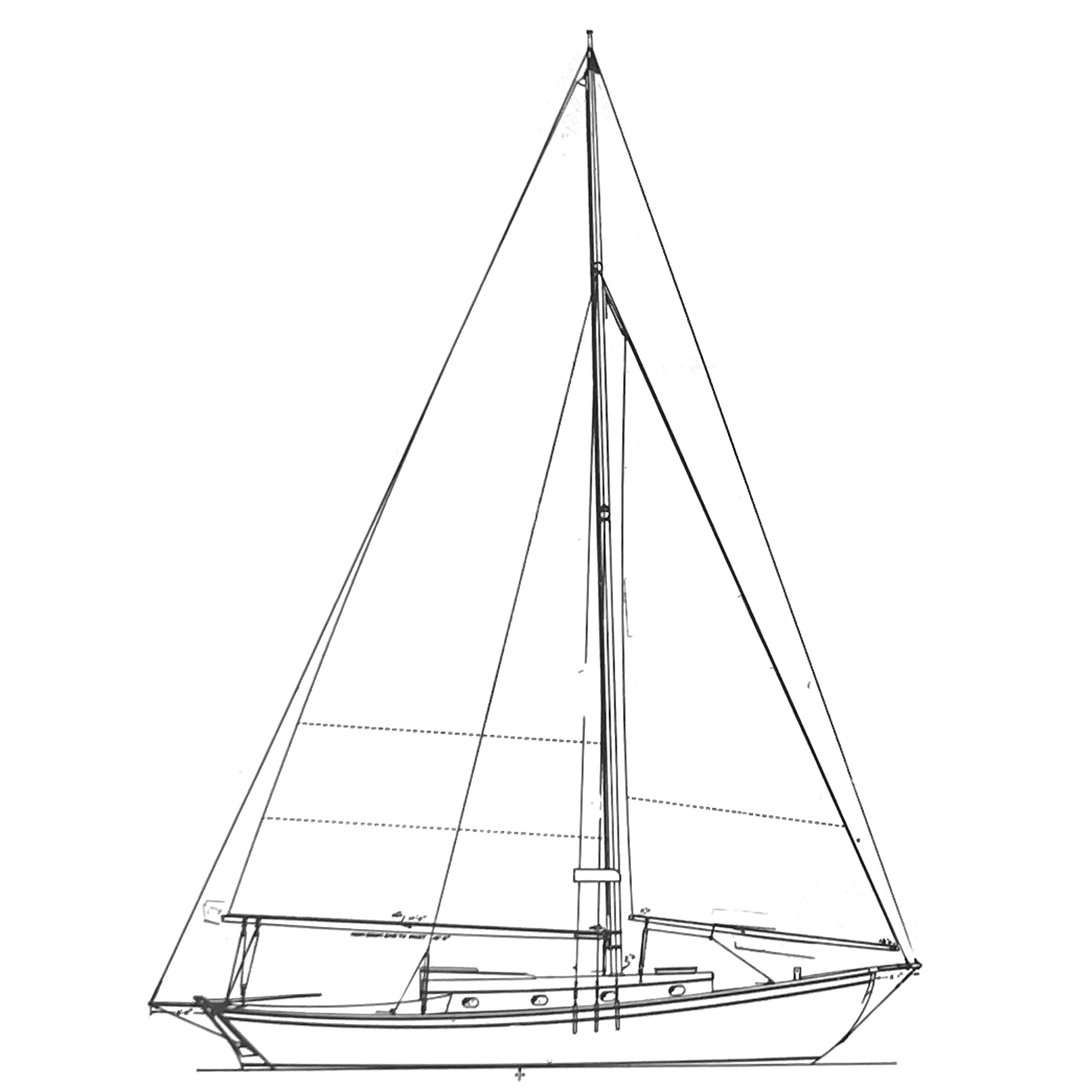
The Concordia 31 sail plan (shown here as published in Waldo Howland’s A Life in Boats) was reduced for the 25-footer’s similar rig.
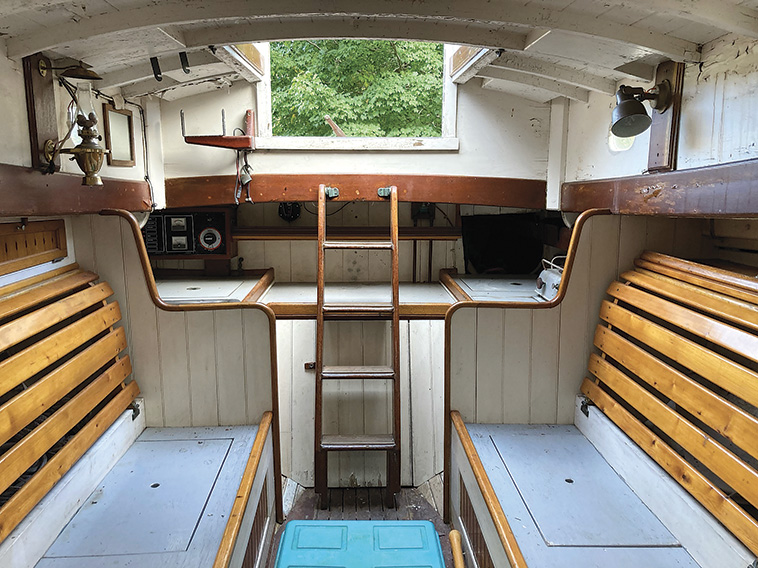
JEANNE is a scaled-down Concordia 31 and is cute as a button. With a three-window trunk cabin, a bowsprit and boomkin, a self-bailing cockpit and bridge deck, and provision for an inboard engine, she’s a real little ship. And belowdecks, she has a pair of wonderfully comfortable fold-down Concordia berths in the main cabin as well as a single pipe berth forward. Her galley is aft, partly under the bridge deck and extending side-to-side the full width of the boat. She even has standing headroom where it counts.
Being smaller than the popular Concordia 31s has advantages: It means easier handling under sail and lower marina and upkeep costs, and bringing the boat home for winter storage under a temporary shed is a practical option.
JEANNE Particulars
- LOA: 25′
- LWL: 20′
- Beam: 8′
- Draft: 4′
- Displacement: approx. 9,000 lbs
- Power: inboard, but not included
- Designer: Concordia Co. (Wilder B. Harris)
- Builder: Carl N. Beetle, New Bedford, Massachusetts, 1940
 David Kelly
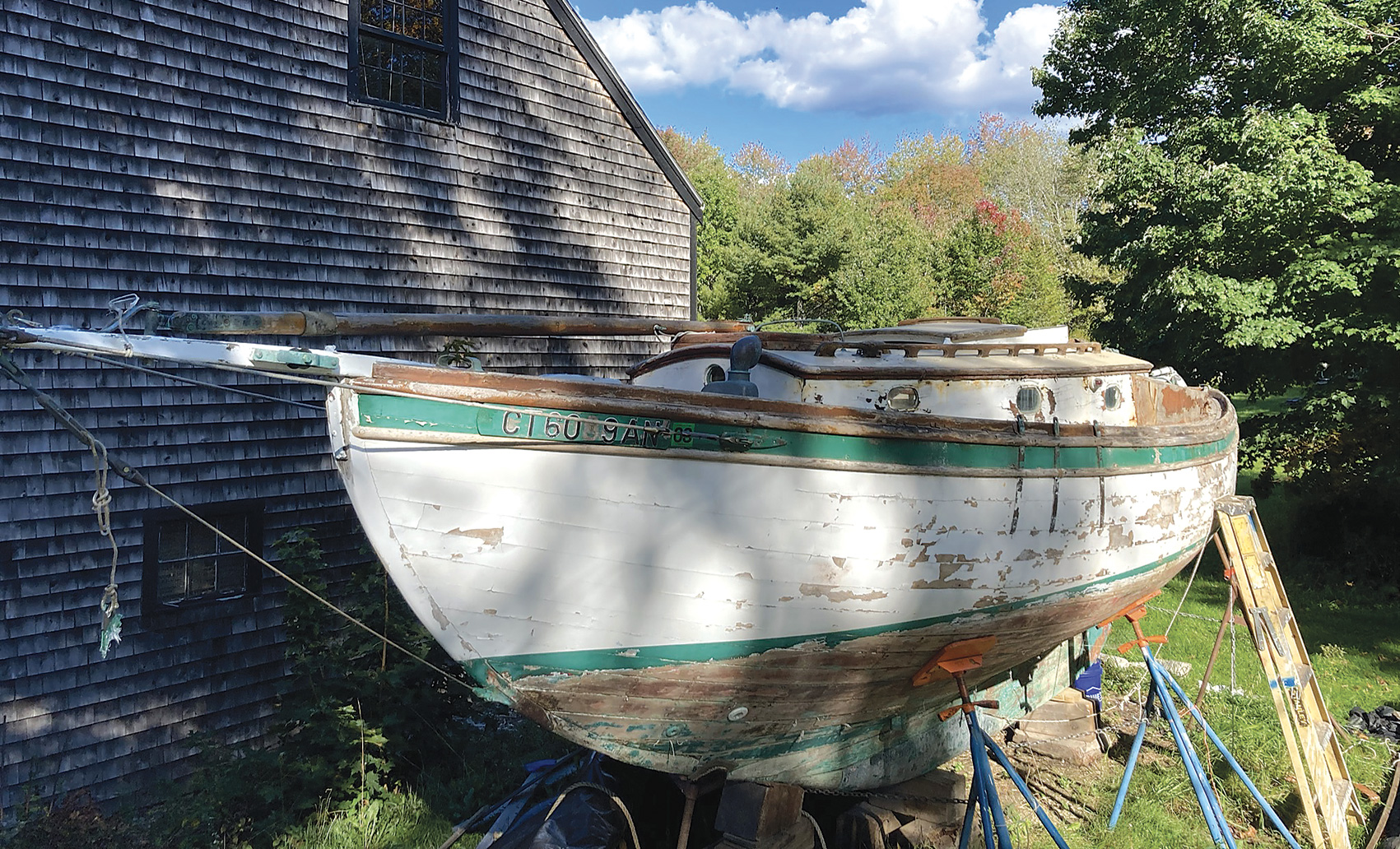
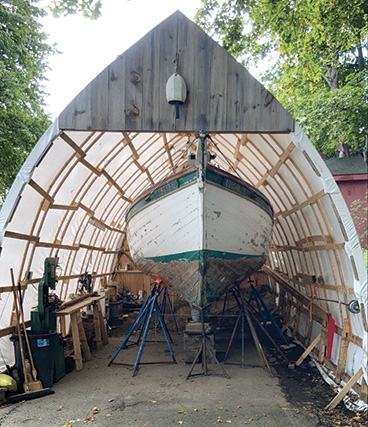
The sloop JEANNE, a 25′ scaled-down version of the Concordia 31, was built in New Bedford, Massachusetts, in 1940. She is now stored out of the weather in a bow shed in Warren, Maine.
Despite her present owner having made a significant start on her needs, there’s still a good deal of work ahead. With a teak-sheathed deck that’s serviceable and an intact interior that should remain, this hull is a perfect candidate for resheathing—either with diagonal wood veneers or with high-strength fiberglass cloth, using epoxy as the adhesive in either case. This treatment has proven to be a “standard fix” for worn-out plank-on-frame hulls when a boat’s original steam-bent frames just don’t have their original strength because of breakage or rot, sistered-frame repairs are failing, or her planking has dried out and its fastenings are beginning to lose their grip. So, you grind down to bare wood, fair the hull, then sheathe it with wood or ’glass, whichever suits your fancy. You’ll find techniques and guidance in WoodenBoat articles, Off Center Harbor videos, and Allan Vaitses’s classic book Covering Wooden Boats with Fiberglass. It’s a heresy, for sure, among traditionalists, but it’s a chance to recycle rather than trash a boat that’s economically beyond a pure restoration.
Afterward, you’ll have a strong and lovely little boat that doesn’t leak. Her spars and rig are okay, and she has brand-new engine bedlogs and a variety of other recent upgrades. She has a lead ballast keel, bronze hardware, and spruce spars with stainless-steel rigging. Her sails range from fair to excellent.
 David Kelly
The cabin has a full-width galley extending under the bridge deck, and the classic Concordia-style settee backs fold down to make berths. The head is forward of the main saloon bulkhead, along with a pipe berth.
The owner has acquired another boat and is ready to pass this one on to a person who sees her potential and can continue the restoration. She’s presently inside a plastic shed at her owner’s home in Warren, Maine.
This could be a real gem, but getting there calls for a truly dedicated owner, not a dreamer. In years past, JEANNE cruised all along the New England coast under several owners with comfort and safety in a wide variety of weather conditions. This is the second time I’ve featured her on this page; she’s gone through a couple of owners as a result, and I hope that, somehow, this time she’ll go the whole distance and soon be sailing again. 
Maynard Bray is WoodenBoat’s technical editor.
For more information, contact owner David Kelly, 67 Main St., Warren, ME 04864; davidkelly1317@gmail.com; or 207–664–9930.