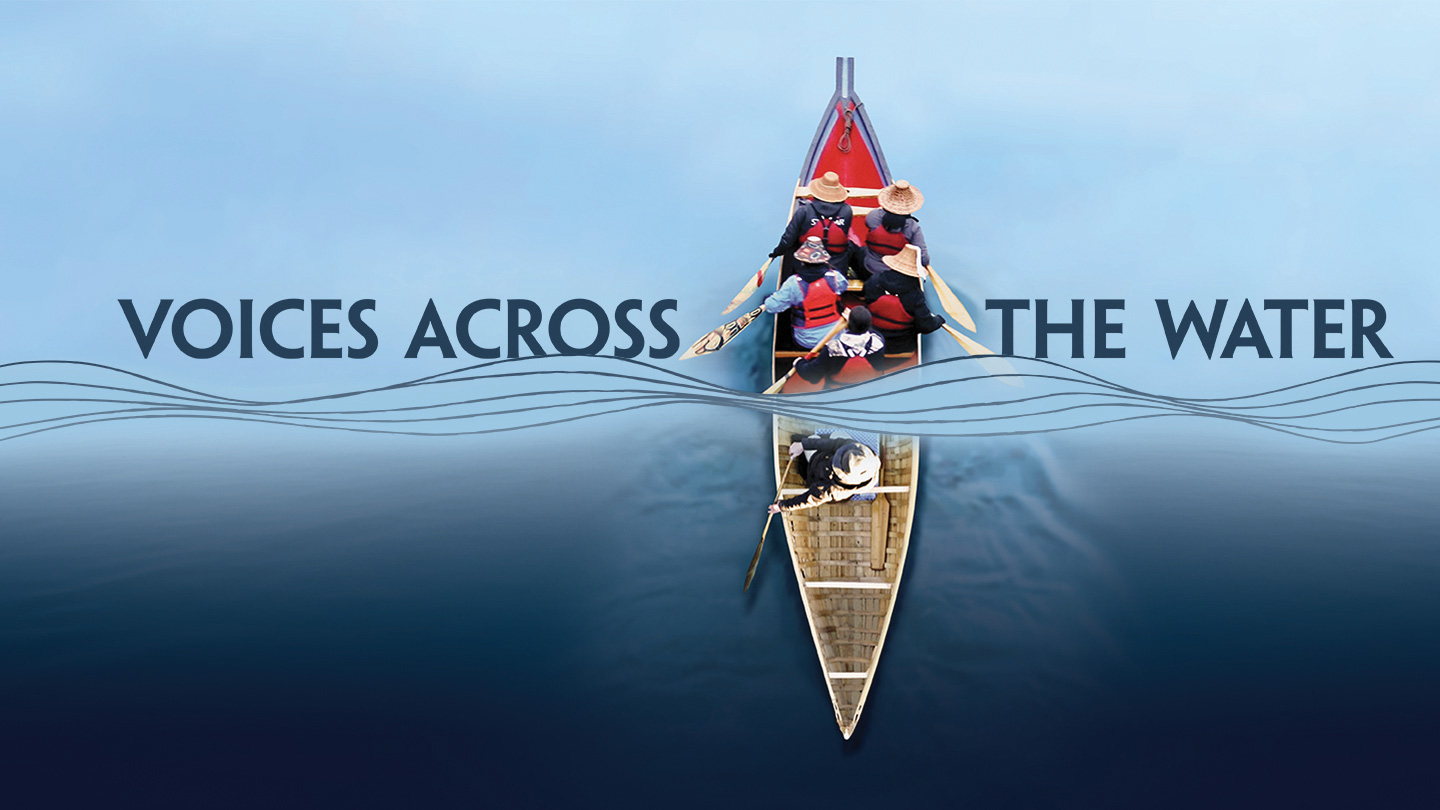
To have grown up in a remote mountainous region of British Columbia was to have the National Film Board of Canada on our single television station as a reliable source of insight from elsewhere in the vast country. The films were always of high quality, if sometimes very quirky. I was reminded about it all recently when I received a notice from the organization about a new film by The Yukon filmmaker Fritz Mueller of Sagafish Media. His Voices Across the Water focuses on two traditional canoe builders from radically different areas and traditions. The film intertwines their stories like a cultural long-splice: at first it seems as though it could never work, but in service it somehow proves more than admirable.

It was The Yukon that brought these threads together. One of the builders is Wayne Price of the Tlingit people in Haines, Alaska, who share a broader cultural heritage with the people of the rainforest coasts of southeast Alaska and British Columbia. The other is Halin de Repentigny, who grew up in Montréal, Québec, and moved to Dawson City in 1981 to live off the land as a trapper. Price, who is also a highly skilled woodcarver in his culture’s iconic style, was evidently invited to The Yukon to build a cedar dugout canoe in a cultural exchange. De Repentigny, a painter, took up birchbark canoe building out of interest after arriving in the province, and that type of canoe holds its own cultural meaning for his French-Canadian forebears.

The film opens with the landscape itself as a character, with beautifully filmed sequences of interior Yukon streams and lakes for the birchbark canoe and the misty saltwater coast of Alaska for the dugout. The film is done entirely without narration—for both boats, the sequences begin with the hunt for materials. This technique can be somewhat frustrating for someone looking for specific information and facts. But the film rewards patience, and in its own way it is an incredibly intimate look into these people, their lives, and their work. From the outset, the viewer enters the canoe-builders’ world on their terms.

Halin de Repentigny building a birchbark canoe.

Halin de Repentigny builds birchbark canoes in Dawson City, The Yukon.

De Repentigny is shown at work on an oil painting; online, I found that he is an artist of considerable note in Canada who now spends half his time in Argentina. Except for the hard labor of felling trees and stripping bark from them, he works alone. “I wanted to do my passion—what I like,” he says. But it is solo work. “I hate it, people helping me,” he says, with a bit of salty language that might trouble those of sensitive dispositions. “I got a vision. You know what you’re doing, and people try to help and they do anything but helping.” Nevertheless, he shares tips with a young neighbor who was inspired to build his first canoe, and he clearly treasures time on the water with some certifiable Dawson City characters, many in toques and one in a top hat.

Price, a gentle soul, works with incredible patience alongside his apprentices, especially one very game young woman, Violet Gatensby. The amount of work involved in building a dugout canoe, from felling an enormous cedar tree to adzing out its interior, is staggering. It is the work of a community. People come and go during more than two months of construction under a large event-style tent. Price is inclusive; he works them all in in some manner, even if it is to simply explain the work. But his delight in watching Gatensby’s emerging skill and her own dedication is radiant.

The degree of sophistication in the hull form of the Tlingit canoe is awe inspiring. Chainsaws are used to fell the tree and to rough cut its interior, but other than that the works is done largely with shipwright adzes and elbow adzes. Small-diameter holes bored at intervals in the finished exterior receive 1″-long dowels that serve as depth gauges when adzing out the interior. The hull is carved with its later expansion in mind. Again, this is the work of a community. Crews fill the upright boat with water. Rocks heated over an open fire are brought to the boat with the modern aid of steel carrying racks. Steam flies up when the rocks are lowered into the water, and a heavy tarp drawn over the hull holds the heat. With enough hot water, time, and athwartships braces to induce bending, the hull splays out at the gunwales amidships from its starting beam of 2′ 11″ to 4′ 21⁄2″, at which point Price’s eye tells him that the hull looks right; the boat is done.

This film’s immersion in the process is impressionistic—this is not a how-to video. But the impression is powerful. How the original builders did any of this work of moving fantastically heavy things without skidders and chopping away massive quantities of wood to such incredibly fine shapes without steel tools remains a testament to ingenuity and skill.

Wayne Price demonstrating dugout canoe carving.

Wayne Price of the Tlingit people in Haines, Alaska, worked with volunteers in The Yukon to demonstrate dugout canoe carving.

“The connection to the land, the connection to the water, is so profound,” Price says. He had only a brief time with his own mentor, who died, or “walked out in the forest,” before he could pass on much of his knowledge. “So much of that is all gone. The boatbuilding is on a resurgence, but not really hanging on by very much. I’ve had quite a few apprentices, I have yet to see one go out and get a log and make their own dugout. I hope I do. You know, if I walked out into the forest, all that would be lost again.”

For de Repentigny, too, the look into his process is entirely impressionistic. So much of the process is organic and resourceful, from lifting moss to reveal spruce roots to identifying a promising birch tree or clear spruce for the gunwales. When he rolls out his bark on a waist-high workbench, he admits it doesn’t look like much. Sticks stuck into holes in the benchtop planks guide the shaping of the sides, and, remarkably, it does all come together as an organic sculpture.

At first the two builders, who apparently never met, appear to have absolutely nothing in common. Slowly it is revealed that they are both artists in addition to being canoe builders. Where the long splice comes together admirably is in the very deep sense of purpose that they share. Each has an artist’s inclination to follow a craft wherever it leads, enrich their knowledge of it, and create something that transcends the object itself.  Article ends.

Tom Jackson is WoodenBoat’s senior editor.

Voices Across the Water may be viewed for free within Canada on the National Film Board of Canada website, www.nfb.ca. It is available for public viewing elsewhere at www.tubitv.com.