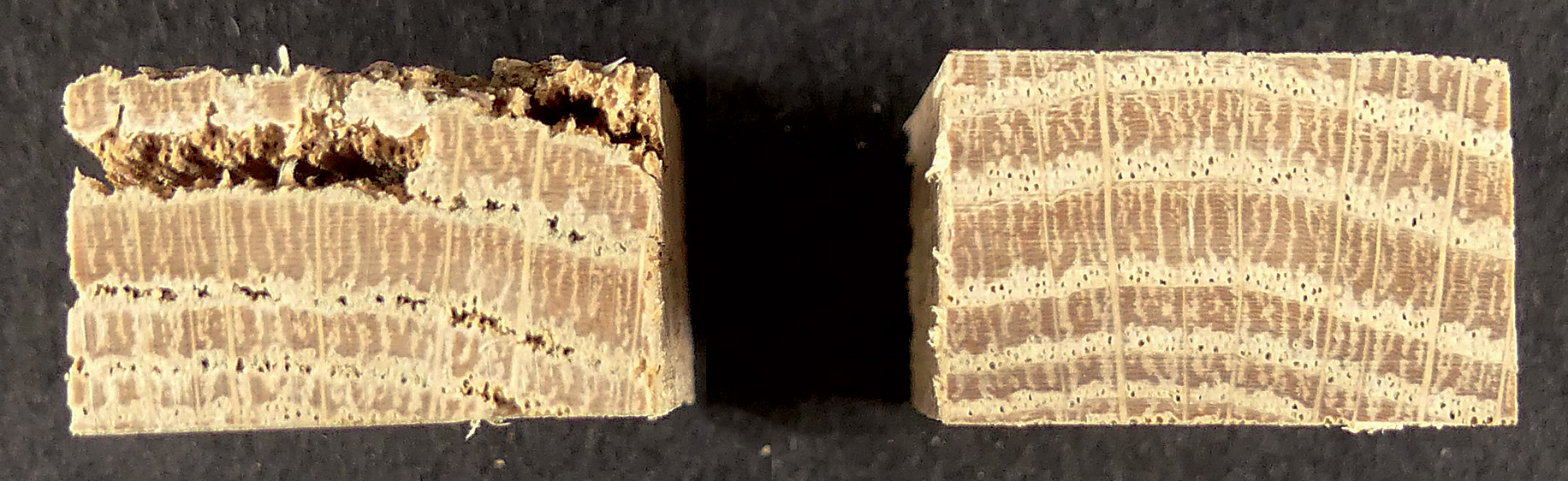
Richard JagelsIn these end-on views of two red-oak beams, the one at left shows that steam-bending failure occurred on the upper, tension side, in the weak earlywood pores, compared to an unbent beam (right). Even where failure has not occurred in the unsuccessful bend, the earlywood pores have become weakened and enlarged.
WoodenBoat reader Peter Collins Huber recently wrote, “I spend several days a week working as a volunteer in the boatshop of the Lake Champlain Maritime Museum here in Ferrisburgh, Vermont. Our work to build and maintain large rowboats (among these are 32′ pilot gigs and 25′ Whitehalls) regularly includes the involvement of teens from local high-school programs. The practical work of the shop also routinely calls for steam-bending white-oak frames and occasionally applying steam to assist the bending of white-pine garboards. To help our students, I try to be knowledgeable about what’s going on, including what’s up in the steambox. While I have some understanding of the fundamentals, I’d benefit from a deeper examination. My questions form along these lines: In steam-bending, how much of the effect is due to the presence of steam, of moisture, or of heat? If heat alone can be used to bend wood, then why use steam at all? Simply soaking wood in water can promote easier bending, but since that lacks both heat and steam, what’s at work here? What is the most effective way to bend wood in boatbuilding applications?”
In the most recent issue (WB No. 303), I touched on the topic of bending thin tropical-pine frames for skin-on-frame boats. The key lesson was to avoid most softwoods when extreme bends are necessary. In other columns, I have discussed particular problems that readers have encountered in bending wood, but Peter Huber’s email prompted me to take a deeper dive into the interaction of the multiple factors at play when attempting to bend wood.
We’ll begin by examining how differing wood species can be sources of variation. And, in response to Peter’s questions, we’ll see how water and temperature affect particular chemical components of wood, sometimes in antagonistic ways. The trick in wood-bending is to find the sweet spot of wood moisture content and temperature to optimize wood plasticity. Overshooting the ideal temperature may initiate processes that actually stiffen wood—definitely not what we want.
The Right Species
In general, hardwoods are much more amenable to bending than softwood conifers. The precise reason for this difference has not been determined, but it may be partly linked to differing lignin chemistries. Lignin is an amorphous polymer that acts like a glue, bonding cellulose and hemicellulose fibrils, not unlike how polymers in manufactured composites bind with glass or carbon fibers.
Within the conifers, a few very-slow-growing species such as Alaska yellow cedar (Chamaecyparis nootkatensis) and yew (Taxus spp.) can be successfully bent; perhaps their lignin content is chemically closer to that of hardwoods. In addition to lignin chemistry differences, hardwoods contain less lignin than softwoods and much more hemicellulose content. These differences appear to play a role in the hydration and heating of wood to be bent.
Ring-porous hardwoods such as oaks, elms, hickories, walnuts, and ashes are particularly adaptable to steam-bending; but moderate-density, diffuse-porous woods such as birch, beech, maple, sweetgum, and mahogany also respond well to steam-bending. Because wood can be compressed as much as 20 to 30 percent but can only be stretched 1 to 2 percent, a metal tension strap constraining the convex surface will reduce failure on the outside of the bend. Another trick to reduce failure on the tension surface is, if possible, to orient the bend so that the radial, or quarter-sawn, surface faces the inside and outside of the bend. This is particularly important for ring-porous woods to avoid tension failure along the weak earlywood zone (see photograph). Of course, bending stock should be free of cross-grain and other grain deviations or knots.
Water and Wood
The moisture content in living trees is generally above the fiber-saturation point (25 to 30 percent). Freshly cut green wood can be bent, but often not to the tight curves achieved after steaming somewhat drier wood. Water acts mostly on the cellulose and hemicellulose, helping to weaken bonding between microfibrils. An analogy would be the change that happens if a piece of natural-fiber rope that had become stiffened in a sunbaked desert environment were soaked in water and became limp again.
If living trees lacked lignin, they would collapse like a limp rope. Lignin provides the solidifying binder. Thus, in addition to “softening” cellulose with moisture, we need to get lignin to plasticize and flow—and this can be achieved with heat. But we don’t want to start with green wood. The moisture content may be so high the cell lumens will be filled with water rather than air. This can lead to hydrostatic compression failure on the concave surface. A moisture content of 15 to 25 percent is ideal.
Soaking wood in hot water will eventually bring the wood to a temperature somewhere below 100°C (212°F), the boiling point of water. But for thick stock, that may take hours, and if we leave the wood in hot water too long the cells may begin to fill with water and we will again be faced with potential hydrostatic compression failure while bending.
Steam-bending
For the most difficult bends in relatively thick wood, steaming is the best option, because it allows us to raise the wood temperature more rapidly and not add more moisture to the wood. Steam, a vapor, when it fuses into droplets, releases heat (6.01 kJ/mol). This heat of fusion continues to raise the air temperature of a steambox, which in turn, raises the temperature of the wood. Unfortunately, steam-bending comes with its own risk. If steamed for too long, the wood begins to lose moisture and becomes less plastic. But you might ask, how can wood lose moisture in a steambox?
Steamboxes are usually made of wood but sometimes of metal or even plastic tubing. Whatever the material, they are generally not insulated. When wood is first introduced to a steambox, hot steam will condense on the bending stock as well as the box walls. But as the bending stock heats up, it eventually reaches temperatures higher than the box walls, and the steam now condenses only on the cooler steambox walls. At this point, water in the cells close to the surface may vaporize, which would reduce cell-wall moisture content and begin a transfer of moisture from the interior to the surface, gradually drying the interior. If this continues long enough, the loss of moisture as well as other volatile components can lead to case-hardening—a phenomenon that can occur with kiln-drying, where the wood surface is swollen and, therefore, is restrained from shrinking while the interior, being drier, wants to shrink.
This is also the early stage of something called torrefaction, a high-temperature process that drives off water and volatile organic compounds and reduces bending strength by up to 30 percent (see WB No. 215 for more on thermally modified wood). The temperatures reached in the torrefaction process (200–300°C or 390–510°F) can actually cause spontaneous wood combustion if oxygen is present. So, how is any free oxygen in the kiln absorbed? Add steam! Here is demonstrable evidence that wood can be dried to near 0 percent in the presence of steam.
Solution
How do we get to the sweet spot of maximum wood plasticity without tipping over into the realm of increasing stiffness and brittleness, particularly with thick bending stock? To begin, the bending stock should be preconditioned to a uniform moisture content of 20 to 30 percent for thick stock and somewhat less for thin stock. The transfer of heat from surface to interior is much faster in wet wood than dry wood. I might even suggest an overnight soak in warm water. That will ensure high surface moisture, and the wood will be closer to the steambox temperature as a starting point. Get the steambox up to temperature before adding stock, and make sure you will have enough steam generation for the entire conditioning process.
The trickiest part is determining the ideal length of steaming time. The usual recipe is one hour per inch of thickness. But wood density, moisture content, and other factors can affect this rule of thumb. I would recommend some initial testing, erring on the side of less rather than more time in the steambox. Many successful bends can be achieved with 20 to 30 minutes of steaming per inch if the moisture content of the bending stock starts at 20 to 30 percent.
Finally, in WB No. 29, I provided a table of 22 woods with characteristics that can affect bending. A look at that column will provide additional wood features, such as interlocked grain, that may favor successful bending. ![]()
Dr. Richard Jagels is an emeritus professor of forest biology at the University of Maine, Orono. Please send correspondence to Dr. Jagels by mail to the care of WoodenBoat, or via e-mail to Senior Editor Tom Jackson, tom@woodenboat.com.