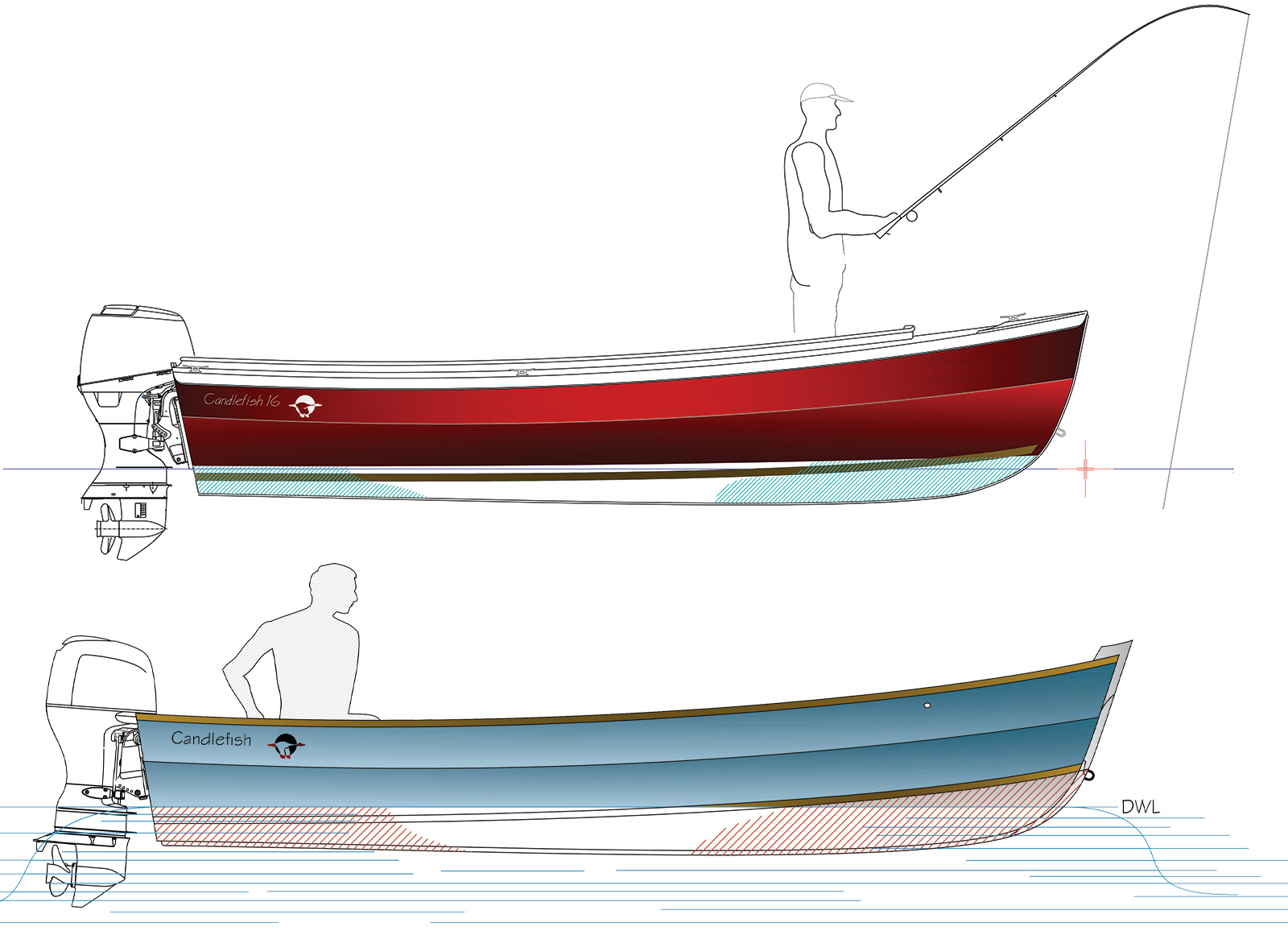
Sam Devlin’s two Candlefish designs measure 16′ and 18′. They are big, burdensome boats that can carry large outboard motors—up to 50 hp for the 16-footer and up to 90 hp for the 18-footer.
Capable open skiffs are just the thing for so many activities on the water: fishing, pulling crab traps or shrimp pots, commuting, tent camping, and just exploring the edges of salt or fresh water. Here are two open outboard boats from Sam Devlin, who has been designing boats for stitch-and-glue construction for a long time. These designs display his experience in building small plywood boats and his enthusiasm for logical solutions that work for builders and users.
These hulls are notably beamy, and there’s a story behind that. The original concept was to create a series of simply built, low-deadrise boats that would operate efficiently with limited horsepower, of a shape like the pangas of Central America. But today’s fishermen want to get to “the spot” fast, and real speed is easy with big modern four-stroke motors. These motors are heavy, and the best way to handle weight is to increase waterplane area. Coincidentally, that wide low-deadrise bottom aids easy planing if the overall weight can be kept in check, and open boats can be kept light with some care.
Both of these Candlefish designs are intended for relatively large tiller-steered outboards, maximum 30 hp on the 16-footer and 70 hp on the 18-footer. Those looking for best efficiency from a 9.9-hp outboard should consider a narrower hull form. On the other hand, if you want high speed in semi-protected water, a Candlefish will be worth looking at.

Above and below—High sides, while costing a slight penalty in windage, contribute to the seakeeping ability of both Candlefish designs. A knuckle runs the length of the topsides, echoing the sheerline and reinforcing the salty character and good looks of both boats.
The strong traditional sheerline, real purpleheart external stem, and hardwood rubrails with quarter knees let everyone know this is a substantial wooden boat. A subtle full-length topside knuckle echoing the sheer reinforces the seaworthy character while breaking up any tendency toward a slab-sided box. These are good-looking boats.
Depth, or height of side, is always a trade-off in open boats. High sides will keep you drier than low ones but are heavier to push and have more windage at speed. I’m with Sam in favor of paying the penalty for slightly higher sides to gain a more capable boat. The high bow will be especially appreciated when running home at dusk into a sharp chop.
In keeping with modern practice, both designs incorporate positive flotation above that of the wooden structure. Sensibly, that positive flotation is fixed just below the sheerline so that the swamped boat will float upright. In the Candlefish 16 drawings, Sam outlines a flotation scheme utilizing a dozen inexpensive PFDs strapped under the stern seats and in the top of the bow locker. The 18 requires two dozen in the same scheme. This idea has considerable merit; the strapped-in PFDs are easy to install, don’t create any water traps, and can be quickly removed to clean and dry the lockers.
Extra beam and a wide waterplane are necessary to safely carry heavy outboards. This beam also creates the dynamic stability to keep crew safe at high speeds. The waterline beam-to-length ratio for the Candlefish 16 is about 2.5:1, while that of the 18 is 2.75:1. So these hulls have greater wetted surface than a slimmer hull, and a fatter entrance angle at the waterline. Neither of these factors matter at high speed but will make a big difference at displacement or semi-displacement speeds. Again, this argues against chasing efficiency with smaller motors. Efficiency with the Candlefish hulls will mean installing adequate power to overcome the resistance hump at about 14 to 15 knots.
A shallow hull with wide beam will also be quick to follow the water’s surface, reacting quickly to any passing wave. This can be both comforting and tiring, but the greater stability means someone can stand right out at the rail without fear of water coming aboard.
The Candlefish hulls have no chine flat; in a boat with a transom deadrise angle of 4 to 6 degrees, eliminating this extra part makes sense. In place of a chine flat the drawings outline installation of a ¾″-wide hardwood spray rail, installed after sheathing the hull in fiberglass. With an aggressive reverse angle, these spray rails will have a big influence on the amount of water blowing aboard at speed, as long as that lower outboard edge is kept sharp.
Actual performance of amateur-built boats is highly variable, because finished weight and loading can vary a great deal. A carefully built Candlefish 16 has been reported to top out at 19 mph with a 25-hp outboard. With a 60-hp motor, speeds could approach 40 mph. For the 18, again carefully built and not overloaded, speeds over 30 mph will be routinely expected from the largest motors.

Both Candlefish designs call for stitch-and-glue construction; plywood panels are stitched together over bulkheads while their edge curves, along with the bulkheads, control the hull form. The hulls are entirely sheathed in fiberglass set in epoxy.
The Candlefish boats, like all Devlin designs, are built using the stitch-and-glue method, in which plywood panels are scarfed to length and cut
to shape before being stitched together over a few bulkheads. The edge curves, along with the bulkheads, control the final hull form. The 16 uses mainly ⅜″ plywood while the 18 requires ½″; both require ¾″ plywood for the bulkheads, frames, longitudinals, and transom. The entire hull exterior is sheathed in fiberglass set in epoxy. If the boat is to live on a trailer under cover, just sealing the interior with epoxy would be adequate protection. If the boat is to be exposed to weather tied to a dock or out on a mooring, I would highly recommend light (2-oz) fiberglass sheathing of the interior.
With size and material differences, the 18 will cost twice that of the 16 in materials, not including the motor. The building time will also be close to double. Only slightly less capability for half the investment of time and dollars really explains the popularity of 16′ open boats.
The 18 has a watertight ¾″ plywood sole just above the at-rest waterline, ensuring self-bailing while moored. My current thinking on this is that it’s better to accept the non-self-bailing arrangement, because in a tough situation the lower seating height and lower overall center of gravity will ultimately keep more water out of the boat. The below-waterline sole in the 16 means it will need an electric bilge pump with battery and solar panel if left on a mooring.

The Candlefish 16 plans offer three arrangements: the open version (top), the bridge-deck model (above), and the casting-deck layout (shown in profile at the top of this page).
The Candlefish 16 is offered in three arrangements: the standard open configuration, the bridge-deck model, and the casting-deck layout. The open version offers long side benches port and starboard, a large bow locker, and an after thwart to sit on while running the tiller motor with either left or right hand. The bridge deck breaks the footwell into forward and after sections, with a large watertight storage locker between them; this locker also offers additional seating. For fishing, the casting deck version’s interior is completely open fore-and-aft, with the side decks and foredeck at sheer height providing the seating. A raised casting area occupies about two-thirds of the cockpit’s length.
The Candlefish 18 drawings outline just the bridge-deck arrangement, though obviously the boat could be built with an open configuration. I’m in favor of the bridge deck, because you get not only massive dry storage but also the arrangement limits the interior volume available to be filled with water in a swamping.
I find very little to criticize in the two Candlefish designs. They are both boats I’d be happy to own and use. With good looks and versatility, small open boats really can be the best. ![]()
Tad Roberts is WoodenBoat’s boat design editor.
For more information visit www.devlinboat.com.
