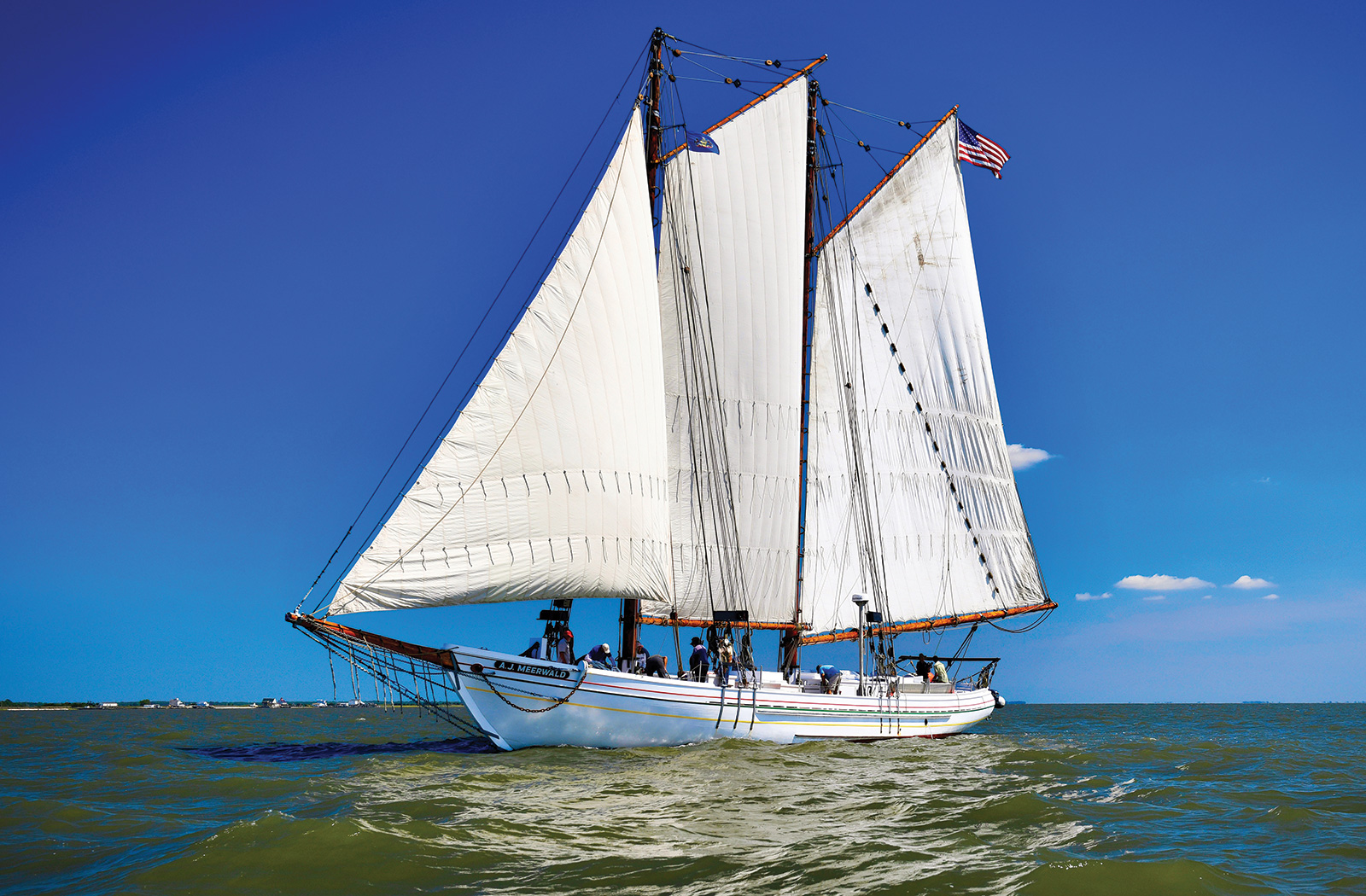
Craig TerryThe 1928 oyster schooner A.J. MEERWALD, the official tall ship of the state of New Jersey, recently underwent a thorough restoration in preparation for many more decades of education and ambassadorship.
One of the things we loved about the A.J. MEERWALD right from the start was how original she was,” Tim Clark said after he and fellow shipwright, Garett Eisele, embarked on a major restoration of the iconic oyster schooner in 2021. “There was so much about her that was like a time capsule from the 1920s and her oystering days. She’s a rare survivor in this respect, since Coast Guard regulations and repurposing have required so many changes on older workboats.”
Before the Great Depression, as many as 600 oyster-dredging schooners such as the MEERWALD sailed from the New Jersey side of Delaware Bay. Mostly they hailed from the Maurice River, and its settlements of Mauricetown, Dorchester, Port Norris, Shellpile, and Bivalve. The area called itself the “Oyster Capital of World.” During the industry’s heyday, trains would leave Port Norris daily loaded with fresh oysters for the restaurants of Wilmington, Baltimore, Washington, Philadelphia, New York, and Chicago. To fill those trains, the watermen of Delaware Bay developed rugged schooners such as the MEERWALD that could handle the bay’s challenging wind and sea conditions, work on shallow oyster bars, house a crew for days at a time, and carry hundreds of bushels of oysters back to the wharves on the Maurice River.
For design inspiration, the bay’s watermen looked to Norfolk pilot schooners and Grand Banks fishing schooners. In the 1880s and ’90s, Delaware Bay builders more or less copied the look of the FREDONIA-style, clipper-bow, fishing schooners. Using double-sawn frames and 9/4 planking and ceiling, local shipyards built their schooners in the range of 60′ to 90′ LOD, about half to two-thirds the size of New England fishing schooners. Delaware Bay schooners were built proportionally beamier than the New England vessels and had a sharper turn of the bilge for stability. Freeboard was lower for retrieval of oyster dredges. They had shallow draft and were fitted with centerboards that could be raised when working in shallow water. The schooners had some structural idiosyncracies, such as using neither knees nor horn timbers, but they were generally heavily timbered like the Grand Banks schooners. During the 1920s, builders began adding internal-combustion engines to their schooners for auxiliary power.
Shipyards on the shores of the bay’s Cohansey and Maurice rivers built most of these craft with white oak framing and planking. Of these builders, Charles H. Stowman & Sons in Dorchester, New Jersey, is known for building as many as six schooners a year during the early decades of the 20th century.
By the 1920s, wealthy oyster companies on the Delaware Bay turned to noted New England fishing-schooner and yacht designers such as William H. Hand Jr. to draw the lines for new schooners. Like the New England fishing schooners of the 1920s, the Delaware Bay oyster boats had spoon bows and sleek-looking hulls. The so-called “new style” vessels carried simple, bald-headed (no topmasts) gaff rigs, with a large “GLORIANA-peaked” mainsails, and proportionately smaller foresails. The bowsprits supported a single large jib.
In 1927, Stowman & Sons launched the J. & E. RIGGIN. At 86′ LOD, she was the queen of the Delaware fleet. Legend has it that the bay watermen were so proud of their queen, they challenged the New England champion racing-fishing schooner GERTRUDE L. THEBAUD to a duel. The race never happened. But what did happen was that in 1928, a year after the launch of the J. & E., Stowman & Sons got an order to build her sister.
Bayshore Center At BivalveAt the time she was built in 1928, the A.J. MEERWALD was one of more than 600 oyster schooners operating on Delaware Bay.
A Hardy Schooner in Hard Times
A pair of oystermen brothers, Gus and Bill Meerwald, contracted Stowman & Sons to build their new oyster schooner for $18,000; the vessel would be named after their father, Augustus Joseph “A.J.” Meerwald. The Stowmans launched her in late August 1928. As built, she was documented as 46 net tons, and 57 gross tons. The schooner was officially measured as 76′ between perpendiculars, or 86′ LOD, with a beam of 22′4″, a depth in hold of 6′4″, and a sparred length of 115′. Her construction was oak planks laid on double-sawn oak frames, as was tradition in Dorchester-built vessels. Like many other Delaware Bay schooners constructed in the 1920s, she had a donkey engine on deck to retrieve the oyster dredges and a 100-hp Standard gasoline engine for auxiliary power.
The stock market crash in 1929 and subsequent Great Depression hit the oyster and shipbuilding industries hard, and the A.J. MEERWALD was one of the last sailing schooners built on the Maurice River. Even before the Depression, the MEERWALD faced adversity. In early May 1929, a sudden gale caught the oyster fleet while working in the bay, and four deckhands on the MEERWALD were swept off the bowsprit while trying to douse the jib. Three of the men were rescued, but 23-year-old Calvin Spedden Jr. was lost.
During the Depression of the 1930s, the Meerwald brothers found scant work for their new schooner and lost her in a bankruptcy settlement. Eventually, the brothers’ wives bought the vessel back for their families, but there was little work in the oyster business.
Like hundreds of other oyster schooners on Delaware Bay, the “A.J.,” as the family called the schooner, might have been towed up a gut to die. But in early 1942, with the United States entering World War II, the War Shipping Administration judged the barely used schooner as worthy of procurement to support the war effort under the War Powers Act. She was turned over to the U.S. Coast Guard, which removed her mainmast, outfitted her as a fireboat, and crewed her as USCG 86001-F.
After the war, the government returned the MEERWALD in 1947 to her family, who sold her to Clyde Phillips. Phillips removed her remaining mast and bowsprit and put her to work dredging oysters under power. His wife renamed the schooner CLYDE A. PHILLIPS after her husband. In 1959, Cornelius Campbell bought the schooner and used her for surf-clam dredging out of Wildwood, New Jersey, until the late 1970s.
A Man with a Vision
After a series of short-term owners, the old schooner ended up on a mud bank near Salisbury, Maryland. But she was not totally forgotten. A merchant marine captain and naval officer named John M. Gandy, a descendant of Delaware Bay seafarers and oystermen, had long admired the lines of the schooner. Like his ancestors, Gandy lived in South Jersey on the Maurice River. He had grown up messing around in all manner of traditional bay boats and watched as the old schooners were lost, one-by-one.
“They were beautiful-shaped boats,” Gandy told podcaster Capt. Johann Steinke, who served several years as MEERWALD’s skipper. “I was totally immersed…. I got a crazy idea in my mind about how neat it would be to restore one of them to its original sailing configuration.”
In the mid-1980s, Gandy had just left the U.S. Navy and joined the team at the Dorchester Shipyard on the Maurice River. While he was there, he met a clammer named Donnie McDaniels, who was building a new boat. He needed the license of an existing boat to transfer to his new vessel because no new licenses were being issued, so McDaniels bought the schooner, which was still carrying the PHILLIPS name, for her clamming license.
“Every time he came into the shipyard I would ask him, ‘What are you going to do with that old boat, anyway?’” Gandy recalled. “Finally, one day we were walking along out in the yard, and I said something about it. He stopped me, looked me in the eye, and said, ‘John, if you want that old boat so bad, it’s yours for a dollar.’ I’m like, ‘What have I done?’” The year was 1986.
Bayshore Center At BivalveAfter World War II, the MEERWALD, then named the CLYDE A. PHILLIPS, went to work dredging oysters under power alone. She was restored to her schooner rig, rechristened the A.J. MEERWALD, and relaunched in 1995.
The First Restoration
Gandy had no idea how to set up the schooner as a nonprofit enterprise or how to raise the buckets of money it would take to restore her original sailing configuration. But then, “quite by accident,” according to Gandy, he met Meghan Wren, a young tall-ship sailor and apprentice shipwright. She not only had seafaring experience but also an insider’s knowledge of the nonprofit corporations that managed such ships.
Wren couldn’t have been more enthusiastic about restoring Gandy’s old drudge boat, and she had grant-writing skills. In 1986, Gandy and Wren formed the Delaware Bay Schooner Project. In Wren’s mind, the mission of the restored schooner would be teaching about the saltmarsh environment and cultural history of Delaware Bay as well as sail training.
“My wife and Meghan began planning and holding various fundraising events…. It just sort of took off from there,” Gandy said. “A lot of volunteers, a lot of people donating services and equipment. We basically rebuilt the boat with volunteer labor.”
“Progress on the restoration was painfully slow…,” according to the authors of The A.J. MEERWALD and New Jersey’s Oyster Industry (The History Press, 2021),6′4″ “But Wren felt that their credibility was established simply by the fact that they didn’t give up.”
The odds turned in the restoration’s favor in 1988 when the Schooner Project officially became a nonprofit corporation, currently known as the Bayshore Center at Bivalve, and the board appointed Wren as the executive director. Shortly afterwards, the schooner got two major grants for historic preservation from the state of New Jersey, which facilitated a haulout in 1992 and the hiring of full-time professional shipwrights Milton Edelman, John Tohanczyn, and Rick Waters.
Rot had infected the deck and topsides, but the shipwrights were able to save the keel, keelson, centerboard trunk bedlogs, and deadwood. Working with U.S. Coast Guard inspectors, they replaced about 200 planks and added watertight bulkheads as well as the safety equipment required for certification as a small passenger-carrying vessel. The deck was a mix of old and new construction. Much of the original woodwork in the forepeak and main cabin was saved. For power she got a new Detroit 6-71 diesel. She received new sails and Douglas-fir spars.
In 1995, a year and a half after the haulout, Wren rechristened the schooner as the A.J. MEERWALD, and the vessel took to the Maurice River to begin her new life as a teacher. In 1998, the New Jersey legislature and governor designated the A.J. MEERWALD New Jersey’s “Official Tall ship.”
The Educator
Bayshore Center At BivalveAs an educational vessel, the MEERWALD has carried more than 100,000 passengers, many of them from local schools.
Since first receiving her Coast Guard certificate of inspection in 1996, the MEERWALD has safely carried well over 100,000 passengers to sea. During the spring and fall sailing seasons, most of those passengers are local school groups. During three-hour sails on the MEERWALD, the students learn about the history of the schooner and the oyster industry as well as how to hoist and trim the sails on a tall ship. But primarily they go out into Delaware Bay to experience the serenity and the fecundity of the vast wetlands along 52 miles of largely overlooked American coastline. They discover what it is like to tow a trawl net and take stock of the wildlife—from blue crabs and sea bass to muskrats and osprey.
Those sails are lyrical experiences. Connie McCart, co-author of The A.J. MEERWALD and the New Jersey Oyster Industry, describes the scene when it is a quiet time aboard the schooner:
We settle down in the sun to listen: the sound of the canvas slapping in the breeze; a few calls from the seagulls going by; the ship creaking slightly as she moves through the water. We can smell the briny water… the fish and the crabs brought up in the trawl… Overhead a majestic bald eagle flies over headed to a nest in the meadow…
On weekends, the schooner hosts public sailings for families and adults from its base, the Bayshore Center at Bivalve. The center has restored the old wharf sheds in Bivalve to their early-20th-century appearance. They function as a museum for the oyster industry as well as a learning center. On the second Friday of each month, the center opens for community gatherings where folks share food, drink, and traditional music.
The schooner ventures farther afield during the summer months, carrying the New Jersey state flag and the story of the Delaware Bay fisheries to tall-ship events and waterfront festivals on the Mid-Atlantic Coast.
“Ben & Jerry”
By 2018, it had been 22 years and well over a thousand sailings since MEERWALD’s restoration as an educator and tall-ship ambassador for New Jersey. The board and staff at the Bayshore Center at Bivalve sensed that the time had come for a professional assessment of their schooner’s condition.
The director of the center at the time, Brian Keenan, says the organization’s board decided to post on Facebook that they were in search of shipwrights for the assessment. Keenan said that was how they found Clark & Eisele Traditional Boatbuilding, whose principals, Tim Clark and Garett Eisele, are dynamos of energy among a thriving community of independent shipwrights based in mid-coast Maine (see sidebar, page 73).
“We traveled down to South Jersey and did some small jobs on MEERWALD at the dock in Bivalve, but she required more,” Eisele said.
“Tim and Garett have been great to work with,” said Rachel Dolhanczyk, the museum curator of the Bayshore Center at Bivalve. “They were the right guys. They would come down from Maine with their sleeping bags and stay for a couple weeks. They love the boat and are immensely capable.”
After a thorough inspection of the schooner, the shipwrights could see that more than 20 years of work and weather had taken a toll. “Basically, she needed a new roof,” Clark said. “We gave our report to the Bayshore Center at Bivalve’s board of directors, and they listened.”
“We got busy fundraising and submitting grant proposals,” Dolhanczyk said.
In 2019, the Bayshore Center at Bivalve won a grant for over $500,000 from the New Jersey Historic Trust. With this, the center had the seed money for a restoration of their schooner. Additional money was raised for restoration work on the historic shipping sheds and wharves of their shoreside facilities on the Maurice River.
In preparation for the schooner’s restoration from the sheerline up, Clark and Eisele inventoried all the elements that needed to be renewed and made a list of the size and material for each timber required. They also made a careful estimate of the hours of labor necessary to complete the job based on large schooner projects they had worked on before, including ROSEWAY, ERNESTINA-MORRISSEY, and MARY E.
“We were able to do it accurately and with efficiency,” says Clark, “because we picked up the knowledge working with most of the best senior shipwrights and project managers in the state of Maine on literally dozens of vessels.”
By the time Bayshore landed more donations matching the state historic preservation funds, the shipwrights had begun to source Alaska yellow cedar for decks and deck structures; Douglas-fir for deckbeams; and white oak for stanchions, caprails, the samson post, and other structures. “Everyone was intentional in keeping this an authentic restoration,” Dolhanczyk said. The schooner is listed on the New Jersey and U.S. Registers of Historic Places, so “as a restoration and due to state funding, we were required to follow the Secretary of the Interior Standards for Historic Preservation,” she said. “The New Jersey Historic Trust signed off on all decisions.”
Clark and Eisele’s careful preparation made for a proposal the folks at Bayshore couldn’t refuse. The shipwrights vowed they could renew most of the old schooner’s deck and associated components, even with the inevitable change orders, for under $1 million and do it in nine months. The price and the timing seemed almost too reasonable and swift to be true.
Possibly the biggest coup for the freelance shipwrights was finding a place to haul the schooner and build a temporary shelter to do the restoration. “It was like ‘Oh-my-god, look what a small town in Maine can do,’” Eisele said.
Garret EiseleFor her recent restoration, the MEERWALD was hauled at Front Street Shipyard in Belfast, Maine, and moved to a vacant piece of land in town. There, a group of marine tradespeople assembled by the shipwright partners Tim Clark and Garett Eisele conducted a carefully organized and executed restoration.
“We went to the town of Belfast,” which is not far from their homes, “and pitched the idea of a schooner restoration on a vacant piece of waterfront,” next to Front Street Shipyard, Clark said. “The mayor and the town council were enthusiastic. They gave us the space. We promised to make the project accessible to the public and hold open-house days.”
Garret Eisele (both)The restoration required removal and replacement of nearly the entire deck structure, including about a third of the deckbeams. New beams were laminated by using the old ones as jigs.
When the good news got out, Clark and Eisele had no trouble recruiting fellow independent shipwrights to sign on to the project, bringing the crew up to 16 at times. John Gandy agreed to oversee the project as a representative of the Bayshore Center at Bivalve. To meet the tight budget and schedule, Clark and Eisele knew that they had to be über-prepared for the MEERWALD’s arrival in Belfast.
“We milled the timber, labeled it all as to its purpose, and put it in stacks so that the pieces came off the stacks in order as the job progressed,” Eisele said.
Garret Eisele (both)Approximately 30 hull planks were renewed, along with the stanchions and the curved and raked transom.
A Motivated Renewal
In September 2020, the MEERWALD arrived at mid-coast Maine to an exceptional welcome. Nearly all the schooners in the Maine windjammer fleet had gathered at Brooklin for their tradition September “sail in” at the harbor off the WoodenBoat School campus. Among those vessels was the J. & E. RIGGIN, now a passenger-carrier in the windjammer fleet. This was a reunion of sorts. Virtual sisters, the RIGGIN and MEERWALD had not sailed in each other’s company for more than half a century. So it was that they put on a show trading tacks beating up Eggemoggin Reach on a blue September afternoon. Then the MEERWALD headed west to Belfast for some serious surgery.
Despite the careful preparation by Clark and Eisele, there were challenges. “One of them was Covid,” Eisele said. It had started spreading across the United States the previous spring, and by the fall and winter of 2020, Covid-19 was raging across Maine. Both Clark and Eisele suffered bouts of the virus.
“But the crew powered through,” Clark said. “They never slowed down. I was out sick for about two weeks, and when I came back, I couldn’t believe how far ahead the guys were on the job.
“We removed and replaced almost everything from the sheer up,” he said. The work included renewing about 30 hull planks, and about a third of the deckbeams and stanchions. In addition, the deck planking, scuttles, galley trunk, knightheads, bulwarks, caprails, and samson post were replaced. One challenge was laying out long battens over the deck to fair the bumps and hollows that had developed over time.
When a new deckbeam was needed, the crew used the original beam as a mold, covered it with poly sheeting, and laminated the new beam over the old one.
Replacing the deckhouse with one built of Alaska yellow cedar, while preserving the original 1920s bead-board trim, beams, and carlins on the interior, was “a fun challenge,” Clark said. But it was restoring the raked transom (with the compound curves evident in historic photos of the MEERWALD) that makes the young shipwrights proudest.
“The crazy thing is that the team had it framed up in a week,” Clark said.
“There definitely was a rhythm to the way we all worked together,” Eisele added. “Sometimes it was like a dance.”
The shipwrights finished their project two weeks early and on budget. By the early summer of 2022, the A.J. MEERWALD was back in the water and rigged at Belfast. For her maiden voyage, Capt. John Gandy took the helm. He was sure his old girl was ready to head back to her home on Delaware Bay. She was as fast and able as the day she first took to the water in 1928.
“It was rather emotional, really, to think about how far the MEERWALD had come from the uncertainty of my early years with her,” Gandy said. “It was just amazing, indescribable actually. She’s a charmed boat, if that’s the right word. It seems somebody’s watching out for her.”
Particulars
- Length between perpendiculars: 76′
- LOD: 86′
- Sparred length: 115′
- Beam: 22′4″
- Mast height: 70‘
- Draft: 6′4″
- Gross registered tons: 57
- Engine: 230-hp John Deere 6068AFM 85
- Sail area: 3,562 sq ft
- Capacity: 41 passengers
- Builder: Charles H. Stowman & Sons, Dorchester, New Jersey
- Launch date: August 1928
Clark & Eisele’s MEERWALD Restoration Team:
Aaron Freeman led the way on the deckhouse reconstruction. He is well known for his repairs and restoration of tall ships, often under the leadership of Maine-based shipwright Andros Kypragoras.
Mike Rogers has been a fixture in the Maine windjammer community for decades both as a sailor and shipwright. Mike took on the transom restoration.
Jim Parker is “a treasure; a real old-school Maine boatbuilder, hilarious storyteller and wisecracker, and a real gentleman,” according to Tim Clark. He was an inspiration to the younger members of the team.
Simon Jack graduated from The Apprenticeshop in Rockland, Maine, more than a decade ago. He has worked both as an employee at several boatshops around mid-coast Maine and an independent contractor.
Daniel Creisher is another Apprenticeshop graduate. He has been an instructor there as well.
Shelly Colantonio is a tall-ship sailor and wizard with a brush. She managed the painting of the MEERWALD.
Annie Bailey is a fixture in the mid-coast Maine traditional-boat community and a “starving artist.” She joined the MEERWALD team to work on the paint crew.
David Stimson is a household name in the wooden-boat world. He took on the reconstruction work on the original varnished aft cabin overhead beams.
James Kimmett came up as a sailor in the windjammer fleet. His first experience with boatbuilding was on the LADONA restoration in 2014 with Clark and Eisele, Rogers, Freeman, and Parker.
Nick Totaro worked as crew on the schooner VICTORY CHIMES when she was carrying passengers and apprenticed under Andros Kypragoras on the restoration of schooners BOWDOIN and MARY E.
Sam Levine worked as a deckhand on the wind-
jammers and joined the MEERWALD project as an apprentice.
Aaron Funk is another windjammer sailor and apprentice carpenter who worked on the paint crew.
Ryan Graham is a career shipwright who got his start after crewing on tall ships such as PRIDE OF BALTIMORE II. He joined the MEERWALD restoration as a master caulker.
Andy White came to the project as a highly skilled welder and fabricator. He rebuilt, repaired, and replaced damaged hardware (such as hawsepipes) on the MEERWALD.
Tom and Dayle Ward of the Traditional Rigging Company of Appleton, Maine, are a husband-and-wife duo. They made the new mainsail for the MEERWALD.
Have Saws, Will Travel
Garret EiseleTim Clark (right) confers with Simon Jack on the fairing of the MEERWALD’s deckbeams.
“A lot of boatbuilders are capable of performing the type of restoration work that the A.J. required,” says 33-year-old Garett Eisele, “but not many have regular practice. The community of shipwrights and world-class yacht yards and the fleet of wooden boats in mid-coast Maine have sharpened our skills.”
He says that, collectively, the artisans who worked on the MEERWALD restoration team with him and Tim Clark represent “one of the last living traditional boatbuilding industries in the country.”
Clark, who is 45, grew up in Boston, Massachusetts, in a lobstering family with their workboats docked at the site of the shipyard of Donald McKay, who designed and built several of the world’s largest and fastest clipper ships. These connections inspired Clark. After high school, he attended the Landing School of Boat Building and Design in Maine. After graduation and a few boatbuilding gigs, he began crewing aboard passenger schooners in the Maine windjammer fleet. Between boatbuilding and restoration projects at numerous museums, shipyards, small-boat shops, and a prestigious yacht yard, Clark worked as a crewman and educator aboard seagoing ships. He sailed on coastal transits and offshore passages, including three Atlantic Ocean crossings. Since then, he has found opportunities up and down the East Coast for what he calls “no-nonsense traditional shipbuilding.”
Raised not far from Lake Huron in Michigan, Garett Eisele says he “declined to become a third-generation Detroit brick mason…[and] took an interest in wooden boats at a young age.” The first boat he crewed professionally, at age 16, was the 123′ W. Starling Burgess–designed pilot schooner then called HIGHLANDER SEA (now restored to her original name of PILOT; see WB No. 295). Soon his wanderlust led to jobs on both coasts and the Great Lakes in sail-training vessels.
“It came as a revelation to learn that there were those that still knew how to build and repair them,” Eisele said.
The work called to him, and he eventually landed in mid-coast Maine, where he began learning and perfecting his carpentry and pacing skills with some of the most experienced shipwrights in the country while meeting like-minded artisans, one of whom was Clark. Along the way, Eisele has become a master caulker as well as a journeyman carpenter.
Eisele and Clark’s experiences typify their vibrant Maine community of independent shipwrights who are willing to travel to wherever traditional wooden boats and ships need them. Many artisans in this community have honed their skills largely under the leadership of men who have since retired or died, shipwrights who in turn learned from old-time boatbuilders such as Roy Wallace, Harvey Gamage, Ralph Stanley, and Sonny Hodgdon.
“This uninterrupted passing-down of knowledge and the continuing operation of the windjammer fleet is what has allowed mid-coast Maine to be a hub of traditional wooden shipbuilding skills,” Clark said. “When it comes to large-timber wooden ship building, perhaps the community of folks who maintain the West Coast salmon boats are our only rivals. But we certainly have the market cornered on the sheer number of independent shipwrights who have regular practice with and knowledge of traditional sailing ships.”
Clark, Eisele, and their fellow freelance shipwrights have worked on major restorations of all manner of large, historic workboats such as the Maine windjammer fleet and tall ships such as LADONA, BOWDOIN, ERNESTINA-MORRISSEY, and LADY MARYLAND. But they are equally at home working on historic yachts such as Spaulding Dunbar’s OCEAN PEARL and the William Fife III schooner ADVENTURESS.
“We are not curators that produce latter-day intimations of a nostalgic past,” Eisele said, “but actors in a still-living trade.” —RP
Steve Fleetwood: A life of saving schooners

The oyster schooner PETER R. PAYNTER has been working about 30 weeks per year since her launching in 1899.
“I started working on oyster boat rigs in my 20s on the Maurice River,” says Steve Fleetwood, a past president of the Bivalve Packing Company in Port Norris, New Jersey. “In my 30s, I became involved at Dorchester Shipyard rebuilding the boats. It was the late ’70s.”
“After a lot of lean years, there was an oyster boom. We needed every boat that was still available. The old carpenters and ‘corkers’ who built these schooners were almost all gone,” he says. “But I hired this old fella who had done it all. I told him to come into the shipyard every day. ‘Just sit and watch,’ I said to him, ‘and tell us when we start doing something wrong.’” At the time there were as many as two dozen Delaware Bay schooners working under power in the shellfish industries of Delaware Bay and Long Island Sound.
“These boats are heavy-built. Good timber was scarce, and so were the square nails that fastened everything. I looked high and low for those things. When I found them, I bought as much as I could. At one point I thought we might run out of square nails, so I bought two tons of them. I still have some kegs left. Thank goodness.
“I may have a few loaded containers stashed around,” Fleetwood says with a wink. “I rebuilt about all of the old boats. It was good. We were lucky. We saved a lot of boats around here. Saved a lot of the Connecticut oyster boats, too.”
When two oyster blights nearly killed the fishery in the 1980s and 1990s, Fleetwood did his best to keep the old boats from moldering away. He couldn’t save them all, so he cheered on John Gandy and Meghan Wren’s efforts to restore the A.J. MEERWALD. It inspired him to do a top-to-bottom restoration of the schooner ADA C. LORE (ex-EMMA EVANS), a near-sister of the MEERWALD and the J. & E. RIGGIN, and put her back under sail. LORE joined the Maine windjammer fleet in the 2000s. Unfortunately, she was badly damaged when a wharf in Eastport, Maine, collapsed on her in 2014, and she has not been repaired. “I don’t even like to think about it,” Fleetwood says.
A “can-do” optimist by nature, he prefers to focus on one of his crowning successes: the schooner PETER R. PAYNTER. “She was built in Essington, Pennsylvania, in 1899, and I believe she is the oldest vessel continuously working in her original trade in America,” Fleetwood says.
At 55′10″ between perpendiculars, 17′7″ on the beam, 5′ draft, and 28 gross tons, the PAYNTER is smaller than the MEERWALD. But she is what the watermen of Delaware Bay call a “big little boat” because of her ability to carry enormous loads.
“I bought her about ’86,” Fleetwood recalls. “We removed her cook shack, gave her a new deck, and sent her back to work on the oyster beds. We take her up to the railway at Flanigan Brothers Boatyard (in Fairton, New Jersey; see WB No. 237) every year now, and give her what she needs. Planks, frames, deck. We don’t take any chances.”
He says the PAYNTER has been working at least 30 weeks a year her whole life.
“She’s done it all this year. We give her a workout. She has dredged or hauled seed, shell, and market oysters. We’ll give her a break over the winter, a new engine, and a new main water pump. Whatever it takes. Yeah, I’m some proud of her… one 125 years young.” —RP
Surviving Delaware Bay Schooners
Sailing as educational and passenger schooners:
- A.J. MEERWALD, Delaware Bay
- ISAAC H. EVANS, Maine
- J. & E. RIGGIN, Maine
- KATHRYN M. LEE (under restoration), Chesapeake Bay
Working under power in the shellfisheries of
Delaware Bay and Long Island Sound:
- A.B. NEWCOMB
- ADDIE B. ROBBINS
- C.J. PETERSON
- HOWARD W. SOCKWELL
- J. ROBERT BATEMAN
- JOHN C. PETERSON
- MAGGIE S. MYERS
- PETER R. PAYNTER
- S.W. SHEPPARD
Further Reading and Viewing
Books
Under Sail: The Dredgeboats of Delaware Bay, by Donald H Rolfs (Wheaton Historical Association, 1971). Includes many archival photographs.
The A.J. MEERWALD and New Jersey’s Oyster Industry, by Constance McCart and Rachel Rodgers Dolhanczk (The History Press, 2021). A comprehensive history of the vessel and the fishery.
Videos
Schooners on the Bay, by Louis Presti (1984). Includes archival photographs and video plus interviews with local oystermen and shipwrights; emphasis on the ISAAC H. EVANS and the J. & E. RIGGIN. www.folkstreams.net/films/schooners-on-the-bay.
White Gold, Delaware’s Oystering History, by Michael Oates. A recent documentary on the past and present of Delaware Bay’s oyster fishery, with content about the MAGGIE S. MYERS. View trailer at www.302stories.com/white-gold. ![]()
Randall Peffer is a regular contributor to WoodenBoat.


