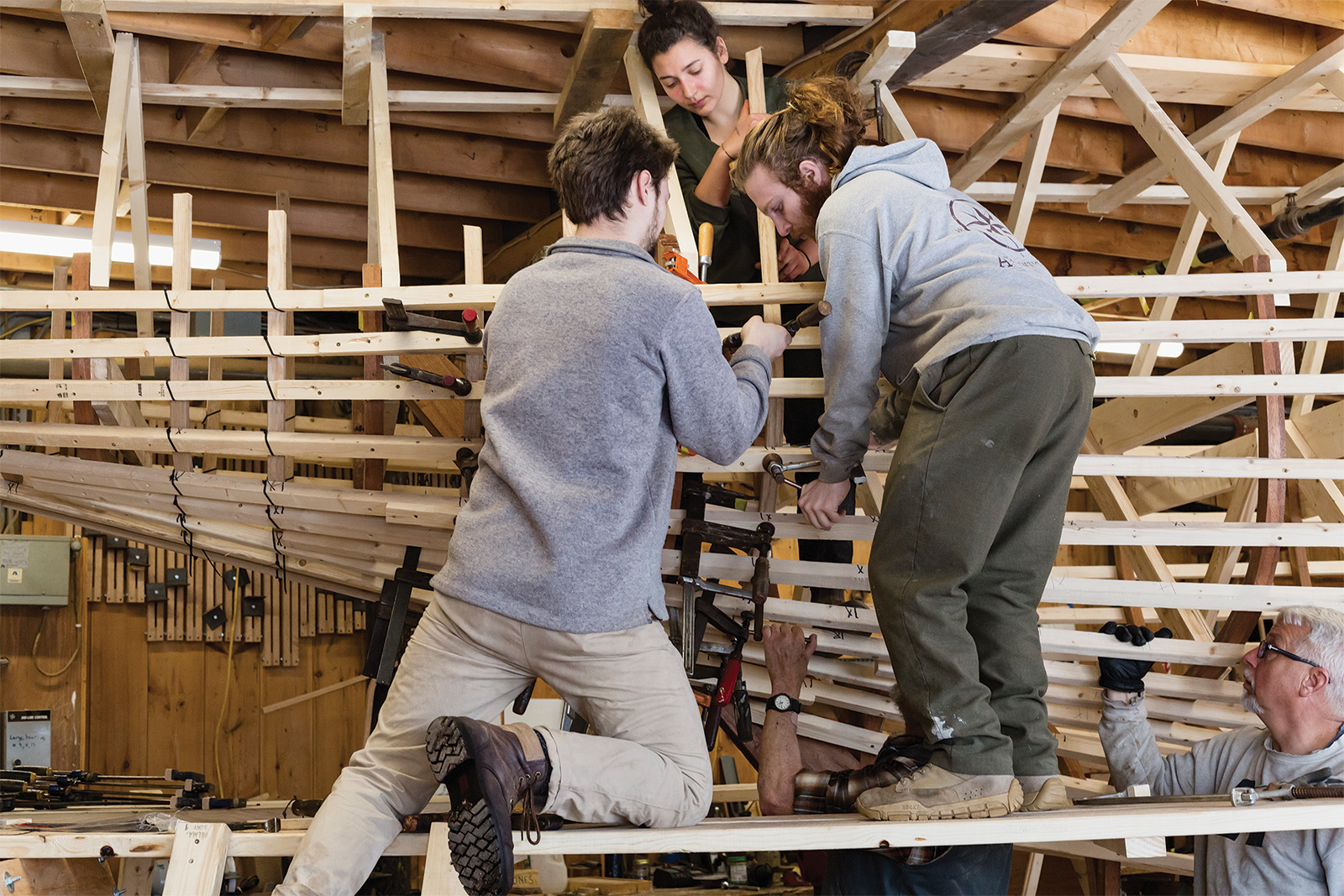
A reconstruction of a Dublin Bay 24 sloop.Erin Tokarz

The Apprenticeshop in Rockland, Maine, this year completed its largest project yet, a multiyear reconstruction of a Dublin Bay 24 sloop for an Irish client.

In the 1960s and early ’70s, anyone fascinated by traditional boatbuilding or small-craft design soon found that resources were few. It was a restless generation, one that resisted conventionalism; these people were unlikely to line up for job-training programs geared toward the needs of industrial shipyards, and for many the thought of fiberglass hull layup held little appeal. But it was also a time of rediscovery, especially of traditional skills and the work of artisans—organic gardening, roots music, craft beer, handcrafted furniture, simple living. Amid this renaissance, wooden boatbuilding was a compelling and unique combination of head and hand skills, and there was real beauty in it. But without relatives or a community directly involved in boats, there seemed no entry, no clear path, no place to go.

Left—Lance Lee, at the oars, Right—Lance Lee at center on the far side of the boat.The Apprenticeshop

Left—Lance Lee, at the oars, founded The Apprenticeshop in 1972 with a philosophy of using boatbuilding to build character. Right—Lance Lee (at center on the far side of the boat) felt that The Apprenticeshop was not a vocational program but rather served as a model that he hoped would be widely in uential in clearing a path for people who would be “chasing their souls.”

Suddenly, like the greening of spring, fresh shoots appeared. In 1972, Lance Lee opened his first Apprenticeshop in Bath, Maine. Jon Wilson founded WoodenBoat magazine in 1974, exactly 50 years ago as of this current issue. Two years later, Dick and Colleen Wagner opened The Center for Wooden Boats in Seattle, Washington, with a livery of small boats and an emphasis on hands-on learning that inspired many others. The Antique & Classic Boat Society was founded in 1975, the Wooden Canoe Heritage Association followed in 1979, and WoodenBoat School opened in 1981. The list goes on.

Above left—Dick Wagne, above right—In 1976, Dick and Colleen.Courtesy of The Center For Wooden Boats

Above left—Dick Wagner discovered Seattle, Washington, while traveling after college. He and his wife, Colleen, were captivated by Lake Union’s history and place in the city. They founded a small-craft livery with traditional boats at Colleen’s boathouse. Above right—In 1976, Dick and Colleen moved their fleet to south Lake Union at their founding of The Center for Wooden Boats, with a floating boatshop of Dick’s design; the center has grown to include another floating building and a pavilion and an education building ashore.

Good ideas spread quickly. In the half-century that has passed since those days, wooden boat building education programs have proliferated across the United States and around the world. People saw ways to reconnect with the water by rowing, paddling, sailing, and otherwise propelling themselves along neglected shorelines. With this came renewed appreciation for craftsmanship and a rededication to its preservation. If skills could be saved, worthy boats could be saved.

Today, a wealth of choices awaits anyone who wants to learn to build, maintain, or restore wooden boats. One- and two-week avocational courses such as those at WoodenBoat School serve those who don’t necessarily want to pursue a career. But for those who do, institutions such as The Landing School, The Northwest School of Wooden Boat Building, the IYRS School of Technology and Trades, and others have largely supplanted the boatyard apprenticeship system of earlier generations. The programs have adapted as boatbuilding itself changed, adding courses as wood-epoxy composites came to dominate new-boat construction, lavish restorations targeted pedigreed classic yachts, and new companies arose to take advantage of CNC machines to market a wide range of boats to home builders. In the early 1970s, the lapstrake Whitehall pulling boats of the 19th century held outsized importance as a touchstone; we’re a long way from Whitehalls now.

Hippies with Ambition

Ray Speck (left) and Pat Mahon (right, in blue cap).Elizabeth Becker (left), Narayan Mahon (right)

Typical of wooden boat builders in the 1960s and early 1970s, Ray Speck (left) and Pat Mahon (right, in blue cap) started out sweeping sawdust in English boatyards and picked up skills along the way. Fifty years later, both live in Port Townsend, Washington, and both have been teachers at the Northwest School of Wooden Boat Building. Pat has also taught at the Great Lakes Boat Building School in Michigan and WoodenBoat School in Brooklin, Maine.

Ray Speck and Pat Mahon seem to have lived parallel lives. In the 1960s, Ray was a self-described California hippie who moved to Sausalito, and Pat drove out of Arizona in a Volkswagen van and developed an interest in woodworking and later in boatbuilding. Both ended up going to England to seek out traditional boatbuilders. Both worked in boatyards there and ended up much later living in Port Townsend, Washington, where both have been boatbuilding instructors at the Northwest School. Pat was also the leading instructor at the Great Lakes Boat Building School in Michigan.

“I built a houseboat and we took it down to Sausalito, and I was smitten by traditional boats down there,” Ray said. “We sold the house, and we went to England ostensibly to find a boat. I ended up working in a yard,” in Whitby in the northeast. “They were two guys, and they were building a 36′ power fish boat,” launching her in just seven weeks after laying the keel. “So I just basically swept the floor and watched, and then I helped a bit.” At the same time, he was asking questions, observing, drawing sketches. “They really had the dance down. On Day 1, these big wide slabs of oak were up on the road, and by the end of the day the backbone pieces were laid up and rabbets cut. They moved right along.” When he returned to Sausalito, the cachet of having worked alongside honest-to-goodness English shipwrights led to more opportunities: “They thought I knew more than I did because I had worked with these guys…. There was a bunch of us hippies living for free, squatting on the waterfront.”

Hippies with a purpose and ambition. They clustered around Don Arques, who later endowed the boatbuilding school that now carries his name in Sausalito. “He was a fount of knowledge,” Ray said. Someone would ask about some particular technique, “and that would circulate. He would find out from Donny, and it was, ‘Oh, this is how they did it.’ And these old boatbuilders from town, they’d teach somebody, or say something to somebody, and within a day or two, everybody had heard that.”

Pat was in his early 20s when he walked into the Tough Brothers boatyard in Teddington on the River Thames west of London, where an 80′ motoryacht was nearing completion and a 120-footer was starting up. “Being the new hire, and also being a Yankee I think, I got all the dirty jobs, which I didn’t mind—I actually liked it a lot. I did a lot of sweeping and cleaning. I also kind of became the shop foreman’s helper. He always needed somebody to hold the dumb end of a board, so that was kind of my job.” He stayed a year before moving on to the U.S. East Coast, eventually finding boatyard work at Hodgdon Brothers in East Boothbay, Maine, and later farther east at Penobscot Boat Works in Rockport and Lee’s Boat Shop in Rockland, where Øistein “Lee” Lie-Nielsen was then building the 92′ cold-molded yacht WHITEHAWK. “Those guys I was working with were like 75, and I was in my early 20s. Mainers are not real forthcoming with information. They were pretty recalcitrant guys.” He learned by observation.

This is an Abaco boat under construction.Erin Tokarz

At The Apprenticeshop, traditional boatbuilding remains a core part of the program, regardless of what changes have occurred in professional boatbuilding over 50 years. This is an Abaco boat under construction in mid-2024, inspired by Lance Lee’s affinity for the type.

Sweeping floors was also how Walt Ansel, the current director of the Henry B. duPont Preservation Shipyard at Mystic Seaport Museum in Connecticut, started out. “The first thing I did was pump out the boats and sweep up the chips and clean the shop out—that’s what I started doing at a very young age,” at a time when his father, Willits, formerly a teacher, worked at the museum shipyard. “The old gang of blue-collar fellows were the main labor force in the yard,” he said. All were shipyard veterans of the World War II war effort, the last big boom in commercial wooden vessel construction. “They were tough, but they would kind of take you under their wing.

“Gradually, the younger generation of back-to-the-land people came in, many of them college-educated,” Walt said. “They changed the flavor of the place quite a bit, and as the old blue-collar guys retired or sadly passed away, then it got kind of left in the hands of the back-to-the-landers, or sometimes we’d call them hippies.”

The workplace apprenticeship system in the United States was never as formal as it was in Europe, Walt said. “The person that showed the talent and had the visual, spatial skills and was handy with tools got taken off painting boats and got turned into a boat carpenter or shipwright, and then was sort of self-taught, really.” Today, the Mystic shipyard often hires IYRS graduates and also has an internship program for them. It helps that Walt, who worked as a commercial fisherman and boatbuilder after college but has spent most of his working life at the shipyard, was, for a while, a full-time instructor at IYRS. “I have this fantasy,” he said, “of starting kind of a graduate wooden ship building program here for people that have come out of school or have yard experience but haven’t worked on bigger ships and want to.”

Lance Lee, too, started young and without formal training. “I started out by watching boatbuilders.” That was in the Bahamas, with everything from dinghies to 50-footers. “I would sit on stacks of yellow pine and just watch. And kids soak up an awful lot. I went to work in a boatyard when I was 11, five-and-a-half days a week, and of course I was the low man on the totem pole.”

He and his brother went on to sail a 30-footer from the Bahamas to their native Cape Cod to set up a charter operation; later, Lance went to Bowdoin College in Maine. After military service, he hitchhiked widely in Europe and the Levant. He ended up working for the first Outward Bound School in Wales in 1966, where he sailed 26′ luggers with students. More important, he became a disciple of the German educator Kurt Hahn, who founded the program and whose philosophy—a term unlikely to have fallen easily on the ears of an earlier generation of shipwrights, no matter how highly skilled—carried over into The Apprenticeshop’s approach.

With its emphasis on craftsmanship, lifestyle, community, and an almost spiritual sense of the value of skill, The Apprenticeshop was far from the job-training programs then available, and so were its successors.

“I think what we’re doing is building citizens,” Lance said. “They are not to become boatbuilders. They’re to become mature, capable, with inner strength, and are chasing their souls. Some don’t like that. I do. And I got a fair amount of it from Kurt Hahn.”

The Apprenticeshop seemed to resonate with the times, with a magnetic attraction for like-minded people. It became highly influential. Lance explained it in a question-and-answer format article in The WoodenBoat, as it was then known, in issue No. 4 in 1975 (the questioner was never identified). In 1977, The American Heritage Society’s Americana magazine published an article with a compelling cover photograph that helped to introduce the school to an even broader audience. Its concepts, and its implied critique of one-sizes-fits-all education, began to spread.

The Northwest School of Wooden Boat Building (left), WoodenBoat School (right).Northwest School Of Wooden Boat Building (left), WoodenBoat School ) right)

Left—The Northwest School of Wooden Boat Building started in Port Townsend, Washington, in 1981 with Seattle boatbuilder Bob Prothero, a co-founder, as the lead instructor. It moved to its current site on the waterfront of nearby Port Hadlock in 2004. Right—At WoodenBoat School, one- and two-week courses focus on specific skills and boats, such as this restoration of a Herreshoff 12½, which spanned multiple seasons. Many students return as alumni year after year to enhance their skills.

Head and Hand Work

One indicator of how things have changed over the half-century since the founding of WoodenBoat, and a little more than a half-century since The Apprenticeshop opened in 1972, is to look at how many boatbuilding educators working today started off in one boatbuilding program or another:

  • Isabella Feracci, director of The Apprenticeshop, and Kevin Carney, the longtime lead instructor, are both graduates of that school’s two-year program.
  • Jake Greiner, a graduate of The Landing School in Kennebunk, Maine, is now the lead wooden boatbuilding instructor there.
  • Sean Koomen went from Minnesota to the Northwest School of Wooden Boat Building, where he is now the lead instructor, and Betsy Davis, the school’s director, is a veteran of a boatbuilding program at Seattle Central Community College, where she restored her power cruiser GLORYBE (see WB No. 187) during the course.
  • Eric Stockinger, before coming to WoodenBoat School as director in 2021, was the director at The Apprenticeshop, whose program he completed after college when he was in his 20s.
  • Josh Anderson, executive director and formerly lead boatbuilder at The Center for Wooden Boats, is an Apprenticeshop alumnus.
  • Warren Barker, the senior instructor at IYRS, graduated from Williams College, worked as a house carpenter for a while, then went to work with the naval architect Bill Peterson in South Bristol, Maine. Later, he worked with Eric Goetz in Rhode Island on high-end composite racing sailboats, and then he went out on his own as a boatbuilder. He started teaching by helping his cousin, Harry Bryan, at WoodenBoat School in 1987 and has taught summer classes there ever since. When an opening came up for a full-time teacher at IYRS, he got the job.
Joe Youcha founding Building to Teach and the Teaching With Small Boats Alliance.Joe Youcha

Joe Youcha, who had considered a career in boat design, instead took to teaching, first at the Alexandria Seaport Foundation, where he eventually became the director, and later founding Building to Teach and the Teaching With Small Boats Alliance.

There is another element of boatbuilding education—call it boatbuilding with a social purpose—that has attracted uniquely suited individuals. For one example, Joe Youcha, who founded Building to Teach, discovered that boatbuilding was an excellent vehicle for teaching math to students who weren’t well-suited to standard classroom instruction. He had worked 18 years for the Alexandria Seaport Foundation, first for three years as co-founder and director of the boatbuilding school and then as the foundation’s executive director. And for another, Adam Green, who founded Rocking the Boat in The Bronx, New York, found boatbuilding a way to do all of that plus bring a sense of teamwork, community, and pride to the city’s poorest borough—and now the program is expanding to San Francisco, California. Like most of these boatbuilding educators, Joe and Adam both graduated from college. Joe studied history at Columbia University after bailing out of the University of Michigan naval architecture program. Adam majored in American culture at Vassar College.

Rocking the Boat boatbuilding education.Rocking The Boat

Rocking the Boat, founded by Adam Green in New York City, uses boatbuilding education as a vehicle to build skills, community, and teamwork in the chronically underserved borough of The Bronx.

Who could have predicted any of this? These career paths are not the type of straight-line progressions that parents might plot out for their promising children. The twists and turns could have led just about anywhere. What unites them?

The answer comes in listening to them:

Warren Barker: “I was supposed to go to Wall Street or something with that fancy degree. Right out of college, I didn’t know what the hell to do…. I needed to make something I could hold onto. I had this super education, but it was missing something. I got tired of the abstract.” He built a boat with his father after graduation; before long, he was working in a boatyard.

Jake Greiner: “I graduated from Skidmore College with a degree in music, which I had no desire to really pursue as a career,” but he found a metalworking program in the art school captivating; people were making things. “I think that what drew me to the metalworking and then subsequently to boatbuilding is that music is definitely creating something, but the creation is ephemeral. With metalworking and then boatbuilding, when you’re done, you have a tangible object…. My parents were at The WoodenBoat Show in Mystic one year, and they were like, ‘Hey, we saw this really cool-looking school up in Maine.’” That was The Landing School. “So I came and visited and was sort of blown away.”

Eric Stockinger: “I got interested when I was a teenager because I wanted a kayak and I couldn’t afford one. So I wanted to build one. I eventually landed at The Apprenticeshop. I’d gone to college, I’d done some stuff; I worked at REI, but I just kept coming back to the fact that I really wanted to do this. I went to The Apprenticeshop as a student for two years and then stayed on just because I liked what they were doing.”

Josh Anderson: “I’d already graduated from Boston University with a business degree. But I had worked in the trades all through high school and college. I was trying to figure out what I wanted to do, and it just so happened that my great-grandfather lived in Owls Head [Maine]. I had gone to Rockland and Owls Head forever as a kid, and, honestly, I was just sitting in the Dunkin Donuts across the street from The Apprenticeshop and saw all these people carrying a canoe out. I looked it up, and it was like, ‘Oh, if I have to learn a trade, I should go learn boatbuilding.”

The first boat launched at the Northwest School of Wooden Boat Building.Northwest School Of Wooden Boat Building

The first boat launched at the Northwest School of Wooden Boat Building was a small working tugboat built on commission for an owner who wanted a replica of a boat that had been used for many years by his family. A close relationship has developed between the school and the marine trades concentrated in Port Townsend.

Sean Koomen: “I knew I wanted to be a boatbuilder. I had already tried to start my career in late high school. I started building just out of [Dynamite] Payson’s books, and then in college [in Minnesota] I got grant money to start a boatbuilding business, and I quickly learned, ‘Oh, I don’t really know what I’m doing.’” He found the Northwest School via WoodenBoat’s pages, and after college graduation he enrolled, sight unseen. He later worked at Rutherford’s Boatshop in Richmond, California, and Brooklin Boat Yard in Maine before becoming an instructor at the Northwest School.

Traditional plank-on-frame boatbuilding.Northwest School Of Wooden Boat Building

The Northwest School’s program still emphasizes traditional plank-on-frame boatbuilding as a way of teaching foundational skills that can be widely applied, no matter what career path a student takes.

Kevin Carney: “I just knew that I was really interested in boats and in woodworking and working with my hands,” and then he heard about The Apprenticeshop. “And that seemed like a good place to kind of put all that together.”

Isabella Feracci: “I was interested in building things and thought I might study sculpture.” A relative encouraged her to consider The Apprenticeshop, reasoning, as many do, that if she could build a boat she could build anything. “So I came by here and poked my head in the door and thought, ‘Oh my gosh, I need to understand what I’m looking at.’ I had no idea that I would go into the industry. That wasn’t even a thought I had. It was just about learning how to build things in an immediate way. You’re not going to sit in the classroom and talk about it, you’re going to start immediately.” She continued her education at the Center for Furniture Craftsmanship up the road in Rockport, then had her own furniture shop and worked for Rockport Marine before returning to The Apprenticeshop as the director.

Adam Green: “I kind of felt that learning by sitting in a classroom was just not working for me.” In a semester off from college in 1995, he volunteered to lead an East Harlem school class in building an 8′ pram. “It gave me a sense of purpose and that I can put my energy into something and actually see results, and I can learn things or teach other people to learn things, like ruler reading, that aren’t just conceptual but are actually being put in to practice. And if you don’t do it right, there’s a result.”

Joe Youcha: “What I’ve learned about myself is that I need to see what I’ve done at the end of the day. And that can be building something, that can be writing, that be a lot of things. But I need the reward that building—in a very broad definition—that building brings. Otherwise, I wonder, ‘What the hell am I doing?’”

Fundamentals

From the beginning, Lance Lee did not conceive his Apprenticeshop program as job training for boatbuilders. “It was kind of a great environment for kids to go and search for their soul,” he said. “My intent is to impel people to set up apprentice programs in their backyard, their bedroom, a museum, an art building, a storefront. Don’t clone The Apprenticeshop. Adapt it, adapt it to metal, to clay, to glass, to tap dancing—but be active. The thing I would most like to see happen—I use the word impel—impel us, our kids, our communities, our educational system, to set in motion adaptations of apprenticing.”

Warren Barker at IYRS also is careful to hedge against the program as a straight-out job training program. “I have to promise these people that come here—I am pretty up-front about it—that you might never get another shot at doing a boat like the one you’re going to do here. But what you learn while you’re doing it will be really transferable. You’ll be a wanted commodity, because you can deal with the weird spaces and curved lines and all of these different things.”

Joe Youcha was even more blunt for his program serving disadvantaged youth in Alexandria, Virginia: “The last thing I would ever want—and people hate me when I say this—when I was running the Alexandria Seaport Foundation, especially the apprenticeship program, was for any of those kids to become boatbuilders. I wanted them to be union carpenters, or union sheet-metal workers, or union electricians,” with good pay and benefits right away. “I guess one way to look at it is, what’s the objective of building the boat? And the objective, for us, wasn’t to teach boatbuilding. The objective was to build the person.”

At The Apprenticeshop, much has changed in more than 50 years of operation, but very little has changed in the core philosophy of the program. “We are committed to traditional plank-on-frame wooden boat construction and are not going down these other roads, because we think that this set of skills is so important for character development, for preserving that or carrying forward the tradition that is this rewarding and enriching way of being in the world,” Isabella Feracci said. The feedback from boatyards that have hired Apprenticeshop graduates is that “people who can think through and do traditional boatbuilding, whether or not that is how the yards are doing it, are incredibly valuable employees.”

The IYRS School of Technology and Trades focuses on traditional boatbuilding skills.Courtesy of IYRS (all)

The IYRS School of Technology and Trades focuses on traditional boatbuilding skills as essential to the restoration of classic boats. The students start with Beetle Cats, but other projects come in, too. This N.G. Herreshoff 15’ sailing tender COLONIA, built in 1928, is one example: its owners had owned it for 15 years, stored outdoors (top left), and approached the school about taking it on as a project. Warren Barker, the lead instructor, recognized it as a rare boat and agreed to take it on. The project involved building a new boat referring to the old boat (above left) for exact methods used; the boat’s hardware and butternut toerails were reused. COLONIA was rebuilt by second-year students over the course of an academic year, relaunched in 2020 (above right), and then returned to her owners, who now sail her out of Middletown, Rhode Island.

At IYRS, which has branched out its programs, as many schools have, traditional construction remains important for the skills needed in restoring classic boats. At The Landing School, wooden boat programs in relatively large cold-molded boats and another in small, traditionally built boats are being consolidated into one that does both. Jake Greiner said that it will continue with some level of traditional construction. “I’ve noticed that the students are sort of two types: They want a career, so they want to know how to build a modern wooden boat. But there’s also that romantic element of building a traditional wooden boat, plus this fact that those skills are also critical for the restoration side of things. They’re not necessarily mutually exclusive—sometimes it’s in the same person.”

Numerous instructors also argued that such skills as lofting add immeasurably to understanding lines plans and blueprints, even as boatyards turn to CNC-cutting, especially for hull setup molds.

They also uniformly believe that boatbuilding, at whatever level, is a fun way to learn skills.

A Change of Watch

A yacht design program at The Landing School.The Landing School

Lately, boatbuilding schools have been adding technology-based programs, notably involving systems. At The Landing School, a yacht design program has been incorporated into the training.

All of these instructors see something of themselves in their students. The new arrivals often express an interest in building something tangible, something that involves fundamental principles and has a purpose, something that requires a combination of intelligence and hand skills. Although many of these programs have changed over the years—most notably with the introduction of cold-molded construction and, more recently, courses in installing the increasingly complicated systems that boat owners are demanding—they stress a grounding in traditional skills.

It’s unlikely, Kevin Carney said, that graduates will move on to traditional construction, because “fewer and fewer yards are doing that.”

But, in a strange way, the students of today are a familiar echo of their forebears. Not a day goes by without an article about the punishing cost of higher education and the burden of student debt. Lance Lee, for example, said that when he went to Bowdoin College his tuition was $800 a year; his son went there in recent years at a cost of $72,000 a year. That’s not only a disincentive to higher education but also to creative work that can make for a highly rewarding life yet risks having to climb on some treadmill to make payments on a huge debt.

The current generation also deals with the loss of direct connection to the world because of the seduction of virtual experience, the endless scrolling of devices, the sitting at desks in front of screens, and on top of that a pandemic that scrambled their day-to-day networks.

“There’s just such a strong demand for people to work with their hands,” said Josh Anderson, whose facility is just across a busy road from one of the centers of Seattle’s booming tech industry. “I see it a lot, because a lot of these people are from the tech industry, and they’re in computers or coding or whatever they’re doing all day long. It’s not tangible. There’s no shortage of people who just want to work with their hands.”

Avocational boatbuilding classes can fill that void for many. “I think it’s a launchpad for people who come and say, I’m 20-something or early 30s, I’ve been sitting in front of a desk my whole life, so my body wants me to make something with my hands,” Eric Stockinger said. “We’re getting a lot more of these young people, all these digital natives who are in their 20s—so many of them are just so desperate to actually create something real. And if you’re an at-home woodworker, one of the zenith projects in your dream somewhere is a small boat.”

The Landing School’s course traditional small-boat construction.The Landing School

Although modern boatbuilding is an important component of The Landing School’s courses, lead instructor Jake Greiner—like leaders in most programs focusing on wooden boats—keeps traditional small-boat construction in the lineup. He argues that it grounds students in fundamental skills and also is necessary for understanding traditional construction as a part of restoration work that might come up in a career.

Jake Greiner at The Landing School pointed out that his students are trending younger now than they were even a decade ago. “We’re seeing a lot more students coming right out of high school,” he said. “In the two years I’ve been here, the first year the median age for my program was probably 30. Last year it was probably 19. As a child of the ’80s and ’90s, I think there was a really strong push away from any blue-collar work; you had to go to college and get a white-collar job. I think we’re starting to see maybe a swing in the other direction now, that there’s a place for everybody.

Recent students, he said, “are here because they want to do something that’s meaningful, where they feel like they’ve accomplished something at the end of the day. There’s still something just inherently satisfying about wooden boats. Seeing that craftsmanship, that stack of lumber you’ve turned into a boat or a part of a boat, is deeply satisfying for people.”

Warren Barker at IYRS also said he was seeing a decrease in the age of students, with the 2023–24 season the youngest class, on average, he has experienced so far.

There are some common traits in the new flock of students, these teachers said. They come in the door often with less basic tool knowledge than their predecessors—which can be an advantage, since they’re more open to being schooled in fundamentals. Hand skills don’t seem to be passed down parent-to-child as much as in previous times. The students can seem less willing to work long hours—which Jake Greiner sees as a healthy sense of work-life balance.

The Center for Wooden Boats opened a new building on shore devoted to education.The Center For Wooden Boats (left), Woodenboat School (right)

Above left—The Center for Wooden Boats opened a new building on shore devoted to education, whether for building traditional boats, restoring boats of the livery fleet, or classes in building plywood-epoxy kit boats. Above right—Cold-molded construction is one of the many one- and two-week courses at WoodenBoat School in Brooklin, Maine.

Above all, the teachers battle the distractions of online devices and their widespread fallout. “They’re so tech-oriented, but they’re also sick of it,” Warren Barker said. “I battle against the phone all the time.” At the same time, “I can empathize with these students. They’re sort of thrashing around wondering which direction to go,” reminiscent of his own experience. “It seems like you have to prod them a lot more, and longer. But I think a lot of them want to make something tangible.”

Betsy Davis said, “This education is teaching people a whole way of working in the world, a whole set of skills that can be applied to boatbuilding or housebuilding or instrument-making or any other trade where they’re working with their hands. They get a deep experience that helps them navigate the rest of their lives in a different way.”

Some students expect learning to be fast, at digital speed, Sean Koomen said. “The work ethic has changed, and so it’s harder for these people to follow through. I think part of that is that they’re seeing online everything. But boatbuilding remains the same. It takes a lot of time to learn. It’s complicated. It’s hard. It’s one of those skills that you just can’t get in a video or certainly master in a video. They think, ‘If I go to school, I’ll leave a master.’ And then we remind them that when they go to school, they’ll leave an apprentice.”

Kevin Carney believes that with time The Apprenticeshop’s type of education will become more relevant, not less, “as people become more digitized and more solely focused on media and things like that. We’ve seen it come and go in waves, and I think we’ll probably keep seeing that. At some point, some of those people will say, ‘What the hell am I doing?’ If they see a group of people completely engaged in what they’re doing it’s like, ‘Oh, maybe I should try this out,’” especially in a post-Covid world where collaborative effort needs to be relearned by an entire generation. Isabella Feracci said, “I think people are already feeling that we have gone very far in this technological direction that has distanced people from working with their hands and their bodies and their minds all together.”

Onward

One of the notable boats of WoodenBoat School is BELFORD GRAY.Woodenboat School

What all boatbuilding education students seem to have in common is a hunger to create something tangible. One of the notable boats of WoodenBoat School is BELFORD GRAY, a Friendship sloop built by students over the course of numerous summers and now part of the sail-training fleet. (Her tender is a Joel White–designed plywood-epoxy Shellback Dinghy, and in the distance are a Mackinaw boat that is part of the school’s fleet, and, partly obscured, a privately owned Crotch Island pinky.

Where does it come from, this fascination with boats and how they work, how they are put together, and where they might take someone? Some experience in youth, a spark whose glow is never forgotten, unique to each person. One book leads to another; sets of plans are rolled up in the corner; seeking leads to finding, then to further searching.

“I think there are always going to be young people that’ll be captured by it, which for me is really encouraging,” Walt Ansel said. “We’re very concerned about passing the torch on to people that are knowledgeable and really will be able to take care of these vessels that we have stewarded for so many years. We worry about them a lot, but I think they’re going to be in good hands.”

“I’ve been just so encouraged by what I see down at the port these days,” Ray Speck said over coffee at the Northwest Maritime Center. Plus, “A lot of the home builders here in Port Townsend, the ones doing the higher-end, stuff, they’re all boat-school grads.”

“A lot of yards now, they’ll ask you what school you went to, where did you get your training?” Pat Mahon said. “They don’t wany somebody just off the street, like we were.”

“They’re a whole new generation,” Ray said. “And they’re almost like a throwback to the ’60s, the ’70s in some ways. They’re their own people, for sure, but as far as the level of work and commitment and the passion for doing things right, the creativity—that’s really encouraging.”

It may not be history repeating itself, but it is an echo that certainly rhymes. That pathway that didn’t seem to exist has been cleared, and it beckons.  Article ends.

Tom Jackson is WoodenBoat’s senior editor.