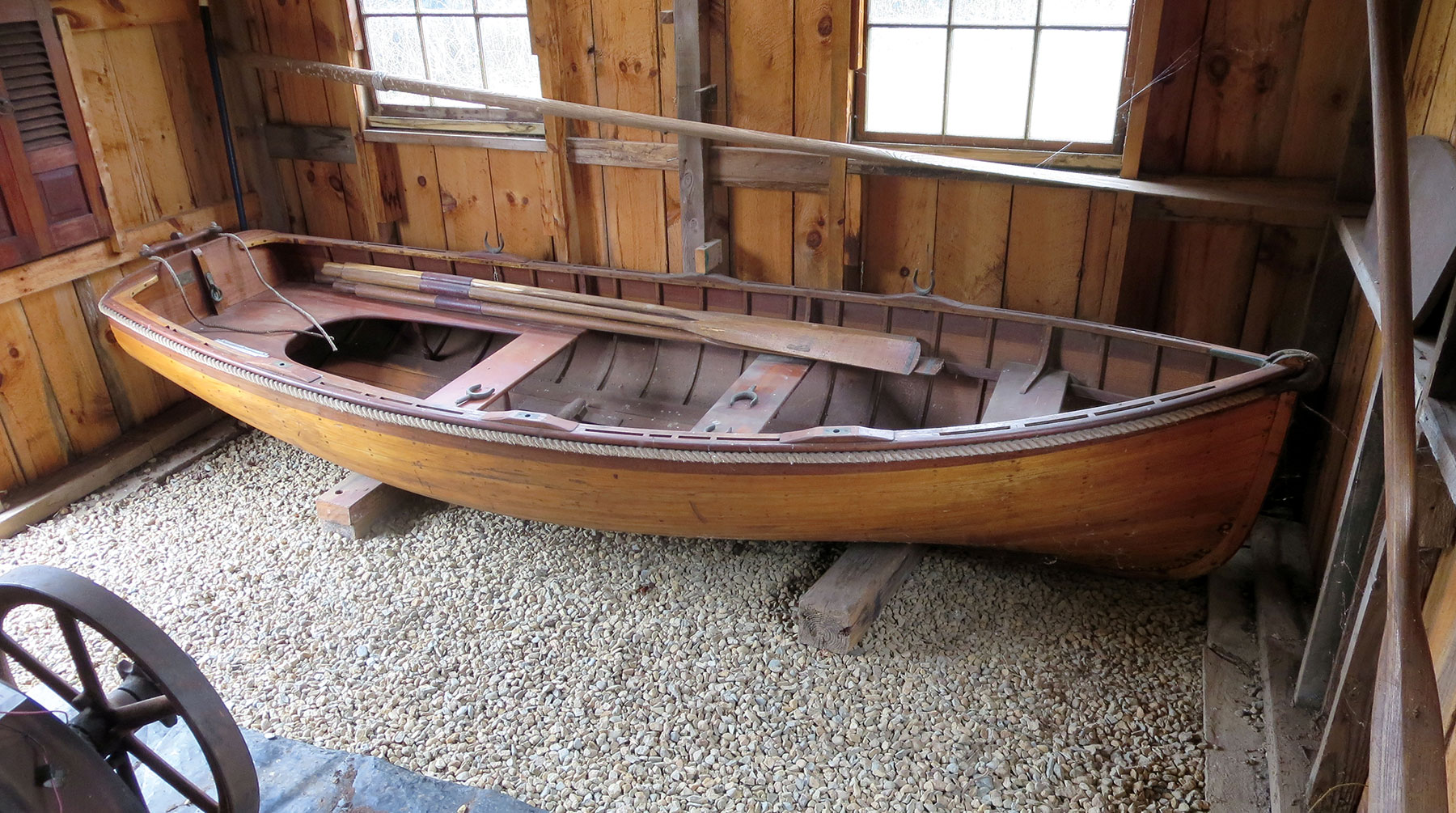
The Lawley tender has a fine entrance but full sections well forward of amidships that extend to the after thwart, providing buoyancy for five or six adults. With her straight run to the transom, she will carry well between strokes, whether loaded or not.
Many of us who love small boats hope someday to come upon a real gem, stored and all but forgotten in the loft of a barn or shed. This happened to me, although I was slow to realize what I was looking at. I had known where this boat was stored and several times had climbed a rickety ladder to give her a quick look. It was only when she was brought out for display that I realized how fine she was. I have built small boats all my life and have been proud of my work, but the craftsmanship built into this boat is truly humbling.
She had been stored for well over 50 years in a loft that was freezing in winter and sweltering in summer, when the sun beat on a black, tar-shingled roof only 2′ above her. She must have been exposed many times to temperatures well over 100 degrees. Despite this, the planking, laid tight with no caulking, showed no open seams.
This tender is now a century old, having been built in 1925 by George F. Lawley & Son in Neponset, Massachusetts, just south of Boston. That company’s founder, George Lawley, had emigrated from Scotland and worked from 1852 to 1856 for Donald McKay, the renowned designer of extreme clipper ships. In 1856, Lawley opened his first boatyard in Scituate, Massachusetts. The yard moved to City Point in South Boston in 1874. In 1909, it moved again, this time to Neponset, where it continued in business until 1946. Lawley was a premier builder of yachts and small boats at the time the yard built this boat as a tender for the 55′ powerboat SAHARA, designed by William Hand Jr.
The boat is 12′2″ long with a beam of 4′2″. Her shape is lovely, but no more so than many other pulling boats. Her layout is conventional for the type. Her interior shows three thwarts for rowing; they also provide critical structural support for the hull. Her U-shaped sternsheets are for passengers, one of whom will steer with lines coming from the rudder yoke, which also allow a solo passenger to steer while sitting amidships to keep the boat level.
Her value for aspiring boatbuilders lies in the details and quality of her workmanship. This boat’s scantlings are a lesson in strength and durability, with no unnecessary weight. Beyond an emotionless list of dimensions is a sense that, as in a fine sculpture, every curve is important to the success of the whole. The photos and captions below are intended to highlight a few of this boat’s details to illuminate the practices of craftsmen who worked at the pinnacle of plank-on-frame boatbuilding.

1. The tender’s thwarts, which are critical to the strength of the hull, are 8″ wide. They are tted tight to the planking and joggled around the frames for strength, distinguishing them from the sternsheets, which are merely beveled against the frames.

2. The planking, consisting of 10 strakes per side, is a scant ½″ thick. The sheerstrakes are mahogany, and all the other planks are most likely northern white cedar. The planking stock is quartersawn, which minimizes its movement. The plank widths, measured at the point of maximum beam, are: 5″ for the garboard, 4½″ for the first broadstrake, 3½″ for the next three broadstrakes, 3″ for two planks at the turn of the bilge, 3¼″ for two topside planks, and finally 4″ for the sheerstrake.
The planks are fastened with copper rivets, the heads of which are slightly countersunk and covered with what may be a beeswax-and-rosin filler (see WB No. 203). The filler has remained in place for 100 years. Setting the fastenings close to the plank edges aids in stabilizing the seams, helping to keep them tight. These tenders were built right-side up, allowing one man to do the riveting, thus saving a significant number of man-hours.
Craftsmanship, quarter-sawn planking, and an appropriate finish are key to the stability and longevity of this tight-seamed planking, which has no cotton caulking. But the historian John Gardner mentions one other factor: it was the practice at Lawley’s that just before a plank was installed, its edges would be burnished with “a polished round of hardwood” to compress the soft cedar slightly. When wet, this compressed wood would swell, tightening the planking seams beyond what could be achieved by good fits alone.
A 1″-diameter cotton rope serves to protect this tender’s gunwales, as well as the mother ship’s topsides, when coming alongside. It is set into a hollowed guard and sewn to the hull with linen thread through two small holes spaced at every other frame.

3. This boat’s finish is a puzzle. It is most likely shellac, which is not thought to stand up to a marine environment. The surfaces were rough, nubbly, and nearly black after years in storage. I soaked an area with denatured alcohol, then covered it with plastic sheeting to retard evaporation, and after several minutes rubbed it vigorously with an alcohol-soaked towel repeatedly. The result was spectacular.
Had the finish been varnish in poor condition, paint remover might have been used, or more likely scraping and sanding, which is a long process that risks damaging the wood. Unlike shellac, neglected varnish tends to crack and peel, trapping moisture underneath. The resulting discoloration of the wood often results in a permanent patina if not carefully bleached. Perhaps the answer to the woes of varnish has been right in front of us in an old-time and relatively non-toxic natural finish. I’d love to know how this finish was maintained; I am guessing that a periodic alcohol wipedown and another coat of shellac would maintain a fresh look with no excessive buildup. Another characteristic of shellac is that it is an excellent moisture barrier, which may be part of the reason this boat has stayed tight over the years.
To learn more about using shellac as a marine finish, I have been using a pair of oars for the past few years coated with this material and find the results most encouraging.

4. Cleaning the thwarts and the after section of floorboards yielded a satisfying result.

5 and 5a. Stretchers, or foot braces, were provided for both of the two forward rowing positions. Made of ash set into mahogany pads, the joinery would be a challenge for many woodworkers. A delicate turned post supports the thwart; without it, the thwart would have had to be more than 1″ thick to avoid springing and consequently straining the fastenings. This turned strut amidships allows a thickness of ¾″ with no loss of strength and a weight saving of over 2 lbs per thwart. A ¼″ × 1″ stop-chamfer is cut on the thwart’s lower edge, making it appear only ½“ thick.

6. The bronze breasthook is representative of the boat’s superb castings. It is beveled to fit the inwales and riveted in place. It is strong enough to hold the sides of the boat together and to the stem without an ounce of extra weight. Rivets were the fastening of choice throughout the boat wherever it was possible to use them. Note the careful fits of the inwale, filler, planking, and guard as they approach the stem.

7. This oarlock pad is another example of what is enough but no more. It is 11″ long and ⅝″ thick for its middle 4″, nicely chamfered, and tapers to ¹⁄₁₆″ thick at the ends.
Not long ago, I purchased a set of oarlocks and sockets from a well-known manufacturer. Finding that one of the oarlocks did not fit into its socket, I called the maker and was advised to mix and match at my marine supply store to be sure of the fit. This is advice a Lawley employee would not have understood. The lovely cast oarlocks with this boat are machined to fit and will surely contribute to smooth and quiet rowing.
Each pair of oarlocks follows the usual custom of having their centerlines located 12″ aft of the aftermost edge of their respective thwart. The vertical measurement from the thwart’s top surface to the bottom of the oarlock’s U-shape is 7½″, which is a critical dimension: more height would make for an inefficient angle to the oars; less would restrict the blades from being lifted clear of the water in choppy conditions.
The oars are 8′ long, closely following the twice-the-beam rule of thumb. The leathers are fastened with tacks, as are the copper guards at the ends of the blades.

8. This natural-crook quarter knee’s fastenings are well placed. Note the 3″ overlap where the inwale and notched knee are fastened together. Too often, builders leave only enough overlap for one fastening, compromising this important connection between the transom and the hull. Quarter knees add significantly to an open boat’s strength. Beyond helping to hold the transom to the hull, they effectively resist wracking strains that try to twist a boat, straining fastenings and leading to movement between the planks.
These knees follow the usual practice of giving a slight lift to their inboard ends. Knees do not seem right if they are set to a straightedge placed gunwale to gunwale, and an eighth of an inch too high or too low will draw the eye. When such subtleties are as they should be, the eye sees only a harmony of the whole.
The notch on the knee’s inboard edge well aft receives a backrest.

9. The rudder yoke could have been a straight piece of wood and performed its function equally well, but the care given to its shape makes it much nicer. Matthew Walker knots are worked into the ends of the control lines. The lifting ring indicates that this boat was likely carried on davits.

10. It is generally accepted that frames steam-bend most easily when the annual rings are oriented fore and aft—that is, parallel to the planking. These ½″ × ⅝″ frames, bent on the flat, show that with light frames and relatively easy bends, this is not necessary. It is more important to have absolutely straight-grained stock from a fast-growing tree.

11. The chapter “Yacht Tenders” in More Building Classic Small Craft, by John Gardner, gives a further look into these remarkable tenders. The builders of Lawley tenders set a high bar with their attention to details. There is nothing to prevent any of us, professional or amateur, from emulating the methods those craftsmen used and finding the kind of satisfaction that they must have felt in being allowed to do their best. ![]()
Harry Bryan (www.harrybryan.com) is a boatbuilder in Letete, New Brunswick, Canada, and a contributing editor to WoodenBoat.