Marianne ScottThe 30′ sloop DOROTHY, built in British Columbia and launched in 1897, is one of the oldest yachts still sailing in Canada. After more than a decade of restoration, she was recently relaunched.
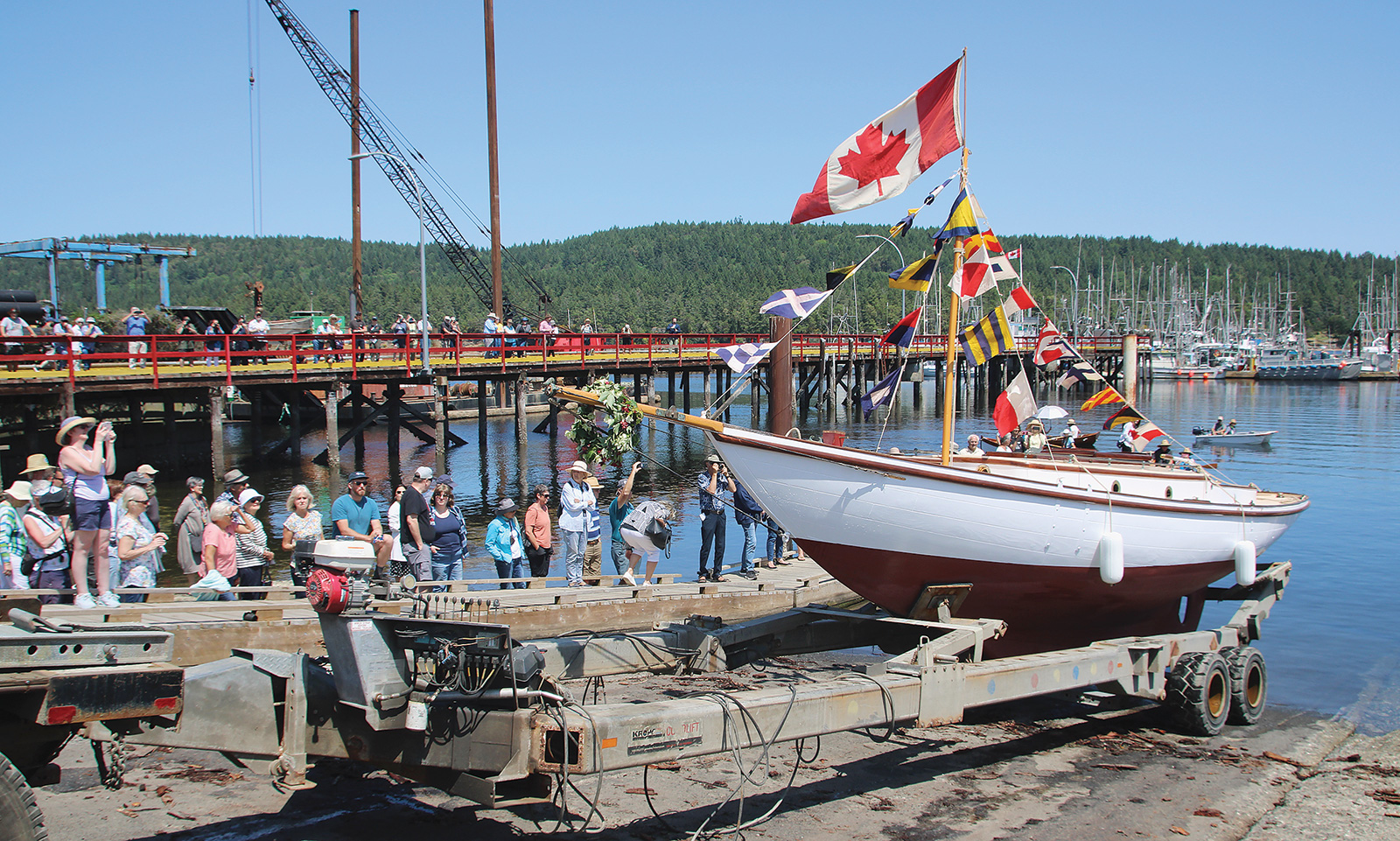
On a warm, sunny May 27, 2023, a truck pulling a trailer bearing a gleaming vintage sailing yacht drew into the Ladysmith Fisherman’s Wharf in Ladysmith, British Columbia. The yacht’s temporary mast was dressed with signal flags, a maple- leaf ensign fluttered from its top, and a flowery wreath festooned her bowsprit.
Roughly 300 spectators were on hand to observe the event, which marked the second formal launching of the 30′ sloop DOROTHY. The first launching had been just shy of 126 years earlier, on July 26, 1897. Many people who had worked on her decade-long refit were in the crowd, as were five generations of descendants of her builder, John Robinson, and first owner, William Langley. One of them, Robinson’s great-great-granddaughter, Carol Bertram, stepped over the trailer beams to proclaim, “I re-dedicate this ship, DOROTHY, and we ask for blessings upon her, and all who sail her.” She then crashed the champagne bottle against the boat’s bobstay fitting.
The audience cheered and the truck carefully lowered DOROTHY down the ramp into the Salish Sea. Langley’s granddaughter Judith Branion, and three more successive Langley generations, also witnessed the launch. “My parents, aunts, and uncles sailed with our grandfather,” said Branion. “Watching DOROTHY enter the water again remains one of my happiest and [most] emotional moments.”
In 1896, William H. Langley ordered DOROTHY to be built at John J. Robinson’s boatyard in downtown Victoria. Victoria, British Columbia’s capital, occupies the southern tip of Vancouver Island, the largest island by area and population along the west coasts of the Americas. The Hudson’s Bay Company started formal British colonization here in the 1840s. When Langley ordered DOROTHY’s construction in 1896, electricity had come to Victoria and the Canadian Pacific Railway had connected Canada from coast to coast. Gold rushes, agriculture, salmon canneries, timber, copper, and coal provided jobs and riches for some island residents, mostly English and Scottish settlers.
Born in Victoria in 1868, Langley was part of the town’s British-style gentleman social class. He was a barrister, and when the provincial government was in session he served as clerk of the B.C. Legislative Assembly from 1922 to 1944. Langley was also an avid racing sailor who, at the time of DOROTHY’s commission, owned an 18′ sloop, VIOLA. But he thirsted for a fast, attractive, and competitive sailboat to race against other members of the Victoria Yacht Club (VYC). VYC, founded in 1892, had a floating clubhouse on Victoria’s harbor; in 1911 it received the royal warrant to transform into the Royal Victoria Yacht Club. Langley was its seventh commodore for three years beginning in 1904. At that time, the nearby cities of Seattle and Vancouver were also growing and founding their own yacht clubs, which spurred interclub racing.
Linton HopeDOROTHY’s plans were drawn by Linton Hope and published in the 1895 eighth revised edition of Dixon Kemp’s A Manual of Yacht and Boat Sailing. The yacht’s original owner, William Langley, brought these plans to the boatshop of John J. Robinson.
Langley found fold-out plans for DOROTHY—“Plate LXXXIX”—in the 1895 eighth revised edition of Dixon Kemp’s Manual of Yacht and Boat Sailing. She had been designed in 1894 for one E. Gould by the British yacht designer Linton Hope, who ran his Thames Yacht-Building Company Ltd., in Greenhithe, Kent. The Encyclopedia of Yacht Designers states that the 1914 Lloyd’s Register of Yachts lists 168 boats designed by Hope and adds that “it is for his contribution to the evolution of the smaller, open-cockpit, racing yacht, that he will be best remembered.”
According to Ladysmith-based boatwright Robert Lawson, who has vigorously researched DOROTHY’s history, the first DOROTHY was built at Hope’s boatyard in the same year she was designed. Her fate is unknown. Langley, captivated by the design, corresponded with Hope, who offered to build him a teak-hulled DOROTHY-type cruiser for £250—about CAD$1,250 at the time. This included £15 for the plans. The yacht would be delivered to Liverpool for transport to Canada. However, from the correspondence Lawson learned Langley didn’t pay the £15 that Hope charged for the drawings and table of offsets. Instead, Langley brought the drawings from Kemp’s book to Robinson, whose boatyard sat among the many industrial enterprises then ringing Victoria Harbour. “I suspect,” said Lawson, that
Hope allowed [the drawings] to be published to encourage business for his fledgling Thames Yacht Building Company and for his design work. Langley saw that there was no copyright or permissions required in Kemp’s book and felt free to have a local builder quote on a local interpretation of the drawings. Later in 1897 he ordered sails of a larger area than drawn from England and asked Hope to be his agent. Hope complied, there was some miscommunication, and things got quite unpleasant with threats of legal action on Langley’s part. In the end Hope charged 10 guineas for the sails that had been quoted at 15 guineas. They seem to have put it behind them as Langley consulted with him five years later when the centerboard was removed and the keel redesigned with extra deadwood and more draft.
The drawings include a profile, body plan, half-breath plan, deck and cabin plan, a section of cabin, and a sail plan. Hope listed the dimensions as 30′ LOA (on deck), 24.3′ LWL, 7′3″ beam (7′9″ if the planks and rubrail are included), 2′3″ draft, a displacement of 2.65 tons, and a Yacht Racing Association (YRA) rating of 1.4. The plans state that “all materials and scantlings be built to Lloyds highest Class, she has proved a fine seaboat, easily handled by one man & fast.” The plans also included a 2,500-lb lead keel pierced by a 300-lb bronze centerboard.
As for the sail plan, Hope noted that “the yawl rig is not used as she is perfectly handy under a sloop rig.” DOROTHY started with a gunter-rigged mainsail and a very unusual permanently mounted whisker pole equipped with a furling drum and wooden foil. The furling drum was moved to a short bowsprit added in 1902; a longer sprit was fitted in the late 1940s.
Maritime Museum 0f British Columbia CollectionIn this undated photograph, DOROTHY cruises the Gulf Islands between Vancouver Island and mainland British Columbia.
If Langley had ordered his DOROTHY to be built on the Thames, she would have been constructed with 1″ teak topsides and a bottom of American elm. But he and Robinson chose full-length, old-growth western red cedar planks on Garry oak frames—both local trees—because these timbers had proven themselves in the numerous workboats, fishboats, and whaling and sealing vessels then being built on the B.C. coast. DOROTHY was one of the first yachts to be built in Victoria. Robinson was a skilled commercial boatbuilder, woodworker, and shipwright, who upon request could turn out a high standard of work. He likely wanted to make an impression with his first yacht-building venture, and ensured she was well-constructed—which likely has contributed to her longevity. Her decks are planked in 1″ vertical-grain tongue-and-groove Douglas-fir, and the cabin is built of staves of the same material.
In October 1896, Langley and Robinson agreed to a fee of $500 to build the hull and topsides. This was less than half of what Hope’s services would have cost, but the arrangement required that Langley do some of the work. In the handwritten contract, Robinson states that the hull will include the keel, stem, and sternpost of oak or elm, floor timbers grown to form, frame oak of suitable size, galvanized-iron chainplates, skin and frame to be copper fastened, decks of good clear seasoned fir of suitable sizes, and spars of spruce or fir.
Langley’s tasks were to supply the 300-lb steel centerboard, the steel rigging, deck hardware and fittings, and sails. Langley ordered bronze portlights, mast fittings, sails, capstan, and other bits from such English suppliers as Norie and Wilson. He procured the ⅜″ galvanized-steel centerboard from the George W. Gibbs Company in San Francisco; it cost $25.09, plus 80 cents to be delivered in the steamer UMATILLA. The yacht’s total cost came to about $1,800—$550 more than Hope’s cost.
The Daily Colonist, the Victoria newspaper, reported DOROTHY’s July 1897 launching, writing “…quite a large number of spectators cheered lustily as … the little yacht took the water in a series of lively and pretty leaps.” Langley prized his new yacht and began racing her immediately. Her responsiveness and speed led to several silver trophies—one VYC-issued cup is engraved, “First Prize, First Class, DOROTHY, 1899.”
Langley, family, and friends also cruised DOROTHY extensively, visiting the Salish Sea area, the Canadian Gulf Islands, and Washington State.
Maritime Museum 0f British Columbia CollectionWilliam H. Langley sails DOROTHY off Cape Keppel, north of Victoria, in September 1902.
How did DOROTHY survive for so long when most yachts of her vintage perished long ago? Langley cared for her meticulously for 47 years—except for the two-and-a-half years he was in Europe serving in World War I, after which the yacht required a thorough cleaning and attention to her finishes. But his routine maintenance included consistent updates and minor fixes. He re-rigged her only once in 1902; the only changes in later years were to shorten the gaff by 2′ and the boom by 4′. By 1902, he’d replaced the gunter rig with a new gaff rig, raising the gooseneck about 18″. He also added a new furling gear on the boom, and for about half her life so far, DOROTHY was a gaff-rigged single-headsail sloop. That changed in about 1950, when the then-owners, the Burnett family, added the longer bowsprit and a second headsail.
Lawson’s research shows that in 1903, adapting DOROTHY’s draft to B.C.’s deep, glacier-scoured waterways, Langley replaced a 1.25-ton full-length lead keel with its leaky centerboard slot with new deadwood and a fixed 2,800-lb lead ballast keel bolted through new floor timbers. A larger rudder was installed to accommodate the increased draft of 4′. In a logbook entry, Langley wrote that “DOROTHY has been converted to a keel boat entirely procuring plans from Hope for that purpose. He informed me that the original ‘DOROTHY’ had been so converted the year before.”
In about 1920, a one-cylinder Kermath gas engine was fitted to facilitate leaving docks and to negotiate windless harbors. Before that time, Langley used an oar with a bronze oarlock fastened to the coaming. Other engines followed, and a later diesel-fueled one has now been removed.
Tony Grove CollectionShipwright Tony Grove works on DOROTHY in his Gabriola Island workshop. The yacht was in his care from 2011 until 2022, at which point she was moved to the Ladysmith Maritime Society for the second phase of the refit, which was conducted by a corps of talented volunteers.
Langley sold DOROTHY in 1944 when he was 77. He died at 82. Over the next half-century, 10 more people owned her, making various exterior and interior changes, repairs, and updates. She was donated to the Maritime Museum of British Columbia (MMBC) in 1995 by Kim Pullen. At that time, “she was still in the water and still looked good,” said Lawson. When the museum lost its historic premises, storing DOROTHY became a challenge. She suffered from exposure to rain and temperature changes. After haulout, she spent about a dozen years on land in various sheltered locations. In 2010, the marine surveyor Brian H. Beckett wrote in a report, “she can be repaired, however it is difficult to see how she would ever be worth the cost of the investment needed.” A decision loomed: should the museum spend hard-won funds to refit DOROTHY?
On December 7, 2011, two MMBC board members, Eric Waal and the late John West, consulted with shipwright Tony Grove on Gabriola Island, 75 miles and a ferry ride north of Victoria, to determine if the yacht could—and should—be saved. They discussed three choices: Do nothing; make minor repairs that might last a few years; or refit her for return to sailing condition, and possibly extend her life for another century.
Grove viewed DOROTHY as “living history and memory.” After what he calls his archeological dig into her innards, he too found the boat’s problems repairable—and worth doing because of the boat’s historic value. He recommended a complete refit, saying, “If we don’t preserve part of our history and part of our past, we lose touch with where we came from and who we are.”
Tony Grove Collection (left), Maritime Museum 0f British Columbia Collection (right)Left—Grove installed new floor timbers and sistered many frame heels. Right—By June 2022, Grove’s hull work on DOROTHY was complete. Here, she rests in his shop awaiting transport.
The MMBC board agreed and launched a “Friends of DOROTHY” fund. Over the next dozen years, the yacht was refitted in two stages. In the first, lasting a decade, Grove rejuvenated DOROTHY’s hull, frames, and other structural parts whenever his other projects and funding permitted. The second stage took place at the Ladysmith Maritime Society, shepherded by Robert Lawson, who along with a group of other volunteers restored DOROTHY’s deck, rig, spars, and interior to their pre–World War I configuration.
Grove began by removing DOROTHY’s garboards, under which he’d found electrolytic decay. “There was considerable separation between the stem, keel, keelson and the lap joint where they all meet up,” he wrote in his restoration journal. “The iron keel bolts had rusted out. It was a critical defect—the mast and the galvanized forged-iron chainplates holding the rigging put tremendous force on that area and could have snapped off the bolts. Even trickier, the original bulkhead had been removed, further decreasing structural strength. If someone had tried to sail her with those corroded keel bolts, she would definitely have breached.”
He recorded the repair in his journal: “Because the keel bolt had rotted away, the lap joint had pulled apart over time in its length by about ⅜″ … I devised a way to pull it together by temporarily installing two ¾″ [fully threaded] ready rods through the stem and keel at either end of the lap joint, then added a ¾″ shackle eye threaded onto both rods, to which I then hooked on a come-along. While carefully listening for any cracks or pops…I was able to pull it back together. It was…a bit of a eureka moment when the components all fell back into their rightful position….” He then replaced the keelbolts with larger ones of silicon-bronze, and replaced the garboards with old-growth red cedar; he fastened them with silicon-bronze screws.
Grove sistered several aging oak frames and installed new floor timbers. The original backbone and stem still serve.
Wooding the hull exposed a fair amount of damaged planking, which was either repaired or replaced; repairs involved routing away old plank edges damaged over the years by spot-caulking, and gluing on fresh edges with epoxy. “About 40 percent of the plank edges were damaged over the years,” Grove said, “most likely due to people not knowing what they were doing when reefing and caulking the soft red cedar planking.” Lawson reckons that 50–60 percent of the planking is original. Grove says he “only replaced the port and starboard garboards planks, and the rotten sheerstrake on the starboard-side fantail.”
Reefing out the old seams revealed “a mess,” said Grove. “I found cement, polyurethane, epoxy, Bondo, white and red lead putty and sticky tar.” The new plank fastenings are a combination of copper rivets and silicon-bronze screws. After recaulking the hull, he applied red-lead primer below the waterline and an enamel primer above the waterline. “MMBC and I had agreed to use traditional products like lead-based putties and primers to keep DOROTHY as historically accurate as possible,” Grove said.
During this phase, DOROTHY also received a new samson post and bowsprit, as well as a new fir rubrail on her curved stern. With her structural elements intact or strengthened, she was ready for the next stage.
Transported from Grove’s island workshop aboard a ferry, DOROTHY arrived at the Ladysmith Maritime Society for the second phase of the refit on June 28, 2022. There, a corps of volunteers, all in their 70s and 80s and led by Robert Lawson, spent a cumulative 6,000 hours completing the refit. They rebuilt the cockpit, cabin, and bunks. They installed a new forward bulkhead to replace the one dismantled about 60 years ago. And they painted and varnished, polished bronze, restored the spars and rigging.
Maritime Museum 0f British Columbia CollectionTony Grove and Robert Lawson (right) were the two primary leaders of DOROTHY’s restoration. Lawson led the volunteer crew at the Ladysmith Maritime Society.
Lawson removed the cabin’s bronze port and starboard portholes; they were cleaned and machine-polished to brighten the metal. The interior wood surrounding the portholes required cleanup; new neoprene gaskets were placed in the porthole casting before they were reinstalled. The original porthole in the cabin’s forward section had been removed and the opening covered. Lawson searched extensively for a matching replacement and finally found one manufactured by Davey & Co. in London and sold by Fisheries Supply in Seattle. Lawson also crafted a new tiller fashioned from a carefully bent-to-shape piece of 1¼″ bronze propeller shaft, finished with a teak grip and a large bronze cap nut. It fits into the rudderstock, which is covered by two cast plates riveted to a cap that reads “DOROTHY 1897.” This all took place over 11 months, because there was a deadline: DOROTHY’s second formal launching was scheduled for May 27, 2023 (also reported in the Times Colonist, as the Victoria newspaper is called today). A further three months of work would precede the restored yacht’s first outing under sail.
After the launch, the LMS crew went back to work. They cleaned DOROTHY’s original keel-stepped fir mast with oxalic acid to eliminate black stains, and Lawson made a new pair of Sitka spruce spreaders. The mast, boom, and gaff then received eight coats of varnish. Before stepping the mast, an 1897 Canadian bronze penny was placed in the step for good luck.
When the LMS crew looked for the mainsail, they were unhappily surprised to find it missing. “We had to move fast to get a sail,” Lawson said. “So we ordered it from Cheong Lee Sailmakers in Hong Kong. They delivered a Fastnet Dacron stitched sail in 32 days. I worried about going offshore to buy it, but then reflected that Langley had done the same in 1897.” The mainsail furls on the boom using the furling hardware installed in 1902 when Langley changed the rig from gunter to gaff. At that time, he ordered the Turner’s Patent furling gear from England and asked John Robinson to build new boom and gaff. “As the boom must rotate,” said Lawson, “it requires a reefing claw to attach the mainsheet, but the earlier claw had vanished. Using old photos, I made a wooden pattern and Victoria’s Achinback Foundry cast a new reefing claw. I machined and finished it myself.” This furling gear is also used for reefing the mainsail.
The staysail is hanked on, but the jib is managed by a bronze furling drum at the end of the bowsprit. It’s a Wykeham Martin No. 3 furler made by Davey & Co. in London. While it’s not original to the boat, Lawson notes that it is period-correct: it’s still being made from the original 1905 patterns. A new teak pinrail manages jib halyards and paired topping lifts.
DOROTHY currently has no motor. Lawson re-created the early coaming-mounted oarlock. A 10′, 80-year-old white-ash oar, recently donated to the project, lives on the cabintop. MMBC is considering adding a small electric motor, but for now that long oar is all that provides auxiliary power.
Maritime Museum 0f British Columbia CollectionAt the Ladysmith Maritime Society workshop, volunteers (shown here in late 2022) spent a total of 6,000 hours completing the refit, rebuilding the cockpit, cabin, and bunks; installing a new forward bulkhead; and painting, varnishing, polishing bronze, and restoring the spars and rigging.
In late August 2023, newly rigged and in commission, DOROTHY set off without fanfare under full sail for the first time in decades. LMS volunteers Lawson and Liam Law as well as MMBC board member Angus Matthews and his wife, Sandy, sailed out of Ladysmith Harbour, looking remarkably like a circa-1939 photo with the Langleys and two fellow sailors seated in the cockpit under a well-set mainsail.
Maritime Museum 0f British Columbia Collection (both)Left—Lawson made a new tiller from a section of 1¼″ bronze propeller shaft. The cap on the rudderstock reads “DOROTHY 1897.” Right—Because the boom must rotate to reef the mainsail, the sheet is attached with a so-called reefing claw.
MMBC plans to make DOROTHY a “living celebration of traditional sailing.” She will serve as the waterborne ambassador for the museum, appearing at classic boat shows and other maritime events. “We want to take out small groups of kids and show them what it’s like to sail a gaff-rigged yacht that reflects the times of their great-great-great-great-grandparents,” Matthews said. “To experience what they experienced.”
Maritime Museum 0f British Columbia CollectionDOROTHY’s jib is now managed by a relatively new Wykeham Martin furler whose parts are cast to original 1905 patterns.
Another MMBC board member, retired Canadian Coast Guard Capt. Bill Noon (who is former skipper of the icebreaker SIR WILFRID LAURIER, the ship that located Franklin’s lost EREBUS in 2014), sums up DOROTHY’s rebirth this way: “The story of DOROTHY’s refit has three defining features. The Maritime Museum of British Columbia’s collection holds a remarkably comprehensive provenance of DOROTHY. This project has been a refit, not a rebuild— DOROTHY is still largely the original boat. A vibrant maritime community has adopted DOROTHY; their skills and generosity have made the refit possible. And all this has happened within 70 nautical miles of Victoria, where she was built in 1897.”
Maritime Museum 0f British Columbia CollectionCarol Bertram, great-great-granddaughter of DOROTHY’s builder, John Robinson, rechristens DOROTHY at her relaunching in May 2023.
Janelle HuopalainenDOROTHY sailed for the first time since her relaunching on August 26, 2023.
An Early Furler
Maritime Museum 0f British Columbia Collection (both)DOROTHY’s original jib was set on an unusual whisker pole that was equipped with a drum-type furler (below). Upwind (left) the sail functioned as a conventional jib; downwind (right) the windward sheet hauled the luff—which was attached to a wooden foil—aft, spinnaker style.
The accompanying photographs show the unusual whisker pole, furling drum, and wooden luff foil used to manage DOROTHY’s headsail. The gear is most likely of Linton hope’s design, and it served Langley well for 47 years. The only change made to it during his ownership was to lengthen the whisker pole with attached furling assembly about 1′ and move it onto the new bowsprit when that was installed in 1902. This furler has since been replaced by a bronze Wykeham Martin unit, recently made but built to a design patented in 1905.
Maritime Museum 0f British Columbia CollectionThe Drum-type furler. The detail drawing is from Linton hope’s book “Small Yacht Construction” (1902); it illuminates the details of DOROTHY’s setup. Many people are amazed at both the use of a furling drum and a wooden foil as early as this, but there are drawings extant of inland Dutch vessels in the early 18th century using similar gear. —Robert Lawson
When DOROTHY was sailing downwind, wing-on-wing, her original device allowed the furling of the jib without changing course. It was an unusual idea that was tried on much larger yachts of the time but found to be cumbersome at that scale. DOROTHY was probably the perfect size for it. ![]()
Marianne Scott lives in Victoria, British Columbia, and writes about nautical topics for Canadian, American, Australian, and British publications. Her longest offshore sail was a roundtrip voyage from Victoria to Tahiti. She’s written three marine-related books and one about craft distilleries on Vancouver Island.