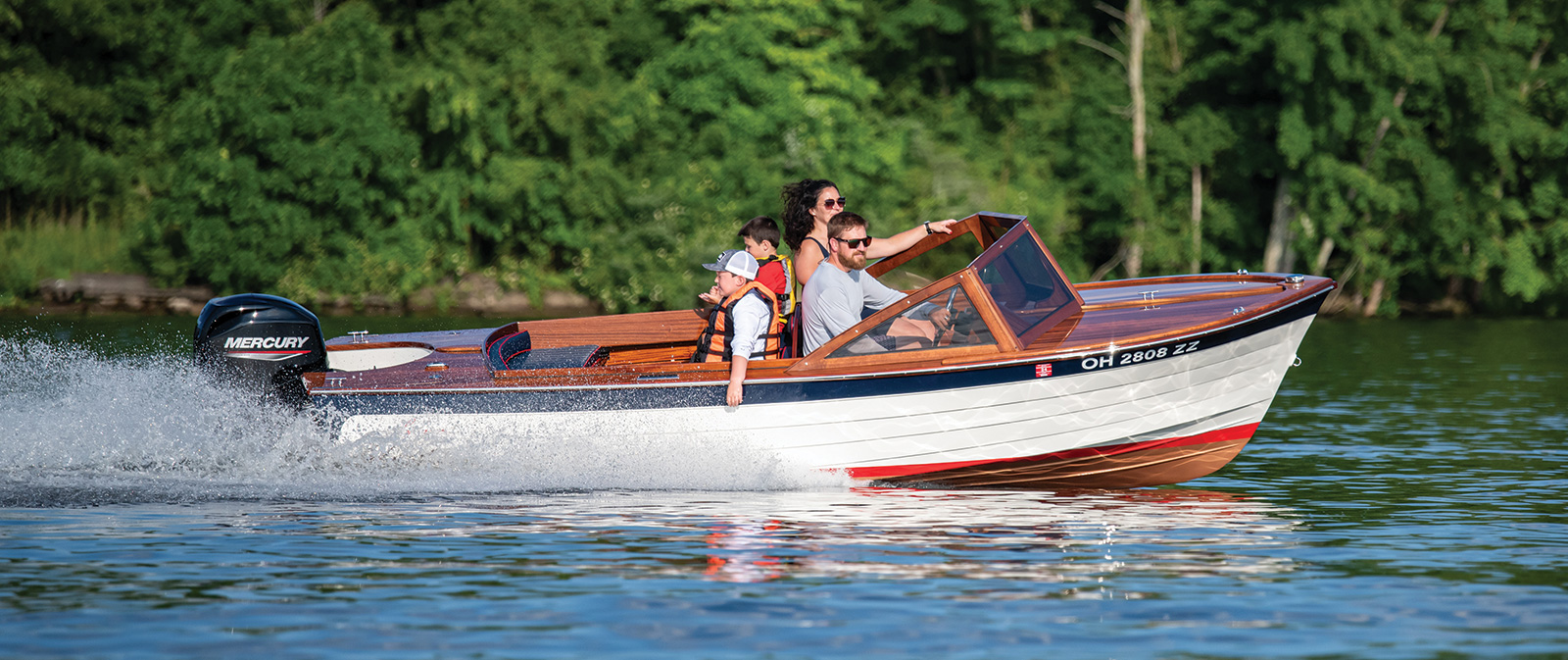
Color images courtesy of Chippewa BoatworksChippewa Boatworks of Seville, Ohio, has developed a new boat based on vintage Lyman designs of the 1950s, ’60s, and ’70s. (photo below) The new boat measures 16′6″ LOA, and comes in runabout (above), tender, and center-console models.
Lyman Boats LLCVintage Lyman design.
The watercraft built by Lyman Boats are renowned for their quality, durability, and timeless style. The company was established in 1875 by Bernard and Herman Lyman in Cleveland, Ohio, moved to Sandusky, Ohio in 1928, and quickly gained recognition for producing high-quality wooden boats that could withstand the rigors of the Great Lakes. Initially focusing on fishing boats and pleasure craft, Lyman eventually expanded and diversified its lineup to include everything from sleek runabouts to spacious cruisers, all bearing a signature blend of handcrafted excellence and practical design. Though the company ceased wooden boat production in the 1970s, the legacy of Lyman Boats endures, with many examples lovingly preserved and cherished by collectors and aficionados. As Peter Spectre wrote in “Lyman Legend” (see WB No. 82), “Anybody who had an appreciation for powerboats of any kind had a Lyman, wanted a Lyman, knew someone who had a Lyman, or was saving up his money to buy a Lyman.”
On any given summer weekend, it’s still not uncommon to see a dozen or more Lymans on the local waters of Sandusky and the nearby islands. Anchored off the beach of East Harbor State Park or making a quick run to nearby Kelley’s Island, these boats are meant not only for shows but also to provide practical enjoyment on the water.
In the spring of 2020 and the depths of the Covid-19 pandemic, Adam Sublett of Benchmark Craftsmen called me to inquire about a new custom design. Their family business, founded by his father, Nate, more than 50 years ago, specializes in the design, fabrication, and management of trade-show displays. In a typical year, Benchmark would be keeping their crew of craftsmen busy working on custom projects for some of the most prominent brands in the United States and beyond. The pandemic had put an abrupt end to in-person shows, and many of Benchmark’s projects were put on hold.
Adam explained that they were looking for a project to keep their craftsmen busy until the pandemic restrictions receded. As these conversations go, I asked a million questions ranging from their business and its capabilities to the more personal. Their craftsmen were very talented with experience in a wide range of materials, from wood to plastics. They had a modern shop with all the toys you can dream of; most important were a large-platform CNC router and a large spray and finishing booth. I quickly understood that they had the ingredients of a good boatshop but were looking for a great recipe.
When the topic of the boat’s intended use was approached, I was pleasantly surprised when Adam explained that their shop was in Ohio and the boat would be used primarily on Lake Erie. My yacht-design business is located in Severna Park, Maryland, but I was born and raised in Ohio, spent my summers at our family cottage on the lake near Marblehead, Ohio, and have been obsessed for many years with the types of craft that perform well on Lake Erie’s short, steep waves. Since childhood, I’d hear my father and uncles debate the merits of their current boats, but the conversation always seemed to end with “nothing handles these waters like that old Lyman we had.”
With my father’s words echoing in my mind, I immediately thought of Lymans and began to list the characteristics that made these boats so renowned on the Great Lakes. I suggested the idea of creating a modern Lyman. Adam loved it, and we scheduled a meeting for me to meet the team, including Nate and his brother, Matt. My first impression of the Subletts was that we shared the same passions for boating, woodworking, and craftsmanship. They, too, had grown up on the water, spent summers on Lake Erie, and dreamed of building boats.
By chance, Nate was introduced to Tom Koroknay, the owner of Lyman Boats LLC, which restores Lymans and stewards the Lyman legacy by maintaining the original company’s archives—the hull records, plans, photographs, patterns, jigs, and tooling. (see sidebar). We spent a day touring Tom’s collection and identified the key characteristics of past models to be incorporated in the modern Lyman: a bit of tumblehome at the transom, a deck layout from the 1950s, a deep forefoot, and a flared 1960s-style bow.
With a clear path ahead, the Subletts set about creating a new company, Chippewa Boatworks, and I headed to the drawing table and computer. The new design had to be efficient to build. It also had to be easier to maintain than the original boats by using modern materials and construction techniques; however, the performance had to live up to the revered Lyman name.

1. We spent much time discussing the construction techniques and how to best utilize the skills and tools of Benchmark’s craftsmen. To quickly cut their planks, the original Lyman Boat Works had hundreds of patterns for each hull plank of every model. Today, we have computer programs and CNC machines. The topside planks were to be developed on the computer and cut on the machine. In theory, they would fit perfectly on the first try and need only to be glued and clamped to the construction jig. Furthermore, we wanted to cut as many of the components as possible, including bulkheads, stringers, furniture, and the building jig. To achieve this, the boat and its construction jig were designed using 3D CAD and it was a simple matter of converting each component to a 2D cut file that the machine could interpret.

2a–2b. A restored classic Lyman is truly a thing of beauty. However, it doesn’t take much imagination to consider the countless hours spent replacing rotten planks, repairing broken frames, and maintaining its acres of varnished mahogany. Reducing maintenance and repair costs was a very high priority. It was therefore decided that the hull would have a cold-molded bottom with interior and exterior laminations of basalt fabric, glued lapstrake topsides, and an egg-crate-type structure of marine-plywood bulkheads, frames, and stringers. The cold-molded bottom would be watertight and rot resistant. Gluing the topside planks together with epoxy and incorporating a small epoxy fillet at the plank seams would ensure a very strong bond between planks. The Subletts, with their many years of experience with different paints and finishes, set out to create a low-maintenance brightwork recipe for the mahogany decks and furniture.
As I sat down to design the hull, I pulled out my notes from our meeting with Doc Lyman. Scribbled across the top of one page was, “it’s one thing to build a boat that looks like a Lyman, but it better perform like one, too.” I don’t remember who said this, but I could imagine it was my father or uncles passing down words of wisdom around the old fish-cleaning table. Likely, it was Doc Lyman offering final words of encouragement (or warning) as I was heading back to my office!

In essence, the recipe for a comfortable and dry boat in short choppy seas is fairly straightforward. The hull must have a deep and sharp forefoot, ample flare to the bow, straight buttocks aft for ease of planing, low beam-to-length ratio, moderate horsepower and speed, and chine flats and spray rails to keep the boat dry. These are all easily achievable on a lightweight, open runabout when I don’t have to worry about cruising comforts, large motors, and blistering top speeds. I had one issue, though: the original Lymans all had round bilges. Besides the fact that enthusiasts swore this feature was the secret to a Lyman’s good ride, I wasn’t comfortable with marrying a cold-molded round-bilged bottom to lapstrake topsides, nor did I think it would look right. On one of our frequent video calls with the Subletts and Tom Koroknay, I extolled the virtues of a chine flat and spray rails. I rendered some views of the design and showed how the chine flat and the spray rails would be shaped to mimic the look of a lapstrake bottom and would blend in seamlessly. After much reluctance, I got the go-ahead as long as I promised that the boat would meet our performance goals.

3. Once the hull was designed, I came up with multiple interior layouts for different uses. We settled on three: a classic runabout, a center-console, and a tender. The classic, for obvious reasons, would be hull No. 1. It consists of a standard Lyman layout with windshield, fore-and-aft seating, and a bench across the back. To meet U.S. Coast Guard standards for flotation, I incorporated a rounded motorwell and enclosed the afterdeck to hide the 8.8 cu ft of foam. Foam is also placed under the sole, filling the cavities between frames and stringers to meet the rest of the Coast Guard standard.

4. With cut files in hand and the CNC machine warmed up, the crew made quick work of cutting and setting up the construction jig and the transom-laminating jig. The construction jig consisted of temporary molds and forms for the stem and keel; there are also permanent bulkheads, frames, and stringers. The permanent structure was glued, and epoxy fillets were applied to all joints.
5. The transom was laminated in three layers of ½″ okoume plywood before receiving a fourth layer of beautifully figured sapele mahogany.

6–7. With the transom mounted on the building jig and the chines in place, the bottom planking began. The planking is ½″ okoume plywood aft, and it transitions to two layers of ¼″ okoume toward the bow to accommodate the shape there.

8. For the topside planks, we found that we could machine-cut a consistent rabbet on the upper edge of one plank, and a corresponding rabbet of varying depth on the lower edge of the next plank. This yielded tight fits along the length of the seams and the so-called “gains” of traditional lapstrake planking, which give the otherwise lapped plank seams a flush appearance at the stem. The planks came off the machine ready to fit to the boat.

9–10. I have been recommending mineral basalt fabric on many of my small-boat designs, with great results. The fabric is similar in composition to E-glass, but uses fibers consisting of melted basalt and comes in a variety of weaves. While it offers better mechanical properties than E-glass, I also prefer it for its superior impact resistance on cored hulls. It’s fair to say that it is built like a rock. In the photograph at left, Scott Hlad and Stephen Zumack are laminating the hull bottom, chine flat, and first topside plank in basalt fabric set in epoxy.

11. One of the benefits of lapstrake construction is the reduced labor during the dreaded fairing stages. The planks are developable, which is to say they curve in only one direction; such a hull typically needs very little work with a longboard to fair out the screw holes and other minor defects.

12–13. The interior structure received epoxy fillets and fiberglass tabbing before the bilge was sheathed with basalt fabric. Flotation foam was then poured into designated cavities before the sole was installed.

14–15. The craftsmen at Chippewa Boatworks had honed their joinery skills building exhibits for venues such as the Rock and Roll Hall of Fame in Cleveland, and the Cleveland Guardians Hall of Fame at Progressive Field, where thousands of fans would view their workmanship. They brought the same standards to bear on the new Lyman. In the photograph above, at left, the windshield frame is being fitted. Note the laminated helm pod in the background. Above right, a solid sapele mahogany coaming and ceiling are being installed.

16. This helm seat is for the “Tender” model. Butterfly inserts add additional strength to the seams—and a tasteful detail.

17. The hull was sprayed with Awlcraft 2000 urethanes and the bottom is painted with Pettit 1933 bronze antifouling, for a classic look.

18–21. The brightwork received extra attention and planning. At the beginning of the project, we identified the yearly maintenance of a traditional varnish system as something to improve upon in the new boat. The building crew’s experience in creating displays that take a lot of abuse, punishment by the elements, and the ravages of breaking down and shipping around the country gave them a head start on creating a durable and low-maintenance finish for the boat’s mahogany components.

All wood was initially sanded to 120-grit before it received three coats of epoxy to fill the grain. The finishers sanded with 180-grit between coats. When the grain was filled, they vacuumed and then wiped down the surface with denatured alcohol. (They find they have fewer issues with residue when using alcohol rather than a prep-solvent cleaner.) The boat or its components were then wheeled into the 600-sq-ft spray booth to be sprayed with three to four coats of R&M High Solid Clear (DC92) with DH44 Medium Hardener. DC92 is a two-component, high-build, acrylic-urethane clearcoat that produces a very glossy, durable, UV-resistant finish. After 24 to 48 hours, the finish is wet-sanded up to 4,000-grit, compounded, and then polished to achieve that beautiful shine.

22. With ample wire chases and rigging tubes installed under the sole, the rigging of the 60-hp Mercury outboard motor, Uflex hydraulic steering, and electrical system was a straightforward affair; it was all installed to ABYC standards.
23. When hull No. 1 was completed, I was handed the keys, hooked up the trailer, and headed north from the shop in Seville to Lake Erie for a few days of sea trials and fun. There is no denying the attention these boats get. I made it as far as the gas station before I was waylaid for 20 minutes answering questions and giving a tour to an interested couple. Multiple times on the drive I was encouraged by honking of horns followed by big thumbs-ups on the highway by fellow motorists and once, at a toll plaza, by a UPS driver.
Over the course of those few days, I had the opportunity to test the boat in a range of sea conditions, from dead flat to steep chop resulting from northeast winds of 15 knots. Pulling away from the launching ramp, I couldn’t help but feel that I was setting off for a Sunday cruise driving a classic 1950s Cadillac convertible. Once past the no-wake zone, I put the throttle down. I had to check our wake to make sure we were on plane because there was no noticeable hole to climb out of. She quickly reached a top speed of 30 knots and cruised very comfortably in the 22–24-knot range while slicing through other boats’ wakes like they didn’t exist. On the choppier days, the chines, spray rails, and flare in the bow did their jobs, keeping the boat surprisingly dry. With the kids along, we made a game of seeing if we could find waves that could get us wet. We found only one.
She sips fuel. Calculations showed that we should get 8.5 miles per gallon of gas at cruising speed. After four days of constant use and covering more than 40 miles while running back and forth to the beach at East Harbor State Park, multiple trips to Marblehead Lighthouse, and a fun ride to Cedar Point Amusement Park in Sandusky, I topped the tank off with 7 gallons.
Looking back through the pictures and videos of those days on the lake, and reminiscing about the memories that were made with my family, I realize that this is the essence of these special boats. Each curve of the lapstrake planking, the hand-rubbed finish of the mahogany, and the polished hardware harkens back to a golden era of boating, where craftsmanship was an art and every launch a cherished tradition. Chippewa Boatworks (whose proprietor, Nate Sublett, is sitting at the helm above) is continuing what Bernard Lyman started almost 150 years ago.
Tom Koroknay, aka Doc Lyman
Kurt CernyFrom Left, Ryan Koroknay, Tom Koroknay (seated, left), Adam Sublett, Matt Sublett, Kurt Cerny, and Nate Sublett present the first Chippewa Boatworks Lyman at the Cleveland Boat Show.
A native Ohioan and third-generation woodworker, Tom Koroknay has gained a reputation as the pre-eminent Lyman boat expert, earning him the moniker “Doc Lyman.” Tom authored the book Lyman Boats: Legend of the Lakes, which details the company’s 98 years of wooden boat building history. He has owned and operated his renowned Lyman Boat restoration business for more than 45 years.
In a once-in-a-lifetime opportunity in 1988, long after Lyman Boat Works had built their last wooden boat, Tom purchased the remaining Lyman Boat Works archives and factory tooling pertaining to the company’s wooden boat production line to supplement his already-flourishing Lyman-restoration business, and later acquired the intellectual property rights to the famous Lyman trademark.
Upon a visit to the old factory, Tom found patterns, jigs, and fixtures piled high on the floor ready to be sold or burned. Made from hard maple, fir plywood, white oak, brass, and steel, these pieces of tooling were works of a lost art. Tom and crew spent weeks relocating the tooling to his shop to begin the long process of cleaning and restoring these fixtures, many of which he still uses to produce factory-original Lyman boat parts. Over the past 30 years, Tom has provided Lyman Boat historical exhibits and technical information for the National Museum of the Great Lakes; The Maritime Museum of Sandusky; the Antique Boat Museum in Clayton, New York; the Chesapeake Bay Maritime Museum; and the Mariner’s Museum in Newport News, Virginia.
In 2020, Nate Sublett was introduced to Tom through a mutual friend, and he laid out their plan to build a modern Lyman. Tom graciously invited the crew to visit his warehoused traveling exhibit, full boat jigs for building the hulls, tooling, and the archives. We pored over original drawings, blueprints, and marketing pamphlets seeking inspiration and design ideas for a new, modern Lyman hull. Tom was impressed by their capabilities, business plan, and vision of a modern Lyman, and the two parties came to an agreement for the Subletts to use the Lyman name on their new line of boats.
—KC
Kurt Cerny is a graduate of both Westlawn Institute of Yacht Design and The Landing School of Boatbuilding and Design. After stints as a boatbuilder and manager with Belkov Yacht Carpentry and Cherubini Yachts, he established his own design office, Cerny Yacht Design, in Severna Park, Maryland, specializing in commercial vessels, recreational boats, and runabouts.