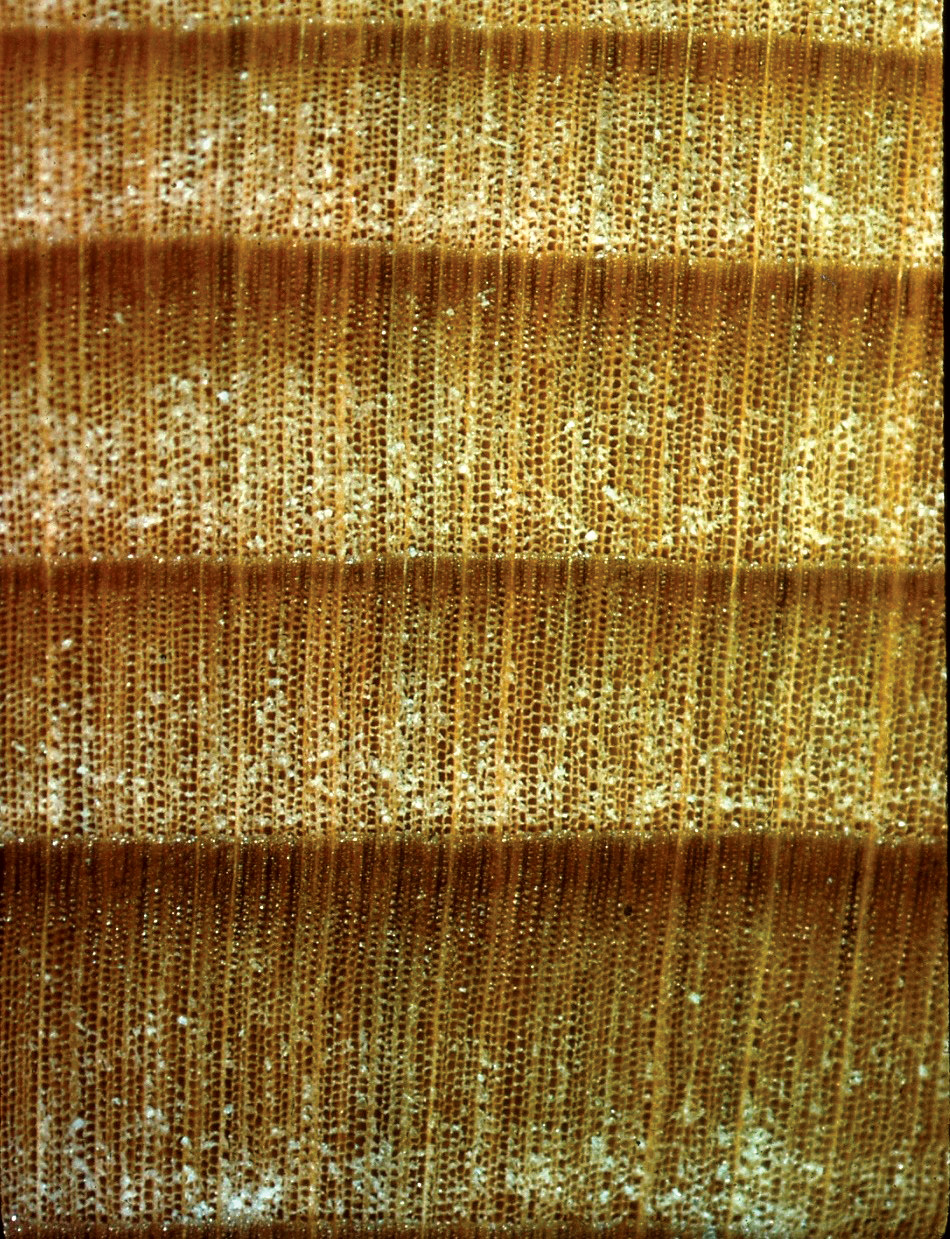
Richard JagelsIn this cross-section of hemlock, the bottom band of growth shows a wide segment of earlywood. The ring at the top of the photo has a narrower region of earlywood. Yet the latewood, which is stronger in softwoods such as this, remains relatively constant in each band. In narrow-ring, old-growth trees, which have a higher ratio of latewood to earlywood, such trees yield stronger wood.
We’ve all heard someone say, “the sap is rising” or “the sap is down,” suggesting seasonal filling and draining of the sap in tree stems. In truth, the sap, or water content, is never up or down but instead is constantly present in living trees. Yet my neighbor is always primed to cut his firewood trees in winter, when he believes the moisture content is lowest because the sap has returned to the roots.
Just based on the laws of physics, this would be impossible. Approximately 20 percent of the total sap in a tree is in the crown, 60 percent in the main stem, and 20 percent in the roots. How would it be possible to move this large volume of stem sap into the roots without a significant volume of moisture being extruded from the roots into the surrounding soil—a process not observed?
More to the point, if stem moisture content is lost in a living tree, it cannot be recharged—the tree will die. The water in a tree stem is not under positive pressure but rather tension, or negative pressure. This is possible because conducting capillaries—the vessels and tracheids—are very small, and the wall surfaces are cohesive with water molecules. The interplay of cohesion and tension moving water up a tree stem also requires transpiration through evaporation at the leaves in the crown. If individual capillaries are abridged by injury or air bubbles forming an embolism, repair or diversion may be possible; but loss of all or a major portion of the water column is a precursor of tree death because root pressure is not sufficient to re-establish the water column.
Dozens of research studies have confirmed that only very minor changes in stem moisture content in living trees are observed at different seasons of the year. In one study (www.scholarworks.uni.edu.pias/vol67/iss1/10), the moisture content of several hardwood trees was slightly higher in winter than in the fall or spring.
My advice is to fell trees for firewood or boatbuilding when you have time to do so. Of course, seasons do matter when considering how long logs or lumber will need to season to reach a desired level of dryness, but that is a separate matter.
Old-Growth
While sap depletion in trees qualifies as a myth, our second example is more of a half-truth. For as long as I’ve been around lumbermen and boatbuilders, the doctrine that old-growth timber produces the highest-quality and strongest lumber has been without challenge. And while I agree with this for most softwood trees, it is not always true for hardwoods.
Richard JagelsIn ring-porous hardwoods such as this red oak, the earlywood zones, the narrow bands seen here, are comparatively xed in width. The latewood zones, which are variable, are composed mostly of strengthening bers with smaller vessels. Rapidly growing trees will have comparatively wide rings and a larger proportion of strengthening latewood, meaning that rapid growth leads to stronger wood.
Conifers (softwoods) produce one type of cell (tracheid) that provides both structural support and water transport. In the early part of the growing season, while water transport to the crown is dominant, early wood tracheids with relatively thin, weak walls are produced by the cambium, just beneath the bark. Only when a tree’s gain in height and diameter ceases at the end of the growing season does the cambium produce a layer of thick-walled tracheids that provide structural strength.
In a regenerating forest or one regularly thinned, trees add relatively wide growth increments each year, while the crowded old-growth forests produce trees with narrow growth rings. As a consequence, these narrow rings contain less earlywood and a higher percentage of the stronger latewood. In photo 1, a cross-section view of hemlock, the growth increment at the bottom has a wide area of earlywood, distinguished by its lighter color. The ring at the top of the photo has somewhat less earlywood and therefore a greater ratio of latewood to earlywood. In narrow-ring, old-growth trees, the reduction in earlywood is even greater, yielding a larger ratio between latewood and earlywood and stronger wood.
Many hardwood tree species such as maple, birch, cherry, poplar, and most all tropical woods produce a relatively uniform wood throughout the growing season, and in those cases, strength properties are mostly independent of growth rate. However, a group of non-tropical trees adapted to seasonal climates have developed a strategy for rapidly moving water to newly expanding leaves in spring. These are what we call ring-porous trees, among them oaks, hickories, ashes, elms, locusts, and sassafras, for example.
In these species, the earlywood is narrow and composed of large-diameter vessels to quickly transport water to expanding leaves. This earlywood zone is fixed in width. The latewood is composed of mostly strengthening fibers with smaller vessels and is variable in width. Rapidly growing trees will have comparatively wide rings and a larger proportion of strengthening latewood. Photo 2 is an end view of red oak. The weaker zone of large vessels remains fixed in width from one year to the next; but the latewood can vary, as seen in this photo.
The consequence of this growth pattern in ring-porous hardwoods is that rapid growth leads to wider rings and stronger wood. Early settlers to New England encountered old-growth forests with oak trees that were soon deemed inferior to English oak. The wide-ringed English oaks, often growing in open hedgerows, were stronger than their narrow-ringed cousins in North America. As forests were felled and second-growth stands of oak developed in New England, those differences in wood quality faded.
Deception?
A little over a year ago, I wrote a column about a genetic-engineering solution that held great promise for re-establishing our lost American chestnut forests (WB No. 292). The breakthrough was a result of research at State University College of Environmental Science and Forestry (SUNY-ESF) where a gene from wheat (OxO) that degrades oxalic acid—the toxin produced by the chestnut blight—was inserted into American chestnut trees.
After several years in laboratory and greenhouse tests, the first transgenic trees were planted in isolated orchards in 2006. Following several more years of improvement, a version named Darling 58 was permitted for field trials in 2016, and SUNY-ESF began submitting documents to federal agencies, proposing deregulation of Darling 58 American chestnut trees.
Recently, I learned that The American Chestnut Foundation (TACF), which had been providing support for the SUNY-ESF research, withdrew its support for this transgenic project in December 2023. I contacted a friend, Mark McCollough, who is president of the Maine chapter of TACF, for his thoughts. He replied, “Last fall, Tim Klak from the University of New England and Han Tan [from the University of Maine] were the ones who discovered the Darling 58 was really Darling 54—setting off a cascade of events that led TACF to withdraw support for the USDA [U.S. Department of Agriculture] application for D58. Last year, there were emerging problems in field trials with slower growth, leaf yellowing, inability to produce homozygous trees, lower survival, and young trees getting the blight. At least some of the problem was the placement of the gene (a mistake made in the SUNY lab years ago), but also the promoter for the OxO gene caused it to be expressed continuously. It was believed that this was an energetic drain for the growing tree or even causing gene silencing in the tree. There were other behind-the-scenes problems as well with communications from SUNY, a plan to commercialize Darling 58, and lack of data sharing from SUNY to TACF.”
Was this simply a mislabeling error that went unnoticed for several years or a deliberate cover-up in order to continue the federal application process? The answer may never be known, but it certainly is a major setback in the decades-long effort to bring back our once-magnificent American chestnut forests.
Societal pressures to “publish or perish,” obtain monetary grants, and generally enhance institutional prestige all weigh heavily on today’s university scientists. We see the negative consequences in faked-data journal articles that later need to be retracted. As a graduate of SUNY-ESF, I certainly hope that the Darling 54/58 mix-up is not a case of intentional cover-up. I am encouraged by seeing that, whether innocent or deceptive, the truth was finally revealed. ![]()
Dr. Richard Jagels is an emeritus professor of forest biology at the University of Maine, Orono. His Wood Technology column, which debuted in WB No. 20 in January/February 1978, is by far the longest-running department in WoodenBoat, which is marking its 50th anniversary of publication with the current issue. Please send correspondence to Dr. Jagels by mail to the care of WoodenBoat, or via email to Senior Editor Tom Jackson, tom@woodenboat.com.