
 Leif Wikberg
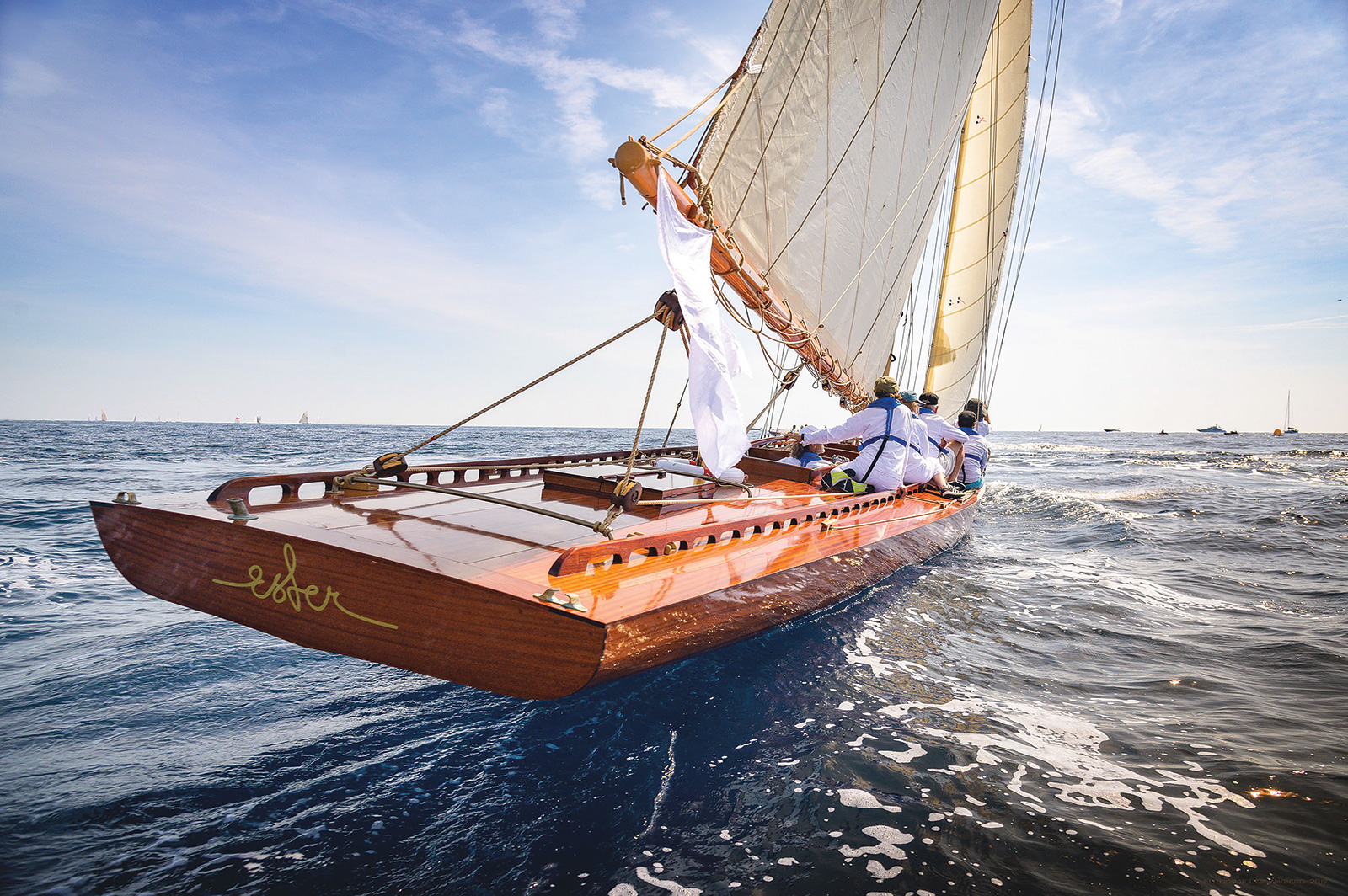
With a waterline length of under 30′ (8.94m) and an overall length of 50′4″ (15.38m), ESTER was designed to take best advantage of the waterline-based yacht-racing measurement rules of her times. Her mahogany handrails, extending from stem to stern, act as inboard bulwarks as much as grabrails, but they also strengthen the extremely lightweight hull.
Classic boats can hook owners with their history. Such a boat is ESTER, a fast Swedish racing sloop from 1901 that dominated Baltic Sea yachting for several years before the First World War. And such an owner is Bo Eriksson, a classic-boat sailor. He and the boat found each other even though she had been at the bottom of the Baltic at a depth of 170′ (52m) for 76 years. After a recovery and restoration effort that was as massive as it was unlikely, she is sailing again today.
Her extreme “racing saucer” hull, 50′4″ LOA with a waterline length of just 29′4″, is from an era when designers such as W. Starling Burgess in the United States and Charles Sibbick in England were pushing the envelope of what could be achieved with the materials available at the time to beat a waterline-based yacht racing measurement rule. Fin keels and rudders were attached to extremely lightweight racing machines that might only last a season or two. Weighing just 3.7 metric tons (8,157 lbs), 1.5 of which (3,307 lbs) were in her lead-bulb ballast keel, ESTER was designed by the Swedish naval architect Gunnar Mellgren to beat Finland in the coveted Tivoli Cup, which she did in the year of her launching. In one subsequent season, she won all 29 races that she entered.
 Gothenburg Royal Sailing Society
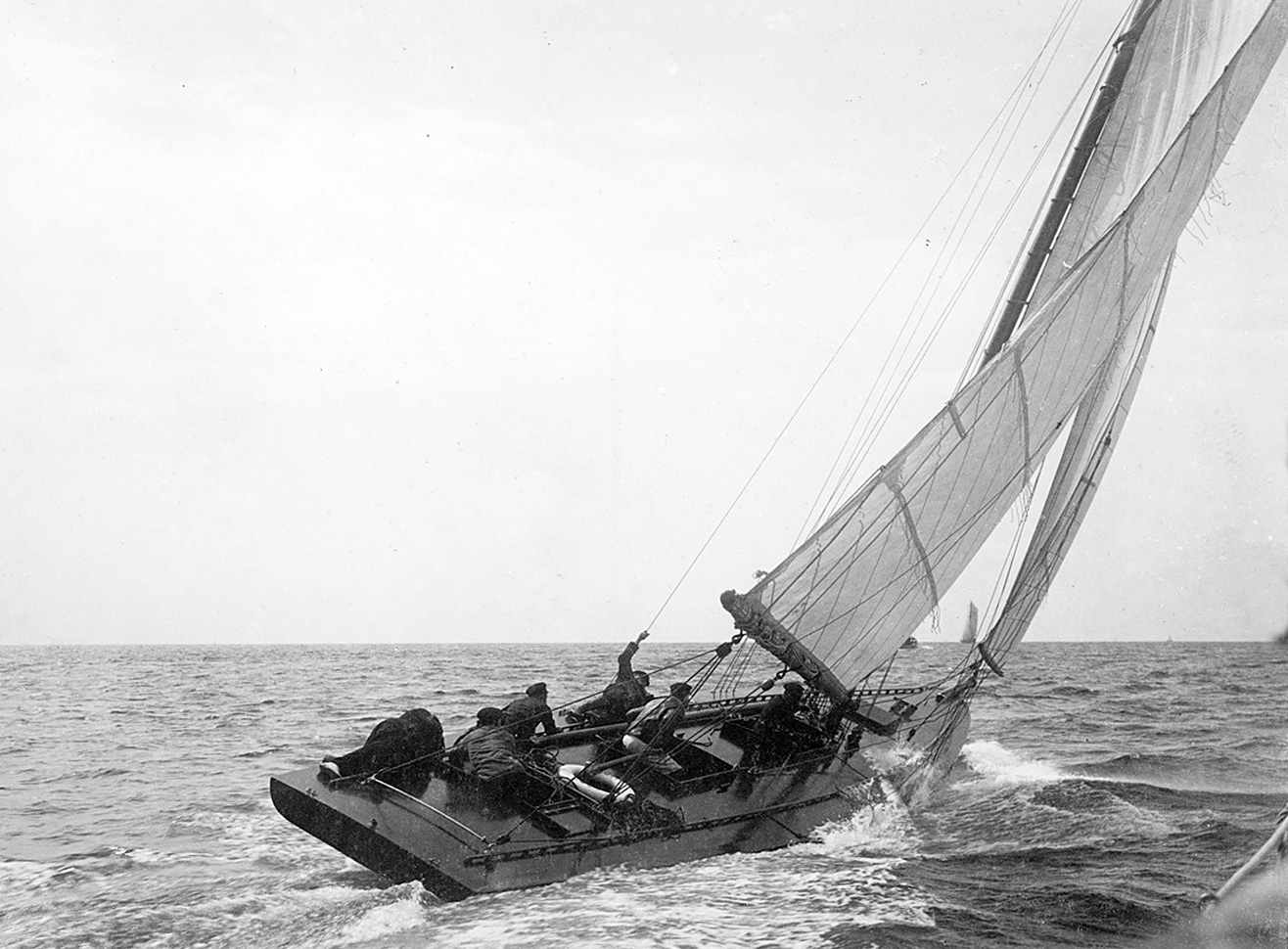
ESTER, launched in 1901, succeeded in her primary goal of defeating Finland for that year’s Tivoli Cup and went on to a remarkable string of victories before rule changes made her obsolete.
Particulars:
- LOA: 50′4″ (15.38m)
- LWL: 29′4″ (8.94m)
- Beam: 10′1″ (3.08m)
- Draft: 6′7″ (2m)
- Displ.: 8,157 lbs (3.7 tons)
- Sail area: 1,080 sq ft (100m2)
- Designer: Gunnar Mellgren
- Builder: August Plym, Liljeholmen, Stockholm
Unlike many pure racers of her day, however, ESTER was built with strength in mind. Her hull was built with the composite construction of her times, with wooden planks over angle-iron frames for the best strength-to-weight ratio attainable. Here lightweight planks were fastened to the steel frames with hollow rivets. Today, such rivets are closely associated with aircraft; however, ESTER was conceived nearly four years before the Wright Brothers’ seminal flight at Kitty Hawk, North Carolina, and the first use of hollow rivets for aircraft construction didn’t come until 1929. Her rudder, built with a wooden core and sheathed with steel plates, diminished in thickness toward its trailing edge, like an airfoil. Her spars were hollow. After she was fully restored following, as closely as possible, the original construction methods, a surveyor remarked that belowdecks she reminded him of the development 60-footer class of the International Monohull Open Class Association.
But in ESTER’s day, rule changes meant that even though she was still fast, she soon ceased to be a winner. In 1933, she was given to the youth section of a sailing club at ÖrnskÖldsvikk, on Sweden’s east coast, halfway up the Gulf of Bothnia in the far north. Just a year later, she was sold to a private owner. Renamed BRITA, she was recorded as winning a race as late as 1937. Shortly after that, however, she sank in a local bay after being damaged by a fire aboard. With time, her story disappeared deep into museum archives just as her hull began to silt over in her Baltic grave.
There she would have stayed, if not for Bo Eriksson and another local wooden- boat sailor, Per Hellgren. In their years of sailing out of ÖrnskÖldsvikk, they may have occasionally, and unknowingly, left wakes directly over the wreck, hidden in her stygian obscurity below.
In 1989, Bo, then 33, bought a book that showed photographs of ESTER and a lines plan. “I was so fascinated by her shape and the design,” Bo said, “and so Per and I made a 1:10 scale model of her. We had some big fantasies about building a replica of her, which we quickly dropped; however, Per carried on researching the story.” About 20 years later, Per found a report of her in the hands of a timber merchant near Gothenburg, and that, in turn, led to their discovery of her donation to the ÖrnskÖldsvikk sailing club. More research locally uncovered the story of her sinking.
 Ester Project
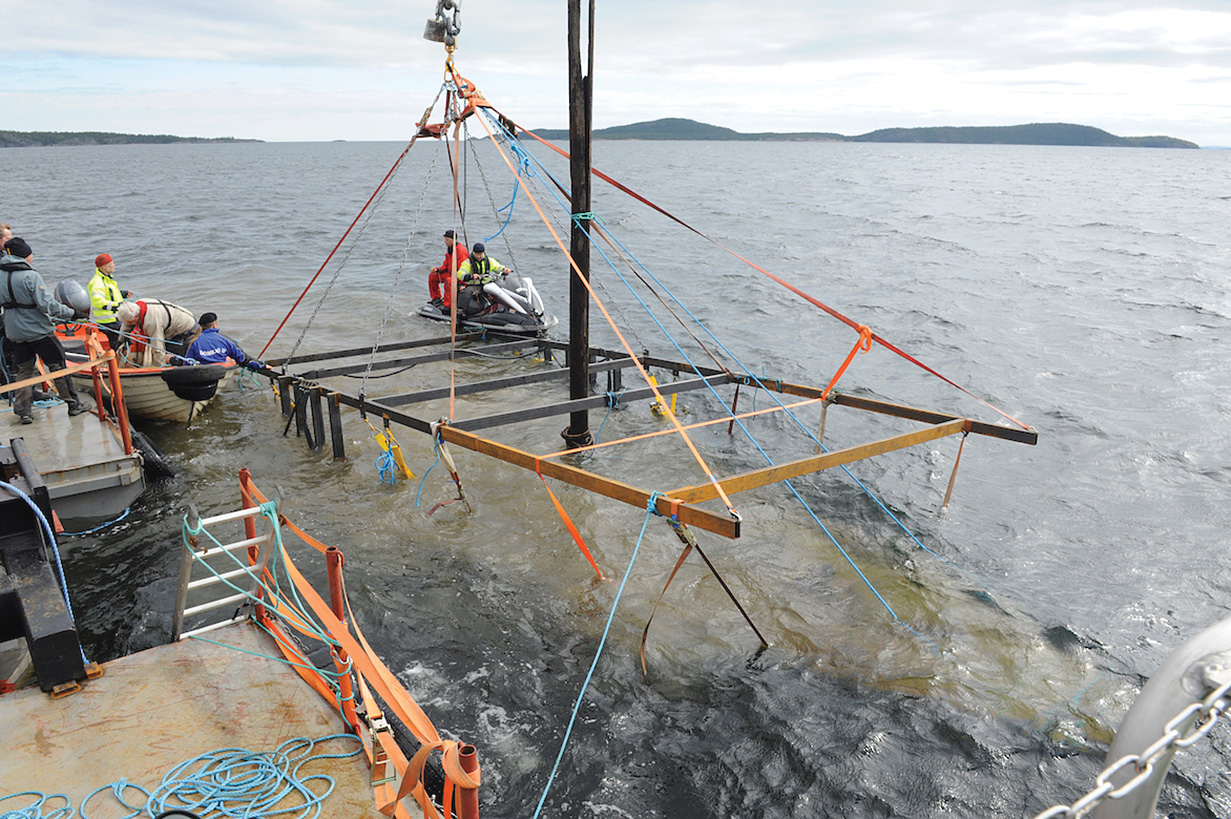
ESTER sank in the Baltic Sea in the late 1930s. In 2012, she was found on the bottom at a depth of 170′ (52m), where she had lain for 76 years. She was raised from the bottom very slowly; on the night of the second day of the operation, she was left suspended 50′ (15m) below the surface, safe from waves, and then on the third day she was brought within a few feet of the surface, as seen in this photograph, for the tow to port.
Per went out with a diver to search for the wreck, but they found nothing. It wasn’t until 2012, when Bo joined him, that they tried afresh, this time with more sophisticated equipment. In only two days of searching, they found ESTER sitting on the seabed in Gullvikfjärden (which means “golden cove”) just a mile (1.6km) offshore. She had sunk on a stretch of water that is within sight of Bo’s house.
“It was absolutely amazing,” Bo said. “And it was not even a discussion about whether we should bring her up. We knew immediately that was what we’d do. We came up with a seven-year plan for salvage and restoration and the idea to launch her onto the classic scene at Monaco Classics in 2019.”
For some of us, the idea of rescuing a boat from a depth that requires divers to use mixed gases to prevent decompression sickness and nitrogen narcosis would induce very negative reactions—let alone the thought of then undertaking a total rebuild of a yacht that has been at the bottom of the sea for almost eight decades. But both Per and Bo are Swedish. Their Baltic Sea coast is known to be littered with shipwrecks well-preserved by the sea’s cold, low-oxygen depths, the most famous one being VASA, a 64-gun warship that sank in Stockholm Harbor less than 1,500 yards into her maiden voyage in 1628. She was raised in 1961 and today is beautifully exhibited in a purpose-built museum in Stockholm, where she is a national cultural touchstone.
VASA must have seared into the minds of many Swedes what possibilities such boat recoveries could hold. And so it was with Bo. Using a remotely operated vehicle to photograph ESTER the day after they found her, they could see that she was largely intact. But there was a lot of silt around her, so the initial stages of work in 2013–14 involved, first, documentation by amateur divers and, second, working out a plan to raise her.
During this time, the divers brought a few objects to the surface, including her 23′ (7m) gaff. Sadly, as it reached the surface one of the jaws broke off and was lost back into the deep.
Even though she was composite-built, her light construction and comparatively narrow, long hull posed risks of breaking up during recovery. A steel frame would be needed to support her evenly in specially sewn lifting straps, and a lot of the silt would need to be removed both inside and outside the hull. A Swedish salvage diving firm, MBT, which had the requisite skill for such a complicated operation, agreed to take it on.
 Ester Project
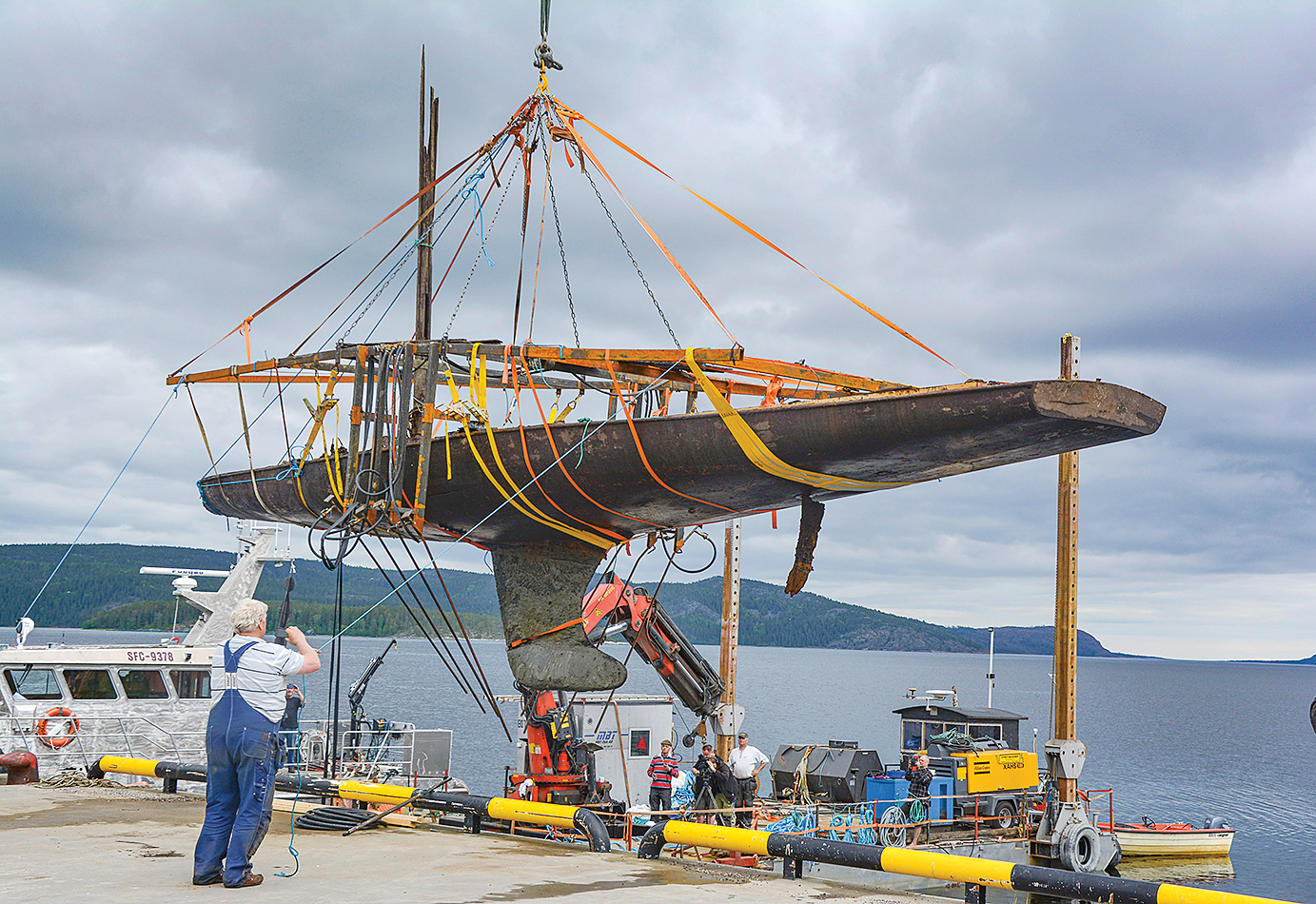
Still suspended in the straps of her steel lifting frame, ESTER finally came ashore, where she spent several months drying before restoration work could begin.
In midsummer 2015, MBT got an unexpected window of time to schedule the work and sprang into action, getting everything in place for the lift. Soon the company’s crew was aboard a crane barge with four two-ton anchors to stabilize it above the wreck. The crane was equipped with a scale to show how much lifting force was being applied. Air compressors and eight air hoses were needed to dislodge the heavy sediment holding the boat in a tight suction-grip. Channels had to be formed to make way to pass the lifting straps under the hull. The depth complicated the work. The divers were only able to work one at a time with a dive length of 40 minutes giving them only 25 minutes of working time on the bottom, in zero visibility, before having to surface slowly to decompress. On the first day, the divers coolly got everything in place, and with the surface of the water bubbling like a cauldron, the crane began to lift. With the scale showing 4 tons of load—an amount roughly equal to ESTER’s weight—she remained stuck fast. It turned out an air hose had come loose, so work was halted. The next day, with more air being shot under the hull, the force on the crane was gradually increased until the gauge was reading 6.5 tons. Bo called a halt to the work to let the pressure do its work. After 15 minutes or so, the gauge fell back to 5 tons, indicating that ESTER had broken free of the seabed. Very slowly, she was lifted to within 50′ (15m) of the surface. With the boat stabilized in this way, the team was able to leave for the day.
On the third day, ESTER was raised until she was just a few feet below the surface, to avoid wave turbulence, and then towed the 10 miles or so southwest into the industrial harbor in KÖpmanholmen. Before she could be lifted out of the water, more preparations had to be completed. First, tons of mud, water, and debris were suctioned out of her. Then, holes in her hull were sealed, and she floated on her own bottom for the first time in more than seven decades. Incredibly, that piece of the gaff jaws, lost the previous year, was found sitting on her deck.
Once out of the water, she was put onto a truck and taken 15 miles to Bo’s boathouse, where two more tons of mud were removed before she could be inspected in detail.
 Ester Project
The original spars were found on the boat, and the mast was still standing. Early in the sea-floor recovery, one jaw broke off the gaff when it was brought to the surface; thought to have been lost, it was found much later lying on ESTER’s deck.
In autumn 2015, with the boat drying out, the restoration planning got under way, and by late 2015, Theo Rye, an English naval architect specializing in restoration, came to stay with Bo to help the team work up a plan for how to proceed. ESTER was just one of many boats that benefited from Theo’s historical technical knowledge. I remember talking to him at the time and hearing his take on how rare it was to see a boat such as ESTER and be able to examine her construction. He had never seen one like her before. People had talked about fin-keeled boats with lead ballast bulbs that were developed in the late Victorian era, but no one had seen one of ESTER’s proportions. Mellgren’s design approach was all the more radical and innovative when you consider that it predated the aircraft industry: his airfoil-shaped rudder had no airplane wing as a reference, just as his use of hollow rivets had no aircraft industry precedent to follow.
Theo also noted that ESTER’s hull did not exactly match her lines plan; subtle differences in form seem to have been introduced during construction. He urged Bo not to rely excessively on the lines plan but to look instead to the boat itself to inform the restoration. The boat had hogged and its port side had been damaged, possibly during the lift. The team compensated by measuring the starboard side and making outboard molds for the port side to re-establish its correct shape.
The work began full-time in January 2016, with Bo being joined by an Eritrean boat refugee, Mebrathom Asafa. At the same time, Per left the project. “After a few months he said was not up for the restoration,” Bo says. “That was not my wish, but it was okay—the restoration amounted to 25,000 man-hours in the end.” That same year, in November, Theo died of a brain tumor; Julianne Hempel from Germany took over the naval architect’s role.
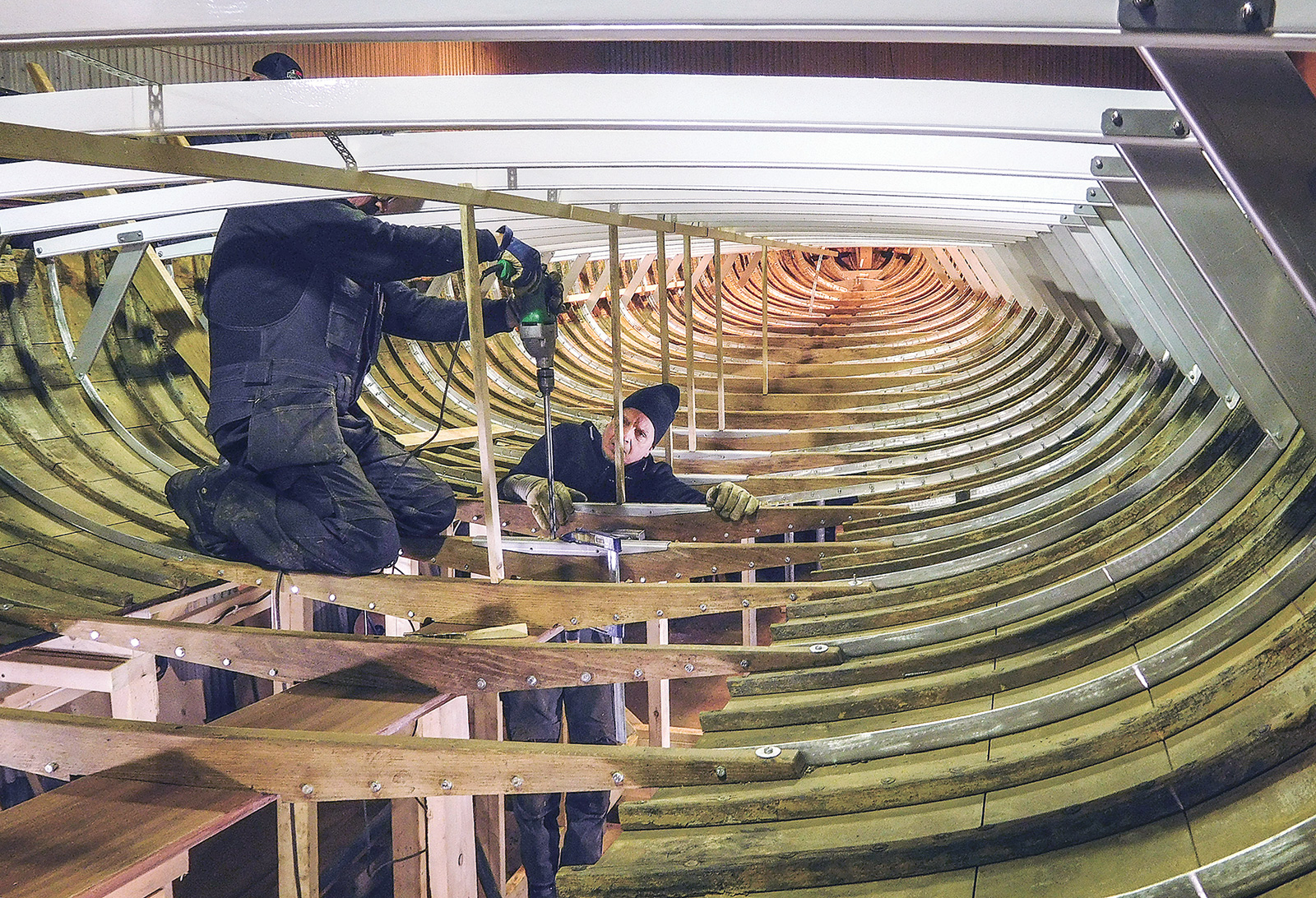
New oak floor timbers were fitted over the keel, and ESTER was reframed using steel angle-iron frames, as original. These frames were radical in their day. ESTER’s sectional shape is not unlike what is known as a champagne saucer glass—a broad, shallow vessel with a narrow and long stem, akin to a fin keel. Angle iron cannot readily be bent, so it was a challenge to get all 30 pairs of frames close-fitting over the boat’s curves. Bo went to local industry rather than the boatbuilding community to find a solution. In the end, steel frames using sheet metal folded into an angle-iron profile were used. Once they were done, the team looked at the frames and decided to remove them and reshape them on a bench beside the boat. They did this even another time before fitting her new 50′ (15m) mahogany strakes.
With work beginning in earnest, the team grew to include Giles Gilbert from Cornwall, England, as well as another boat refugee from Eritrea: Johannes Araja.
The work went on. “It was a case of defining problems and coming up with solutions eight hours a day, 40 hours a week,” Bo says, “and we discussed what we were going to do ahead of time. So, for instance, for the frames we began discussing that with the metal guy six months beforehand. It takes time, but it meant that by sorting out the problems early it made the actual work easier, and it was cheaper in the long run.”
 Gunnar Mellgren
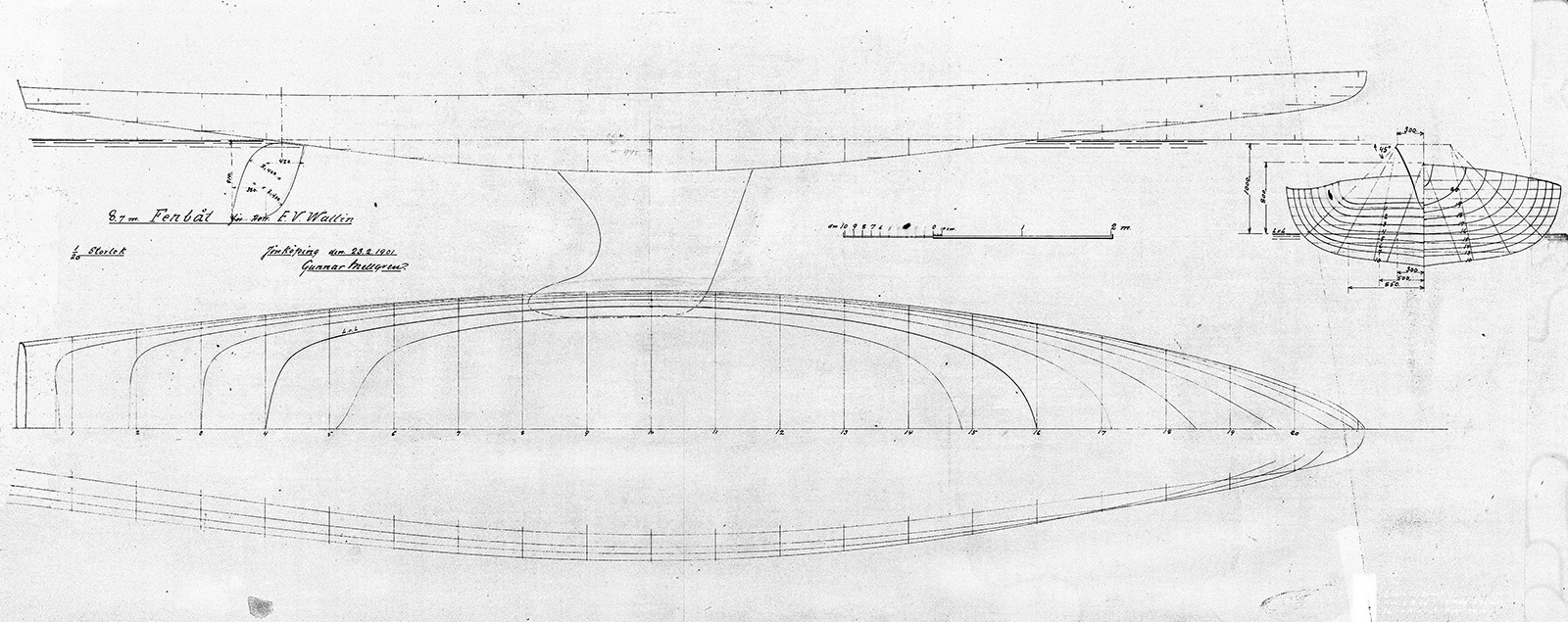
ESTER was designed by Gunnar Mellgren in Sweden and built in 1901 by August Plym’s boatyard in Liljeholmen, Stockholm, using an oak backbone structure and sipo planking over frames of both steel and steam-bent oak. Few of Mellgren’s plans survive, and changes in the hull shape were evidently made during ESTER’s construction—for one example, her hull as recovered proved to be 1′2″ longer than shown in the only lines plan, a blueprint, that survived. The restoration project relied more on the analysis of the boat as found than on Mellgren’s plans.
ESTER was built with just seven hull planks per side, and some of them were almost 36″ (90cm) wide; in the Scandinavian tradition, the boat had tight-seam planking, relying on the expansion of wood fibers rather than cotton caulking to be watertight. For fastening the new sipo planks to the steel frames, the restorers used hollow aircraft rivets from a local supplier. “We went to a company dealing with oil rigs and they helped us design the hollow rivets,” Bo explains. “When we were happy, we ordered 5,000 of them, and I would say only five cracked during the fitout.” These rivets were set in the same way as regular ones, in holes drilled to receive them and then peened on the inside while the head on the outside was supported by a bucking iron.
ESTER was strengthened with intermediate frames of oak, 120 of them steam-bent and fitted into the boat 12 at a time. That work was all done in one day. Bo had broken his hip in a fall in 2017, but he returned to work quickly for the framing project: “They put a titanium nail in it, and I had to take two days off work,” he says. “But I found the rubber feet of the crutches were very useful when we were holding those steamed oak frames down on the hull to shape them.” The next day, these frames were removed, trimmed, and treated before being fitted to the planks and fastened using 6,000 copper nails and roves.
 Gunnar Mellgren
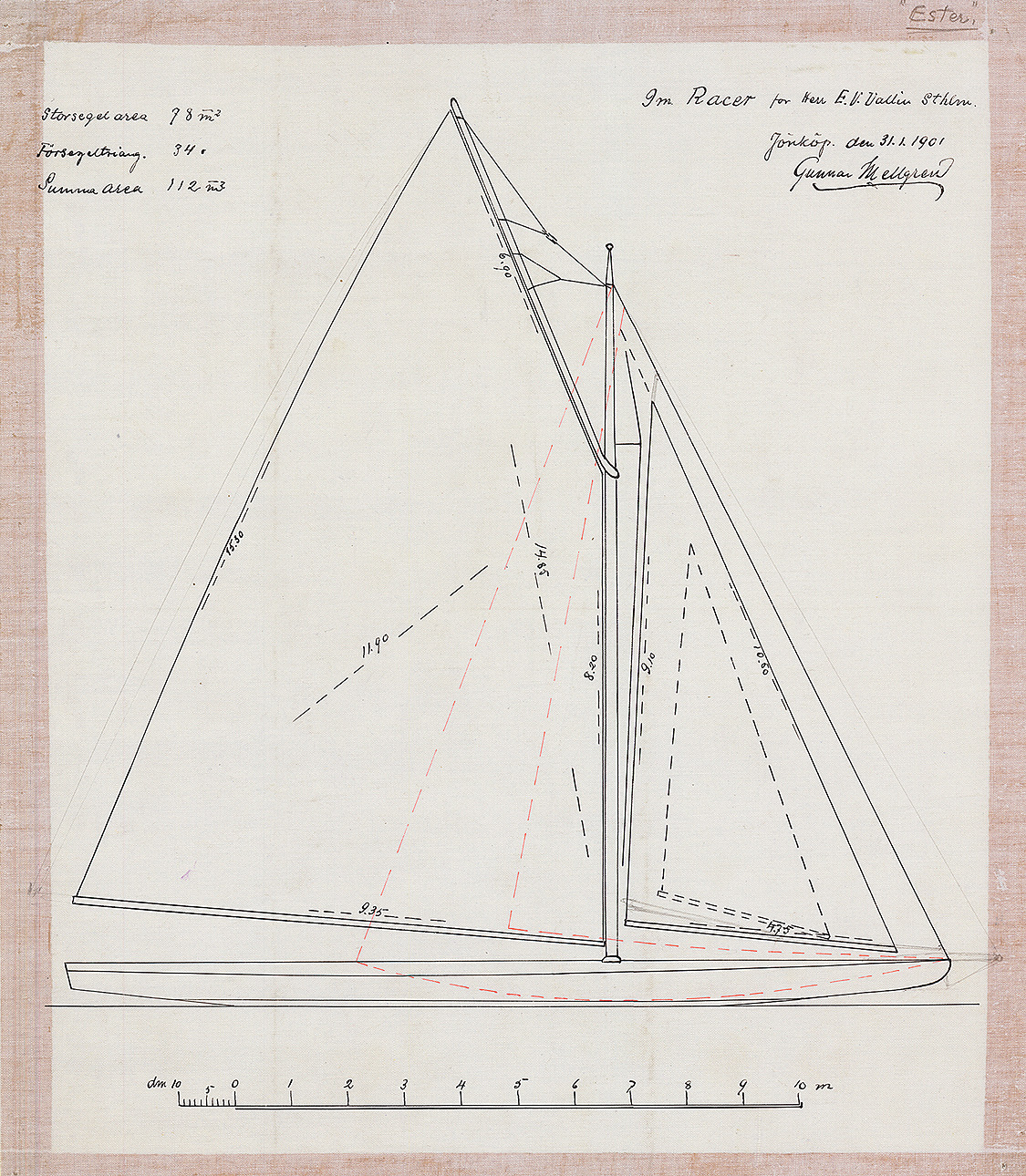
Mellgren’s primary sail plan shows ESTER’s headsail possibilities, including a removable short bowsprit and bobstay (faintly visible), which were sometimes seen in early photographs. Note the very low clearance, with barely any headroom, under the main boom.
Bo describes Mellgren’s radical design of ESTER as requiring the team to solve a constant bombardment of problems, but he is proud of how the work progressed. “In those 25,000 hours we never had a hard word spoken,” he says. “Everybody in this project communicated easily, so as a team we got better at finding solutions to the problems.”
The deck reconstruction proved to be as challenging as the hull’s. With just six deck planks, including covering boards, across her 10′1″ (3.08m) beam, some of them were about 19″ (480mm) wide. Bo says that wide planks are stronger than narrow ones, and this is how she was built; however, they are so thin—only ¹⁹⁄₃₂″ (15mm)—that without adequate support they would crack as soon as anyone walked on them.
 Ester Project
Fresh wooden floor timbers are installed to connect new angle-iron steel frames across the new timber keel. Only after this work was done could the wooden frames and planking be replaced. Note the steel plates that connect to the deck structure.
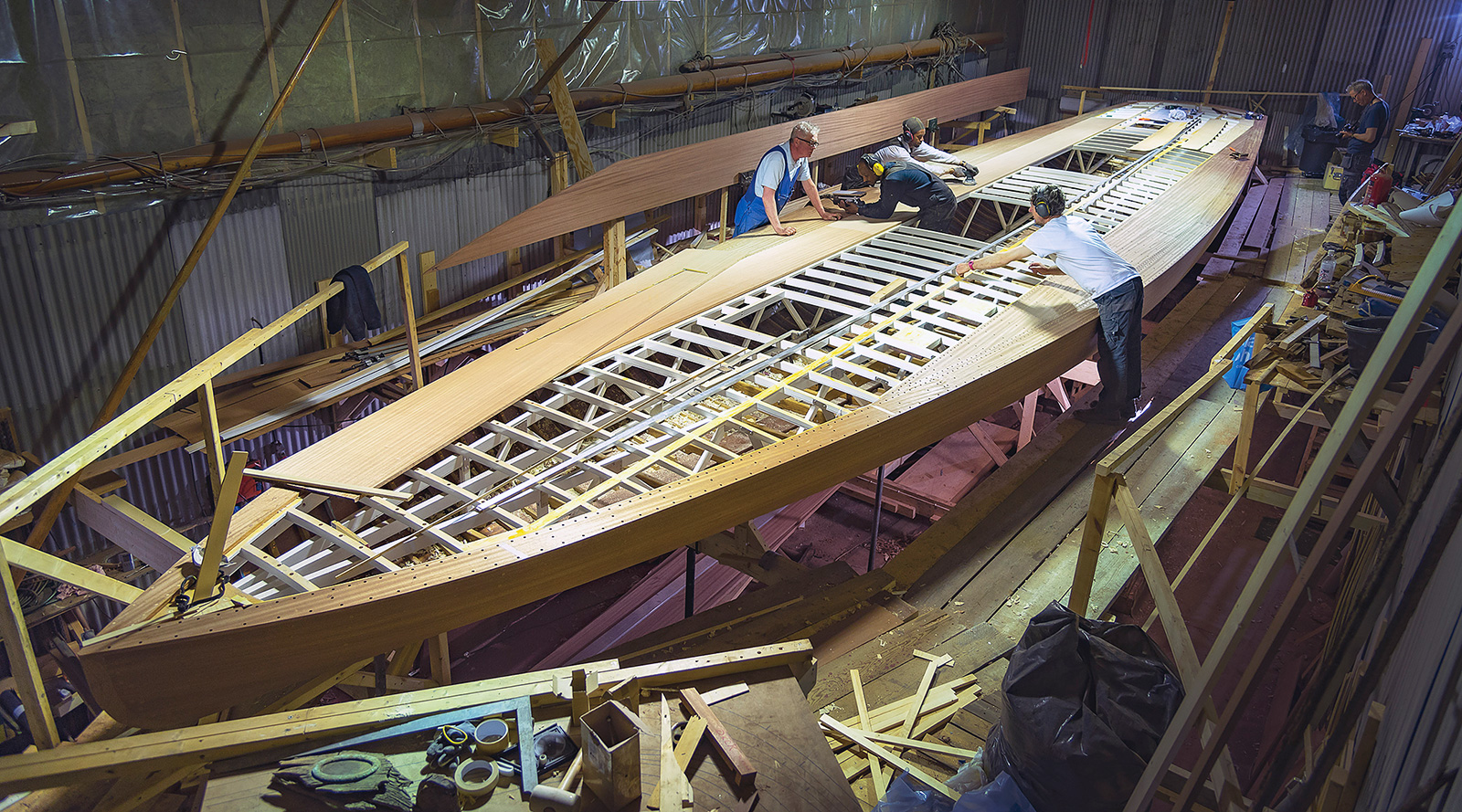
Work on the deck started with fitting 30 new, close-grained pine deckbeams, 1⅛″ × 1¹⁵⁄₁₆″ (28mm × 48mm) and tapered at both ends, that were sawn to shape rather than steam-bent. These were attached to the 30 new steel frames as they were installed. After the hull was finished, 30 more intermediate deckbeams were fitted. The final deckbeam spacing was 10″ (254mm) on center. Mellgren’s construction scheme added more support: longitudinal pine stringers 2⅜″ wide by ½″ thick (60mm × 12mm) were notched into the tops of the deckbeams for the length of the deck under each plank seam for extra support. This technique was matched in the reconstruction, and each stainless-steel screw fastening the plank adjacent to its seam passed through the plank and batten and into the beam, making a deck that is lightweight but superbly stiff. In all, 6,000 screws fastened the deck planks in place, and the recessed holes for them were bunged. “The other thing we did was to put a piece of cotton caulking along a groove in the edge of each plank, like the Fife boats have. And this helps to keep the deck waterproof,” Bo says. The groove was rolled in with a wheel to compress rather than cut the wood fibers.
 Leif Wikberg
ESTER’s planks are fastened to her frames with hollow “aircraft” rivets, which were specially made for the project. Here, a dolly is used to clench the rivets as they are hammered in from above.
No glue was used in the deck installation. “We used ship tar mixed with linseed oil on the areas under the deck where the planks landed on the beams and battens,” Bo says. “It’s the best thing, because it never gets hard and it does not affect the wood. We did not dare glue the deck with its solid mahogany wide planks, because it would crack. You can actually see the deck working when the weather is very dry or if there is a lot of moisture in the air, and this is the perfect solution. The deck is very strong; you can jump up and down on it, no problem.”
The deck has another unusual feature: large mahogany grabrails running from stem to stern about 16″ (400mm) inboard of the gunwales and about 3″ (80mm) high. Each one is fastened, using 60 bolts, through the deckbeams and into steel plates that connect to the steel frames. The connected grabrail, deck, batten, and deckbeam create a structure over 7″ (187mm) thick, which is where the running backstay, sheet blocks, and cleats are sited. The connection of these deck structures to the hull makes the boat extremely stiff and strong.
 Leif Wikberg
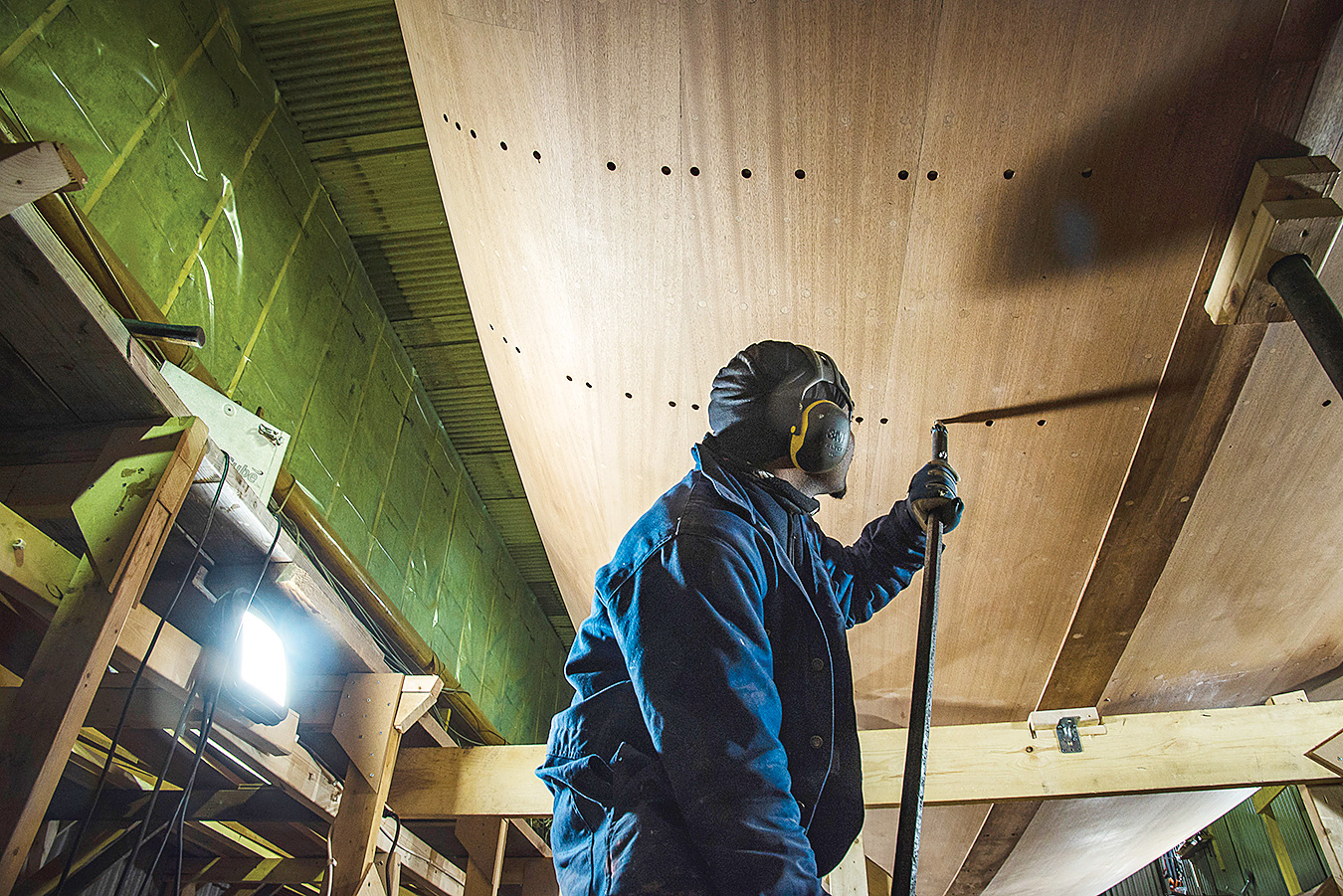
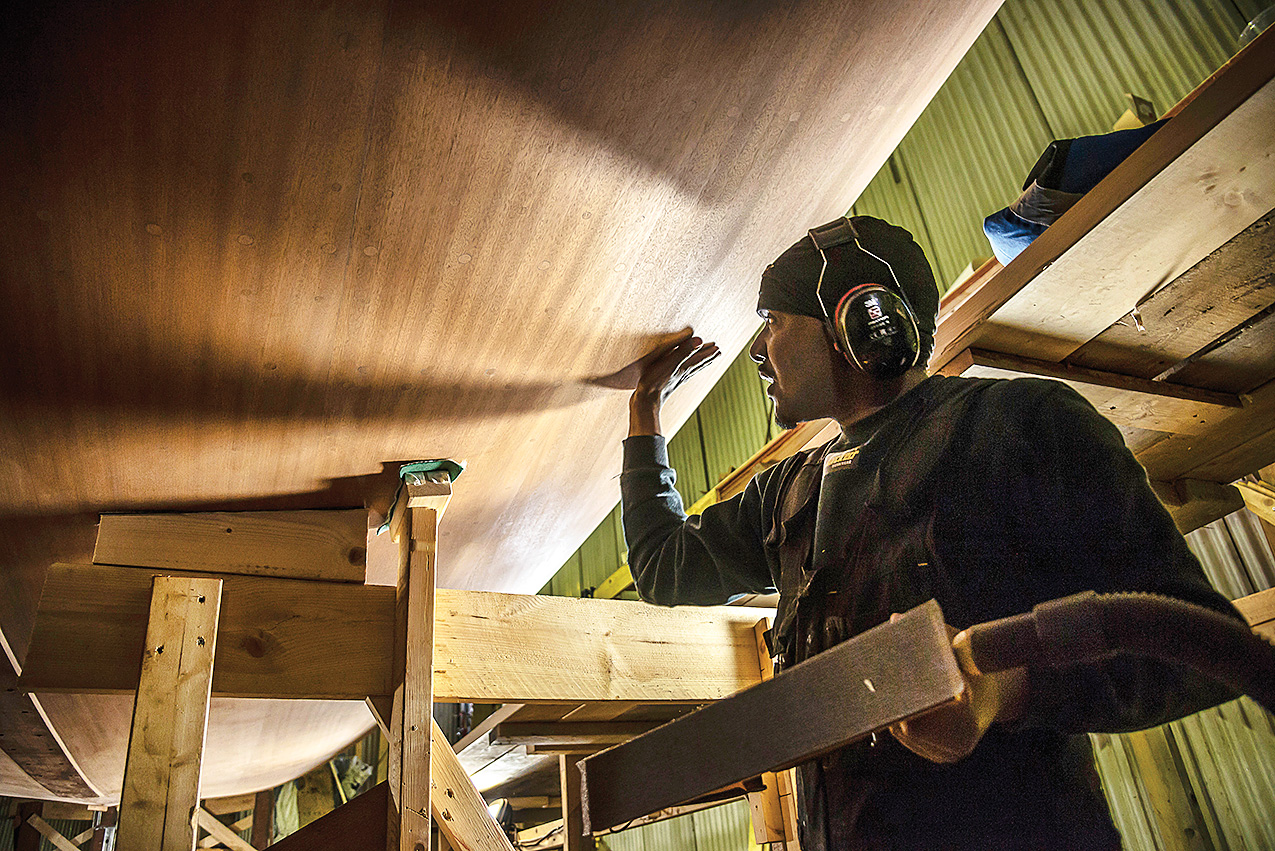
Mebrathom Asafa spent 1,500 hours drilling bung holes, planing bungs, and longboarding ESTER’s hull to its final perfection.
When the boat was raised, her original belowdecks shroud turnbuckles were missing. To recreate them, Bo had to develop his own design. There are four shrouds each side, the forward pair of which are parallel with the mast. “The available turnbuckles were too long to fit under the deck, so we had to custom-design and make our own,” connecting them to the chainplates, which in turn are anchored to the keel. In addition, two of the chainplates connect across the keel to form a kind of ring frame in way of the mast.
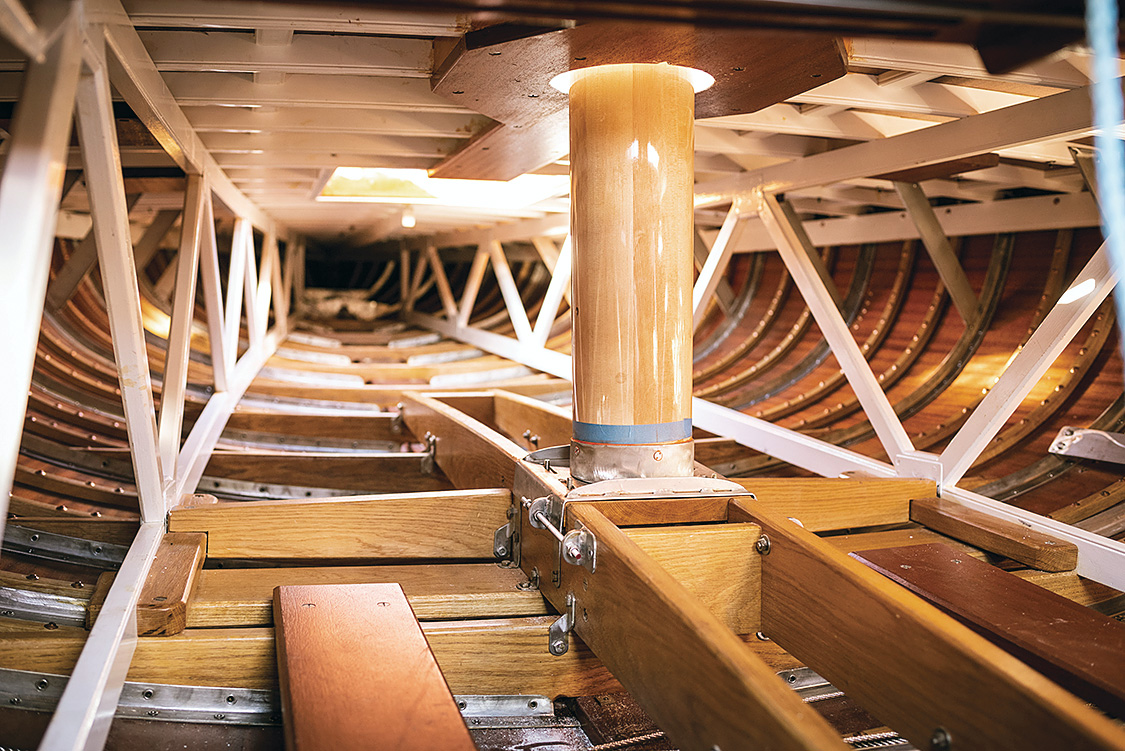
Belowdecks, trusses made of pine stiffen the hull. ESTER has one such truss on each side of the mast, extending from the floor timbers to the deck structure and running almost the whole length of the boat to effectively support the stresses of the rig.
Everything in the restoration, as in the original, was done with weight-saving in mind. So the running backstays travel along a steel T-track, but the upright of the “T” is made of oak, which is slightly lighter than steel would have been. The rigging pinrail on deck at the foot of the mast is made of oak, with oak belaying pins covered in bronze tube to reinforce them in the same rationale of gaining strength but saving weight.
ESTER’s Sitka-spruce mast and gaff are hollow and made of eight staves in the case of the mast and six in that of the gaff, glued with melamine urea formaldehyde. The mast is elliptical in cross-section, with the sides pieces ⁹⁄₃₂″ (7mm) thinner than the forward and after ones; it weighs just 160 lbs (73kg). The boom, also hollow, is of Douglas-fir to give it just a little more weight than a spruce boom would have had.
 Leif Wikberg
Bo Eriksson (at left) and the team are seen here fitting ESTER’s broad deck planks across the lattice of her 60 deckbeams. The planks are just 15mm thick (¹⁹⁄₃₂″), but their support gives them strength: “You can jump up and down on this deck, no problem,” Bo says.
Bo calls the rig a masterpiece. All of the running rigging is of sheathed Dyneema and weighs just 30 lbs (13.5 kg) in total. The halyards are composed of spliced sections with three different diameters, ranging from ¼″ (6mm) to ½″ (12mm). “It all adds up to keeping the boat as light as possible,” he says.
 Leif Wikberg
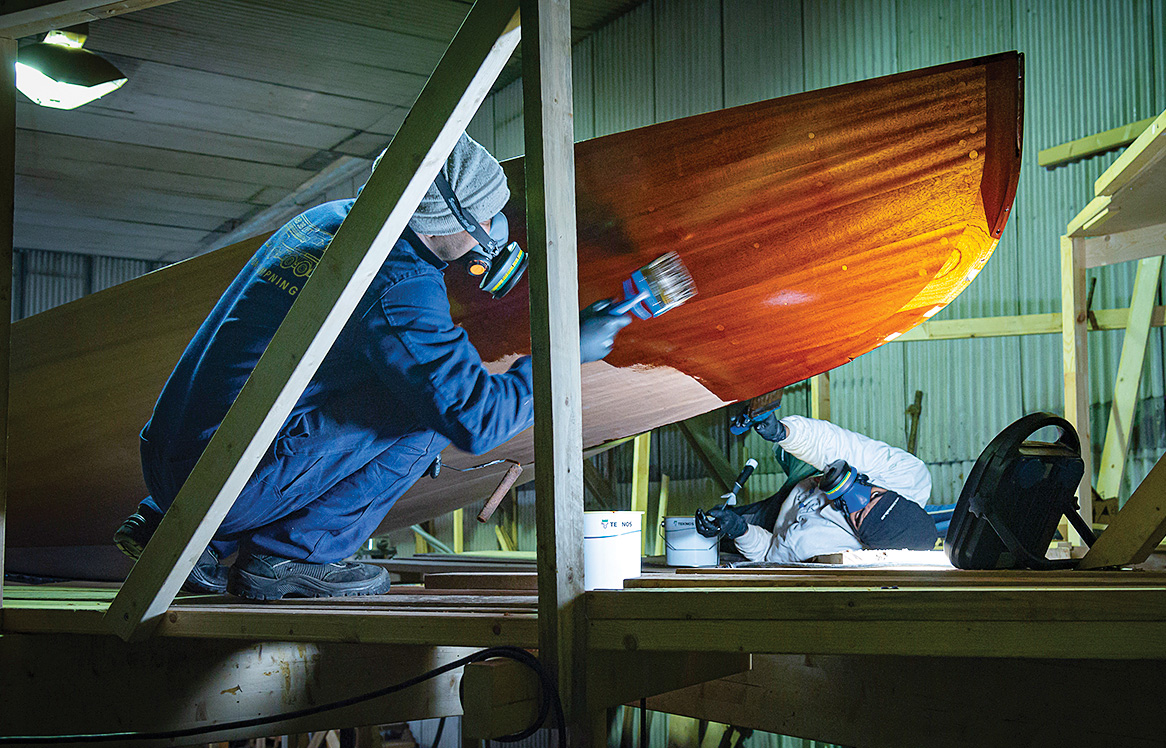
The first coat of varnish reveals and highlights the figure of the sipo’s grain with a deeply satisfying amber luster, which only improved with a few more coats.
ESTER, completed with bright-finished topsides, was run through a limited series of sea trials in Sweden, and then it was time to take her south. She was launched at Hyères, just east of Toulon in southern France, where she also found a permanent berth. Soon afterward she took part in the classic regattas at Monaco, Cannes, and St-Tropez. “Our best sail was the first race in St-Tropez,” Bo says, “where we had the famous skipper Fabrice Payen on board as tactician, and we won easily. We got a good start, and the conditions were perfect, with some breeze; we are undercanvased in light winds. And we found the potential in the boat. One of the hot-shots there told us we were like a Formula 1, but just in first gear.”
 Leif Wikberg
This photograph, looking forward over the maststep, shows the intricate array of steel and woodwork that makes ESTER light and strong, including the port and starboard trusses that stiffen the hull.
So what is she like to sail? “I thought she would be more crazy, but she’s actually very stable, and she has a friendly feel,” Bo says. “The design of the rudder makes her extremely handy and maneuverable; she feels more like a dinghy than a normal gaffer. She also responds to the wind instantly. She has 1,080 sq ft (100m2) of sail area, so a puff makes her go off like a bang, but also when the wind drops you need seatbelts on because she just drops dead.
“You only need two to handle her, but for racing you would sail with seven to eight people; for trimming, we have two for the main, two for the backstays, and two for the jib and reacher. We have no winches, and we just have a jigger for the jibsheet. As for the mainsheet, you just sit there and haul it in by hand. And we don’t carry barber haulers or anything like that because we don’t need them.
 James Robinson Taylor
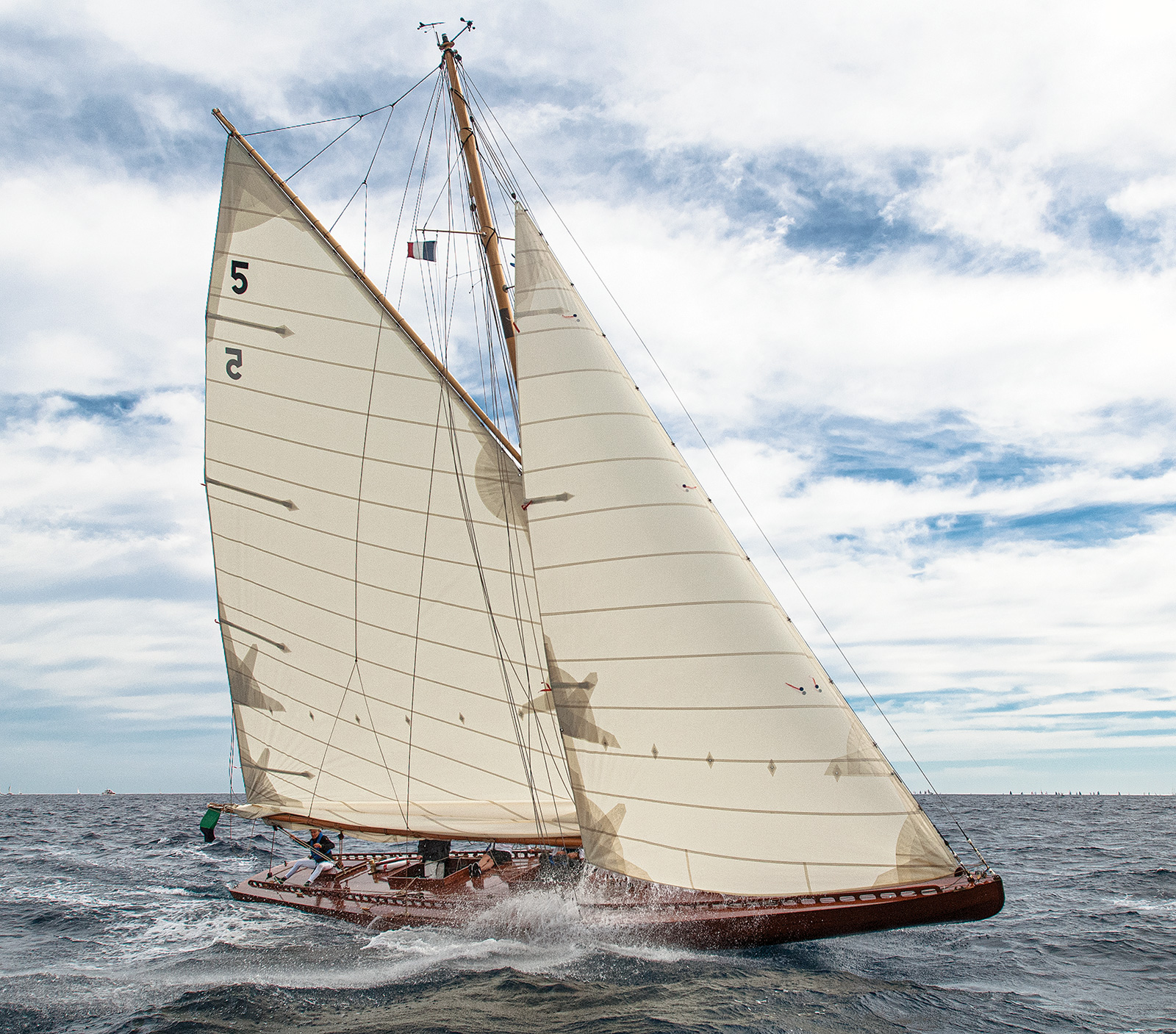
Under a reefed mainsail, ESTER stomps along, shouldering a moderate sea. Bo says she made 13.5 knots in these conditions, and he believes she could easily reach 20 knots. She is a unique survivor of her type.
“She can definitely make 20 knots under sail,” Bo contends. “We sailed her in a fresh offshore breeze with two reefs in the main and one in the jib, and her bow lifted up; there was spray coming up either side of the stern and we made 13.5 knots of boat speed. If we had taken out the reef from the jib and one from the main, we could easily have reached 20 knots.”
ESTER’s crew reports that the faithfulness to the original traditions of sailing her can be a bruising experience. “There is only 1′8″ (50cm) between the boom and the deck,” Bo says. “You have to be aware of it at all times. But it’s easy to sail this boat. As for bruises, we are not allowed to complain.”
Bo says nothing has survived of boats that were built like ESTER; her sinking made her a survivor of a rare species. “They were mostly monsters, and they didn’t last long,” Bo says. When I mention BONA FIDE, the 1899 Charles Sibbick 45′ (13.7m) gaff cutter (see WB No. 180), Bo almost scoffs. “I can’t find the word to say how basic she is in comparison,” he says.
When the Covid-19 pandemic arrived, it scuppered ESTER’s second season. “The boat would have suffered in the heat of the south,” Bo says, “so in April 2020 we brought her back to Sweden. It needed to be done. We sailed her locally in 2021, but I no longer have the time to look after and campaign ESTER.” She’s for sale, and she is the subject of a recently published book, ESTER—Searching a Dream Under the Sea.
ESTER was certainly built to a rule, but she is not just a rule boat; she is radical, strong, and fast in her own right. To see her return is like finding an evolutionary missing link. 
Dan Houston is a lifelong British sailor who restored NEREIS, a 30′, 1936 teak sloop. He is a newspaper and magazine journalist specializing in classic sailboats and traditional seamanship.
For more information about ESTER, visit www.ester1901.se.