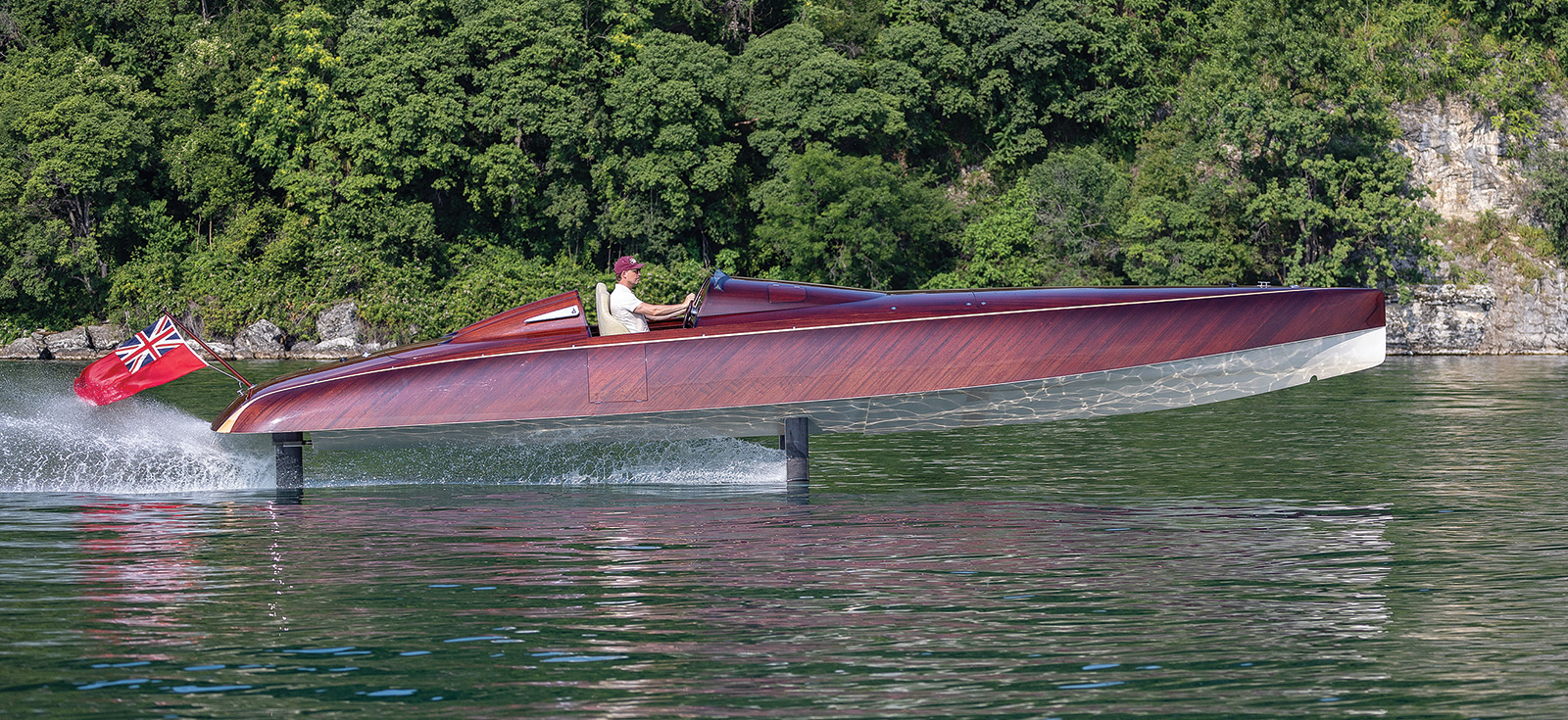
The Spirit 35(F), an electric foiler recently launched.Carlo Borlenghi/Spirit Yachts

The Spirit 35(F), an electric foiler recently launched by the English boatbuilders Spirit Yachts, is taken through its paces on Lake Maggiore in Italy. Thanks to state-of-the-art foiling technology developed for the AMERICA’s Cup, the boat is capable of up to 32 knots and has a range of 100 miles at 20 knots. Her owner wanted her as a tender to his two Spirit sailing yachts, one 52′ and the other 111′ long.

Cowes, England, might like to think of itself as the birthplace of yachting, but nowadays most of the boats filling its marinas are of the modern, plastic variety. For one week every year, however, the marina Cowes Yacht Haven (CYH) is transformed into a mecca of wooden boats. The occasion is Cowes Classics Week in July, during which the CYH docks are lined with venerable old craft as well as a fair few new-builds. The 2023 highlights included the 58′ Laurent Giles yawl LUTINE OF HELFORD and the William Fife 12-Meter MIQUETTE, both looking spectacular after their recent rebuilds. There was the usual fleet of Spirit Yachts modern classics, along with a 26′ Stella (a Folkboat derivative), a 1967 One-Ton Cup racer, and a handful of vintage motoryachts.

But the yacht that really stood out at this year’s event wasn’t old, wasn’t a sailboat, and wasn’t even racing. It was a 35′ speedboat with a long, pointy bow and sloping reverse stern reminiscent of an English slipper launch. The whole boat was varnished above the load waterline, with an inlaid stripe of pale wood between its curvaceous foredeck and its equally curvaceous hull. The cockpit was luxuriously fitted out with cream-colored upholstery, varnished trim, and retro-looking analog instruments. Moored alongside the float, it looked like the essence of 1920s style, and it was a pleasure just to look at those carefree curves and the fine craftsmanship that made them possible.

But it was when the boat left the dock that her secret was revealed. For a start, there was no deafening roar or clouds of smoke as the crew fired up its engine; just the quiet whir of an electric motor as the boat was maneuvered out of the marina. Once out on the Medina River, the boat gathered speed, rose 3′ in the air, and sped off across The Solent with minimum noise or wash. For this was no pastiche of a boat from another era. This was the latest innovation from two of the most dynamic companies in the British boating industry: Spirit Yachts, creators of lightweight “modern classics,” and BAR Technologies, foiling specialists with roots in Britain’s most recent AMERICA’s Cup campaign.

The design was inspired by 1920s racing powerboats.Carlo Borlenghi/Spirit Yachts

The design was inspired by 1920s racing powerboats such as the legendary BABY BOOTLEGGER—a classic aesthetic married to a thoroughly modern underwater shape. The cockpit can be converted from the two-person racing mode to an open layout for cruising.

For the past two years, the companies have been tasked with creating a craft with state-of-the-art performance and classic styling. The result is the SpiritBARTech35EF (or the Spirit 35(F) for short), a high-performance foiler capable of 32 knots under electric power; it will cruise at 20 knots for 100 miles on a single charge. It’s a boat that is quite literally head and shoulders above its rivals.

The Spirit 35(F) represents a quantum leap forward for electric boats. For years, electric launches have struggled to offer more than 50 miles at 5 or 6 knots. Technology has improved, but you still have to choose between speed and range. Few boats offer both. For example, the Optima e10 achieves the best range, an impressive 200 miles, but at 6 knots. The nearest equivalent to the Spirit 35(F) is the all-carbon-fiber Candela C8 foiler, which blasts along at 24 knots, but for a mere 51 miles. The only other electric wooden speedster I came across currently being built was the Riva-style Boesch 750, which has a range of just 14 miles at 20 knots. Needless to say, I didn’t find any other wooden electric foilers.

Given its huge advantage over rival electric boats, it didn’t take long for the Spirit 35(F) to make an impression. A few days before Cowes Classics Week, it set a new Round-the-Island record for an electric boat, circumnavigating the Isle of Wight in 1 hour 56 minutes. That’s four hours faster than the previous record-holder, David Kendall and his Optima e10, the first electric boat to complete the 51-mile course.

For years, the narrative has been that electric boats are only suitable for short hops because the weight of batteries needed for traveling a considerable distance made them inefficient. Now, at last, that equation seems to be shifting, and foiling technology—once the preserve of top racing teams—might provide one of the solutions.

The idea for the Spirit 35(F) came from one of the company’s most loyal customers: the man who loved his Spirit 52 sailing yacht so much that he commissioned an even bigger one: the 111′ GEIST, the biggest boat built by the yard to date. (Only the smaller boat, HAPPY FOREVER, was at this year’s Cowes Classics Week, and duly won its class against six other Spirit yachts.)

The owner wanted a chase boat that was in keeping with the retro style of his sailing boats, was electric-powered (like his 111-footer), and yet would provide a fun, fast ride for all the family. It was a challenge that Spirit founder Sean McMillan took on with enthusiasm. After all, this is the man who has made a career out of designing ultra-lightweight sailing boats with low freeboard and long overhangs that give them a classic look above the water while clocking up remarkable turns of speed. It was just a matter of applying this “visual joke” to a motor launch.

The retro dashboard (left) and hinged lids in the foredeck open to allow the foils to lift up (right).Carlo Borlenghi/Spirit Yachts (left), Nic Compton (right)

Left—The retro dashboard hides a mass of technology, including multiple chargers. Right—Two hinged lids in the foredeck open to allow the foils to lift up when the boat is maneuvering in shallow water.

“The inspiration for the design was BABY BOOTLEGGER, the 1920s American Gold Cup winner, which the owner owns a replica of,” says Sean. “I’ve always loved that boat, so it was an obvious starting point.”

The original BABY BOOTLEGGER (see WB No. 60) was a 30′ speedboat designed by George Crouch and built by Henry Nevins in New York in 1924. Fitted with a 220-hp gas engine, it was capable of speeds up to 45 knots and won the ABPA Gold Cup in 1924 and 1925. Sean’s design echoes BABY BOOTLEGGER’s memorable curves (and acres of varnish), but has a square stern, rather than the original boat’s canoe stern, which makes her more suitable for foiling.

Wood might not seem the obvious material from which to build a lightweight hull, but Spirit Yachts is adept at doing just that. As Sean put it: “It was a slightly more extreme version of what we do on a daily basis.” Indeed, the yard used much the same approach as it does on all its boats, starting with a layer of 12mm (about ½″) Douglas-fir planking. The hull sides and deck were then stiffened with “judicious” use of carbon fiber before being covered in a 6mm (about ¼″) layer of sipo veneers and then varnished to great effect. The bottom of the boat, which would be subject to the most pounding, was strengthened with a layer of hemp fabric set in epoxy on the outside; the inside bottom is similarly sheathed in carbon fiber.

“The carbon fiber is there mainly just to stiffen the timber,” Sean says. “We find that if we take the timber scantlings down to where they’re absolutely strong enough, they then get a little too flexible, so we sandwich them with a little bit of carbon to stiffen everything.” The finished bare hull, without any of the propulsion system or fit-out, weighed just 595kg (1,312 lbs).

In displacement mode, the foiler looks like a rather elegant launch.Nic Compton

In displacement mode, the foiler looks like a rather elegant launch. With foils down, she maneuvers like a yacht thanks to her large rudder. With the foils up, she handles more like a rigid-hull inflatable and requires engine thrust to turn.

While Spirit Yachts had plenty of expertise in building beautiful lightweight hulls, they weren’t so well qualified in the mechanics of how to make a boat fly. For that, they teamed up with BAR Technologies, the company created by Ben Ainslie for his AMERICA’s Cup bid in 2017 (BAR is an acronym for Ben Ainslie Racing). Thanks to this alchemy, the project benefited instantly from years of research and development, which gave it a huge head start. And there’s little doubt that foiling was key to the project’s success.

“Foiling inherently reduces your engine requirements massively,” says Simon Schofield, chief technology officer at BAR Technologies. “Once the boat is up and flying, the engine requirement is about 85 percent less than a similar boat going at the same speed without foils. And getting there is not as hard as you might think. We use about the same energy at take-off as we do at 30 knots foiling.”

Simon Schofield, joint founder of BAR Technologies.Nic Compton

Simon Schofield, joint founder of BAR Technologies, takes the wheel as the foiler heads out of Cowes. Simon has 20 years of experience working on AMERICA’s Cup and Volvo Ocean Race campaigns.

Unlike a planing hull, which requires a large amount of energy to get it on the plane in the first place, it doesn’t take much effort to get a foiler to fly, providing the hull is at the correct angle of attack, which is a phrase that comes up often in discussions of foilers. The other key factor is weight—especially on an electric boat.

“Batteries have very limited power, so the challenge is getting range,” Simon says. “You can quickly get yourself into a negative spiral where you end up making something less efficient, which means you need more batteries, which means it gets heavier. It’s a compounding problem. You’ve got to get that design spiral going in a positive direction and making things more efficient, which means you get lighter so you can reduce batteries.”

To achieve that positive spiral, BAR designed a stepped underwater hull optimized for foiling. Thus, while the above-water shape designed by Sean might be redolent of another era, the underwater shape is “as modern as you can get,” according to Simon.

To make it fly, the Spirit 35(F) has three retractable foils, all made from titanium. A T-foil rudder aft controls the pitch and yaw while the two forward foils are joined by a fixed bar with trim tabs at either end to control the roll. An ultra-compact 80kW electric motor, made by the pioneering British electrics company Equipmake, is embedded in the bottom of the rudder to maximize drive. That in turn is powered by a custom-made 120kW battery pack.

The whole emphasis is on keeping things compact, light, and ultra-efficient to provide the maximum output for the least weight. The boat’s finished displacement, including cooler and water-ski attachment, comes to 2.4 metric tons (5,291 lbs), which is not bad for a 35-footer. But getting the boat to fly is one thing; controlling it while it’s up is the really tricky bit.

“A boat that’s foiling is inherently unstable. It’s like an upside-down pendulum,” says Simon. “It’s like balancing a broom on your finger and you have to keep moving your hand to keep the broom up. That’s effectively what we have to do the whole time to make the boat fly. It doesn’t want to fly; it wants to fall over because the center of gravity is all the way up in the air.”

To stop the boat from falling over, BAR has developed a flight-control system—its so-called Foil Optimization and Stability System (FOSS)—that can read the sea state and adjust the foils accordingly. This isn’t allowed in the AMERICA’s Cup, where the foils must be controlled by the crew; however, the technology was originally developed for the British AMERICA’s Cup campaign for simulation and testing purposes.

The retro dashboard (left) and hinged lids in the foredeck open to allow the foils to lift up (right).Carlo Borlenghi/Spirit Yachts (left), Nic Compton (right)

Left—The retro dashboard hides a mass of technology, including multiple chargers. Right—Two hinged lids in the foredeck open to allow the foils to lift up when the boat is maneuvering in shallow water.

The Spirit 35(F) is fitted with five sensors that determine how high the hull is off the water’s surface, and equipment to monitor and calculate the boat’s inertia and acceleration. All those sensors feed data to a computer that develops a mathematical picture of what the boat is doing and what the sea surface is doing around it. From that information, it adjusts the foils to correct for roll and pitch according to the size of the waves. If it’s just a bit of chop, it just skips past them, but if it’s a longer wave it will follow it.

My official ride for Cowes Classics Week last year was the Laurent Giles yawl mentioned earlier, but I was also booked for a trial run on MOQUAI, the prototype Spirit 35(F). I was excited about the foiler, imagining some white-knuckle, high-adrenalin ride, crashing over the waves with spray all around—just like those dramatic pictures of foiling Open 60s racing around the world. Or something like that.

The foiler blasting down The Solent at over 20 knots.Nic Compton

The foiler is seen here blasting down The Solent at over 20 knots, with Spirit Yachts’ marketing director, Helen Porter (left), and photographer Ingrid Abery.

The truth was far more mundane and yet far more impressive, as I discovered when I went for a spin around The Solent with Simon and a couple of friends. As we headed down the Medina River, Simon gradually opened up the throttle—or I assume he did; it was hard to tell, since the electric motor was so quiet. At 14 knots, the boat rose gently above the surface of the sea, once again almost imperceptibly and without any drama. Within a few seconds, we were flying around Castle Point, leaving Cowes behind in our no-wake.

It was, of course, exhilarating to be flying over the water at more than 20 knots, but not in the bone-shaking, slightly scary way it often is on a planing monohull. As we flew around the east end of The Solent, there was a constant tremor and small movements as the flight control adjusted the angle of the boat, but it was never so strong as to throw me off my feet. It was more like standing on a jetty in a strong wind.

The Spirit foiler set a new round-the-Isle-of- Wight record.Spirit Yachts

In July 2023, the Spirit foiler set a new round-the-Isle-of- Wight record for an electric boat, beating the previous record by four hours.

What’s more, all that clever technology means that there’s only one control more than there would be on a non-foiling powerboat: the up-and-down lever. The rest is all done by the BAR program. Choosing how high to fly is a matter of judgment left to the driver.

“It’s a trade-off between efficiency and maneuverability,” Simon says. “The higher you fly, the less foil there is in the water, so there’s less drag. But if there are waves and you’re turning sharply, you’ve got less margin before that foil starts reaching the surface. So, if it’s rougher or you’re doing lots of aggressive turning, you tend to fly a little deeper in the water. If it’s silky calm and you are going in a straight line, you can fly higher and minimize drag.”

Spirit Yachts high standard of craftsmanship.Nic Compton

The high standard of craftsmanship at Spirit Yachts ensured the boat was beautiful—as well as extremely fast.

An unexpected development during prototype testing was the discovery of what they call “skimming mode.” In very rough conditions (usually above a Force 6, or more than 27 knots) when it’s too uncomfortable to fly, the foils are used to “lighten” the boat, reducing its displacement to a minimum without actually rising out of the water. Thus, the boat remains in displacement mode but just skims from crest to crest, without absorbing the full brunt of the waves.

Despite the boisterous sea conditions, MOQUAI was in full flying mode when she set that new round-the-Isle-of-Wight record, yet she still proved more comfortable than the rigid-hull inflatables that were trying to keep up with her but had to retire in ignominy. The main difference for the record run was that the aft part of the cockpit was covered over with purpose-made wooden cowlings to turn her into a two-person “spider” mode. In the alternative “family mode,” these cowlings become seats and a table with seating for six people, and it was in this form that she was presented at Cowes Classics Week.

Twin cowls fit over the aft end of the cockpit.Carlo Borlenghi/Spirit Yachts

Twin cowls fit over the aft end of the cockpit to convert the boat into “spider” racing mode, with seating for two.

It was all surprisingly comfortable and surprisingly ordinary. It wasn’t difficult to imagine doing this day in, day out, as a normal way of getting about. Which of course it will be before too long. Only once, right at the very beginning, when Simon accidentally tried to turn the boat too sharply, did the system simply refuse and dumped us back at sea level, before resuming what it considered a safe trajectory. As ever, human error is more likely to get you into trouble than the machine itself, something Simon is acutely aware of.

“This project was technically more complicated than an AMERICA’s Cup boat,” he says. “The flight-control system is much more developed. The AMERICA’s Cup boats are driven by experts who know what they are getting into. If something goes wrong, they have engineers around to fix it. But this boat is being driven by the general public, and you’ve got to keep them safe, so there are layers of safety added in.”

It might seem a pointless exercise—or deliberately contrary—to build a boat with such a modern provenance out of wood, but Simon reckons it only added 15 to 20 percent extra weight, something their highly developed foiling system could accommodate quite easily. Certainly her owner would have it no other way, nor would her principal designer, Sean. Yet, with a price tag of £1.8 million (ex-VAT; about $2,265,000), there’s no question that the Spirit 35(F) is a niche project.

Not surprisingly, however, BAR Technologies is developing the idea for a more mainstream clientele, with a carbon-fiber composite hull, which will no doubt fly even faster. They are also applying the technology to commercial projects, such as a flying catamaran that will be used to deliver service crews to wind turbines in the North Sea.

Five sensors monitor sea state and automatically adjust the foils.Carlo Borlenghi/Spirit Yachts

Five sensors monitor sea state and automatically adjust the foils to keep the boat level. The boat is 85 percent more efficient at foiling speed than a conventional launch traveling at the same speed.

Two days later, I joined LUTINE OF HELFORD for a race around the same part of The Solent as I had been flying on the Spirit 35(F). With the wind picking up to a Force 6 on the nose, it proved a far more hair-raising ride than that of the modern foiler, albeit performing at less than half the speed. Indeed, what was made clear by my experience is that flying at 20 knots or more over the sea is nothing special. In fact, it’s so comfortable, and this boat makes it look so easy, that it’s hard not to believe it will be the absolute norm in a few years’ time.

How typical of Sean McMillan to design a boat that looks 100 years old but is actually at least five years ahead of its time. The future starts here.  Article ends.


Nic Compton is a regular contributor to WoodenBoat.