
From 1250 to 1450, the longbow was the British foot soldier’s devastating weapon on the battlefield, most especially during the Hundred Years’ War. Only one tree—yew—was considered adequate to produce the kind of wood that was needed for longbow construction. Yew trees are slow-growing and never reach great height. As the wars dragged on and yew trees became scarce, the British began importing yew wood from the continent. But archaeological evidence from the 1545 wreck of the ship MARY ROSE, which sank within sight of Portsmouth Harbour, suggests that by the mid-1500s most longbows were not made of yew but rather of hazel or poplar. Many 17th-century British forestry records fail to even mention yew, likely because no mature trees had survived the centuries-long harvesting onslaught.
Flexure
What properties make woods such as yew and Osage orange so sought after by archers and bowmakers? Clearly, the ability to bend but return to the original shape is critical. I will call this property “flexure” to distinguish it from “elastic,” a term that can have different meanings: to a mechanical engineer, elastic means stiffness (as in modulus of elasticity or MOE). Woods that easily flex would have a low bending MOE compared to bending strength (modulus of rupture or MOR).
A wood property that is indicative of high flexure is one called toughness, defined as the “energy required to cause rapid complete failure in a centrally loaded bending specimen.” This differs from MOR, which involves a gradual load increase. Woods that can absorb considerable energy by bending before failing when an impact load is applied will be tougher. The machine designed for testing toughness uses a weighted pendulum arm that is released to break the test beam. The original angle is compared to the final angle of the pendulum to determine the energy absorbed in fracturing the beam. Unfortunately, toughness-testing machines were only rarely used in the past and now seem to have gone the way of the passenger pigeon. However, we can get a reasonable estimate of toughness by combining a measure of flexure with density or basic specific gravity. In wood data tables, MOR is most often given in megapascals (MPa) and MOE in gigapascals (GPa). Dividing MOR values by MOE yields a “flex index” that will range from about 4 to 13; the higher the number, the greater the flex. Matched to specific gravity, a wood with appropriate toughness can be determined.
With the exception of yew and a few other small conifers, the woods with highest flex are among hardwood tree species, with indices often above 8. Most spruce, fir, and pine species have flex indices in the 5 to 7 range, with sugi (Cryptomeria japonica) having a flex index of only 4.76. Part of this difference can be attributed to the maximum height attained by many conifers, exceeding that of many hardwoods. Tall trees are stiffer than shorter trees (see WB No. 258, page 48). Also, the lignin chemical composition differs between hardwoods and softwoods, adding another distinguishing feature. Steam-bending is often difficult or impossible with many softwood species.
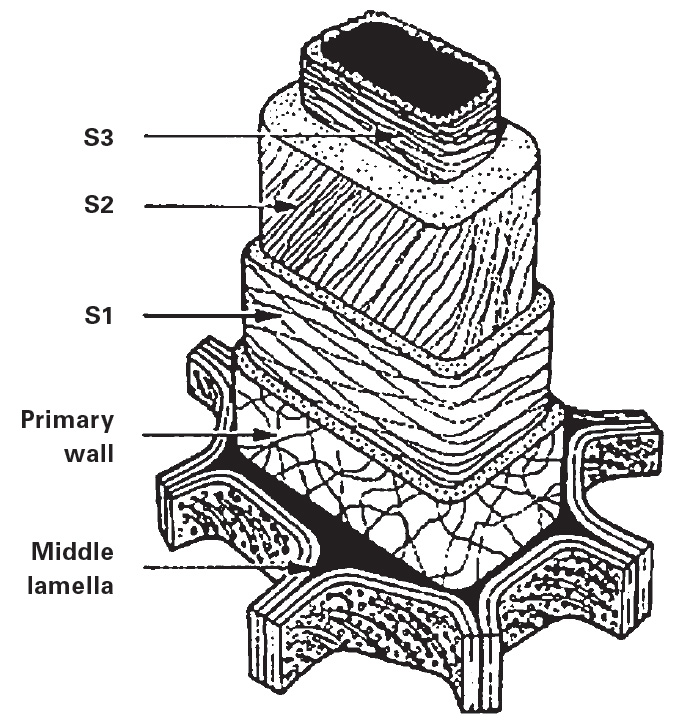 Figure adapted from: Zhang, X, L. Li and X Feng, 2022. Forests 73:439. (doi.org/10.3390/f13030439).
Figure 1—Among the cell wall layers of wood fiber, the angles of the micro brils in the thick S2 layer determine fiber tensile strength and wood stiffness.
Application
Flex and toughness are often important properties in boatbuilding. Gunwales take a beating and yet need to be bent into shape. Unstayed masts that give with a gust of wind rather than snapping off will be appreciated at critical moments at sea. Oars that bend slightly at the end of a stroke can add an additional kick. Trunnels need toughness both to withstand installation forces and, later, lateral stresses. Lightly built small boats will often be stressed to their materials’ limits in river rapids or choppy seas, relying on flex and toughness for survival.
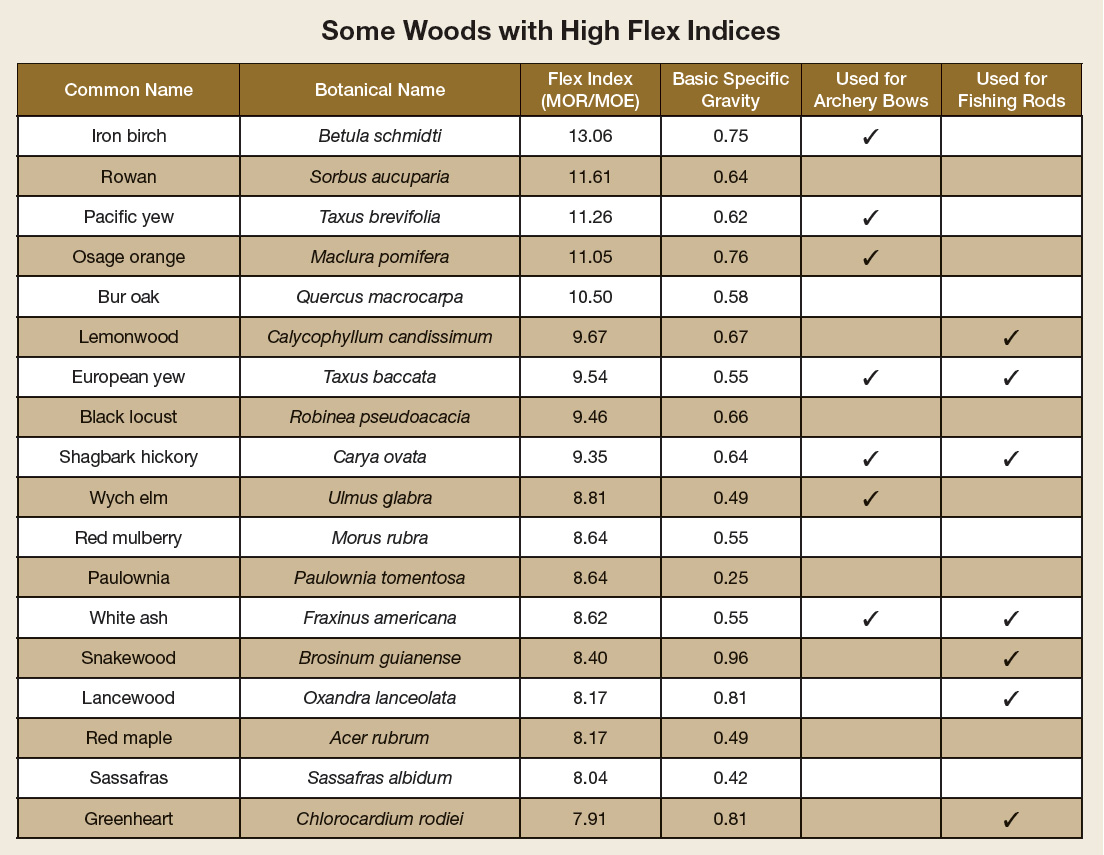
In the accompanying table, I have listed a selection of woods with flex indices that mostly exceed 8. A number of these woods have been employed in producing archery bows or (in the past) fishing rods.
Before we look more closely at the table, I should point out that not all situations call for flexible woods. A ship’s stayed and shrouded mast should have high stiffness—hence the usual choice of a conifer species. Too much flex in fastened planking can lead to leaks or popped fastenings. Deckbeams and thwarts generally should be stiff.
I have listed only a handful of woods in the table to provide some examples. By going to references such as The Wood Handbook or the online Wood Database, you can obtain MOR and MOE values to calculate your own flex indices. Even easier, within the Wood Database, a table of flex indices called “bow indices” reports values for a large number of woods (www.wood-database.com/wood-articles/bow).
Examining the table, the highest flex indices are often found in the smallest trees, among them rowan (or mountain ash), Pacific yew, and Osage orange, thus somewhat limiting their use in boatbuilding. But woods such as bur oak, black locust, English or wych elm (wych meaning pliable in Old English), mulberry, paulownia, ash, sassafras, and red maple have high potential. In previous columns, I have noted the use of black locust and mulberry for trunnels, paulownia for light boat construction, sassafras for johnboat planking, and red maple for Adirondack guideboat oars. The flex index is probably best used by first choosing a wood density appropriate for the application and then finding a wood within that density range that has a high flex index.
Tree Age a Factor
The flex index not only varies between species but can also be a function of tree age. Wood from young trees or from near the pith in old trees will often be more flexible than mature wood. This is a consequence of the arrangement of cellulose microfibrils in what is known as the S2 layer of the fiber cell wall, as shown in the diagram at the top of this page. As the thickest wall layer, the S2 has the greatest influence on fiber properties. In young trees, the angle of the microfibrils to the fiber long axis, a relationship known as the microfibril angle (MFA), is large. As the tree ages, the MFA decreases. This has the effect of increasing the tensile strength of the fiber and consequently wood stiffness. The tallest trees have the smallest MFAs and are the stiffest.
At this juncture, you might be asking where you could get some iron birch (Betula schmidti), a wood with the amazingly high flex index of 13.06 and density comparable to Osage orange. Iron birch is a small tree that grows to 30m (about 98′) and is native to mountainous Eurasian forests, from far-eastern Russia through Manchuria to Japan, where it is known as ono-ora, or ax-breaker. We know that Mongol warriors, led by Genghis Khan, used short, recurved bows in battle on horseback. Those bows were said to have been made from birch, sinew, and sheep’s horn. Although I have no proof, I would wager that iron birch was the species used for bow construction. Betula schmidti trees are available from tree nurseries in Europe and the United States and perhaps elsewhere. 
Dr. Richard Jagels is an emeritus professor of forest biology at the University of Maine, Orono. Please send correspondence to Dr. Jagels by mail to the care of WoodenBoat, or via e-mail to Senior Editor Tom Jackson, tom@woodenboat.com.