
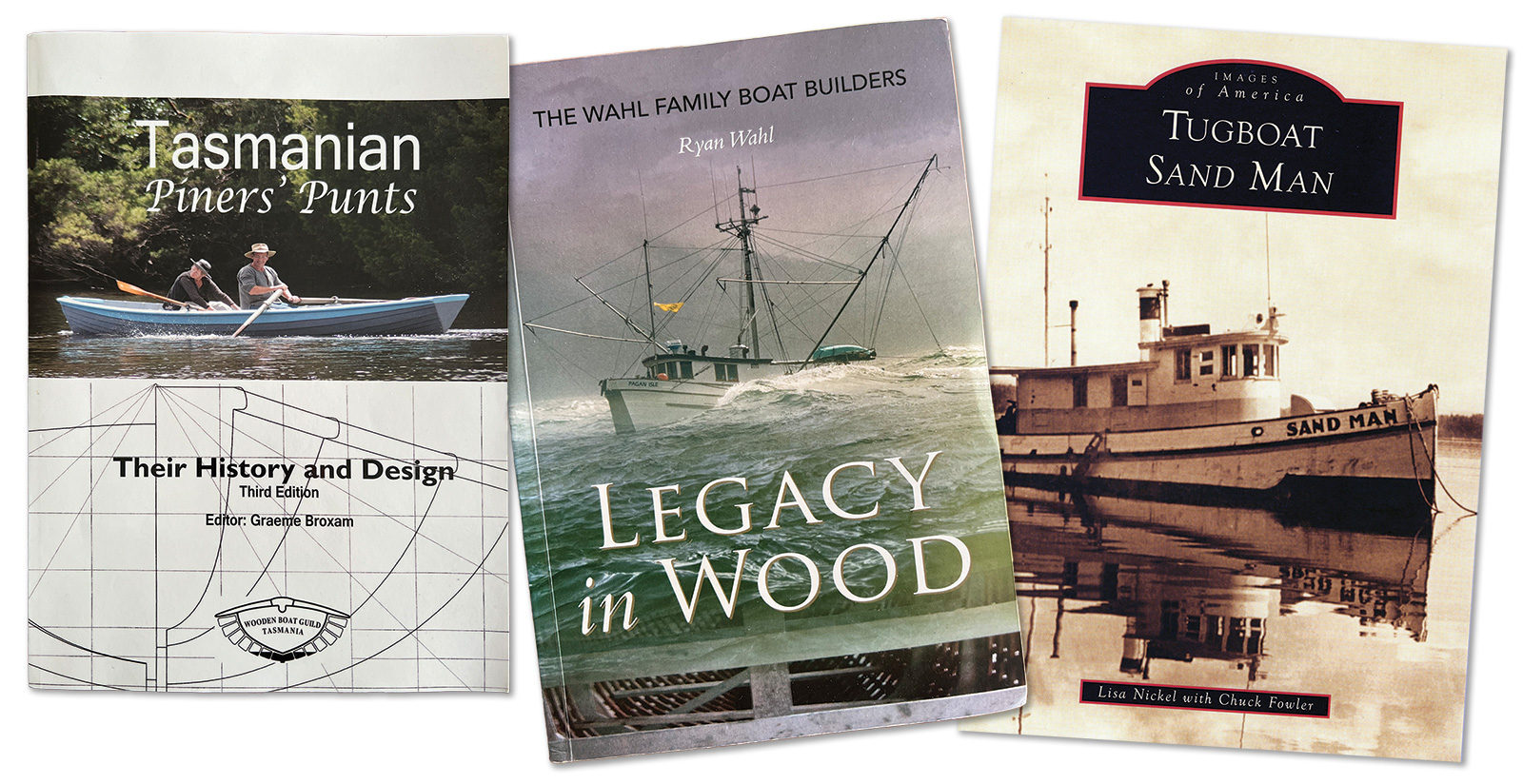
Tasmanian Piners’ Punts: Their History and Design, Third Edition, 2023, Wooden Boat Guild of Tasmania, P.O. Box 28, Battery Point, TAS 7004, Australia; www.woodenboatguildtas.org.au. Paperback, 145 pp. Many photos and lines plans, three appendices, index. AU$25, from Navarine Publishing, www.navarine.net.
Legacy in Wood: The Wahl Family Boat Builders, by Ryan Wahl, Harbour Publishing, Madeira Park, British Columbia, 2008. Paperback, 222 pp. Black-and-white photos, bibliography, index. $24.95, www.harbourpublishing.com.
Tugboat SAND MAN, by Lisa Nickel, with Chuck Fowler, Arcadia Publishing, Charleston, South Carolina, 2025. Paperback, 127 pp. Black-and-white historical photographs, chapter introductions and captions. $24.99, www.arcadiapublishing.com.
Books have a habit of collecting on my desk, where they have a secondary habit of being buried under other stuff, sometimes for a long time. In a recent reshuffling, three of these books—all of which were given to me one way or another—stood out in an unusual way in that they share a focus on regional boats of specific types: in Tasmania, the small punts used on remote rivers by timbermen in the 19th century; in British Columbia, salmon trollers and gillnetters built by the Wahl family’s boatyard near Prince Rupert; and in Washington State, a photo-driven account of the 1910 tugboat SAND MAN. What the boats that populate these pages have in common is how deeply they have been admired and loved in their own respective regions.
Such books seem most often to come via personal connection. I’ve twice attended the Australian Wooden Boat Festival in Hobart, Tasmania, where I met Peter Higgs of the Wooden Boat Guild of Tasmania (WBGT). The boats that are the entire focus of the guild’s book, Tasmanian Piners’ Punts: Their History and Design, figured prominently in the festival both years I was there. Like dories in New England, peapods in Maine, gillnetting boats on the Columbia River, canoes in Canada, lapstrake double-enders in Scandinavia—any list of comparables would be a very long one—these punts occupy an important cultural space in Tasmania. Their era is long past but still very much present in memories.
The pine with which the type is associated is Huon pine, a species much-celebrated by woodworkers of any kind, but boatbuilders in particular, for its rot-resistance and blemish-free lengths unimaginable today. Loggers used bluff-bowed punts to navigate rivers in western Tasmania to search out and harvest Huon pine. Perfect for planking, it was prized by shipyards and boatbuilders and still is, when it can be recycled from building beams or reservoir-recovered logs. Much-overharvested in earlier times and targeted for conservation as early as the 1860s, the species is now heavily protected.
The early days of the logging industry in Tasmania are eerily reminiscent of my own native Pacific Northwest, where celebrated and revered species such as Douglas-fir, western red cedar, Alaska yellow cedar, and Sitka spruce reach towering heights. The story of early loggers’ hard labor in cutting trees was only heroic in its day; in hindsight, it is both heroic and tragic. Forests established for thousands of years were all but gone after only about a century.
In Tasmania, as in the Pacific Northwest, it is the early days of resource hunting—the pioneer period—that retains its allure. Whalers, fur trappers, loggers, gold-rush miners, and a host of others worked largely before machinery took over. The sheer scale of their tasks and the amount of work and hardship involved in scraping a living out of wild and remote lands are compelling stories. In Tasmania, the piners—some of them convict laborers—used punts as everyday workboats that only later were elevated to a revered status. Small, stout boats were necessary to work the upper reaches of rivers, often among rapids. The book does an excellent job of tracing what is known about the boats and their development and their numerous possible European antecedents. It doesn’t skimp on photographic evidence: a couple of early pictures from western Tasmania in the 1880s are published across two facing pages, with punts flagged in a way that puts them in context beautifully.
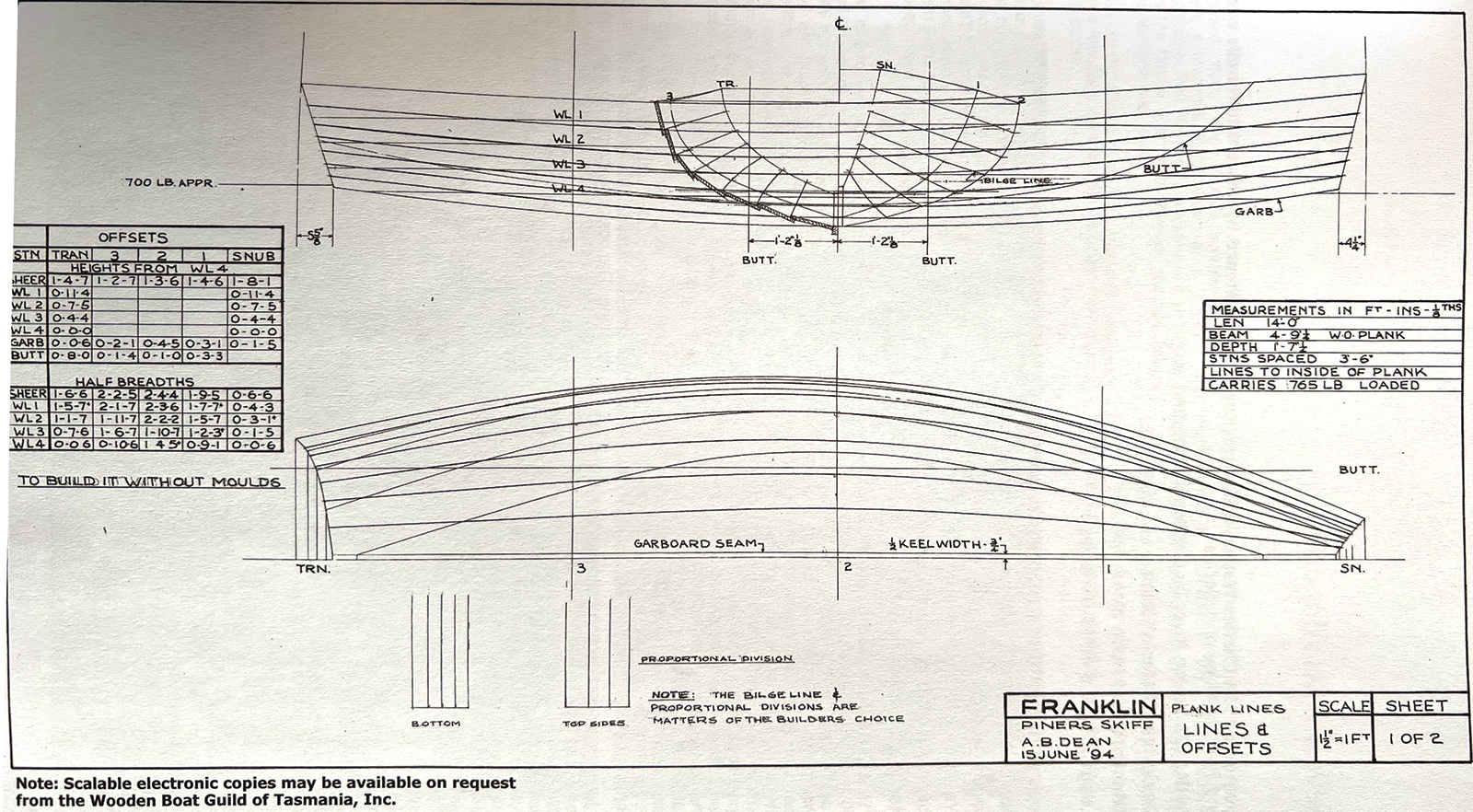
The book is in two parts, the first being devoted to everything that is known about these workboats, which were generally 14′ to 18′ long, planked lapstrake fashion but sometimes batten-seam. Extensive lists of builders, transcripts of oral histories, and references particular to this section give a reader ample avenues for further exploration. The second part is about the 21st-century context for the type, including individual accounts of 46 boats known to exist; the WBGT continues to search for others in barns and backways. A more diverse collection would be difficult to imagine: some are fully documented (in photos, photogrammetry, reconstructed lines, and detail drawings), others are not much more than derelicts, still others have been restored, and yet more are modern reconstructions in either traditional construction or even stitch-and-glue. A number of these boats are faithful replicas that have been built by the guild’s members.
An important inspiration for the renewed interest in the type was Adrian Dean, who in the 1960s was a teacher at School of Mines in Queensland and took an interest in the type; later, in the 1990s as a teacher at The Wooden Boat Centre in Franklin, Tasmania, he started building reconstructions. His fingerprints are on many of the boats in this collection, as are the guild’s.
Legacy in Wood: The Wahl Family Boat Builders is written as a labor of a different kind of love: family. The author, Ryan Whal, is a great-grandson of Øystein Whal, who emigrated from Norway in 1915 first to the United States and then, in 1920, newly married to a Canadian-Norwegian, to Canada. He started building boats for his own use during winters and fishing the Skeena River during summers. Eventually, he chose boatbuilding and settled near Prince Rupert, British Columbia, ultimately at nearby Dodge Cove. The boatyard he founded built somewhere between 1,000 and 1,300 boats between 1928 and 1990, across three generations. All but a few were fish boats, most of them salmon trollers and gillnetters.
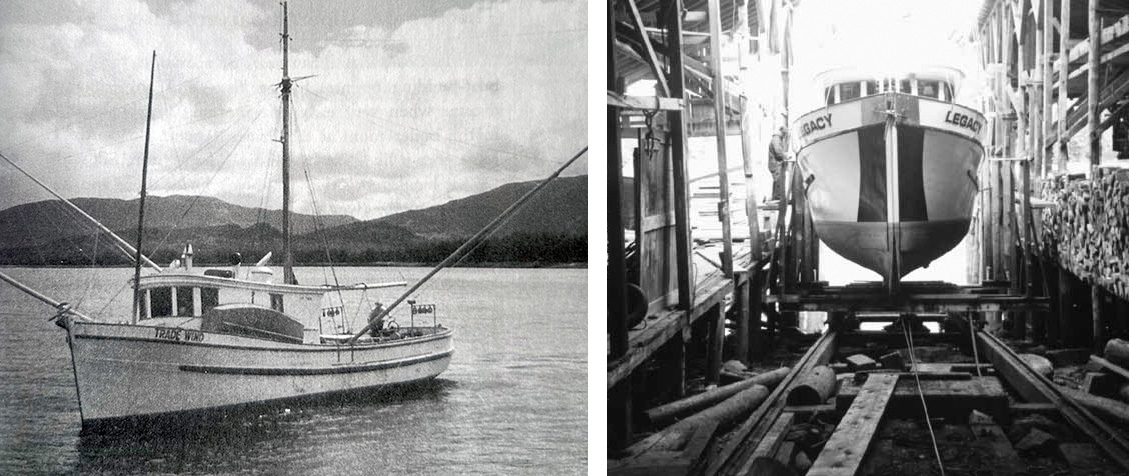
Left—The Wahl family built fishing vessels, including TRADE WIND, near Prince Rupert, British Columbia, beginning in 1920. Right—They built their last wooden boat, LEGACY, in 1990.
Whal started the research for his book by asking his grandfather questions and recording his memories. This book, however, is much more than a straightforward family reminiscence. The West Coast of North America has always been closely associated with salmon fisheries and with the timber that came from the temperate coastal rain forests—especially Douglas-fir, western red cedar, Alaska yellow cedar, Port Orford cedar, and Sitka spruce. Øystein Whal was not alone in seeing opportunity there and in choosing to put his formidable energy into supplying boats for the region’s fishermen. The result was an intertwining of experience and expertise that was closely aligned with the meteoric rise and extended diminishment of the salmon fishery. As a 17-year-old, the author worked on LEGACY, launched in 1990 as the last wooden-hulled fish boat that his family’s yard built.
The Wahl yard was not alone in experimenting with fiberglass boatbuilding but ultimately rejecting it; however, the post–World War II widespread emergence of aluminum and steel for commercial boat construction spelled the end of the era of the handsome wooden boats—especially trollers—that were the Wahl yard’s specialty. The yard’s building techniques remained old-school, with construction molds developed from half-models and a lot of the work done by eye. (One former employee describes them thus: “They were good, but they were backwoods boat builders.”) Writing for a general readership, the author doesn’t delve too deeply into the specifics of their techniques.
“For most of the last century, fishing was the backbone of the local and provincial economy,” Wahl writes. “Now all the coastal fishing communities have either died out or undergone major transformation to stay alive, forced to remodel their waterfronts for tourism…. Gone are the packs of commercial fishboats so tightly docked together that you could walk from one to the other to get to the next pier. Today it’s the sport fishermen’s boats that occupy those spaces, which isn’t surprising since the tourism and sport fishing industries are so tightly integrated.” His family was equally tightly integrated with that history and legacy, and he is to be commended for getting the story down in print.
Another way of getting a story in print and in circulation is on exhibit in the third book in my found set, Tugboat SAND MAN. This tugboat has been a much-loved fixture of the waterfront at Olympia, Washington, for decades and a sometime participant in the Port Townsend Wooden Boat Festival and the tugboat races at Olympia Harbor Days. Unfortunately, just after this volume was published, the foundation created as a caretaker for the boat was disbanded. The boat, seized for unpaid moorage, had no bidders at auction in late July 2025 and is now in limbo on land in the hands of the Port of Olympia, possibly for some sort of land-based historical display. She has been out of the water for about three years and is unlikely ever to be relaunched.
The book, therefore, demonstrates an important aspect of this type of publication: getting history down in print. The original goal was to call attention to the boat for continued preservation. Now, it may serve as a resource for some unknown savior. At a minimum, it documents the life of a boat.
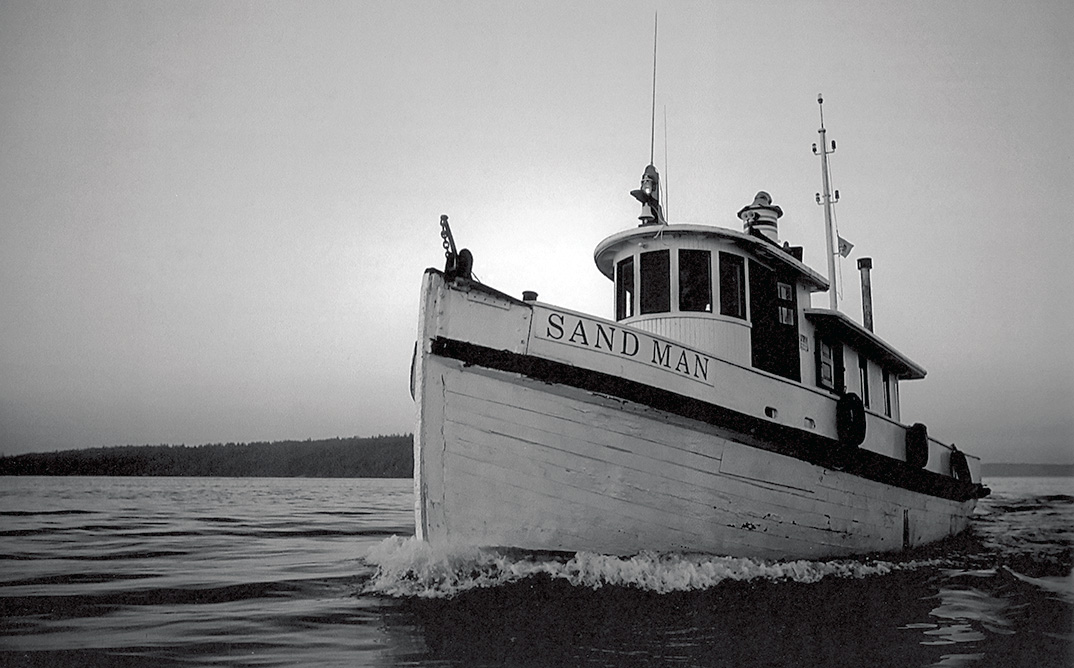
The tugboat SAND MAN has been a fixture on the Olympia, Washington, waterfront for decades.
The author, Lisa Nickel, who credits a mentor, Chuck Fowler, who guided her into the project, as coauthor, grew up in a tugboat family on Puget Sound. She, in fact, appears in the foreground of a 1979 SAND MAN photograph as a young girl on the foredeck of her father’s tugboat. She worked with the Arcadia Publishing Company, which has an extensive series called “Images of America,” using historic black-and-white photographs chosen by local writers who write the introduction, chapter lead-ins, and captions.
The photographs, as you would expect, carry the day. The one-page chapter introductions give context for an aspect or era of the boat’s history. It could certainly be argued that the approach is a formulaic one, but it’s a formula that seems to work, given the thousands of local history books in Arcadia’s uniform 6½″ × 9¼″ paperback format. The series gives a very real opportunity to highlight specific historical subjects, many of which would never otherwise have been the subject of books. Nickel spoke highly of how the publication came together.
Historical photos work because they extend ample opportunities for browsing and, as with the piner’s punt photos, for grasping the historical context of a boat and her times. SAND MAN’s name came from one of her primary tasks of hauling sand and gravel from quarries in southern Puget Sound, including a large operation in Steilacoom, south of Tacoma—now an enormous linear park with views of the sound and the Olympic Mountains to the northwest. Hours can pass in simply picking details from the photos.
Not all boats can be saved. I can think of numerous fish boats in Puget Sound that are now gone. The Tasmania punts often were alongside much larger, and very elegant, boats, now all gone. Wahl wrote about the end of an era in British Columbia. But some are saved. A wheel or wheelhouse may end up in a museum. Whether they survive or not, getting their stories into a form that can be passed to the future is an act of devotion. If a boat survives, it survives because it was notable enough, or loved enough, that somebody cared about it, and often cared a great deal. The memory of a boat survives for the exact same reason. 
Tom Jackson is WoodenBoat’s senior editor.