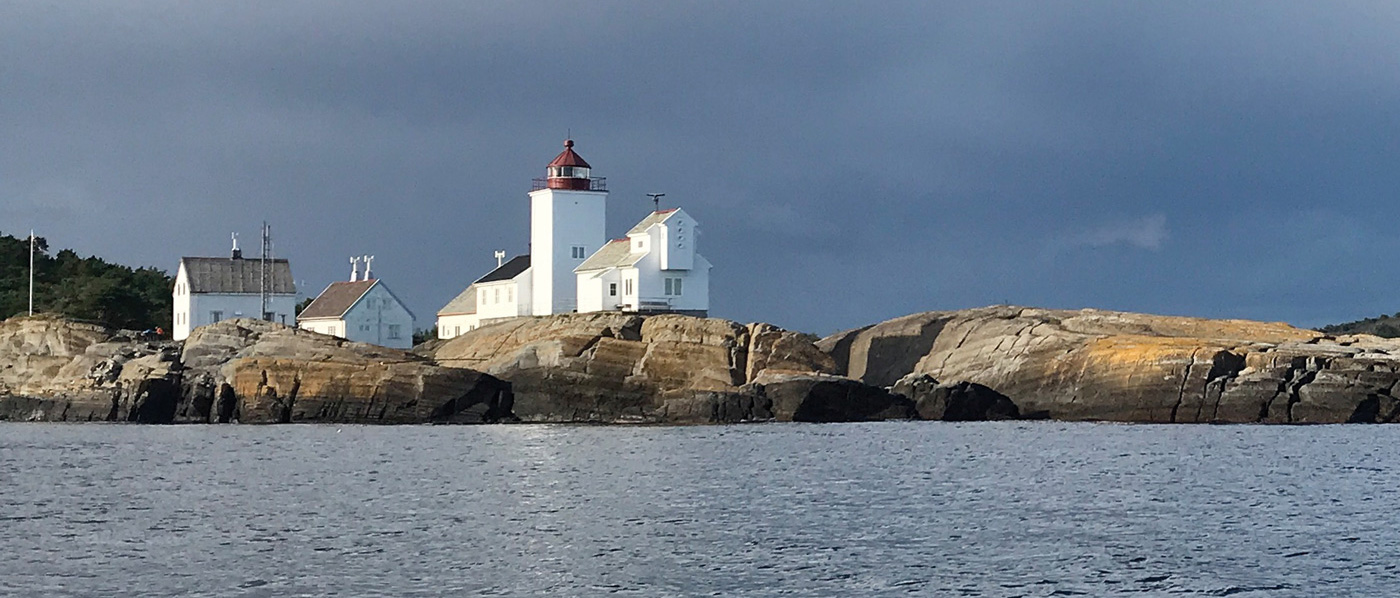
Lighthouse, which marks the entrance to Langesundsfjord in Norway.Atle Knutsen/kysten.no

Langesund lighthouse, which marks the entrance to Langesundsfjord in Norway, was once a manned facility but has long been automated. The organization Langesundsfjorden Kystlag, which is part of a countrywide federation of coastal preservation organizations, maintains the historic keeper’s buildings and rents them as holiday or conference accommodations.

The Norwegian coast is seemingly endless. It extends nearly 1,000 nautical miles, as the seagull flies, from the South Cape, Lindesnes, to the North Cape, and the country’s coastline extends in both directions well past these two iconic landmarks. It includes countless skerries, islets, islands, and deep fjords, composing a vast seascape that, measured by satellite imaging, might account for 56,000 nautical miles of shoreline if stretched out. It’s a difficult measurement, so that’s only an academic estimate, but mere numbers will never do this region of ancient land and sea justice, anyhow.

Against this mighty backdrop, one can begin to grasp the dimension of Norway’s maritime heritage—a national treasure and a mainstay of the country’s cultural identity. For many centuries, sailing and rowing were the only means of transportation and communication in this vast area—despite the harsh climate, strong winds, and rough coastal waters. Farmers were often seafarers, too, building fine, strong, and seaworthy boats in their barns during long, dark winter months. Fishing itself has been the principal source of income and sustenance on this coast for centuries and has produced some remarkable and strong craft. And, of course, there is an unrivaled seafaring heritage handed down by the Vikings. Coastal farming hamlets and fishing outposts in Norway were once isolated by fjords and mountains, but in the past 150 years, bridges have spanned fjords and roads have been created by blasting into rock. Despite this modern infrastructure, Norway’s current economic and social well-being are still tied to the sea, largely because of the offshore oil industry.

Road construction was well underway in Norway in the 1950s, and boats and waterfront structures fell into disrepair as they became less significant for daily life. In the 1970s, a band of visionary Norwegians became aware of the decline of maritime traditions, knowledge, craftsmanship, boats, and buildings, and saw an urgent need to preserve them. This group formed the organization Forbundet Kysten—loosely translated as coast society—in 1979 to preserve historical vessels, coastal culture, and maritime heritage. Kysten is a countrywide communal project based entirely on private initiative. By the end of 2021, the movement had 10,000 active members throughout Norway, organized in a federation of 128 local branches scattered along the coast, one of which I visited late last winter. The organization is still growing.

The flagship cutter RS2.Langesundsfjorden Kystlag

The rescue cutter RS2, designed by Colin Archer, is the pride and flagship of Langesundsfjorden Ksytlag, which maintains and operates the boat.

Langesundsfjorden Kystlag

The enthusiasm for Norway’s coastal culture was tangible when, in January this year, I attended a long, sprawling, and thoroughly enjoyable breakfast meeting of Langesundsfjorden Kystlag in the town of Langesund on the Telemark coast in southern Norway. The town was once an important shipbuilding center; the locals are still proud of the fact that the Norwegian naval hero Peter Wessel Tordenskiold (1690–1720) had one of his warships built here for use in the Nordic Wars—a series of regional conflicts spanning the 16th to 18th centuries, whose history is as confusing as it is protracted, and which led to Russian dominance. The more modern shipyard Langesund Mekaniske Verksted, on the other hand, was founded here in 1914; it built a wide variety of ships very successfully until 1967. The successor company then welded gigantic oil-drilling platforms for use in the North Sea at the same location for several years.

Jan-Olav KvitnesDetlef Jens

Jan-Olav Kvitnes is the current head of Langesundsfjorden Kystlag.

Langesundsfjorden Kystlag is a typical local branch of Forbundent Kysten. The meeting I attended was in a beautiful former customs building on the Langesund waterfront that could have been mistaken for a museum. The gathering included a rather informal association of elderly folk, mainly men, who, with good humor and a relaxed attitude, devote much of their time and energy to their cause. They accomplish a lot. The members take care of a number of historic wooden boats, including the oldest sailing lifeboat, RS2 LANGESUND; several wooden waterfront buildings that have in the past been related to the shipping activities in town; and other buildings on the island of Langøya, which faces the town. This includes renting out the restored living quarters of Langesund Lighthouse, built in 1839, for vacationers or team-building activities. However, as pointed out by Jan-Olav Kvitnes, the current head of Langesundsfjorden Kystlag, the operation of the light itself is the responsibility of the Norwegian state.

Breakfast meeting of the Kyastlag.Detlef Jens

Last winter, the author attended a working breakfast meeting of the Kyastlag, which is located on the southern Norwegian coast.

There are many lighthouses, large and small, along the Norwegian coast, and with the notable exception of Lindesnes Fyr on the South Cape, all have long been automated. Now, most of the attached buildings, such as machinery huts and living quarters of lighthouse keepers, are maintained by local Kysten branches. Most of these structures are available for rent. As one member of Kysten said, one can rent a heavy, seaworthy, and historic rowboat to venture along the coast, stopping along the way at the lighthouses and overnighting in the old living-quarters there. In fact, some Norwegians have made such voyages in recent years, despite the prevailing sea conditions and distances involved.

The members of Langesundsfjorden Kystlag save old boats, buildings, and traditions. Antique boat engines are brought back to life in a mechanic’s shop; in a woodshop, teenagers from the very enthusiastic youth department are building a new wooden lapstrake, or clinker, rowboat to a traditional design. It’s a promising way to keep boatbuilding skills alive—and significant because, in December 2021, traditional Nordic clinker construction was added to UNESCO’s Representative List of the Intangible Cultural Heritage of Humanity. On a ropewalk set up in the attic, using an old but well-oiled hand-turned ropemaking machine, members also make their own cordage for rigging.

A fleet of wooden working craft and a historic warehouse.Atle Knutsen/kysten.no

The Langesund harbor waterfront is home to a fleet of wooden working craft and a historic warehouse—all of which are maintained by Langesundsfjorden Kystlag.

The former house of the local customs officer was restored by members of the association, as was the old customs warehouse, which now holds the aforementioned workshops. The former watchkeeping hut for the guard at the end of the pier is particularly beautiful. This is where the customs officers once surveilled the traffic on the fjord and, if necessary, boarded vessels that might have been attempting to slip away or enter unseen. Today, this is a particularly popular place at the harbor, because one can see everything from here—including the association’s own fleet of various wooden boats, which are moored here in summer. The fleet is ever-ready to take members and interested visitors across the sound to the island of Langøya, where the association acquired the shed of a boatbuilder who retired at the age of 80 after building more than 100 boats; Langesundsfjorden Kystlag’s boats are now maintained there.

Kystlag members working on RS2 in winter.Langesundsfjorden Kystlag

Working on RS2 in winter, with the promise of a sparkling Norwegian summer, does not dampen the enthusiasm of the Kystlag members.

Back across the sound on the mainland, members of the association operate a small museum on the harbor on behalf of the local council. There is a fisherman’s old wooden house here, which was saved from total ruin by Langesundsfjorden Kystlag. It was transported to the harbor on a low-loader and half of it has already been restored there. The renovation should be completed when the house is in its final location, in a small waterfront park being built by the city.

Gasoline engine from a historic fishing vessel.Detlef Jens

Kystlag volunteers bring an old gasoline engine from a historic fishing vessel back to life in the mechanic’s workshop.

Currently, Jan-Olav is negotiating with the local council about the future use of another old waterfront building that once housed a dental practice. That structure, he said, “is in a very poor state. Restoring the building will be a lot of work over the next years. The community has to decide; some want to sell [the building] to property developers and make a lot of money.” Others, however, favor turning it over to Langesundsfjorden Kystlag. This, he said, “will open up possibilities for tourism and cooperation with the hotel—and regional exhibitions.”

RS2, Norway’s Oldest Sailing Rescue Cutter

On the water, the association’s flagship is the rescue cutter RS2 LANGESUND, designed by Colin Archer. She is a redningskoite—a rescue vessel—hence the designation “RS.” This particular vessel’s history is relatively unknown even in Norway and is therefore all the more eagerly spread by the Kystlag. Leif Karlson is the foreman responsible for running the boat, which is considered to be the first and oldest of Archer’s rescue cutters—despite there being a lower-numbered RS, which was also restored and is sailing from Oslo.

A double-ended Norwegian motor launch.Detlef Jens

Last winter, Langesundsfjorden Kystlag members worked on a snekke, a style of double-ended Norwegian motor launch ubiquitous along the coast.

“There was a storm in the Skagerrak outside Langesund that cost many lives on February 12, 1892,” Leif began. “Two pilot boats, designed by Colin Archer, were able to save some, but not all, of the fishermen. The local pharmacist donated and collected money for a lifeboat to be stationed here and traveled to the Norwegian Lifeboat Institution in Oslo, which had just formed a committee to decide what kind of design their new rescue cutters should be. He knew exactly what he wanted, as the pilot boats designed by Colin Archer had already proven to be very tough and seaworthy. However, the committee was reluctant to just follow the ideas of this provincial pharmacist. This man, however, had the necessary funds, so he proceeded to have a new rescue cutter, designed by Colin Archer, built anyway. The vessel was built at a yard in Porsgrunn, very close to Langesund, by Thor Martin Jenssen, who had been a foreman at the Colin Archer shipyard. The two were good friends. It was built quickly and finished in January 1893—more or less around the same time as RS1 in Oslo.” Although the Langesund vessel received the designation RS2, “it is actually considered the oldest sailing rescue cutter in Norway.”

RS2 LANGESUND sailing.Langesundsfjorden Kystlag

Kystlag members sail RS2 LANGESUND on a Norwegian summer day. The massive cutter measures 45′ on deck and displaces nearly 50 tons.

This massive cutter, 45′ on deck and displacing nearly 50 tons, is built of pine planking on massive oak frames. “We once had a lot of oak in Norway,” Leif said. “The city of Amsterdam is entirely built on oak piles from Norway.” Now 131 years old, the cutter has been renovated several times, but the restoration that saved the boat was completed in 1989.

“By 1913, the boat and its crew had rescued 102 people from distress at sea, and until 1937, RS2 was still sailing as a pilot boat for the Norwegian Hydrographic Institute. The vessel was not fitted with an engine until 1945, when it was converted into a fishing boat. In 1989, the very dilapidated ship was bought and saved by enthusiasts,” Leif said. “This was the very rich land and forest owner Christian Bang. He had his own woods to choose from and could pick only the very best and oldest trees, with very closely grown rings, for the boat—the kind of wood that you probably can’t find anymore. His daughter and son-in-law wanted to sail around the world in the vessel, but when the restoration was finally done the couple had split and the cutter was sold to a guy in Sweden. A while later, Langesundsfjorden Kystlag wanted to bring LANGESUND back home and local businesses formed a consortium to buy her. They use her for various purposes, and also pay for the upkeep, but we actually take care of her, doing all the maintenance and generally running the ship.”

Varnished lapstrake workboats.Atle Knutsen/kysten.no

Here we see a sampling of beautiful varnished lapstrake workboats maintained by Langesundsfjorden Kystlag. Traditional Nordic lapstrake, or “clinker,” construction is listed on UNESCO‘s Representative List of the Intangible Cultural Heritage of Humanity.

Work on LANGESUND never stops despite the perfectionist restoration of 1989. Every once in a while, a plank or a spar might have to be replaced. Deck and spars are varnished with a mixture of Benar—a slow-hardening oil—and varnish, in a ratio of 30:70. “I would prefer to use a 50:50 mixture,” Leif said, “but I can’t get anyone else to agree to it. The varnish is thinned with oil to keep it flexible and prevent it from becoming brittle and cracking, but it is also harder than pure oil. The exact mixture is a hotly debated question of faith. Ask five people and you’ll get ten different opinions.”

In the summer, LANGESUND sails day trips with groups ranging from corporate guests to school groups. “We teach them to row and make knots and then take them out sailing for a couple of hours, which is a lot of fun,” Leif said.

Lifeboat in home waters of Langesundsfjord.Langesundsfjorden Kystlag

LANGESUND drifts along in light airs in her home waters of Langesundsfjord. The vessel was designed for rough conditions; in its first two decades of lifeboat service it saved 102 distressed mariners.

Back in LANGESUND’s days as a rescue cutter, it took three or four men to sail her. “It’s almost unimaginable when you see this massive ship, almost 50 tons, and the incredibly heavy spars. You can’t set the mainsail alone; at least two people must do it. Just the gaff, made of solid wood, is so heavy. The mast is massive, made from a pine tree felled in 1989. [That spar] is still in perfect condition, but it needs to be maintained. It has very few wind cracks. This is a sign of very high-quality wood because it has grown slowly.” Leif recalls that, when the vessel was built, “the timber barons selected individual trees for their grandchildren and then allowed them to grow for decades or almost 100 years so that their grandchildren could build their houses out of them. Today, they only have fast-growing trees that hardly ever get old. I call that balsa pine.”

Langesund harborfront and historic wooden buildings.Atle Knutsen/kysten.no

Langesund has a beautifully preserved harborfront rimmed by historic wooden buildings, many of which were saved from demolition by the active involvement of Langesundsfjorden Kystlag.

Along with being home to the oldest sailing rescue cutter, Langesund has another obscure distinction: The skis of the Norwegian explorers Fridtjof Nansen and Roald Amundsen were made by a small workshop here, to the polar explorers’ exact specifications. This small town on the Telemark coast has an impressive maritime history. Langesundsfjorden Kystlag plays a major role in preserving this heritage, and the organization is just one link in a chain of such organizations operating under the umbrella of Forbundet Kysten, with thousands of volunteers along the endless Norwegian coastline.  Article ends.

Detlef Jens is a maritime journalist and editor of the classic yachting magazine Goose, based in Flensburg, Germany.