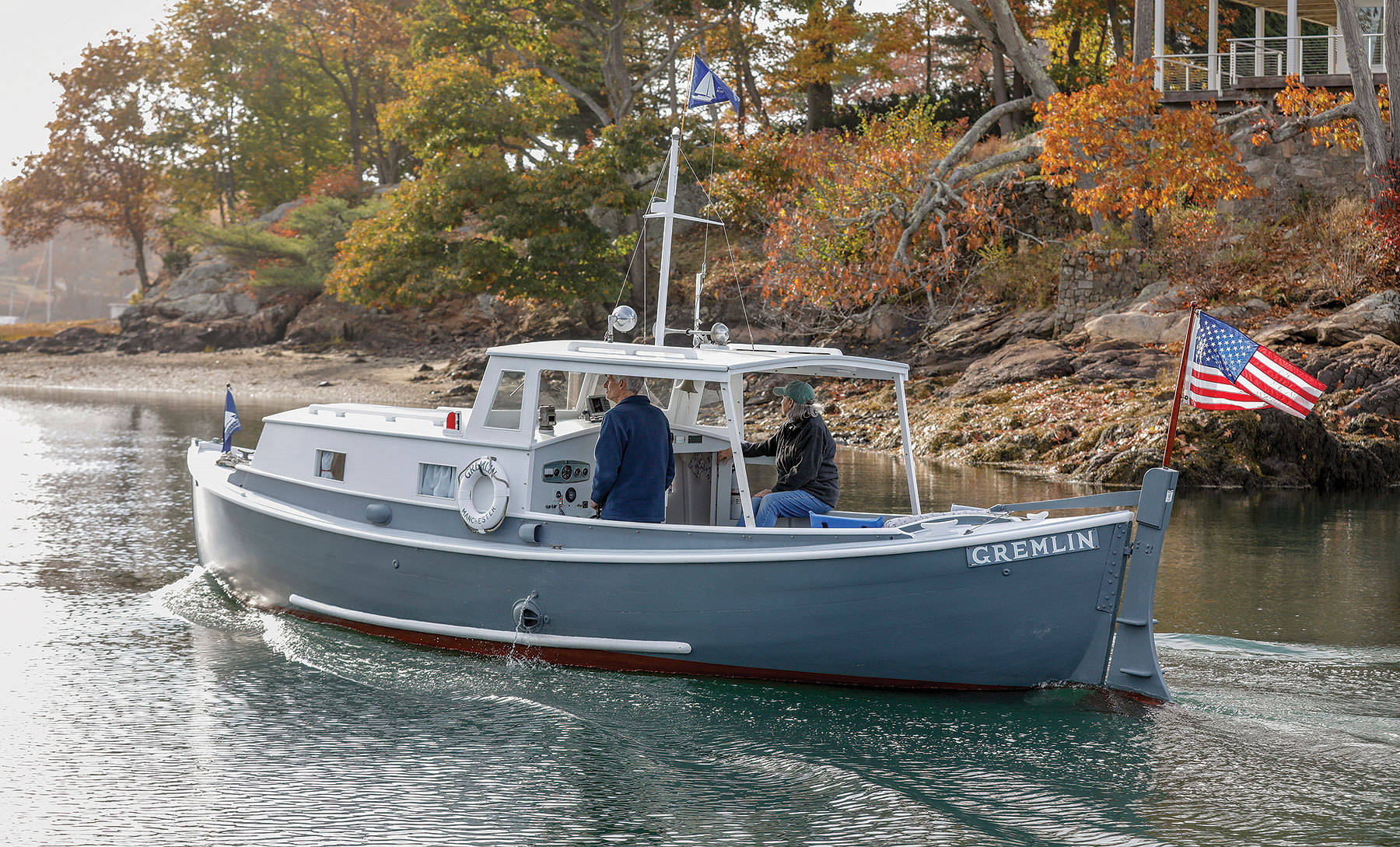
GREMLIN, a 26′ motor whaleboat.Billy Black

GREMLIN, a 26′ motor whaleboat originally built for the U.S. Navy in 1942, was converted in the 1950s to pleasure use. She hails from Manchester-by-the-Sea, Massachusetts, and is in her eighth decade of ownership by the same family.

On a fine morning in early November 2024, Kathy and Ray Anderson arrived at the harbor in Manchester-by-the-Sea, Massachusetts. They were there to enjoy a cherished custom, a day outing aboard GREMLIN, a converted U.S. Navy motor whaleboat that has been owned in their family for many decades. GREMLIN is a unique and quite distinctive small vessel, and getting her underway involves certain time-honored rituals.

Kathy and Ray Anderson.Billy Black

GREMLIN’s current stewards are Kathy and Ray Anderson.

This particular day marked the end of the boating season, bringing the final ride of the year and the start of GREMLIN’s annual decommissioning. After rowing out to their mooring, the Andersons invariably follow a familiar routine. Take down the weather curtains and roll them up to store below. Transfer the day’s provisions from the dinghy and set the ensign in its socket atop the rudder. Check the bilges, batteries, and free travel in the cable steering. Briefly switch on the pre-lube pump to establish engine oil pressure before starting, and lift the hinged engine cover to check for a slight puff of preheat smoke. Then start the engine and scan the gauges to verify that all is well.

When everything was ready, Kathy went forward to drop the mooring pennant, and GREMLIN headed out of the harbor to make one last day excursion before returning to the dock for the start of decommissioning—a process that is largely handled by the owners themselves. The first step involves changing the engine oil and filter, using the pre-lube pump to remove the old oil. Other tasks include further winterizing the engine, draining the fresh-water tank, and offloading gear. Virtually everything aboard is removed for the winter, including the cabin and cockpit soles. Before GREMLIN is hauled, the fuel is topped off and the holding tank is pumped out and flushed with pink non-toxic antifreeze. Bilge pumps are winterized after the boat is out of the water. Completed tasks and those anticipated for the coming year are noted in GREMLIN’s log. Finally, Kathy and Ray coat the bottom with a 50/50 mixture of boiled linseed oil and turpentine. After that task is completed, they erect a frame and cover GREMLIN, using a tarp instead of shrink wrap for better ventilation.

It is exceedingly uncommon for a wooden boat to be in its eighth decade of ownership within the same family, affording joy and adventure across five generations. Yet such is the case with GREMLIN, a 26′ motor whaleboat originally constructed for the U.S. Navy in 1942, and subsequently converted in the 1950s to pleasure use. Ever since that conversion, GREMLIN has resided each season on her mooring in the lovely and well-protected harbor at Manchester-by-the-Sea, on the North Shore of Massachusetts. While Kathy and Ray are the current owners, it was Kathy’s father who was responsible for assuring a new postwar chapter for GREMLIN.

Whaleboat from USS ISABEL and GREMLIN.Left—Wikimedia Commons, Right—Courtesy of Kathy Anderson

Left—Whaleboats served many purposes, ranging from shore transfers to maintenance to captain’s gig—not to mention retrieval of downed aviators. Here, a whaleboat from USS ISABEL (PY-10) carries a liberty party off Amoy, China, in 1933. Right—Burrage “Woody” Woodberry purchased GREMLIN in 1953 for $150 as U.S. Navy surplus. He and his father converted the open hull for cruising. Here, Neil Woodberry inspects his father’s new acquisition from a ladder that is still in use on the boat today.

Before the start of her second life, GREMLIN logged an eventful term of military service. This plank-on-frame boat, bearing the registry number MWB 20039, was one of hundreds built during World War II at the Portsmouth Navy Yard in Kittery, Maine. Though motor whaleboats were among the Navy’s smallest vessels, they were ubiquitous in the fleet and carried in davits by warships of all sizes, from destroyer escorts to battleships. These workhorse utility craft served many purposes, ranging from shore transfers to maintenance tasks to occasional service as the “captain’s gig.” Whaleboats also did duty in the rescue of downed pilots and survivors of sinkings, because their low freeboard amidships facilitated recovery of personnel. The design specified a double-ended boat of 26′ overall, framed in white oak and planked with cedar fastened by copper rivets. Power was provided by a 25-hp Buda diesel engine that afforded a maximum speed of 7 knots. Capacity was 20 passengers in addition to the standard crew of two. Steering was by tiller, which controlled an outboard-hung rudder.

Left—Courtesy of Kathy Anderson, Right—Billy Black

Left—After Woody died in 2012, his daughter, Kathy Anderson, and her husband, Ray, commenced their stewardship of the boat with a thorough multiyear overhaul that included removing and refurbishing the engine. Right—Woody’s conversion included the addition of steps to the outboard rudder so that a person overboard would be able to climb back into the cockpit.

In February 1944, MWB 20039 (later to become GREMLIN) was assigned to a brand-new naval vessel, a 166′ Director-class offshore rescue tug that had been built in Camden, Maine. The rugged and capable wooden-hulled tug (ATR-18), displacing 850 tons and propelled by a steam power plant developing 1,875 hp, was immediately transferred to the British under the Lend-Lease program. After crossing the Atlantic and taking on the name HMS EMULOUS (W-138), the tug was enlisted in the invasion plans of the Allies. At the same hour that troops were commencing the June 6 landings on the beaches of Normandy, EMULOUS joined a large fleet of vessels charged with towing massive components of the “Mulberry” artificial harbors—prefabricated components of a system comprising floating breakwaters, pontoons, piers, and roadway sections—on a slow 100-mile trip across the English Channel. Just how MWB 20039 might have played a role in this risky mission is impossible to say. Yet the assignment overall was hellishly difficult, as the 132 towing ships that participated came under continuous bombardment by shore batteries as soon as they arrived at the French coast—all while attempting to place hulking concrete structures precisely amid strong winds and tides. In the months following the Allied landings, EMULOUS was assigned to rescue work and convoy duty in the Atlantic. Thus, the motor whaleboat later to become GREMLIN was indubitably present for some of the most challenging and grueling deployments of the entire Atlantic campaign.

GREMLINBilly Black

Woody worked at Manchester Marine, which for decades has cared for and refit many classic yachts. During her conversion in the 1950s, GREMLIN took on discarded pieces of some of these vessels, including an engine panel and various lights from the 1939 Alden schooner WHEN AND IF.

Within a year the war in Europe was over, and U.S. Navy assets were gradually recalled to the United States and in many cases mothballed. It was Kathy Anderson’s father, Navy veteran Burrage “Woody” Woodberry, who decided to adopt GREMLIN in 1953, after the boat had been classified as government surplus. Purchased for $150 from the marine surveyor Ray Kershaw of Manchester (who also dealt in marine machinery), the vessel was little more than a disused open hull, and a good deal of work would clearly be involved merely to render her seaworthy and functional. Yet Woody had a more extensive plan in mind: he would create a platform for family cruising. And he was well placed to realize this goal, given that he headed the busy mechanical department at the yacht yard Manchester Marine. In addition to his impressive skills, his position afforded him access to an array of components that had been removed from customer boats but were still serviceable. Thus GREMLIN came to incorporate an engine panel and various cabin lights from the 1939 Alden schooner WHEN AND IF, windshield-wiper motors from the Concordia motorsailer HURRICANE, a propellor from the Alden schooner GOBLIN, and a varnished teak cockpit seat fabricated from former Hinckley sailboat components. GREMLIN’s steering wheel was repurposed from a catboat built at Manchester Marine, whose owner had subsequently requested a tiller. Woody also removed and sold for scrap the copper flotation tanks that GREMLIN had carried during her Navy career.

The conversion project, carried out after hours and on weekends by Woody and his father, extended over several years, with the work being conducted in the driveway of the family home. With design assistance from the naval architect Stanley Potter, Woody settled on a plan to create a raised cabin and a semi-enclosed wheelhouse sheltered by an extended roof. The concept was well executed, and has endured ever since with only a few alterations—one being the addition of steps to the outboard rudder in case anyone went overboard. Various gasoline engines (Kermath, Hercules, and Lathrop) were installed over subsequent years, eventually giving way to the current Westerbeke/Perkins 4-107 diesel. Woody rebuilt every one of these engines before they went into the boat.

GREMLIN’s cabin accommodation.Billy Black

GREMLIN’s cabin accommodation is small but cozy; it has sheltered Kathy’s family on many excursions in Massachusetts Bay and the Gulf of Maine.

After the newly configured GREMLIN was relaunched on Labor Day in 1956, the Woodberry family cruised her extensively and ambitiously. They spent most weekends aboard, rain or shine, and during many summers they made longer excursions across Massachusetts Bay and northward to Maine, with women and girls sleeping below and men and boys sheltering in the cockpit. The boat’s cruising speed of 6 knots meant that progress was made at sailboat pace, with 35 nautical miles being a good day’s run. Accommodations were distinctly cozy, and great consideration for fellow shipmates was a fundamental necessity. Yet those who cruised in small boats during that era will well recall that waterborne adventuring by jolly groups stuffed into tight quarters was very much the norm. According to Kathy, the entertainment options aboard GREMLIN back then included books, stuffed animals, a transistor radio, and nightly games of Canasta.

Following in her father’s footsteps, Kathy began working at Manchester Marine in 1973, during breaks from her studies at Massachusetts College of Art. For many years until her recent retirement, Kathy led the yard’s finish department, and she specialized and excelled in high-end varnish work. Yet GREMLIN has very little brightwork, in keeping with her military background. In an explicit nod to the boat’s Navy heritage, her topsides have long been painted battleship gray, with lighter grays and white as the color scheme above deck. Over the years, GREMLIN has benefited from advice and assistance provided by many of Kathy’s colleagues at Manchester Marine, contributing directly to her longevity.

As GREMLIN reached and passed her 70th year, the boat was undeniably showing her age. While the hull’s original oak framing and cedar planking were in largely good condition, the deck and cabin house were exhibiting considerable rot due to freshwater intrusion. Yet repairs were delayed in order to keep GREMLIN in service while Woody, then in his late 80s, was still able to come aboard. Woody and his wife, Dorothy, enjoyed their very last afternoon cruise on Labor Day of 2011, and Kathy took over ownership after Woody died in March the following year.

GREMLIN on Salem Sound.Billy Black

GREMLIN’s modest cruising speed is ideal for the day outings on Salem Sound that Kathy and Ray enjoy best.

In November 2014, GREMLIN was hauled and the engine removed. The boat soon made a 6-mile truck trip to Wise Marine in Essex, Massachusetts, where she would undergo a major refit under the guidance of Tom Perkins—with the Andersons and their son, daughter, and son-in-law assisting in much of the work. The deck, coaming, and house sides were carefully prepped, overlaid with meranti plywood, and fiberglass-sheathed. A new windshield was installed, and in the process the re-covered cockpit canopy was raised slightly in order to accommodate Ray’s 6′ 2″ height. After all this work had been completed, GREMLIN returned to Manchester Marine for the motor’s reinstallation. Various mechanical subcomponents were rebuilt or replaced as necessary, including heat exchangers, the Cutless bearing, and the propeller shaft. In due course, much attention was lavished on a careful reworking of the accommodation space, including complete refinishing and new canvas work. At the conclusion of this multiyear restoration, GREMLIN was once again glowing and fully ready for further decades of service.

In recent years, Kathy and Ray have limited their excursions to the abundant pleasures of Salem Sound, a compact cruising ground that nonetheless offers an appealing variety of venues and vistas. The couple savor frequent day outings, at times with their children and grandchildren, and they often stay aboard overnight to enjoy the peace and quiet of Manchester Harbor. Given such a program, GREMLIN’s modest cruising speed presents no impediment. While Kathy reports that GREMLIN handles well in close quarters and does well in following seas, the boat also has a pronounced tendency to roll. This is not surprising given the notably round contours of the sections, a feature that affords considerable volume and carrying capacity but at the same time provides little in the way of initial stability. In an attempt to moderate the rolling to some extent, GREMLIN has long been equipped with 3″×3″ angle irons 10′ in length, mounted longitudinally along each side of the keel. Inside ballast is carried as well, in the form of heavy iron sash weights salvaged after the renovation of a courthouse in nearby Salem. Most of GREMLIN’s annual maintenance is seen to by her owners. Thanks to Ray’s mechanical and electrical background, the boat’s engine and systems are kept in top condition. And given Kathy’s extensive experience in finishing, she is more than up to the task of keeping GREMLIN in entirely Bristol condition.

The 2012 obituary for Woody Woodberry included the following: “Second to his wife, Burrage’s lifelong passion was his boat the GREMLIN.” Thanks to the highly devoted stewardship of Kathy and Ray Anderson and their children, Woody’s magnificent legacy to his family lives on, serves faithfully, and is honored each season with highly devoted attention and care.  Article ends.

Jay Panetta has owned the Concordia yawl OWL (No. 31) for 29 years, and is the editor of The Concordian, the semi-annual journal for owners and admirers of Concordia designs.