There are nearly nine billion people on Earth, and not one of them is identical to another. Three-quarters of the planet is covered with water, which can be whipped into waves, ripples, or tsunamis—and neither are any of those identical to the others, nor predictable.

You and your boat respond to unpredictable waves and weather categorically: with hatches down, sail shortened, eggs in the galley secured. But you must be prepared to respond momentarily, too. You cannot predict the ever-changing action of the coming waves because they are packets of energy; their dynamics interact constantly to amplify, decrease, nullify. One wave is not like the next wave. There will come a time when the foredeck will require attention for reasons you cannot now predict. The security of your first step out of the cockpit, and the steps that follow, will change momentarily. Secure yourself in the moment.

How can you secure yourself and still move? In stages, along jacklines strategically strung fore-and-aft, moving from one affixed section to another with two tethers working in tandem.

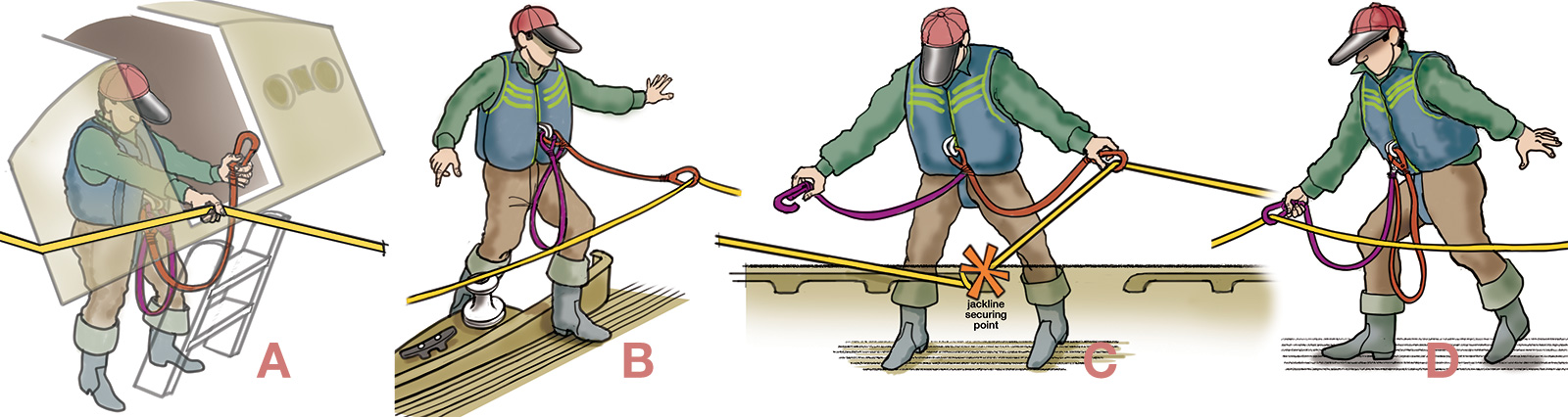
Clip into the jackline with Tether One (A) from a secure place, ideally from the companionway. Move out of the cockpit and forward to the boundary of the jackline segment (B). Clip Tether Two into the
farther jackline (C)only then can you afford to release Tether One (D).

Move forward on Tether Two to the next affixed jackline segment.

When the foredeck calamity is resolved, return to the cockpit constantly clipped sequentially by tandem Tethers One and Two. Acknowledge unpredictability; stick around.

There is no single way to run your jacklines. The pattern in this illustration is used by Vince Todd (see WB No. 310), who is a Bermuda Race inspector, and it’s particular to his boat. The best pattern for your boat’s jackline will be suggested by its layout. Might you need additional padeyes to keep the jacklines central and the distance-to-overboard short? Perhaps.

The jackline is customarily made of tough webbing of prodigious strength, more than 4,000-lb test. It’s acknowledged that tether carabiners slip more easily on slick, malleable webbing than on rove or braided line. Some canny sailors rotate their jacklines into curls that stand; these are easier to pick up, provide smoother travel for the shackle, and the practice results in no change in strength. Webbing is interesting cordage. Unless you are singlehanding constantly, you will probably coil your jacklines for harbor sails and genteel jaunts. Because jacklines can be demanded quickly by weather or sea conditions, take special care in coiling them down. Once confused, webbing is devilishly difficult to unsnarl. We recommend large, regular coils secured with sea gaskets. Coiling webbing is best done with alternate coils: as a forward loop, then as a backhand loop. Some jacklines have end fittings, but since they should be set up all a tanto (taut, in old sailor’s tongue) they can be tensioned and snugged with familiar cleat hitches. Jacklines are subject to sun damage; regular testing and replacement on a sensible schedule is essential.

Traditional webbing safety harnesses were often handsewn and simple. Presently, however, outfitting yourself with a high-performance Personal Flotation Device (PFD) that doubles as a harness is a crucial investment in your own longevity. Current PFD technology yields a remarkably comfortable rig that won’t cramp your movements; these devices are easily donned, and easily hung below. They’re not cheap, but you’re betting your life; think of them as a sailing tax. Look for a self-inflating mechanism that operates with hydrostatic pressure (in 3″ or 4″ of water). There are manually inflated rigs, but you won’t be able to inflate one of those after you’ve been knocked unconscious by a boom. There are rigs that inflate if their triggers get wet; we assume you’re on the foredeck in lumpy weather being soused by wave action and having your PFD suddenly turn you into a large balloon is contraindicated. Good PFDs have integral lights to make you visible to a spotter at night and a reinflation tube so you can keep the pressure up. The best rigs have a crotch strap that ties you and the PFD together vertically but needn’t be uncomfortably tight. Newest PFDs have a spray shield you can pull over your face; surface waves and hard spray in high winds can be deadly.

Your PFD probably has a simple plastic snap that closes to bind it over your chest. The double D-rings that mate you to the tethers should never be used singly; always clip through both! A harness vest pulled by one D-ring will overstress the plastic chest clip and can pull the PFD off. Some newer PFDs use “soft” high-strength webbing D-rings instead of metal hardware; the tension tests prove they’re reliable, and lighter and less bulky than their metal counterparts.

Commercial tethers customarily have a Y pattern: a tough shackle at your PFD D-rings is bound to a pair of tethers with one-handed terminal shackles. The tethers aren’t of equal length. The longer tether is easier to use when traveling fore-and-aft, but when you reach a point that needs your attention, you’ll clip into a “local” strong point with the shorter tether. Leaning against the short tether offers stability and both hands free. Long tethers sound convenient, but they can be treacherous: limit your scope.

You boat is churning along with a good breeze. Iron Otto (the autopilot or wind-rudder) is at the helm and you step forward to check for chafe. Crikey! A capricious wave overcomes your balance and you fall over the lifeline and into your boat’s hull wave. Smart you, you’re clipped onto the jackline! If you hit the water and discover your tether was too long, you are in jeopardy, being jerked along at 6 or 7 knots with the seaway tearing at your arms and legs, the inflated PFD imposing major water resistance, threatening to drown you. Hoisting yourself up onto the deck by force will be harder than you expect. This isn’t a mere wetting; it’s a mortal emergency. We’ve lost shipmates, good sailors, this way. In leisure at the dock, at anchor, with mates, check the play in your jacklines and tethers. Their work is not to get you back aboard the boat; their work is to keep you connected to the boat and out of this killing sluiceway.

Some PFD chest shackles have an escape function to use if you’re being dragged beside the boat by your tether, or if your boat is sinking and the jackline is taking you down with it. A single pull will free you. You’ll then be floating handsomely via a fully functional PFD with a water-activated light. The alternate release is a sailing knife that will cut through the tether in one motion.

As described in the previous issue (WB No. 310), your PFD-assisted buoyancy is the play between your weight vector downward (N, a force measured in newtons) and the upward vector of the PFD’s lifting force (FB, also measured in newtons). The desired result is FB > N. Review the chart in the previous issue to determine how many newtons your particular body—and waterborne pursuit—require. Choose your PFD accordingly.  Article ends.


Jan Adkins is a regular contributor to WoodenBoat. Visit his blog, Dockwolloping (www.dockwalloping.boats), for more insightful illustrated discussion of all sorts of maritime matters.

Special thanks to Vince Todd for providing insight on current best practices.