43′ INTEGRITY.Hugh Coulson

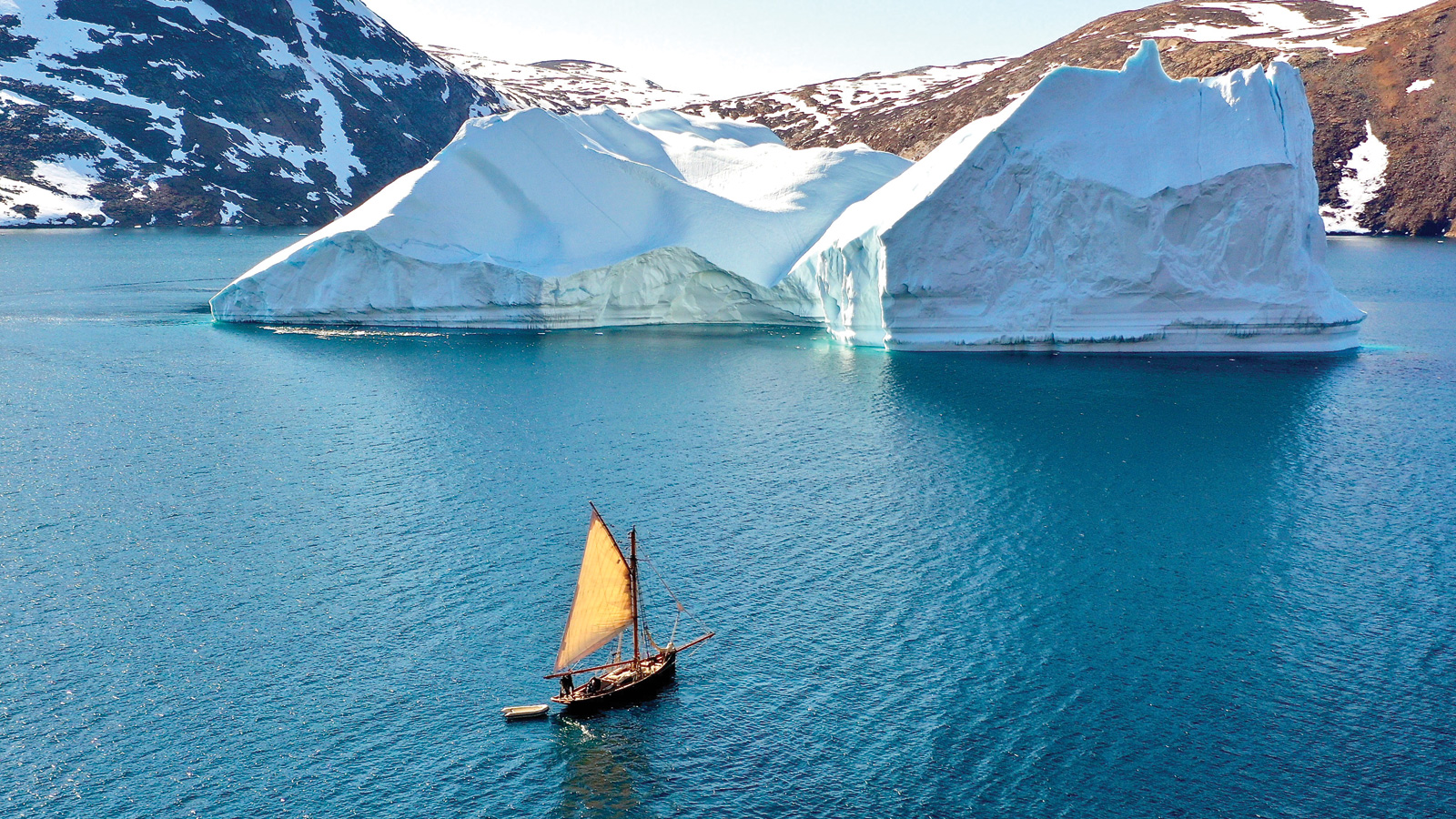
INTEGRITY, 43′ LOD, was conceived for high-latitude sailing and a transit of the Northwest Passage. This photograph shows her sailing among icebergs in northwest Greenland early in her 2023 east-to-west voyage via the fabled passage.

It is a common escape to have expedition ideas by the fireside, all the more so when a dram of whiskey is involved. One can happily hold forth about the trials of sailing to Jan Mayen Island, a Norwegian island at 70°59′ north latitude northeast of Iceland, and summiting the island’s Beerenberg volcano, secure in the knowledge that one will probably never own a vessel suitable for voyaging there. If, on the other hand, one happens to have a perfectly capable boat, be either careful what you say or be sure to wear an edible hat.

With INTEGRITY, my objective was to conceive, design, and build just such a boat, one meant for high-latitude sailing, and specifically for a transit of the storied Northwest Passage across North America. Yacht design is diverse; boats are a matter of taste. Yet I had an awareness of what might be in store, having previously sailed on three expeditions to the European Arctic and one in the Canadian Arctic. Design is also a compromise, and my restrictions were these: she must be a beautiful vessel that would be exciting to sail and be seaworthy. As a starting point, I chose the class of straight-stemmed British sailing yachts of the 1880s, the “gentleman’s cutter” of the Victorian era, a type that I find particularly graceful.

The yacht was designed by Will Stirling.Will Stirling

The yacht was designed by the author and built of English oak at his shipyard, Stirling and Son in Plymouth, England, where she was launched in 2012.

She must also be comfortable to live on, capable of being handled by two experienced sailors on watch. She must be of sufficient size (ultimately 43′ LOD, 37′ LWL, with a beam of 11′ and draft of 7′6″) to accommodate a strong expedition crew when sailing in high latitudes, built for strength and longevity, and suitable for worldwide cruising that could include small-scale icebreaking if needed.

She must, in addition, be well balanced. A well-proportioned hull with an appropriately designed rig will give the helmsman a feeling of responsive control in any circumstances. INTEGRITY, as designed and built, has a great deal of canvas—2,000 sq ft in fine weather. However, she is not an uncompromising plank-on-edge racing cutter, like some of her precursors. Her hull has integral form stability with ample beam and firm bilges that help her stand up to her rig. Her sections show a clean run aft culminating in an elegant counter with enough V-section to cleave the water and lift when running before a sea. Her forward sections are fine enough to be driven through the waves, yet her forward reserve buoyancy is good. She retains enough forefoot to grip the water when hove-to. Under inclement conditions, with the bowsprit reefed—meaning retracted and housed on the foredeck—and the topmast likewise housed, she can be snugged down to a quadruple-reefed main with a storm jib. It is important to have confidence in a boat’s ability to remain comfortable and safe when the weather deteriorates.

INTEGRITY was laid down and built over less than 18 months at our small shipyard, Stirling and Son, at the No. 1 Covered Slip in Plymouth, England (www.stirlingandson.co.uk). We used seasoned English oak, copper and bronze fastenings, and 4.25 tons of external lead ballast. At her launching in 2012, she was christened by my mother, Elizabeth Barlow, in the same shipyard where one of our forebears, who had the same name as my mother, christened an 80-gun ship-of-the-line in 1798 that went on to serve as Adm. Horatio Nelson’s flagship in the Mediterranean.

After launching, there was no rush to depart—we would go when we were capable, always keeping the words of Norwegian explorer Roald Amundsen in mind: “Victory awaits he who has everything in order; some call it luck.” It was Amundsen, with the 60′ cutter GJØA, now in the FRAM Museum in Oslo, Norway, who first successfully completed the Northwest Passage transit in 1906. By 2000, 90 vessels, taking advantage of Arctic warming and reduced sea ice, had transited, and at the time of this writing an estimated 400 vessels—including ice-breakers, ice-class ships, submarines, yachts, and even a dinghy—have made the journey.

Five years of use in all seasons and within hailing distance of the shipyard allowed us to test INTEGRITY and make improvements, and in those trials we also taught ourselves how to sail her. Much was altered and refined. Things were worked and reworked until the standard refinement phrase became, “If a job is worth doing, it’s worth doing twice.” Some of these revisions were specific to the envisioned Northwest Passage transit: sheathing the hull in copper plating, installing effective cabin heat, adding a simple square sail to our rig, and developing ways to easily strike and house the topmast to reduce weight aloft.

Copper Hull Sheathing

INTEGRITY’s hull was sheathed in copper plating and a cast-iron stove in the main saloon.Will Stirling

Left—INTEGRITY’s hull was sheathed in copper plating to resist ice damage and marine borers. Right—A cast-iron stove was installed to keep the main saloon comfortable and a cup of tea close at hand.

One of the final shipyard jobs in Plymouth was to haul INTEGRITY in the slipway and fully copper-sheathe her hull below the waterline. This not only protects her hull against fouling—even thwarting the teredo worms that could be a threat in any warm country we might wash up in—but also protects the planking against the thin ice that forms on the surface and can cut through planking like a hacksaw. This is not to say the sheathing protects against pack ice, which poses grave risks when struck at any speed.

The work started a few inches above the waterline with a small amount of sheer added to that line forward and aft. The 2′×4′ plates overlap fore-and-aft like fish scales, shedding water as the hull moves forward just as scarf joints are oriented so that water runs by instead of into the joints. Often one sees the lower plates overlapping the upper ones; however, we avoided this arrangement because we knew that the boat would probably be hauled out in winter in very cold environments. In that circumstance, fresh water from occasional rain or thaw could run off the deck and down the topsides, where it could find its way between the plates. With a return of cold weather, that trapped water could freeze, and its expansion could blow plates off the hull. To avoid this, INTEGRITY’s higher sheathing plates overlap outboard of the lower ones, like slates on a roof.

The plating at the waterline, at 1.2mm (³⁄₆₄″), is thicker than the lower plating of 0.9mm (¹⁄₆₄″). All of the plating is semi-hard except where it had to be annealed to persuade it to conform to the complex curves of the tuck. In these awkward areas, the plates were shortened to 2′× 2′ instead of 2′×4′. The after face of the sternpost and the leading edge of the rudder were coppered during construction so that the rudder wouldn’t have to be unshipped to do the work.

Cabin Heat

INTEGRITY has a cast-iron, solid-fuel stove fitted onto a bronze shelf in the main saloon. The flue has a kink, with two 45-degree bends, to promote dissipation of the chimney heat inside the boat rather than allowing it to quickly escape straight up. Ready fuel is stored nearby in a barrel. Foraging for wood and mining for coal are two good ways to keep a crew busy in harbor, but north of the treeline, where the land is locked in permafrost, appropriate and plentiful supplies must already be aboard.

The boat also has two repurposed Land Rover fan heaters connected to the engine calorifier take-off. They are fitted strategically, one in the forepeak and the other near the companionway aft, to dry out the ends of the boat. They have also proven effective in quickly drying wet clothes. This system is fitted with a bypass so that the engine can still operate if something goes wrong with the heating system.

Square Sail

When sailing gaff rig off the wind in a swell, even a well-steeved-up boom is apt to dig into the odd sea to leeward. As the boom drags aft in the sea, the mainsheet slackens and then thumps back into position when the boom resurfaces, sending a shudder through the boat as the wind takes charge again. Sailing off the wind inevitably causes weather helm, and sailing dead downwind risks an unintended jibe.

Our 440-sq-ft square sail has none of these issues, plus it causes little chafe or stress on the rig. This is a lifting sail, and it is its own self-steering device. It has become a much-relied-upon part of her INTEGRITY’s rig.

There are many ways to set a square sail, but we found that simplicity is a virtue. Our method relies on only four lines and a halyard. The sail head is twice the beam of the vessel, and the 24′-long spar is 18″ longer than the head of the sail. The spar has a single eye mounted amidships to receive the halyard. A control line made off to the port end of the yard is long enough to reach the deck when the sail is aloft, allowing for slack. A tensioning line is shackled to the forestay, laid over the yard to the port side of the central eye, and is long enough to reach the deck when the yard is aloft. Before hoisting the sail, the bitter end of the tensioning line is tied loosely to the mast spider band.

The sail has no head lacing; short earrings attach the upper corners to to the spar and serve as outhauls. At its midpoint, the sail is shackled to the spar’s central eye.

When not in use, the sail and yard live on deck to port, secured in a pair of spar irons. The after iron is a full ring, and the forward one is U-shaped, open at the top. These irons keep the spar captive and elevated far enough off the deck to allow water to run off underneath. The sail remains tied onto the yard, and a generous sail bag is slipped over the assembly, with the open end facing aft to avoid taking in water.

A view from aloft and on the right the rigors expected on the Northwest Passage crossing.Will Stirling

Left—A view from aloft shows the tapered and semi-swept deck planking, inspired by the Victorian aesthetic of the yacht’s forebears. Right—Preliminary cruises in northern Iceland helped prepare both boat and crew for the rigors expected on the Northwest Passage crossing.

To hoist the sail, the bag and sail stops come off and are stowed in a barrel, so we know where to find them later when striking the sail. We don’t fly the square sail and the staysail at the same time, so the staysail halyard is available for hoisting the square sail. We make off the halyard to the spar’s central eye while the spar remains in the spar irons. To raise the sail, one person hauls the halyard enough to take the weight of the spar while another person keeps hold of the after end of the spar and walks it forward, more or less cock-billing the spar fore-and-aft. When the after end clears the rigging, it is released, and the halyard brings the yard parallel with the sea and set athwartships for the final hoist to just below the forestay splice.

The end of the tensioning line that is shackled to the forestay rides up the stay as the yard is fully hoisted, after which it is pulled tight to the foot of the mast, thus holding the yard in position so that it cannot bang against the mast. The port control line is loosely made off to the pinrail.

To keep the rigging simple, we decided against using braces and lifts. Braces might lead from the yard ends, via the forward end of the bowsprit and back to the main shrouds to adjust the sail athwartships; lifts, turning through blocks high on the mast and brought down to the pinrail, control the height of the yard ends. For our sail, the sheets control the sail and the yard and are used to brace the yard around, even when sailing to windward. We also rigged a midsheet, controlling the center of the foot of the sail.

To douse the sail, the port control line is hauled down, which cock-bills the yard once again and scandalizes the sail. Then the halyard is lowered until the end of the yard comes within reach of the person on the control line, who gets hold of the spar’s end and walks the yard aft down the port side and guides it into the spar irons. Having the spar on deck reduces weight aloft and greatly simplifies striking and housing the topmast, which is only sent aloft when we set the topsail in light winds.

Through trial and much error, agonizing, and thought, two steps forward and one giant leap backward, we found ourselves with a workable solution.

Preparatory Voyages from Iceland

Ice floes gave the crew a chance to stretch their legs.Will Stirling

Ice floes gave the crew a chance to stretch their legs, while keeping an eye on the seals which, in turn, were keeping an eye on the polar bears.

After sea trials in Plymouth, INTEGRITY spent five years in Iceland, with a number of summer voyages—during which we did reach the Jan Mayen Island of our fireside imaginings and scaled that volcano.

These years in northern Iceland brought a different type of preparation and training. Each successful voyage cultivated a deepening assurance in the qualities of the boat and the crew. Crucially, we gained experience navigating in ice. By managing the boat when we were tired, cold, hungry, and at times frightened, we also learned about ourselves.

After each voyage, the need for “spares and repairs” was clear. There is an Inuit saying: “It is never wise to get too confident in the Arctic.” Far from help, we would have to be able to service, maintain, and repair the boat and have the tools and parts to do so. Iceland also brought a key element of great value: friendships with, and advice from, those with Arctic experience.

INTEGRITY was hauled out at North Sailing’s slipway in Husavik and painted black for Arctic work. In fall 2022, we sailed for Lunenburg, Nova Scotia, where we could haul out in an area with infrastructure and expertise for a thorough inspection and refit before attempting the Northwest Passage the following season.

INTEGRITY sailiing along a wall of ice.Will Stirling

During a passage along eastern Greenland, INTEGRITY sailed along a wall of ice, carefully selected for its low-gradient, and therefore stable, glacier snout.

Crew

A critical element of any journey is the team. From the beginning, the crew was carefully selected for experience and skills. Most of us had already sailed with INTEGRITY in the Arctic, but we organized a course in cold-water survival and high-latitude first-aid, doubling as team-building. Crew members were delegated to organize specific areas. Due to the remote locations to be transited, the hope was that once the journey had started, we would have the equipment and ability to adapt.

The most important element was temperament: team dynamics were vital to success. The plan was to divide the voyage into three legs of between four and six weeks each (see sidebar). We planned to rotate crew; if we misjudged the dynamic, each team would have “a light at the end of the tunnel.”

Our experience was similar to one that was well-stated by the British explorer Edward Parry on December 31, 1821, during his expedition with HMS FURY and HECLA, at Winter Island off the Melville Peninsula, setting a record for the farthest-north voyage that stood for 50 years: “With our time thus occupied, our comforts so abundant, and the prospect to seaward so enlivening, it would indeed have been our own faults had we felt anything but enjoyment in our present state, and the most lively hopes and expectations for the future.”

I am proud to report that in INTEGRITY’s 6,000 miles of travel, there was no regrettable conduct or serious problems with the boat. We had delicious meals, warmth, and a sense of achievement. We had friendly advice; the unsolicited kindness we repeatedly met during our tour around the top of a continent made a lasting impression.

We reached Nome, Alaska, on September 16, 2023, and INTEGRITY is hauled out for the winter as of this writing. But rather than any distance made or destination reached, I would hold that measured, calm, and considerate behavior was our greatest collective achievement.

The path of the Northwest Passage

First Leg — Nova Scotia to western Greenland

On June 1, INTEGRITY set sail from Lunenburg. By dark, we were roaring up the Nova Scotia coast. The crew of four was divided into two watches; one to steer and one to pump. By the time the small electric bilge pump failed and the rebuilt engine-driven emergency pump had broken down, the off-watch team was pumping every 10 minutes with the manual pump. In our first night, we had covered only 20 miles of 6,000, with no sickness but a general distaste for the job in hand.

The most immediate issue was leakage in the topside seams, the topsides having been “refinished” by the yard. As the wind increased and the sea rose, water ingress continued, and then the gaff jaws came adrift. On the face of it, finding a harbor seemed a sensible proposal, but I felt that first we might try to tackle our problems one-by-one and then reassess.

On we sailed for 100 nautical miles to the rural quay at Fisherman’s Wharf, Nova Scotia. Readily supplied with lobsters by the kind fishermen, we set about refitting the refit. There was much to rectify to address the poor work. We payed the topside seams with linseed wax until they swelled shut and later refinished the topsides afloat. There is some benefit in traveling with your own shipwrights; the adage, “If you want a job done properly, do it yourself,” comes to mind and we will now only use our own shipwrights wherever the boat is in the world. With the boat back in first-class condition, by mid-June we encountered our first ice, thick this year, in the Strait of Belle Isle between Labrador and the mainland, and in short order the southern edge of pack ice hove into view. We elected to sail 700 miles across Davis Strait to Greenland. Having turned off the GPS before departure in order to better develop our traditional navigation skills, we navigated by dead-reckoning augmented by sextant sights when the sun was visible. Venus and the moon also helped. As we proceeded north, we entered the land of midnight sun.

After six days at sea, the fog peeled back to reveal Greenland’s snowy mountains. Through fjords and among offshore islands, we worked our way north. Wildlife included eagles, an Arctic fox, an Arctic hare, and one muskrat. With no darkness, sleep patterns became erratic. We might tackle a mountain at midnight and have breakfast in the afternoon.

On reaching Disko Bay, Martyn Oates, in a joke of considerably patient gestation, produced a mini disco ball. The increasing ice became tricky at times, with narrow anchorage entrances and grounded icebergs.

We arrived in Ilulissat in time for the first crew change.

Traditional navigation method.Kev Oliver

The crew chose to use traditional navigation methods in the land of the midnight sun.

Ice floes threatened to push the boat ashore.Kev Oliver

Ice floes threatened to push the boat ashore.

Second Leg — Greenland to Resolute, Nunavut

Approaching the North Water, we waited for the pack ice in Melville Bay, Greenland, to dissipate, spending almost a week near a landmark called The Devil’s Thumb, where crew member Kev Oliver led a climb but turned back for lack of rock-climbing gear. Despite the 24-hour sunlight, in one bay the sea settled into pancake ice by early morning.

The saloon’s cast-iron stove proved crucial to our comfort. We had a quarter of a ton of anthracite, the only coal we could find, but burning it required constant and fawning attention. The solution came when Owen Nye took a sack of it ashore and individually hammered the lumps into pebbles, using a frying pan as an anvil.

On our approach to Canada, we meandered for three days through ice in persistently thick fog, with blue sky above the masthead and the appearance of fogbows. We used the sun at local midnight sun sights to determine true north; the variation between the magnetic pole and the geographic pole increased to almost 40 degrees, and one chart noted “magnetic compass useless in this area.”

INTEGRITY’s saloon (left) and the Devil’s Thumb in northwest Greenland (right).Will Stirling

Left—The comfort of INTEGRITY’s saloon provided ample opportunity for constant planning and replanning route options. Right—The Devil’s Thumb in northwest Greenland gave the crew a chance for a shore excursion.

Following the retreating pack ice edge west along Lancaster Sound, Nunavut, we took shelter from stronger, cold winds in Erebus and Terror Bay beside Beechey Island. This was the 1845 winter refuge of the Franklin Expedition, which ended in disaster; all hands of the Royal Navy ships EREBUS and TERROR were lost, and the fate of the long-sought ships was only settled when Parks Canada archaeologists found the wrecks in 2014 and 2016, respectively. From Franklin’s cairn, we surveyed the ice ahead. We found a route to Resolute Bay, sailing often with Hugh Coulson aloft directing us through floes.

Within six hours of anchoring in the bay, wind shifts surrounded the boat in ice and dragged her toward shore. After we extricated ourselves, a local hunter guided us to a partially sheltered cove, where we were able to pole the more threatening ice away from the boat. Heeding more local advice, we moved to a secluded bay near Resolute, where the Royal Canadian Mounted Police detachment kindly facilitated the final crew change.

Third Leg— Resolute Bay to Nome, Alaska

The single square sail and the Northern Lights.Will Stirling (left), Hugh Coulson (right)

Left—The single square sail proved its merit time and again, here while transiting the Bering Strait. Right—The Northern Lights put on a wonderful cascading display near Point Barrow, Alaska.

We remained cornered near Resolute for five days; we couldn’t even leave the boat because of the sea state. With 36 hours of moderate weather predicted at last, we set out for Peel Sound, a crucial milestone because it is an ice choke point. The later it opened, the later in the season we would emerge in Alaska and the greater the probability of autumn trouble in the Bering Sea.

Through Peel Sound, the St. Roch Basin, and Rae Strait, we reached Gjøa Haven, which Amundsen found in 1903 and called, “The most perfect little harbor in the world.” He wintered there for two years. From there, we negotiated Simpson Strait, the narrowest part of the Northwest Passage and the site of the Franklin Expedition’s last stand in the somberly named Starvation Cove.

We had a good square-sail run out of Dolphin and Union Strait. This was the final narrow passage between mainland North America and the Arctic Islands, leading into the Beaufort Sea. With the weather boisterous again, we careered into a lovely bay that protected us during a six-day gale. One day, we were able to get ashore by dinghy and walked 7 miles to a river. We fished, with no luck, but it was good to be out in the low-lying desert of brown gravel, with subtle changes in the light, as far as the eye could see.

We had completed one-third of our distance in two-thirds of our allotted time. Patience is said to be an essential trait of the Arctic traveler; with 1,500 nautical miles still to go, we kept busy while waiting for the opportunity to press on.

INTEGRITY with two reefs in the mainsail.Will Stirling

With two reefs in the mainsail, INTEGRITY endures cold, blustery weather in the Beaufort Sea.

The gales abated, allowing us to sail 750 miles to Point Barrow, Alaska. We stopped briefly at Tuktoyaktuk, Northwest Territories, which is the terminus of the ice road, where hospitable rangers were packing up after the summer. It was a helter-skelter journey in order to make the most of the reasonable weather to reach the Beaufort Sea. Shallows were common; we became used to approaching land in 4m (about 13′) of depth.

We were entering U.S. waters; the chart conventions for soundings changed, and the compass became more useful; the variation shifted to east 9 degrees as we moved west past the longitude of the magnetic North Pole. We attempted to stop at Kaktovik, Alaska, but it was too shallow. As two polar bears played in the water nearby, we set off for Point Barrow. We were rationing fresh water but had delicious cooking, and a northern lights display.

At Barrow, Alasdair Flint and Dan Curgenven landed the dinghy on an open beach to take on fuel and water and were twice swamped in the surf, with water temperatures at 1.5°C (34.7°F).

The final leg was 550 miles across the Chukchi Sea and through the Bering Strait, south past Icy Cape and Point Hope under the square across the Arctic Circle, through the 2-nautical-mile gap between the two Diomede Islands, the eastern one U.S. territory and the western one Russian. On September 16, we reached the safety of Nome, where INTEGRITY is overwintering.

—WS

  Article ends.


Will Stirling was educated at Eton College before taking an apprenticeship as a wooden boat builder in 2000. In the intervening years, Stirling and Son has become one of the leading shipyards for European classic yacht and traditional workboat construction and restoration. For more information, see www.stirlingandson.co.uk.

In addition to the author, the crew consisted of Tim Marchant, Luke Browne, Martyn Oates, Kev Oliver, Hugh Coulson, Sara Stirling, Owen Nye, Dan Curgenven, Arthur Hamel, and Alasdair Flint. The author extends his thanks to all for putting up with everything expected and unexpected in such an affable manner, and to those we encountered who shared knowledge and experience.