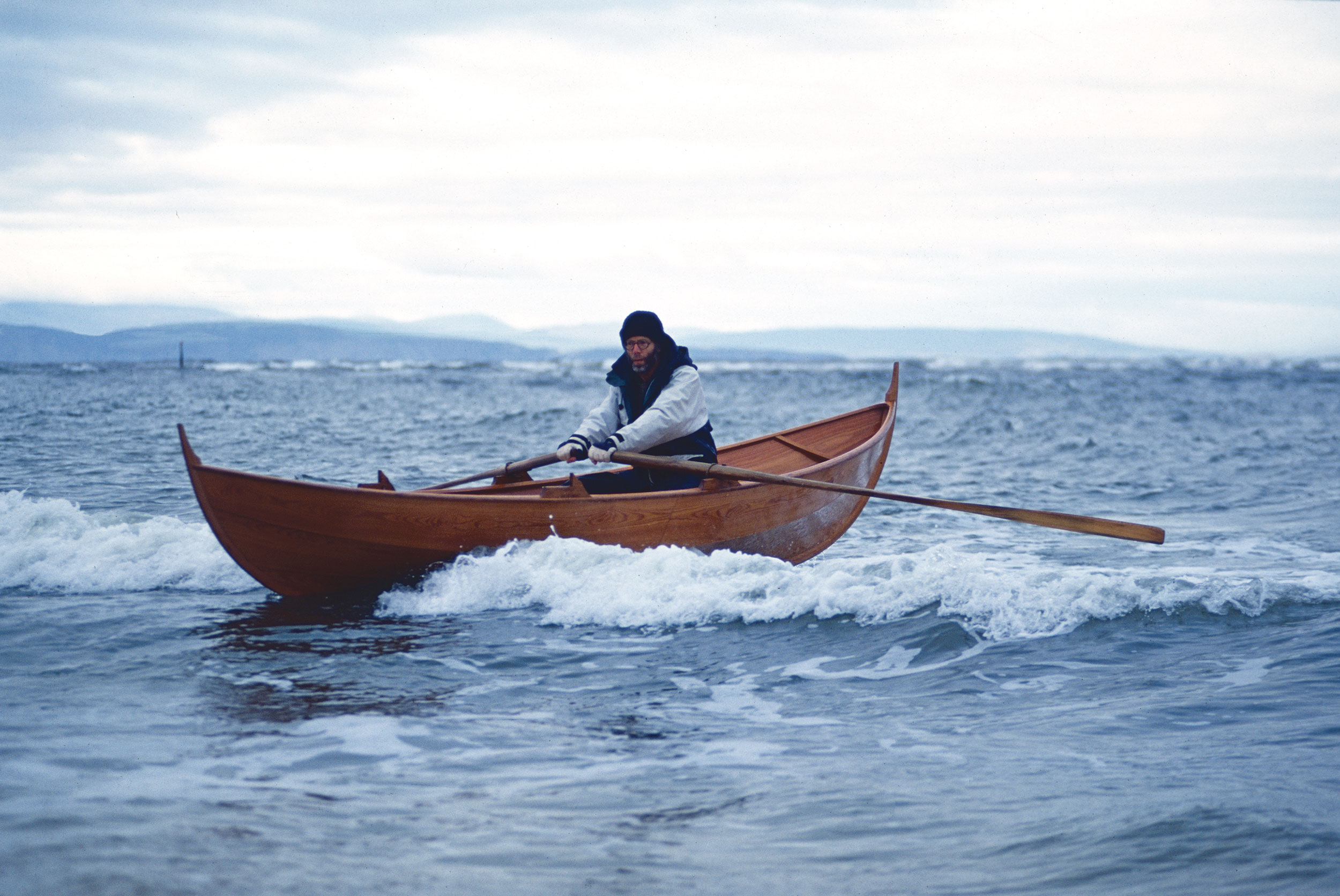
Iain Oughtred wearing cold-weather clothes rowing an Elf faering.Nic Compton

Iain rows MAIREAD near his former home in Findhorn, Scotland, in 1990. The boat is of his Elf design, which is based on Norwegian faerings and rooted in the Viking Age.

It’s more than 100 miles from Inverness to the Isle of Skye, in Scotland. That’s a two-and-a-half-hour drive through some of the most spectacular scenery in Europe: along the shores of gloomy Loch Ness, through Glenmoriston and Glen Shiel, with their roaring rivers, crashing waterfalls, rustic cottages and, to top it all, elegantly poised stags gazing disdainfully at the road. It’s as if you’re driving through a tourist brochure for the Scottish Highlands, except that it’s for real. And then at the end of it all, the sea—vast, constant, and omniscient.

For the past 20 years or so, this was the route most people wanting to visit the small-boat designer Iain Oughtred had to take. It’s long, it’s laborious, it’s stunning—and somehow it seemed a very appropriate home for such a shy, modest man, dragged into the limelight almost despite himself. For Iain never made things easy for himself, so why should he have made it easy for his visitors? If you want an easy life, get someone else to build a boat for you. If you want to build a wooden boat yourself, particularly an Oughtred design, then it’s going to take a long time, it’s going to be laborious, and it’s going to be stunning. That’s a choice you make.
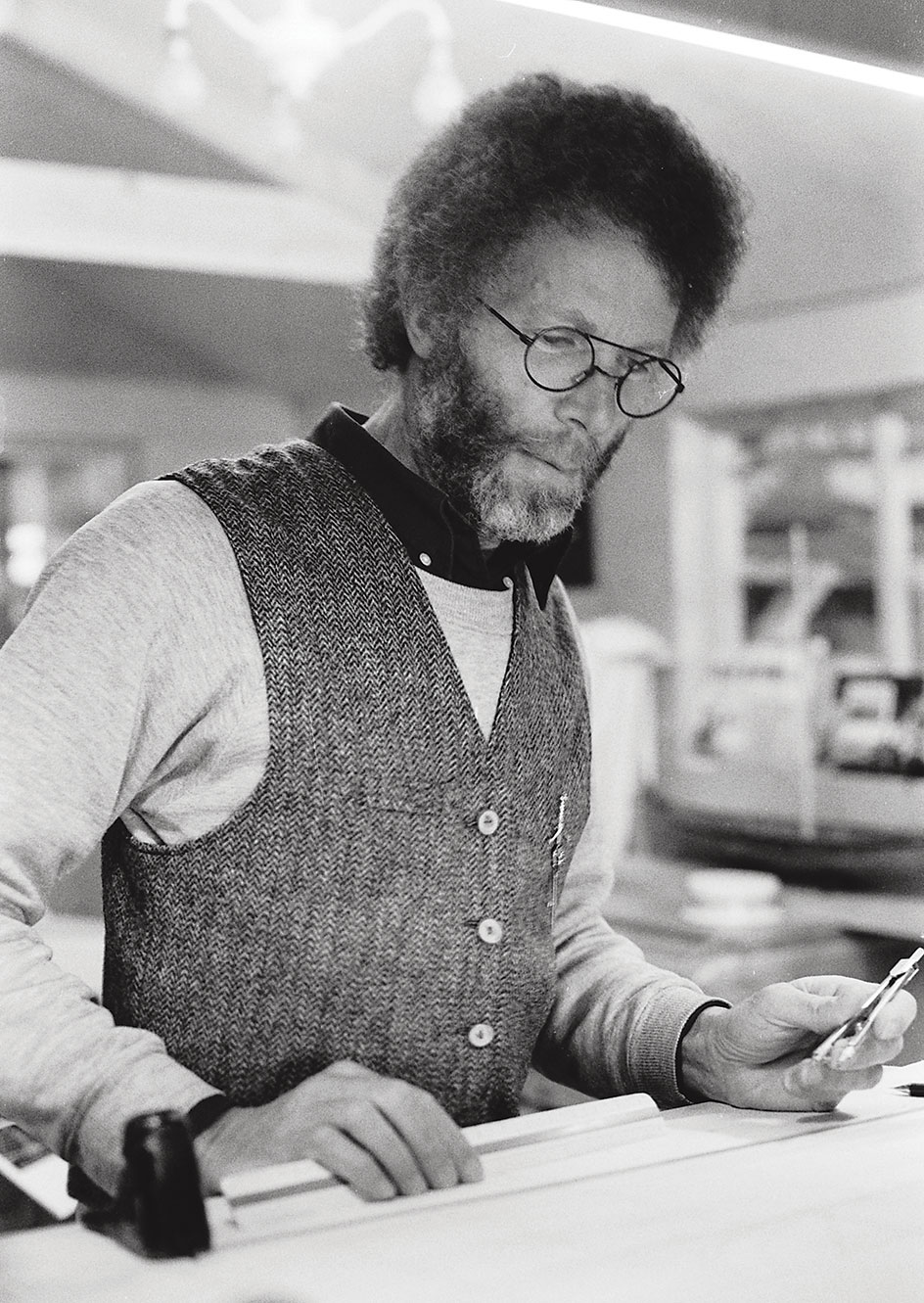
Iain Oughtred wearing glasses and a button-down vest at his worktable.Nic Compton

Iain Oughtred (1939–2024) designed exquisite small craft, mostly of glued-lapstrake plywood, derived from historical boat types.

I first met Iain on the lawns of the National Maritime Museum (NMM) in Greenwich, England, in the early 1990s. The occasion was the annual Greenwich Wooden Boat Show, which ran for 12 years before being moved to Beale Park, farther upriver on the River Thames. He was already well established in the wooden boat world, having designed a range of traditional dinghies, including several skiffs, dories, and canoes for glued-lapstrake construction. Even then, he had a slightly mysterious aura, an inscrutable manner that often left me fumbling for words. Still waters run deep, they say, and Iain could certainly be quiet when he wanted to be.

It was the Caledonia Yawl that really caught my eye and made him stand apart from the growing number of designers and builders jumping on the retro-boat bandwagon. It began with a few awkward chats on the lawn of the NMM, when I was deputy editor (later editor) of Classic Boat magazine. Eventually, I plucked up the courage to ask him to judge our annual amateur boatbuilding competition and, to my surprise, he accepted. So began our friendship. In 1999, I went to Findhorn, the Scottish town where he was then living, and interviewed him for a three-part article in the magazine. Then, in 2008, I visited him again, this time at the Isle of Skye, to interview him for a full-length book about his life and work.

Caledonia Yawl design and three sailing boats racing in the water.Iain Oughtred Estate (design), Nic Compton (photo)

Left—Like several of his designs, Iain’s popular Caledonia Yawl has Norse ancestry. Its clean, frameless interior, high volume, and good sailing qualities have made it a popular camp-cruiser. Right—The Caledonia Yawl GJOA won the 2003 Blekinge Archipelago Raid.

I took a bus to the island, past all that dramatic scenery, and stayed for four days with Iain in his little cottage a few miles from Portree, on the east coast of the island. Almost from the moment I arrived, the visit provided numerous insights into Iain as a person; the real man behind his reclusive-artist persona. I included some of my observations in the final chapter of the book:

After a quick tour of the cottage, we sit down in the kitchen. Iain has made a vegetarian stew, with great chunks of vegetables in it, which he dishes up and picks at judiciously, while I wolf mine down greedily, eating twice as much as he does. We open the red wine I’ve brought, and he sips modestly at his half-glass, while I soon guzzle half a bottle. He speaks quietly about how he came across the cottage and about spending days moving the boatshed into position; I blather on about my new flat and the difficulties of juggling multiple responsibilities.

While I stay there, we each eat and drink from one bowl and one cup, and use one set of cutlery. Like Iain, I strip-wash at the sink and pee in the garden. Although, at just over 6′ tall, I am about the same height as Iain, I consistently eat about twice as much as he does and drink twice as much, too. At home, I am regarded as an introspective non-consumer; here I feel like a loud-mouthed glutton. […]

Iain’s needs are minimal, and he has exactly what he needs to eat, sleep, and stay warm—no more and, just occasionally (it seems to me), a little less. It’s as if he’s measured what his bodily requirements are and is determined not to consume an iota more than he needs, and that includes food, warmth, space and, arguably, love. It’s a skill learned from years living on the breadline and devoting himself to artistic and intellectual pursuits, when there was little leeway for self-indulgence. And of course it comes from his spiritual beliefs: from the Presbyterian regime enforced by his father, through to the earthly release of transcendental meditation, and the simple sobriety of his Quaker faith.

The story he told me during those four days was a complicated one, full of restless movement, of constantly moving from one place to another, of trying out different things, of striving, of being thwarted again and again. He remembered in astonishing detail the races he had competed in half a century ago and described them, tack by tack, along with a forensic analysis of every boat he ever sailed. He was surprisingly open about his personal life and the difficulties he experienced as someone with autism, as he diagnosed himself. It’s a story that was and is worth retelling.

Small white sailboat sits anchored among large rocks.Mikhail Markov

KOTIK, a 22′ centerboard pocket cruiser, is a stretched version of Iain’s 18′ 6″ Wee Seal design.

Iain was born in Melbourne, Australia, on September 15, 1939, the eldest of seven children. His father was the manager of a scientific-instrument company. His mother was a big reader and deep thinker, although somewhat overwhelmed by the relentless demands of motherhood. Neither parent was a sailor, but the family moved to Sydney when Iain was 10, and he and his brother David soon caught the sailing bug. As a member of the Mosman Amateur Sailing Club, Iain raced a variety of dinghies, eventually settling on the Gwen 12. He not only raced these boats successfully but only built several of them—three for himself and four for other people, two of which won national championships. He eventually became the class measurer for the association.

After a two-year stint in Europe, including a fateful visit to Scotland, he returned to Australia and got a job as a draftsman at Cecil E. Bowden & Associates, a naval architecture firm in Sydney. There, he published his first set of plans: an 18′ pocket cruiser called Happy Jack and intended for amateur construction. But it was while on a second trip to Europe that Iain really found his calling, when someone gave him a copy of The Common Sense of Yacht Design, by L. Francis Herreshoff. The beauty of the designs (and no doubt the drawings themselves) blew him away, and he decided then and there to become a yacht designer.

A decade passed, however, before he found his niche. During that time, he designed half a dozen unexceptional modern cruising boats as well as a couple of Moth dinghies. He also went on a road trip of the United States, meeting several eminent yacht designers (not least Phil Bolger, who charged him $30 per hour for a consultation), and visited the offices of WoodenBoat magazine in Maine. There, he became fascinated by the rich diversity of traditional craft extensively documented in books by Howard Chapelle, William Gardner, and others. It was only natural, then, that when he returned to England in 1981 his first design should be that most quintessential of American boats: a dory. The 15′ 4″ Blackfish was the first Oughtred design available to the general public, and plans were offered in the back pages of Practical Boat Owner magazine at £15.

Green and white small wooden boat with a sailing rig on a trailer.Kathy Mansfield

The Whitehall-inspired Acorn series began life in the 1980s as a diminutive 11′ 8″ tender meant primarily for rowing; it sprouted into 13′ and 15′ versions that proved able under sail as well.

That was followed a year later by another U.S.-inspired design, the 11′ 9″ Acorn Skiff, closely based on the Whitehall type of rowing boat. Iain built the prototype during the winter of 1981–82 in a drafty shed in Cookham Dean on the River Thames. He had very little money and was living in a travel trailer lent to him by another fellow aspiring designer—the future multihull guru Nigel Irens, with whom he had shared a flat in Bristol the year before. It was a cold, hard winter, but Iain had a vision: to build a traditional boat in glued-lapstrake plywood, the material of the future, as he saw it. He was savvy enough to send some photos of his new design to the editors at WoodenBoat, who duly published an article, which described the boat as “a sweet-lined, slippery little jewel.”

The Acorn Skiff was followed by several variations on the theme, ranging from the 7′ 9″ Acorn pram to the 15′ Acorn 15. These were followed by his first canoe designs, the MacGregor and the Wee Rob, both with the option of a small sailing rig. Finally, he had his own small range of designs.

Iain Oughtred standing next to a MacGregor sailing canoe on a grassy beach.Kathy Mansfield

Iain’s MacGregor sailing canoe, designed early in his career, is based on a type popularized by the Englishman John MacGregor, who cruised Europe, the Baltic, and the Middle East in a variety of such double-paddle canoes in the late-19th century. The boat can be built in one of three lengths (13′ 6″, 15′ 8″, or 17′ 3″) from the same plans.

Iain’s relationship with WoodenBoat—and the United States generally—was cemented in 1986, when the magazine invited him to Maine for a three-month sabbatical, which eventually stretched to six months. Iain was in his element at WoodenBoat, helping out at the boatbuilding school, writing articles, making the most of the office’s research facilities, and trying out the various boats available at the waterfront. It was a rare moment of genuine happiness, when the perpetual misfit found himself in a place where he not only fitted but was liked and respected.

“It was wonderful to have him here,” says Jon Wilson, founder of the magazine and its editor at the time. “Everyone in our community loved his quiet demeanor and the simultaneously lovely and rigorous thinking of his design work, and I think it was an extremely fertile time in the evolution of his lapstrake plywood creations. It was wonderful to have him living among us, and we all still miss him.”

There was a concrete outcome from his time in Maine too: a new design for a double-ended cruising boat with Scandinavian roots. The Gray Seal (or Grey Seal in the British spelling) was completed two years later, and for many years it was, at 22′ 2″, his biggest design available for amateur construction.

Back in England, Iain was about to enter one of the most productive phases of his life. After decades of deference to American working craft, British traditional boat enthusiasts were finally waking up to the fact that their country had a wealth of indigenous craft worth preserving and emulating. The publication of Eric McKee’s Working Boats of Britain in 1983, with its wonderful contemporary illustrations, was a source of inspiration to many.

Small white sharpie sailboat on the water with two sailors.Nic Compton

Iain’s inspiration was not limited to northern Europe. Many years ago, he developed a fascination with the sharpies of Commodore Ralph Munroe. His Haiku, the result of that study, was featured in WB No. 278.

It’s probably no coincidence that, within five years of its publication, Iain produced his first fully fledged British design. The Caledonia Yawl was based on the working boats of Scotland, in particular the sixareens and yoles of the Shetland Islands—themselves imported (often literally) from Norway. Iain used his magic to pare the design down and simplify it for modern plywood construction. The result was a distinctive, relatively light, yet seaworthy day boat that could be easily trailered and yet was capable of coastal sailing.

Once again, Iain was absolutely clear about his objectives, as he told me in between sipping cups of green tea poured from a pot that he topped up repeatedly with hot water, occasionally adding fresh leaves.

“I had no intention of trying to design an actual Shetland sixareen,” he said. “The commission was for a glued plywood boat, with a completely different purpose to the original. It had to be lighter, more versatile, and with better all-round sailing performance—and simple to build. At the same time, I wanted to retain the graceful character and extraordinary seagoing ability of the traditional boats. The challenge was how to evolve tradition, and how far you should go. It’s easy to start with a Shetland boat, see ways to make it go faster, and then lose the whole point. But at the same time, if you’re designing a different boat for a different purpose, then it should look different too.”

The design struck a chord in the United Kingdom and overseas and went on to become one of Iain’s most popular designs. It no doubt helped that its launch coincided with the advent of the “raid” concept, whereby groups of open boats cruise and race in company, often camping overnight (see WB No. 187). The Caledonia Yawl, and all its descendants, was ideally suited for this role and turned out to be surprisingly fast too, usually ending up near the top of the leader board—including four wins at Sail Caledonia (formerly the Great Glen Raid).

It proved a rich vein, and over the years Iain designed many variations based on the original three “Shetland boats”: the Caledonia Yawl spawned the Caledonia Yawl II (with seven strakes per side instead of four); the Ness Boat spawned the longer Tirrik; and the Whilly Boat spawned the Whilly Tern (longer), the Ness Yawl (versions I and II), the Jeanie II (smaller), and the Arctic Tern (seven strakes).

Iain Oughtred wearing rain gear sails a Ness Yawl with a tree-lined shore in the background.Nic Compton

The Ness Yawl is Iain’s interpretation of the classic Shetland Ness yoles, which have buoyant ends and a shallow, rounded bilge. Iain’s boat has lower topsides than the originals, for better rowing. Here, Iain is sailing the Ness Yawl ALBANNAGH in the Irish Raid on the River Shannon.

His approach to designing such über-traditional boats, whether a Scottish sixareen or a Canadian canoe, was to acquire as much data as possible of existing craft, compare the data, and then use that information to develop his own interpretation of the type. It’s something we discussed when I interviewed him in his lonely artist’s garret (actually a small cottage, but it might as well have been a garret) all those years ago.

“There’s a moment of insight,” I wrote in my book, “when we talk about his Beaver design, a 16′ Canadian strip-planked canoe commissioned by McNulty Boats. How does he go about designing something as quintessential as a canoe, I ask, when surely every type of canoe has already been produced? How can he find anything new to say about it? ‘With a Canadian canoe, I don’t want to bring anything new to it,’ he answers, ‘I just want to get it right, to get it as it should be, to make the archetypal Canadian canoe. All variations and designs are evolving towards the perfect canoe, and that’s what I’m trying to achieve.’

“He then pulls out a book of canoe designs and flicks through the pages, pointing out the different shapes, how one is too rounded in the ends, another too flat; one has too much sheer, another too little. I’m astonished at the amount of variation between what initially seems like a single design. Bit by bit, I see what he is getting at, and I see that there really isn’t a perfect canoe. I realize that the boat he has drawn really does seem to incorporate all the best features of the boats he has shown me, while at the same time having its own individual identity.”

Two years after designing the Caledonia Yawl, Iain moved to Scotland. It was a move he’d been meaning to make ever since he visited the country on his first U.K. tour back in the 1960s. “I totally fell in love with Scotland,” he told me. “I believed this was my place, where I should be. I felt a deep-down connection, like an empathy with my ancestral roots.”

In his usual peripatetic way, he moved around a great deal after heading north, first to Carbeth near Glasgow, then Edinburgh, then Findhorn, before finally settling at Struan Cottage on the Isle of Skye in 2000.

A group of St. Ayles skiffs, each crewed by four oarsmen and a coxswain, race in the water with mountains in the background.Steve Gourlay

The St. Ayles Skiff, crewed by four oarsmen and a coxswain, was commissioned for team-rowing events by The Scottish Fisheries Museum in 2009. Its popularity spread worldwide, with more than 250 boats being built in Europe, the United States, South Africa, Australia, and New Zealand.

Once he’d made that “deep-down connection,” Iain threw himself into the Scottish boating scene, not only expanding his range of “Shetland” boats but also taking commissions for two Scottish galleons—the first, the 60′ HENRY ST CLAIR, his biggest design—although neither was ever built. One of his greatest successes came in 2009, when he was 70, with the design of a 22′ double-ender for the Scottish Fisheries Museum. The St. Ayles skiff was intended to foster the sport of coastal rowing and, to many, sounded like a worthy idea doomed to failure. Against all the odds, however, the project took off, with communities getting together to build and row the boats, first in Scotland and then overseas. To date, more than 400 boats have been built to the design, including at least 18 in the United States and another 10 in Australia.

By the end of my four days at Iain’s cottage, I had recorded several hours of conversation, though he had clearly won the battle of silences, as I noted in the ensuing book: “As ever, the conversation is punctuated by long pauses, while he collects his thoughts and words, during which it’s hard to resist the temptation to prompt him with more questions. Later, when I listen to the recordings, I am struck by how my questions become fewer, the silences longer and his answers more in-depth, as I adjust myself to his pace.” Despite this, my final transcript stretched to more than 24,000 words—more than enough to fill a biography.

Man wearing cold-weather clothing stands next to a St. Ayles skiff on a pebble beach looking out over the water.Gardner Pickering

Iain Oughtred with a St. Ayles Skiff.

When the end came, it came quietly. Earlier this year, Iain was rushed to hospital with acute dehydration. He was diagnosed with cancer and given only a few days to live. His brother, David, and his son, Haig, flew in and drove down the road from Inverness to the Isle of Skye, past the rivers, the waterfalls, and the stags. Others followed, as Iain lay in hospital, apparently lucid and calm. I was moved to hear from his sister, Elizabeth, that he had a copy of my book in hospital, which he proudly displayed to staff and visitors to show what he had achieved in life.

Then on February 21 came the message we had all been dreading: Iain had died, “calmly, peacefully and without pain, and with a wonderful view out over the waters of Broadford Bay and the Isle of Skye,” as Haig wrote.

“Iain,” Elizabeth wrote, “you have lived a life true to your passion, as best you could. We love and honour your memory. Go well with peace and love. Old souls will be waiting to welcome you. Our love surrounds you as you leave us.”

Iain’s legacy is undeniable—hundreds of boats have been built around the world to his 120 designs. It’s all the more remarkable given that it didn’t come easily. He struggled every inch of the way, and it was only through complete belief in and commitment to his vocation that he overcame the material difficulties of everyday life to create a body of work that will outlive him by many, many years. It’s not hard to imagine him now, standing side by side with Charon, designing a new boat to take him the Underworld. And you can bet your bottom dollar that it will be lighter and faster than any that came before.  Article ends.


Nic Compton is a regular contributor to WoodenBoat. His article about a modern, wood-epoxy proa begins on page 80.