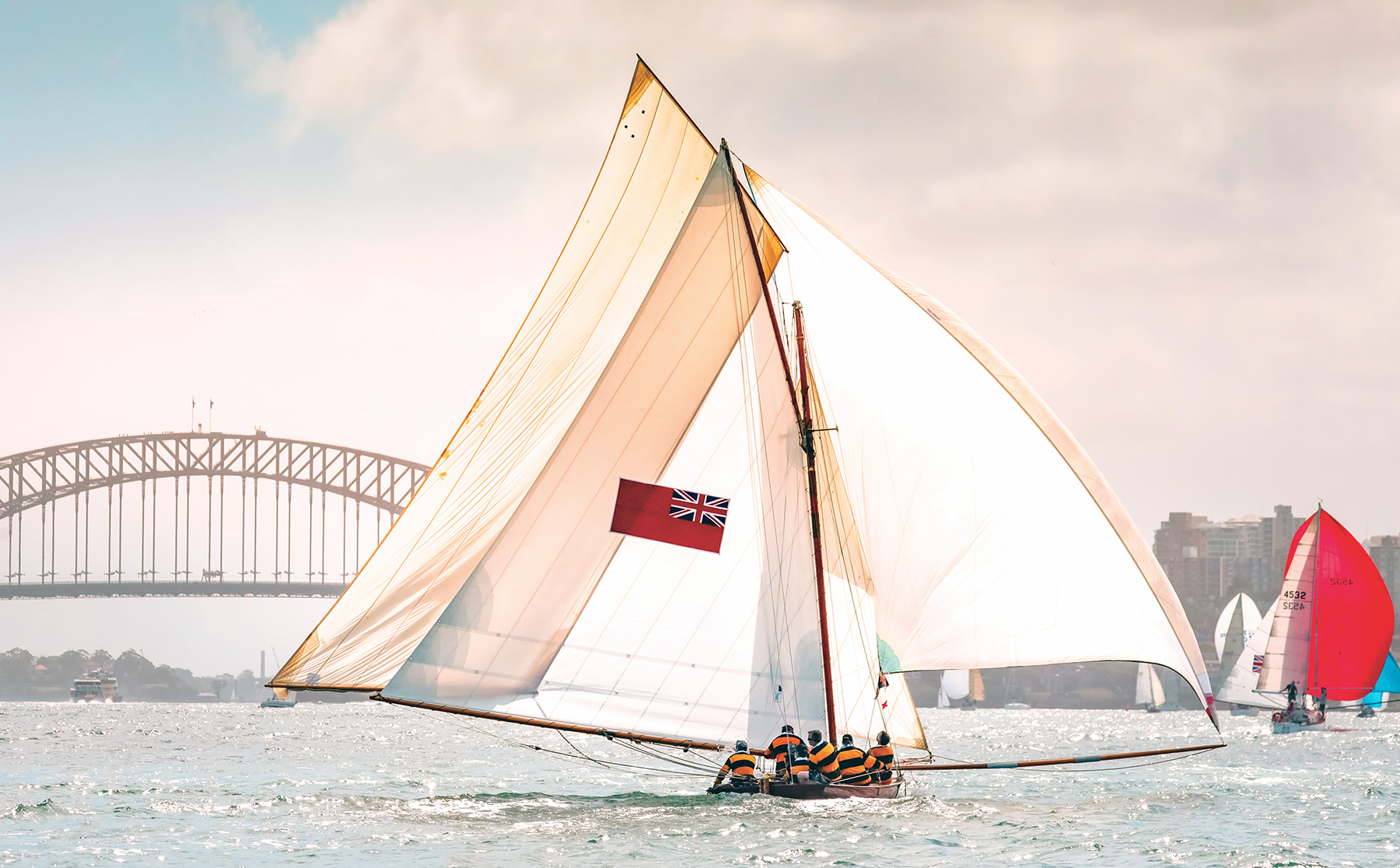
BRITANNIA, an 18-Footer built in 2002.Michael Chittenden

BRITANNIA, an 18-Footer built in 2002 to replicate a 1919 boat now in the Australia National Maritime Museum, is one of the iconic Sydney Harbour types that Ian Smith has built. Here, incredibly, she flies the smaller of her two rigs, with a period-correct spinnaker and a ringtail that extends the mainsail’s leech.

Ian Smith of Sydney, Australia, eats, sleeps and breathes wooden boats. He has built them for clients as a profession and also for himself. He has taught other people how to build them. He has raced aboard them, most notably with his faithful replica of a famous Sydney Harbour 18-Footer BRITANNIA of 1919, which is now in the collections of the Australian National Maritime Museum in Sydney. He has cruised extensively along the east coast of Australia in a succession of his own boats. And even while he was working 40 hours per week as a boatbuilder and running his own business, he founded the Sydney Wooden Boat School for evening and weekend classes. He has written books, made videos about wooden boat construction, and taught hundreds of first-time boatbuilders the fundamentals of the craft.

Even though he closed the school in 2000 and officially retired in 2013, Ian hasn’t stopped building and restoring boats. He is now 74, and his current project, a 24′ carvel-planked Ranger class sloop native to Sydney Harbour, began a year after he retired in 2013 and has been progressing methodically ever since.

With his home boatbuilding projects highly likely to continue, his wife, Tricia, asked him recently: “You are not going to die and leave me with an unfinished project in the shed, are you?”

“Well of course I am,” he replied. With a gesture to the Ranger 24, he said, “I just hope it’s not this one.”

Now 74, Ian Smith is nearing the completion of another boat type.Nigel Sharp

Now 74, Smith is nearing the completion of another boat type native to Sydney: a Ranger 24 designed in 1933 by Cliff Gale.

Ian started out as a self-described “hobby woodworker” who had “played around” with his own boats. While he was renting workspace in a large shed in Glebe, a neighborhood on Sydney Harbour’s southern shore just west of the city’s central business district, he found himself occasionally helping “a very friendly bunch” of boatbuilders. “Suddenly, I realized that I was spending quite a bit of time doing that, so I started charging for it and haven’t done much else since,” he said. “But my early career in boatbuilding was supported by working for a bookmaker on horse-race days, illegally—including being busted three times and dodging the coppers once.”

Although he occasionally worked on fiberglass boats in his early days, almost all of his boatbuilding and restoration work has involved wooden boats in a wide array of styles: carvel, lapstrake, glued-lap plywood, strip-planked, batten-seam, cold-molded, plywood, tortured plywood, and stitch-and-glue among them. The smallest have been dinghies and the largest a 45′ sloop by the New Zealand yacht designer Ray Beale. At the same time, he has been an avid racing and cruising sailor.

Steam-bent frames.Ian Smith

The Ranger 24 has steam-bent frames of spotted gum.

Ian’s current boat is a Lyle Hess–designed 24′ gaff cutter called SERENITY. His son, Jordan, strip-planked the hull in Douglas-fir over spotted-gum sawn frames and completed the deck while he worked as an apprentice for Ian. Jordan then went off sailing in HMS ENDEAVOUR, the Australian-built replica of the bark that British Capt. James Cook used to explore and chart New Zealand and Australia’s east coast. Jordan was aboard when the replica sailed to both coasts of the United States as part of its 1996–2000 circumnavigation of the globe. He occasionally went home to advance the cutter, but it was Ian who eventually completed the boat. SERENITY was launched in 2007 without an engine or rig; three more years passed before she first sailed. In theory, Ian and Jordan co-own the boat, but Jordan now has a young family and little time to sail, so Ian and Tricia sail her and look after her. “We’ve sailed the coast and estuaries from Jervis Bay to Lake Macquarie since then. She’s a magnificent little boat.”

His previous boats included a Chuck Paine–designed Frances 26 called BLACKWATTLE and an 18′6″ canoe yawl, TIRRICK, both of which were strip-planked and both of which he built himself. For BLACKWATTLE, “about a third of the work happened in the first six months, a third in the last six months, and the other third in the intervening 10 years,” Ian said. He also owned a 1947 Halvorsen 25 Standard Cruiser motor launch, SEA MIST. And he already has a project in mind for after the Ranger 24 launching: he’ll complete a cedar-planked lapstrake dinghy that was started by the boatbuilding school and is currently hanging from the shed roof beams.

Ian Smith teaches interior trim.Ian Smith

Smith, always an educator in addition to being a boatbuilder, has made a series of YouTube videos of his project; this photograph is a still taken from a recent one focusing on interior trim.

I asked Ian which he enjoys most, building boats or sailing them. “Pretty even,” he answered. “I’d find it hard to do without either, but if I was faced with the choice of only being able to do one, I would have to say building. I had always played with my own boats at the same time as working, so to retire and work on my own boats was a natural step and a lot more pleasant than having to cater to owners.”

Since his earliest days as a boatbuilder, Ian has woven teaching into his career. In the late 1980s, Arnie Duckworth asked him to do a bit of troubleshooting for people building their own boats at home. Duckworth had worked for Gougeon Brothers, Inc., in the United States before opening his own company, Adhesive Technologies, in New Zealand in 1977; it quickly became the Asia Pacific representative for Gougeon’s WEST System epoxy product line. The firm had been getting a lot of technical questions, and Arnie saw a demand, and an opportunity, for education in wood-epoxy boatbuilding.

“It was generally the same problem,” Ian said: “people mixing the two parts in the wrong ratio, usually because they applied the ratio of another brand they had previously used.” Duckworth’s idea was to run classes on fiberglass-sheathed strip-plank boatbuilding, which was then becoming a very popular method. Ian had sufficient experience with the technique to pass his skills on to others. Teaching became a lifetime commitment.

The Sydney Wooden Boat School (right), lifeboat (left).Ian Smith

At his Sydney Wooden Boat School (right) in Mortlake, a suburb of Sydney, Smith focused on a variety of boats, all traditionally constructed. Among these were two lifeboats (one of which is shown at the center) built by a team of unemployed people in 2001 for the 180′ bark JAMES CRAIG.

In 1989, he established the Sydney Wooden Boat School at River Quays Marina in the Sydney suburb of Mortlake with the encouragement and financial backing of the marina’s owner, John Wood. Around the same time, he was awarded an administrative certificate as a shipwright, which in those times could be granted in recognition of work experience rather than formal education: “If you proved you could do it you got one, but that is now no longer the case,” Ian said. His classes proved popular, and the school soon brought in more instructors and added classes in more varieties of boatbuilding, repair, and restoration.

In 1992, River Quays Marina got into financial difficulties and then changed hands; as a result, Ian moved the school the next year to a former post office building in Mortlake and an old factory building adjacent to it. After about three years of rent hikes, he moved the school back to its old location River Quays Marina.

The length of the courses varied, as did the construction methods being taught and the boats being built. Ian designed a simple boat—the Whiting skiff—specifically for the courses. It is an 11-footer built with glued-lap plywood-epoxy construction, with four strakes per side and carrying a standing-lug rig. The first one was built at Mortlake, the second at the Rathmines Men’s Shed, one of several similar places that have built boats of Ian’s designs. The Whiting skiff could be built over two weekends, starting on a Friday evening and finishing on a Sunday afternoon. Other boats might take five months to build, with the class working one evening per week. During one period of about three and a half years, the school produced 50 boats ranging in size from small nesting dinghies to a 25′ Vertue sloop; many of these boats were built or restored for the students themselves.

A lapstrake Pee Wee pram.Ian Smith

A staple of the school was a lapstrake Pee Wee pram (left) that Smith designed.

Some of the students learned by building two sailboats for Sailability, an organization that helps disabled people get out on the water. Initially, Sailability wanted to have Sonar-class boats, which were used in the Paralympic Games, but couldn’t secure rights to have them built in wood. So Ian instead asked his friend David Payne, a naval architect who was also the curator at the Australian National Maritime Museum in Sydney at the time, to design something suitable; the result was the 24′ Salvo Class, so named because the Salvation Army contributed to its construction and provided the workshop. Two of the yachts were built by a team of unemployed people working under Ian’s direction. “Those boats are still out there being sailed by disabled people,” Ian said. Sailability today operates two of the boats out of Brisbane, Queensland, and two out of Hobart, Tasmania. “Whenever I see them, I feel pretty proud that I had something to do with that.”

Other boatbuilding students learned their skills while building two replacement lifeboats for the 1874 iron-hulled bark JAMES CRAIG, whose extensive restoration was completed in Sydney in 2001. “I don’t think they use them much, but they are displayed on deck and are pretty authentic looking,” Ian said.

Like the Salvos, the lifeboats were built by unemployed students as part of a government-sponsored program called “Work for the Dole” at a time of high unemployment among Australia’s youth, but it has since lost its funding. “It was a wonderful scheme, because it helped people who had lost confidence get it back and then succeed in interviews and get jobs,” Ian said. It didn’t take with all of them; nevertheless, “I am very pleased that we did manage to change some people’s lives, in the short term at least.”

In all, about 300 students came through the school’s doors during its years of operation, not counting those in the government program, for which Ian doesn’t have a count. Among those who studied under Ian are boatbuilders who have gone on to have notable careers of their own, as several examples show:

  • Paul Tingey, a New Zealand shipwright who apprenticed with Ian’s son, Jordan, at technical college, came with his father to take a class in traditional clinker, or lapstrake, construction decades ago. Paul, who went on to be a leading shipwright back in New Zealand, with many A-class yacht restorations to his credit, still has the boat that he and his father built in the class. “I got into boatbuilding for the love of wooden boats,” Paul said. “As an apprentice, I found myself in a Sydney waterfront yard faced with mainly fiberglass cruising and racing yachts, none of which really scratched the itch for wooden boatbuilding or fine woodwork. I learned of Ian and his boatbuilding courses. I persuaded my father to join me in a class building a Sydney pram dinghy. Through this class, a great friendship developed and drawing on Ian’s skills and motivation, it was confirmed that it was wooden boats for me. I have been a shipwright and boatbuilder for quite a few seasons now, and these skills have taken me all over the world working on all sorts of wooden craft: fine yachts, launches, workboats, even tall ships. Today, I’m still fortunate to draw on these skills learned through Ian and feel privileged to maintain and restore a variety of wooden craft.”
  • Garry Clubley, an arborist, befriended Ian after taking a class in the early 1990s. He ended up sailing on Ian’s crew in the 10′ class REPUBLIC and on BRITANNIA for 21 seasons, and for his own use he restored a Twister, a 28′ sloop developed in 1964 by Kim Holman of the design firm Holman & Pye in Mersea Island, England.
  • Cody Horgan, the current director of the Wooden Boat Centre boatbuilding school in Franklin, Tasmania, crossed paths with Ian many times over the years and worked under shipwright Andy Story, who had worked for Ian at River Quays Marina.
  • Dave Scarborough, who started Scarborough Engineering outside of Sydney to specialize in restoring small motor launches, started his turn toward small craft after taking Ian’s class in lapstrake construction. He had an earlier career as a mechanical engineer working on destroyers and submarines for the Royal Australian Navy. “Ian loved teaching and had a passion for traditional boat construction, clinker dinghies, rowing skiffs, and his religion: gaff-rigged sailboats. Meeting Ian was great. I was at a crossroads in my career and it took me in a different direction. But best of all, I was learning new skills. Boatbuilding as a subject is huge; you can work your whole life and still not master half of it. Ian’s school allowed people of all walks of life to attend—but it is the younger kids that we all hope will get inspired by these creative courses and get the bug.”
BLACKWATTLE (left) and the The 10-Footer REPUBLIC.Ian Smith

Left—In 2000, Smith had his own cruising in mind when he launched BLACKWATTLE, a strip-planked and fiberglass-sheathed Frances 26 designed by Chuck Paine. Right—Racing was a parallel interest for Smith, and in the early 1990s the Australian Historical Sailing Skiff Association found him to be an eager supporter. The 10-Footer REPUBLIC was the second of his replicas of historical racing sailboats.

In 2000, Sydney’s rapidly escalating real estate costs were simply incompatible with running a boatbuilding school, so Ian “pulled out before we lost the house.” Real-estate costs increased right through the year of his retirement, 2013, so he never really had a permanent base even for his boatbuilding work, let alone the school. He used space in various boatyards for relatively simple repair projects; when the work was more substantial, he found it more economical to truck boats to temporary facilities away from the waterfront. Even after his official retirement, he has never stopped building boats.

Lyle Hess–designed 24′ cutter SERENITY.Ian Smith

Smith’s son, Jordan, strip-planked the hull of the Lyle Hess–designed 24′ cutter SERENITY while apprenticing with his father. While Jordan was off sailing. Ian went on to finish and launch the boat in 2007.

Nor has he stopped conveying his skill to others. Since retiring, Ian has produced a number of books and videos. When he was running Sydney Wooden Boat School, he published several books relevant to the various courses: Building a Traditional Clinker DinghyEpoxy Strip PlankingPlywood Clinker Construction, and Building the Whiting Skiff. In 2019, he published a new one (available through the WoodenBoat Store) called Wooden Boatbuilding—The Sydney Wooden Boat School Manuals, which is a conglomeration of all the previous books and with a new section on carvel planking.

The videos began in about 2000 during the construction of a lapstrake dinghy at the school. David Burr, an Australian vacationing in Sydney, filmed a series of them about lapstrake boatbuilding. He had previously taken Ian’s class in the subject. David, who was taking a break from his film work in Hollywood, made what Ian called “very professional” video of the project. Inspired by this, Ian began making his own instructional videos, more than 20 of which cover every aspect of the Ranger 24’s construction and fitout. Ian says the response to the videos has been gratifying—one person said, “Finally, someone who explains properly”—and that encourages him to continue.

“I don’t need to make money out of it,” he said, “but it is nice to have some beer money occasionally. I don’t want it to become a job, but if I think something is interesting, I like to film it.”

The Ranger 24—a Sydney native

Traditional plank-on-frame construction.Ian Smith

For his latest boat, Smith chose traditional plank-on-frame construction, using Huon pine planking stock.

After a lifetime of building wooden boats and teaching others his skills, Ian Smith knew what he wanted to build in his retirement—a type native to Sydney Harbour called the Ranger 24. And he knew that he wanted to build it with traditional carvel planking over stem-bent frames.

Ian Smith caulking.Ian Smith

Caulking had to be done in close quarters in Smith’s small boatshed.

The boat was designed in 1933 by Cliff Gale (1886–1968), who grew up near Woolwich Baths, a suburb of Sydney. Gale’s father, a swimming instructor, gave him his first boat when he was 8 years old, and soon he was building his own boats. He was a self-taught designer, using half models to work out his design ideas. He created a 24′ raised-deck cruiser, which he named RANGER, for his own use, but at least six have been built since. “I never liked the Rangers when I first saw them,” Ian said. “I thought they were ugly boats. But the more I saw them, the more I got used to their unusual looks. Now I just think they are beautiful boats, and they are a perfect boat for Sydney Harbour. They were never intended as a racing boat, but they are faster than anyone had a right to expect.” Gale raced his boat, often successfully.

Ian started building his Ranger in 2014. He used native Australian woods, including spotted gum for the keel, blackbutt for the stem and sternpost, spotted gum for the steam-bent frames, and Huon pine for the carvel planking. He bought the Huon pine, which is highly prized and now scarce, in 1983. While on holiday in Tasmania, he happened to drop by a Huon pine sawmill, where he found an opportunity to obtain “a whole load of it.”

Smith’s Ranger is a celebration of Australian boatbuilding woods.Ian Smith

With Huon pine planking, spotted gum frames and stringer, a celery-top-pine sheer clamp, Queensland maple bulkhead paneling, and a compass-timber knee of tea-tree, Smith’s Ranger is a celebration of Australian boatbuilding woods.

With a 9′3″ beam, the hull is a very tight fit in his construction shed, to the extent that Ian occasionally had to use a “lump hammer,” or small sledge, rather than a claw hammer amidships when driving the copper rivets that fasten the planks to the frames. Space restrictions also meant that he was unable to build the spars while the hull was in the shed, so he made them first—a lesson learned from an earlier boat—to ensure that he would be able to sail his new boat as soon as possible after completing the hull and its interior fitout.

Most Rangers are gaff-rigged, although the designer’s prototype was initially lug-rigged. One of the boats was converted to Bermudan rig, which turned out to be unsuccessful: it was slower than the gaffers without pointing any higher. Ian’s boat, which is expected to launch December 1, 2024, will sail as a gaffer. She will join a roster of boats that Ian has built for himself or acquired.

—NS

BRITANNIA — a faithful reconstruction of a historic 18-Footer

Shortly after Ian Smith opened his Sydney Wooden Boat School in 1989, a group of sail-racing enthusiasts established the Australian Historical Sailing Skiff Association (AHSSA) to “acquire, restore, build replicas of, sail, race, display, and promote historical Australian skiffs and other open boats.” Initially a fleet of 10-footer replicas was built. In 1994, Ian, already a keen sailor, was invited to go sailing in one.

Smith’s BRITANNIA.Ian Smith

Smith’s BRITANNIA was exhibited in Hobart City Hall during the 2023 Australian Wooden Boat Festival in Tasmania. Her No. 1 rig was too tall for the room, so she was shown with her smaller No. 2 rig.

“It was just fantastic,” he said. “Five of us on this 10′ boat set off and sailed twice around Cockatoo Island,” in the heart of Sydney Harbour. On the second rounding, they capsized “But at that point, I had already decided I was going to build one, as I was having so much fun.” He built a 6-footer first to “experiment with a few things,” but the 10-footer soon followed. By then, members of the association had started to build replicas of the celebrated 18-Footer class that had been founded in Sydney Harbour a century earlier, and Ian quickly realized that that was what he really wanted to build.

As a model, he chose BRITANNIA, which was built in 1919 and had been restored in 1990 for exhibit in the Australian National Maritime Museum. Wee Georgie Robinson built the boat for himself and raced her for 23 seasons, winning 40 of her 650 races and taking 14 club and state championships. Ian built his replica in a small space in the former Lars Halvorsen Sons boatyard, once Australia’s biggest boatbuilding company. The shed, on the north side of the harbor, was financed by the government during World War II mobilization and is still the biggest wooden shed in the Southern Hemisphere. Ian spent 1,100 hours over 15 months building the boat, with a couple of hundred hours of help from volunteers.

He was determined that his boat would be as authentic as practical and the most faithful of the 11 replica 18-Footers built between 1993 and 2013. She is built with batten-seam construction, a technique that was introduced to Sydney in the late 19th century by American whalers using Sydney and Hobart as South Pacific bases. Their light, strong whaleboats often needed replacement, and several boatbuilders in Sydney responded. Most of the planks for these boats, which were typically 28′ long, were butted together edge-to-edge as in carvel construction. Because they were only 1⁄2″ thick, and sometimes less, their seams were too shallow to caulk with cotton in the usual manner for carvel planking. Instead, narrow longitudinal battens covered the full lengths of the seams on the inside (see WB No. 171). The planks were clench-nailed to the battens all along their lengths; the frames, which were installed last, were notched over the battens. The result was a strong, light construction that didn’t need time to “take up” when lowered from a whaleship’s davits. The technique took hold in Australia; by the 1880s, all of the racing sailboat classes in Sydney were of batten-seam construction, supplanting the earlier preference for lapstrake hulls.

BRITANNIA’s hull.Ian Smith

BRITANNIA’s hull was built authentically, using batten-seam construction, and all surfaces were varnished.

For Ian, there was never any doubt that his replica would be built as the original. “All the other replicas are cold-molded,” he said. “The first ones were at least built to look like the original boats, with mimicked battens and frames, but the later ones didn’t even bother doing that. I was very disparaging about that, because I believe that if you are in a historic group, you should be relatively historic.” BRITANNIA, like the other replicas, is planked with Australian cedar, which is lighter than one other likely choice, Douglas-fir, but a bit heavier than another, western red cedar.

The new BRITANNIA was completed in 2002. Ian has raced her almost every summer Saturday out of the Sydney Flying Squadron sailing club, which was formed in 1891 and named after a British Royal Navy fleet of torpedo-boat destroyers. The AHSSA handicapping system rewards boats based on authenticity, the era of the original boat, and performance. Over 21 seasons, BRITANNIA has averaged between two and four handicap wins per season, mostly in strong winds since she is the heaviest boat.

The 18-Footers have few measurement rules. The length is the principal one, and various rules have governed beam over the years; however, there has never been any restriction regarding sail area. This has resulted in countless iconic black-and-white photographs of boats setting huge clouds of sail (see WB No. 222). Ian thinks, however, that sail-area reports are often exaggerated. “Downwind areas of about 1,500 sq ft, maybe 2,000, are about as big as they would ever have gone,” he said. “But that is a pretty big area, so I don’t think it needs to be exaggerated.” An assortment of spars and sails can be combined for rigs of four different sizes; the rig is chosen before each race according to the weather forecast.

Matching the original 1919 boat.Bob Chapman / Ian Smith Collection

Matching the original 1919 boat, the hull and deck planking, transom, thwarts, and centerboard trunk are of Australian red cedar; the keel, frames, seat edges, and trunk cap are of spotted gum; and the knees are of tea-tree. The only variation from the original was in using stringers of silver ash, since the New Zealand kauri used in the original was unavailable.

In recent years, the use of ringtail sails has been revived. This long, narrow sail is set outboard of the mainsail leech for downwind legs, with its own spars effectively extending the boom and the gaff. To encourage the use of ringtails, an annual trophy is awarded to the 18-Footer that sets one most often during the season, and BRITANNIA has won it more often than any other boat.

In 2003, BRITANNIA was one of seven Australian boats to compete in New Zealand in a regatta for various classes of 18′ open boats that celebrated a 1938 challenge. In that year, Australian sports promoter J.J. Giltman grandly invited sailors from all around the world to Sydney for a “world championship” of 18′ open boat classes—but only six competitors came, all of them from New Zealand. In a 2002 re-enactment, six New Zealand boats again came to Sydney to compete, and the 2003 regatta was a return match. (On both occasions, the home team was the victor.)

Ian also took the boat to Perth on Australia’s west coast, in company with eight other 18-Footers, to try to encourage—in vain, as it turned out—the construction of a replica there. And he has taken her four times via ferry across Bass Strait to the Australian Wooden Boat Festival in Hobart, Tasmania, twice to sail with a handful of 18-Footers and twice just to exhibit her. He has written two books about the boats: Open Boat, which traces the history of the Sydney Harbour 18-Footers and details of how they were built, and The 18-Footer BRITANNIA: 100 years of a Sydney icon.

Ian also became something of an international representative of the class. While traveling in the United States in 2010, he visited Annapolis, Maryland, where he joined the crew of a sandbagger that was “just doing little day sails for tourists.” That ignited the idea to take Sydney Harbour 18-Footers to Chesapeake Bay to race the sandbaggers. “I had made a bit of a study of the sandbaggers and their history,” he said. “People sometimes think that our 18-Footers evolved from them, as there are a lot of essential similarities. But, actually, they both evolved from the same ancestors, which were the American centerboard fishing boats of the 1850s.” Once the idea of an international competition gained traction, as many as 15 sailors from Sydney were keen to go to Annapolis. Ian decided against taking BRITANNIA, which had suffered from overheating in shipping containers to and from the earlier regattas. But the owners of ALRUTH, ABERDARE, and AUSTRALIA IV were game, and the sandbaggers BULL and the BEAR (see WB No. 135) were awaiting the challenge.

Smith was 52 when he first took BRITANNIA’s helm.Bruce Kerridge

Smith was 52—already older than the original boat’s skipper had been at his racing retirement—when he first took BRITANNIA’s helm. He campaigned her for 21 seasons, and his crew continues to race.

In each of the three races, Aussie crew members rotated into one of the sandbaggers and an American crew took the other; the remaining Aussies sailed the three Sydney boats with local sailors as additional crew. The Aussies won two of the three sandbagger races, and Ian was at the helm of BULL for one of them. All three Sydney Harbour 18-Footers beat both sandbaggers comfortably in each race. “But we didn’t put too much store on that,” Ian said, “as conditions were light, and we had our big rigs while the sandbaggers only had intermediate rigs.”

When Ian and I met in January 2023, he was conscious of the fact that, at age 72, he may only have had a few more seasons sailing BRITANNIA. “It is hard work,” he said with some understatement. “I don’t do much on Sundays!” As it happens, he decided to retire at the beginning of the following season after a few races, the last of which he won. “A great ending to my career” he said. But his old crew continues to sail BRITANNIA with his long-term right-hand man Dave Paget at the helm, and Ian is in the process of donating the boat to the trust that owns most of the fleet.       —NS

Article ends.

Nigel Sharp is a lifelong sailor who worked for 35 years in the British boatbuilding industry before leaving in 2010 to work as a freelance marine writer and photographer; for more of his work, see www.nigelsharp.co.uk.

For more information about Ian Smith’s work, see his school’s website, www.sydneywoodenboatschool.com.au, which is still active. His YouTube channel, @SmithysBoatshed, currently has more than 60 videos, which are also linked on the school’s website.