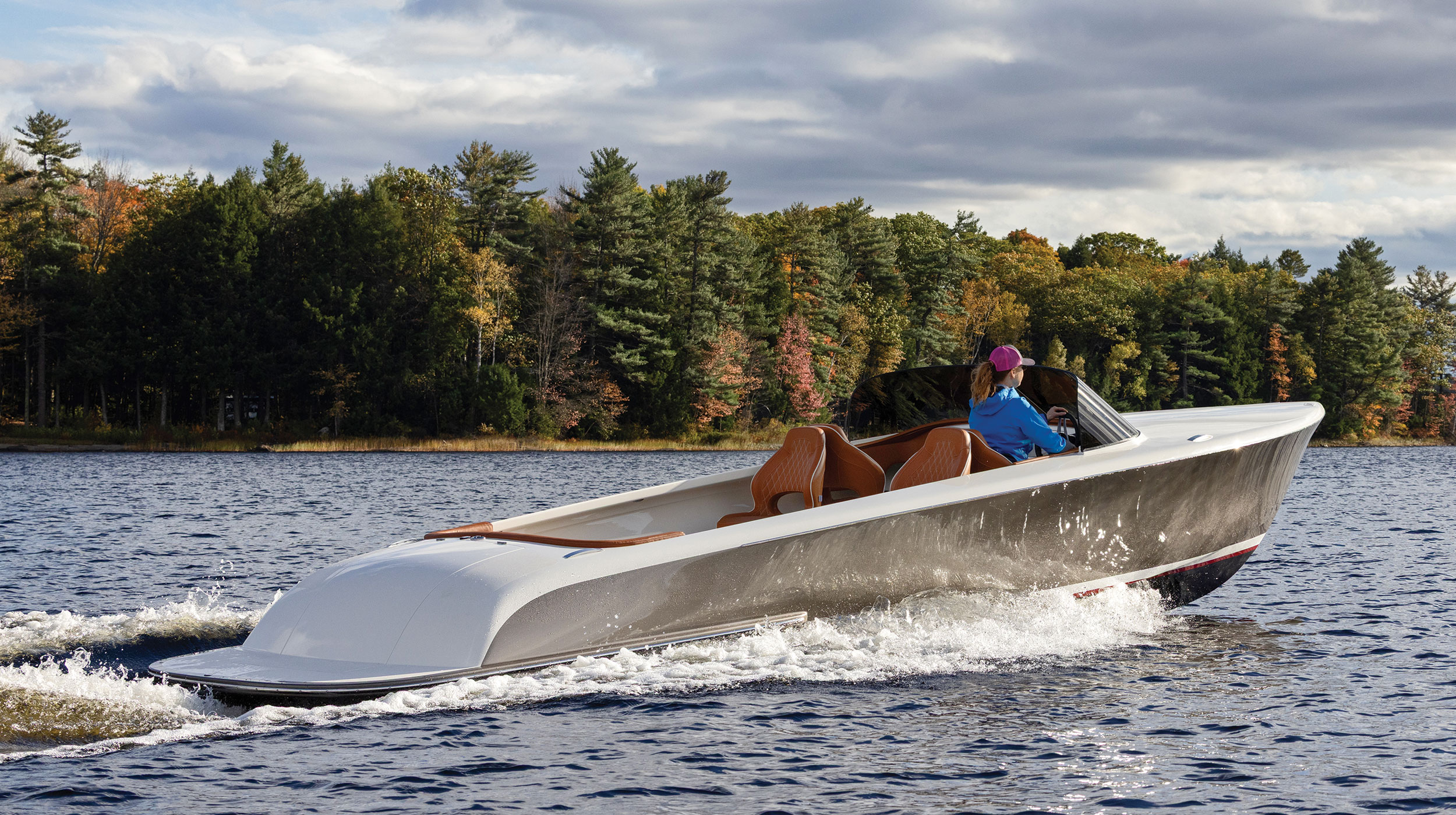
Alison LangleyISOBEL, a 26′ runabout from Stephens Waring Design of Belfast, Maine, was conceived as a commuter boat serving an island property on a Maine lake. A tight set of parameters—a short commute, readily available charging on both ends of the commute, and occasional watersports outings of an hour or so—made the boat a ready candidate for clean, quiet electric propulsion.
Every now and then, the stars align and every element falls into place for a very special project. In the spring of 2021, during the depths of the Covid-19 pandemic, a good friend telephoned me for some boat advice. Mary Jane was considering purchasing a lakefront property, and she asked me to advise her about an appropriate small motorboat to serve as a tender to the property. She had a trial run scheduled with a local dealer for a small production outboard launch and wondered if I would like to take a ride.
It was early May, which in coastal Maine is very early boating season. The temperature was chilly, but the sun was bright, the air was crisp and breezy, and I hadn’t been afloat yet that year. Why not go for a ride?
We met on the shore of Lake Megunticook in Camden, Maine, where the dealer had the boat ready to launch. It was a brand-new, traditional 21′ offering—something that would have been familiar to anyone who grew up on a lake in the U.S. or Canada in the mid- to late-20th century. More attractive utility launch than runabout, it featured a boxy metal-framed windshield over a short foredeck, bench helm seats aft of the dashboard, aft-facing seats amidships, and a bench seat across the after end of the cockpit. All surfaces in the cockpit were carefully wrapped in marine-grade white vinyl. In a splash-well aft, a 150-hp two-stroke gasoline-powered outboard motor loomed over the quarterdecks.
The motor rumbled to life, and we cast off from the dock and explored the beautiful lake for an hour or so putting the boat through its paces. Mary Jane had experience with large saltwater sailboats, but the small powerboat world was a mystery to her, so this experience was quite enlightening. The boat was a good performer, coming up on plane easily and running at speed smoothly and steadily. It also exhibited the typical vices of outboard boats: difficult close-quarters maneuvering, engine noise from the tall cowling, and the outboard motor’s visual interruption of the boat’s lines—and the sight lines from the boat. The most noticeable vice came when we tried backing into a stiff breeze; the exhaust gases welled up from the water’s surface and blew back through the cockpit, carrying the distinctive gas-and-oil smell of a two-stoke motor.
Alison LangleyISOBEL banks into a turn at speed.
In a debrief over lunch, Mary Jane conveyed her impressions and asked me for my take on the boat. I knew intuitively, from the history of our friendship, that she was chafing at the idea of compromise.
Mary Jane’s husband had been a longtime client of ours at Stephens Waring Design; he’d became a dear friend through the design and build of four custom sailboats between 2001 and 2011. Marrying into “the family,” Mary Jane had been a part of the design input for the last two yachts, a 50′ sleek daysailer named GINGER and a 68′ unconventional fast cruiser named ISOBEL.
If there’s one thing the luxury of having a custom design experience does for a person, it’s to make them resistant to settling for “good enough.” Working together on the design of the sailboats, Mary Jane and her husband had collaborated with us on a couple of exquisite yachts that suited their requirements ideally and expressed their aesthetic priorities emphatically. We had then frequently sailed together aboard the yachts for a decade before her husband’s death in 2020.
The utility launch was a good boat and would have served Mary Jane’s purposes well. It was well-built, sturdy, and decently finished. In every respect it was perfectly fine. But when you have had exquisite, settling for perfectly fine isn’t easy to do.
During our debrief, I compared the launch to a high-end pickup truck—luxurious and comfortable, absolutely serviceable, but not beautiful. It’ll do everything you need, but it’ll never be a Ferrari.
And, like a high-end pickup, the launch was not exactly cheap. Its cost was much less than an equivalent custom boat, but still a significant sum to plop down on something that’s…well…serviceable.
As we talked, it became clear that Mary Jane felt the property deserved something special, and that she would derive enough enjoyment from continuing the custom design-build process she had learned with her husband, and from operating the resulting tailor-made craft, to warrant the additional expense.
We considered her biggest objections to the utility launch and found they centered on the power plant. The two-stroke outboard was bulky, noisy, visually obtrusive, and smelly. Could we design something that eliminated all those concerns?
Thinking Afresh
My design partner, Paul Waring, and I have been interested in the possibilities of electric propulsion for a couple of decades. We’ve designed a few electric and hybrid boats over the years, followed the development of increasingly practical electric solutions for propulsion, and kept abreast of battery technology and how it has affected the broader application of electricity as a realistic marine-power solution. The biggest lesson that keeps getting hammered home is that electric propulsion can be a viable choice—but for the time being, only in specific use cases that suit the limitations inherent in today’s motors, batteries, and management systems. The goalposts are moving, but the big limitation is the energy-density of batteries versus a tank of gasoline or diesel fuel.
To put this in perspective, consider a standard 6-gallon portable gas tank that supplies a small outboard motor. That 6 gallons of gasoline with its tank will weigh about 42 lbs, which is roughly comparable to a Group 24 deep-cycle lead-acid battery, but it contains about 500 times as much usable energy. You can see from this simple example the dramatic difference between the ability to go fast or far under electric-vehicle (EV) power compared to internal-combustion (IC) power.
Improvements in batteries have made the difference between impractical-under-any-circumstances and practical-under-very-specific-circumstances. Land-based EVs use lithium-nickel-manganese-cobalt chemistry, which provides an energy density about five times higher than lead-acid batteries and can be discharged to a much lower level without damaging the battery. So, they have about eight times the usable energy density of lead-acid, and ¹⁄₆₀ the usable power per weight of gasoline.
Fortunately, other factors benefit the electric side of the weight ledger. Electric motors themselves usually have higher power density compared to gasoline-powered ones, and even more versus diesel engines. In extreme cases, an electric motor not much larger than a large coffee can is capable of producing in excess of 200 hp (150kW). Compare this to a six-cylinder IC engine that may weigh close to 1,000 lbs (450kg). Reduction gears aren’t required for electric motors in most cases, so we can save another couple of hundred pounds (90 kg). No exhaust components are needed—another 100 or 200 lbs. And electric motors are so quiet that soundproofing the engine compartment isn’t needed, and this can amount to a couple of hundred pounds for a 200-hp IC engine. Any weight saved in these ways can be devoted to increased battery capacity and thus longer range.
Still, finding a use profile where a battery-electric propulsion system will work is challenging. The user’s range requirement must be low and recharging easily available. The time required for recharging must be an acceptable hindrance to the boat’s use. In general, the user must be willing to make a tradeoff between speed and range. And usually there must be other compelling factors to push the decision toward electric propulsion.
In Mary Jane’s case, all these factors fell into place. Her lakefront island property is only a fraction of a mile from the shore dock. The lake is only about 2 miles long. Electricity is available at the mainland dock. And she’s willing to use the high-speed ability of the boat only under certain conditions, such as for an hour or so of water sports. As a further incentive toward electricity, conventional fuel isn’t available on the lake, so it would have to be carried in by truck a few times a season.
Finally, aesthetic considerations tipped the balance. We can conceal the small electric motor within the shell of the boat, its operation is virtually silent, and there’s no exhaust gas to foul the air or water. Mary Jane’s vision for her island retreat is a low-impact camp-style compound, powered by a modest solar array and heated with woodstoves. The electric boat would complement this ethos.
Stephens Waring DesignThe deck plan shows seating for six or seven clustered around a central “coffee table” concealing the Fellten battery. A pop-up bow light and removable all-around stern light on a wand serve for night-time operation.
Stephens Waring DesignThe mechanical schematic demonstrates the simplicity of the motor and battery installation.
Bringing it All Together
Having received the go-ahead, our challenge became to make it all work. The first step was to set performance parameters for the hull. Mary Jane wanted the sensation of speed and the capability for limited water sports—towing a tube or light-duty water-skiing. This meant planing speeds, with a top-end of about 20 knots (25 mph). She would plan on running the boat as a commuter at much lower speeds—a high displacement speed of 5 knots (6 mph) would get her from the mainland landing to her island dock in a few minutes. She wanted at least an hour’s range at max throttle; this would result in at least 20 hours between charges at the lower speed. As is evident from the above numbers, asking a boat to plane involves much higher power demands than operating at displacement speeds; this is a much bigger factor when the lower energy-density of batteries is in play, compared to an IC engine. If one wants to operate a boat only at displacement speeds, the case for an electric powerboat is much easier to make competitive with IC operation.
We designed the hull as a conventional moderate-V, constant-deadrise shape with wide chine flats—nothing exotic, a shape well-proven for 60 years. For passenger capacity, we were looking at a hull length in the low 20′ range, with an extended stern and swim platform. I expected we could get the weight under 1,500 kg (3,300 lbs) all-up. This dictated a power plant in the 40–50 kW (54–67 hp) range. I knew of several possibilities for suitable motors, but I needed to solve the battery and the drive puzzles.
Most easily available marine electric motors are either configured as standard outboards or designed for inboard installation. With this project, knowing the boat would spend winters on a trailer and be launched on a shallow ramp, we needed a drive that would tilt up. But we also knew the look of a conventional outboard mounted on the stern was a non-starter. I had to find something in between.
We looked at using a conventional sterndrive, designed to mate with typical IC engines ranging from 120 hp to 400 hp but mated in this case with an inboard electric motor. This would have been relatively straightforward—but this type of drive is bulky and heavy, and designed for far more power than we were going to be putting through it. We would have seen substantial power losses in the gearing, and such drives are designed to direct exhaust gases through their lower units—a feature neither needed nor wanted.
I thought I had a promising lead for a while: a new tech company came on the scene with a big splash, with lots of financial backing from a major U.S. auto company and a very slick-looking unit with a 25kW motor mounted inside the lower pod. I could use two of these and hide the upper parts of the outboard motors under a lifting cowl for a super-clean look. We actually placed a pre-order for these units, but over the next months things began looking less promising. Tech support wasn’t forthcoming, and eventually I learned that even though they showed examples of twin motors being employed on their proprietary pontoon boats, they did not have a ready-for-sale control system to manage twins for the masses. Such are the tribulations of working at the cutting edge.
About a year after we began the design process, and nearly constant internet searches for new developments, I stumbled across an email news blast alerting me to a new company called RAD Propulsion, a U.K.–based startup with a power plant that looked very promising. Better yet, my first email inquiry resulted in an instant response from RAD’s chief technology officer, Peter Byford, first by email and shortly after by phone. This was a very good sign, because in cutting-edge projects combining new technology in new ways, technical support is key. Peter explained that my call came at an excellent time: they had just completed prototype trials of their 40kW low-profile outboard and were moving toward the first true production run of 500 motors.
Peter also gave me a valuable lead toward a battery supplier, also U.K.-based: Fellten, who specialize in providing EV retrofit kits for classic vehicles—Land Rovers, Morris Minors, and the like. Their battery solutions rely on standard EV technology—high-voltage DC battery packs and charging systems. This allowed us to use standard EV plugs and fittings, although we also have an adapter to charge from standard marine 220-volt U.S. dock towers. Although ISOBEL will likely never use the feature, the battery also has the capability of using a Level 3 automotive-style DC fast charger—topping it up in mere minutes. (Level 3 chargers are spreading fast along Europe’s waterfronts, but their adoption has been slower in North America). RAD has since developed a collaboration with Fellten to sell Fellten batteries direct from RAD.
With motor, drive, battery, and tech support all wrapped in a single package, the roadblocks fell away. It was time to get this boat designed and built.
Stephens Waring DesignThe CNC-cut jig assembly is designed to support structural components and planking, then be inverted to support the deck planking and slipper stern.
Dan MillerThe upside-down hull is show here ready for sheathing with 12-oz fiberglass and epoxy.
Refining the Stylistic Details
Dan Miller (left), Truman Forbes (right)Left—Turned right-side up, the hull was ready for the deck and slipper stern installations. Right—Here, the foredeck has been cored and its top skin installed, while the slipper stern’s core and nal layers are being vacuum bagged into place.
In my early sketches shared with Mary Jane I had been inspired by the classic varnished speedboats of Italy—Rivas in particular—my imagination fired by youthful exposure to James Bond movies and cigarette ads. Their shapely slipper sterns and rolled sheers were the stuff of dreams, and Mary Jane responded to these images. We worked to refine the tumblehome and the sweep of the swim platform, using the power of 3D modeling and our design team’s capability to generate photorealistic renderings to assure we had an eye-catching and dramatic shape. We agreed early on that we’d minimize decoration and simplify finishes to create a spare, clean look; this was our only departure from the Riva inspiration, where glossy varnished mahogany and elaborate mid-century metalwork adorn the boats. With this simplicity, the shapes and curves all had to be just right to convey the elegance we desired. We wanted references to classic mid-century shapes and style, but a modern stripped-down spareness.
Given her husband’s fondness for wood construction in his four sailboats, we knew wood would be the construction material of choice. We also knew wood could be competitive in weight to all but the most exotic of composite construction, and it would be a considerably less expensive method than building in high-tech molded composite. Belmont Boatworks in Maine was selected as the builder, given their enthusiasm for the project and their willingness to commit to service after the build. This was convenient, because the boat’s home lake lies only a few miles from this boatyard, which is just inland from the saltwater of Penobscot Bay. The yard’s owner, Dan Miller, was excited to prove what his talented crew could achieve, and service manager Reid Garrity and project boss Meyric Matthews stepped up willingly and cheerfully throughout a project that pushed their skill set beyond the typical limits.
For light weight and simplified construction, I selected a wood-strip composite schedule for the hull. This is particularly effective in more complex shapes such as our V-bottomed hull with wide chine flats: we could minimize internal structure and reinforce the complex corners at the chine with additional layers of fiberglass tape. The hull is built of 12mm-thick (about ½″) eastern white cedar sheathed inside and out with biaxial nonwoven ’glass, with additional tapes at the keel and chine. We had originally planned on using western red cedar, which for decades has been a go-to material for modern wooden-boat construction, but we learned that the U.S. supply was depleted and Canada was no longer exporting the species. Two beefy stringers of 25mm (about 1″) Douglas-fir contribute longitudinal strength under the cockpit sole. Only two bulkheads are installed. One is the transom, of 18mm (about ¾″) plywood, which is actually forward of the extreme end of the hull, because the hull extends in slipper-stern fashion along each side of a motor well. The other is a conventional bulkhead forward of the dashboard, which extends down only to the cockpit sole; it is of 12mm plywood. All of the plywood is okoume, chosen over sapele for its lighter weight.
The deck is designed to require no beams, relying on its structure to create the shapely rolled sheer. It’s a cored plywood construction: the bottom and top skins of 3mm (⅛″) plywood sandwiching two layers of 25mm (about 1″) CoreCell foam with perimeter blocking of Douglas-fir, which is carved to the rolled shape along the sheer. The slipper stern is built as part of the deck; the skins are doubled to two layers of 3mm (⅛″) plywood laid in double diagonals and the core is reduced by 6mm (¼″) to compensate.
The cockpit sole is cored also: it is composed of two skins of 3mm plywood separated by 19mm (about ¾″) CoreCell, with fiberglass skin on the top surface and taped to the hull sides. The cored swim platform was built over an inner horseshoe laminated of Douglas-fir veneers bent around forms placed on a full-sized lofting provided from our computer files. An outer horseshoe was laminated at the same time and then applied over the edge of the platform after the hull was planked and sheathed; this laminated horseshoe serves as a cantilever beam to support the platform.
The hull and deck were built over a set of CNC-cut forms that we designed in our Rhino 3D software to define the shape and provide the support needed to lay the strips in place. We designed the interlocking, egg-crate-style forms to accept the stem, transom, stringers, and inner horseshoe for the swim platform before planking was applied to the forms and structural members. The outside of the hull was sheathed in 12-oz (300g/sq meter) ’glass fabric and epoxy and primed, then the hull, with forms still in place, was turned right-side up. We designed the forms so that they also served to establish deck crown and the shape for the slipper stern. The deck and stern were built atop the hull with forms inside and a plastic barrier to prevent prematurely bonding the deck to the hull, then lifted off so the forms could be disassembled and removed. The already-assembled cockpit sole panel and forward bulkhead were dropped in, then the deck was installed by bonding it and screw-fastening it to the laminated Douglas-fir sheer clamps.
Alison LangleyThe wrap-around dash was 3D printed from PETG plastic and wrapped in faux-leather upholstery. Anodized aluminum panels shroud the modern electronics in retro style.
We began construction with a few unknowns still to work out. We had modeled and photorealistically rendered a shapely, upholstered dashboard without a clear idea of how we would build it cost-effectively. We considered molding it of fiberglass, but upon reviewing bids we rejected that direction. Next, we contacted the Advanced Structures and Composites Center at the University of Maine, aware that they had recently acquired a very large 3D printer. We connected with James Anderson, an engineer at the university and also a longtime boat nut who takes his work home with him as a hobby: he has a smaller 3D printer at his house and agreed to print the dashboard in several pieces in PETG plastic (polyethylene terephthalate glycol, a thermoplastic polyester) indexed for assembly upon a plywood structural support. The faux-leather upholstery was obtained from Vetus, suppliers of the off-the-shelf helm seats for the boat, and expertly installed on the printed dash by Gemini Canvas in Rockland, Maine. Gemini also built and upholstered the curved rear seat and bolster. The finishing touches were applied in the form of CNC-machined and anodized aluminum dash panels, designed with a retro theme to conceal a modern chart-plotter and steering unit. We reached out to our friends at Van Dam Custom Boats in Boyne City, Michigan, to produce these exquisite panels, knowing that Ben Van Dam and his crew would easily be able to handle the precise metalwork required, given the extravagantly beautiful metalwork they produce every year for their gorgeous wooden powerboats.
The other unknown was the windshield. Combining elegance and cost-effectiveness in a curved, custom glass windshield is a big ask, and Mary Jane pushed me to discover a solution that would be acceptably priced and stunning-looking enough to satisfy her. After trying and rejecting several solutions using laminated wood, then laminated composite, then bent metal frames, we settled on simple curved laminated and tinted glass, unframed.
Dan Miller (both)Left—After being sheathed and faired, the hull and deck are ready for primer. Right—ISOBEL receives her sprayed-on Awlgrip topcoat, which was applied in the yard’s dedicated paint booth.
The RAD motor is designed for standard outboard-style installation, but it is has a much lower profile than many motors of this type. It thus easily lives beneath the slipper stern; we designed a lifting central portion to allow it to tilt up for trailering or beaching. Unlike conventional outboards, the motor head doesn’t pivot to steer; instead only the lower unit pivots below the cavitation plate, 90 degrees to each side of the centerline, so it can serve as a stern thruster, pushing the stern directly sideways.
The motor comes complete with dedicated controls and electric steering, simplifying the selection of equipment and assuring compatibility. We chose to purchase a multifunction display from RAD as well, which operates navigation and music apps as well as managing the electric propulsion and battery operation. RAD’s constant support with wiring diagrams and other equipment selection was a valuable part of the project’s success.
We installed the Fellten 55 kWh battery under a “coffee table” box forward of the after bench, about where a conventional inboard motor might live. The top of the box has the only varnished wood on the boat, a beautiful fabrication of foam-cored sipo mahogany. Storage for chart books, sunscreen, and other low-profile items hides beneath the butterfly lids.
Alison LangleyThe Fellten 55kWh battery lurks beneath the “coffee table” cover. Belmont Boatworks owner Dan Miller (left) and project lead Myeric Matthews are moving the cover into place in preparation for sea trials.
An Auspicious Beginning
After a 21-month build, Belmont Boat Works proudly loaded ISOBEL (named for Mary Jane’s grandmother and for the 68′ sailboat she and her husband owned together) aboard their large hydraulic boat-transport rig and moved her to a nearby lake for trials. The October day was pushing the end of the boating season, and the lowering clouds looked ominously like rain—much-needed after a record-setting drought that had dropped lake levels by 2′. A brisk breeze threatened to strip the remaining autumn leaves from the trees. A successful trial and photo shoot looked chancy.
Alison LangleyISOBEL is in her element on a Maine lake.
But as they had throughout this project, the pieces again fell into place. The wind dropped, the clouds parted, the launching ramp offered just enough water to submerge the hydraulic trailer deep enough to slide ISOBEL afloat. And she was off. Her topsides glistened in their shimmering metallic bronze paint, a custom blend and a nod to her larger namesake, which shares the same color scheme. The low afternoon sun picked out the contrast between the off-white deck and the deeply tinted windshield.
Mary Jane pushed the throttle forward and the boat accelerated in near silence as electrons flowed from the battery through the motor. A roostertail blossomed astern and ISOBEL came up on plane. Mary Jane grinned. The stars aligned.
ISOBEL Particulars
- LOA: 26‘6” (8.09m)
- Hull Length: 24‘3“ (7.4m)
- LWL: 21‘8“ (6.6m)
- Beam: 7‘11“ (2.42m)
- Draft
(motor down): 2‘2½“ (67.5cm)
(motor up): 11“ (28cm) - Displacement (two aboard): 2,750 lbs(1,250kg)
- Power: 40kW (54 hp) RAD outboard
- Battery: 55kWh Fellten power pack

Bob Stephens is a principal at Stephens Waring Design in Belfast, Maine (www.stephenswaring.com), where he works with his partner, Paul Waring, and their team designing new-builds and refits, along with floating homes and other unusual projects. He has been designing, building, and sailing wooden boats for nearly 50 years.