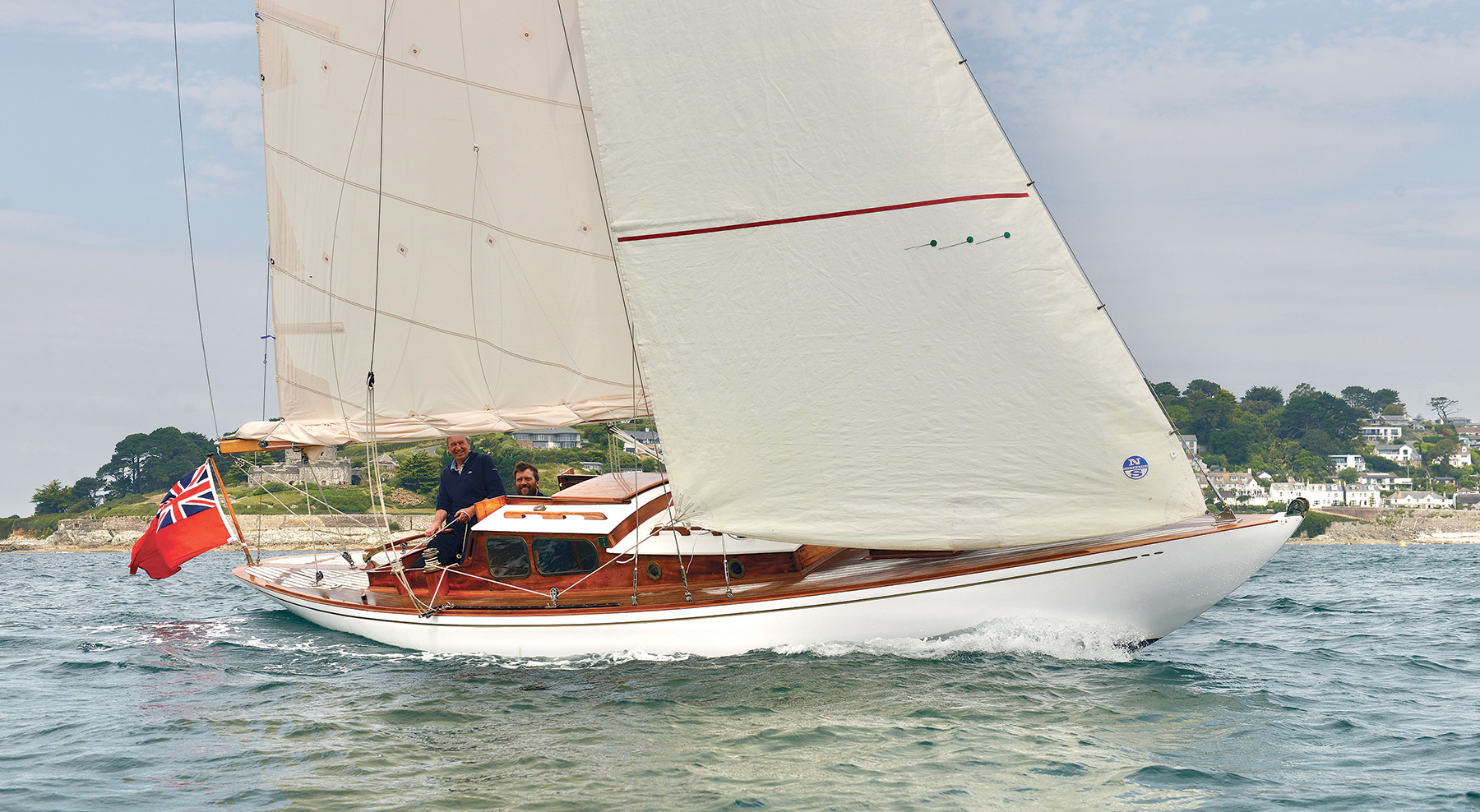
GALENE is a member of the Teal Class.Nic Compton

Designed by Albert Luke and built by Luke Brothers in Hamble, England, in 1938, GALENE is a member of the Teal Class—a wholesome 1930s racer-cruiser. She has been under the same ownership for more than two decades and steadily maintained and upgraded. Here she is reefed down off St. Mawes, near Falmouth, Cornwall.

When you know, you know, says the old adage about love. And it seems that it can equally apply to boats. Take James Smith, who comes from a salt-water family: his father, mother, and step-grandfather all served in the Merchant Navy. James joined the Sea Scouts and has sailed dinghies from a young age; he raced a Laser 2 out of Bosham in West Sussex, England, for many years before himself joining the Merchant Navy as engineer and traveling the world in cargo and passenger ships. But he never owned anything bigger than a dinghy.

Then, one fine day in 2000, he decided it was time to buy himself a yacht. He soon spotted an elegant 30′ sloop for sale in the local paper and went down to Poole on the south coast to have a look at her. “I took her for a trial sail and loved her to bits,” he remembers. “I’ve sailed on a lot of dinghies, so I can feel a boat very well. And GALENE feels just right. You hold on to the tiller, and it feels just right.”

On “impulse,” James bought GALENE (he pronounces it so that it rhymes with Delaney) without even looking at any other boats. Yet, as impulse buys go, it seems to have turned out rather well. For here he is, 24 years later, happily sailing the boat on Carrick Roads in Falmouth, Cornwall.

“Take the helm, and see what you think,” James says. So I take the helm, and it does feel firm and steady—or “just right,” as he put it. In fact, it’s not the only thing about GALENE that is just right. For an 86-year-old wooden boat that has been through at least 14 owners and had major surgery at several points in her life, she feels remarkably homogeneous. The woodwork is all neat and tidy, the varnish well-tended, the non-original teak decks immaculate. Overall, the mix of bronze and modern fittings speak of an owner who knows when performance matters more than originality and yet is willing to be traditional when the situation is right.

With a boat as beautiful and authentic-looking as GALENE, one must wonder: Why bother with the Fifes, Nicholsons, and Watsons of this world when you can have a 1938 Luke Brothers yacht that ticks all the same boxes at a fraction of the price?

Racing, Cruising and Design, by Uffa Fox

Uffa Fox wrote that that lines of the Teal Class “give the impression of power.”

Particulars

  • LOA:  30(9.14m)
  • LWL:  21‘  (6.4m)
  • Beam:  7(2.1m)
  • Draft:  5 (1.5m)
  • Displacement:  8,267 lbs (3,750kg)
  • Sail area:  368 sq ft (34.25m2)
sail plan for 1930s British yacht.Racing, Cruising, and Design, by Uffa Fox

The original sail plan shows a small, affordable, jib.

Hull plans for British sailboatRacing, Cruising, and Design, by Uffa Fox

The boat’s construction drawings show the original small cabin, which was incorporated into a new doghouse that was added in the 1960s.

The Birth of a Yacht Class

The origins of the Teal class, of which GALENE is a member, are told in Uffa Fox’s 1937 book Racing, Cruising and Design. In it, Uffa describes how fellow yachtsman Bernard Clay was wandering around London with a model under his arm “preaching the gospel of TEAL” but that his seed fell on “stony ground” because most of the people he met were “stony broke.” Eventually, Clay had the boat built himself anyway.

Of the actual boat, Uffa wrote: “Like the model, TEAL was a delight to the eye, as one would expect, for she was designed by Albert Luke, of Hamble. She proved herself to be such an able boat, both as a racer and as a day cruiser that more were built the following year, and to-day we have half-a-dozen boats to the Teal class, and there is every prospect of this class growing as the years go by.”

He went on to describe the lines drawings, giving us the benefit of his special insight: “The sections show that being unhampered by any rule she has a good flare forward and throws a great deal of water away from her deck when sailing, which is in contrast to boats to the international rule who are pinched in at the deck to save girth measurement. The buttocks, water-lines and diagonals all give the impression of power.”

After a detailed description of the boat’s construction, Uffa noted that the sail plan was “quite normal” and that the headsail has been kept deliberately small because “all the owners agreed amongst themselves to keep this sized headsail on the score of expense, for there is no doubt that while an overlapping headsail would improve the speed it would also increase the cost of racing in the class.”

A 1930s view of a British sailboat. Beken of Cowes

GALENE (ex-THORA) was flying a fine collection of race pennants from her topping lift when this photograph was taken in 1938.

The class soon proved it was as fast as it looked, with the original TEAL winning the Round the Island Race (then a recent addition to the sailing calendar) in 1935 and 1936. Nine boats were eventually built to the design, of which five are thought to have survived: GALENE (ex-THORA), ANTOINETTE (ex-BRITT), TIGER (ex-LALAERNE), PHAKOE (in the Netherlands), and ZEST (in Canada).

Uffa competed in the Round the Island Race in 1937 in TL3 CONTENT, built by A.N. Compton (no relation to the author of this article) in Cowes the previous year. It was an all-weather race, starting with a strong south-southwesterly, then going calm, and finishing with a strong southwesterly. CONTENT’s fortunes were equally fickle; at one point she led the fleet (which included such iconic craft as the Laurent Giles–designed MAID OF MALHAM and Nathanael Herreshoff–designed 59′ NEITH) before sailing into a wind hole and falling back.

The last leg of the race was a windy romp back down The Solent, with CONTENT reaching her theoretical maximum speed of just under 7 knots after Nab Tower. Uffa was in his element. “As we rounded the Fort a heavy squall struck us and hove CONTENT down till her cockpit coaming was in the water,” he wrote. “Though the wind was off shore and the tide was slack, we soon had quite a popple of sea for such a small vessel. The wind threw the stinging spray over us, and though it was strenuous sailing, the eight miles from the Forts to Cowes in the twilight and darkness, were the best miles of the day.”

CONTENT finished 14th out of 23 yachts, half an hour behind TEAL and less than two hours behind NEITH—which is not bad for a boat that’s just 20′ long on the waterline.

Sixth of Her Kind

GALENE was built for Capt. (later Maj.) Bertrand L. Ainsworth and was originally called THORA (Old Norse for thunder). She was No. 6 in the class and, judging by the number of race pennants flying from her topping lift in a 1938 Beken of Cowes portrait, she must have achieved some racing success. In 1949 she was renamed GALENE by her third owner, after an ancient Greek goddess personifying calm weather.

She was based on the Hamble River until 1959, when she was bought by John W. Clark (her seventh owner) and moved to Ipswich, on the East Coast, and it was during this time that she underwent some major changes. The original design had a very low coach roof that provided barely any headroom forward. Someone had the ingenious idea of not just adding a small doghouse but also moving the old coach roof forward, to give more headroom down below, and joining the two parts together. The result is one of the best doghouse conversions I’ve ever seen, half of it built using the boat’s original structure.

This work probably took place around 1962, when the boat was fitted with its first engine: a 4-hp Stuart Turner. GALENE then went through a series of owners in Ipswich before returning to the South Coast, first to Colchester in 1973 and then to the Hamble in 1983. By the late 1990s, she had migrated to Poole, which is when James appeared on the scene. He was to be at least her 13th owner, and probably her luckiest—or at least her longest-serving. James was living in the Thames Valley at that time and his mother lived in Dorset, so for several years Poole was a convenient place to keep the boat.

That all changed in 2003, when James discovered a soft spot on GALENE’s keelson. It so happened that the London Boat Show moved from Earls Court in central London to Excel in London Docklands in January 2004, and as part of that move the show featured a large section devoted to traditional boats. One of the exhibitors in the show’s classic boat “village” was Gweek Boatyard, whose then-manager, Clive Emerson, quickly took James under his wing. In no time at all, GALENE was being shipped overland to Cornwall for the repairwork to begin.

GALENE was by then 65 years old, so when Clive and his team started working on her, they were not surprised to discover more problems that needed fixing. The keelson repair soon turned into a six-year restoration, including an entire new keelson and a new teak-on-plywood deck to replace the old canvas-covered pine deck. Ever the committed owner, James bought a Dutch barge, which he moored at the yard and used as an occasional houseboat while he kept an eye on GALENE’s progress.

Owner James Smith.Nic Compton

Owner James Smith bought GALENE “on impulse” in 2000, having never owned a yacht before, and has maintained her unwaveringly ever since.

One of the less-successful aspects of her 1960s rebuild was to shorten the mast and step it on the coach roof without adding enough internal support, which had stressed the cabin structure. The coach roof therefore needed strengthening in way of the mast. The mast itself was also condemned, and James approached the yacht designer Ed Burnett to draw up a new one—this time keel-stepped, as per the original design. In characteristically uncompromising language, Ed, who died in 2015 at age 43, described the old mast as a “silly stick” and set about taking measurements for a new rig. When he plugged them into his computer, he came to a surprising conclusion.

Extra doghouse space below.Nic Compton

GALENE was designed for speed, not for volume, and even with the extra doghouse space below is limited to “camping under wood,” as Richard puts it. Note the extra chainplates and hanging knees, which were designed by Ed Burnett.

“He laid it out and said, ‘I’ve got an existing rig here, which pretty much sits straight on top of it. It’s for a West Solent One Design,’” James said. “‘If you’re happy with that, it will do the job. I happen to have all drawings. All I’ve got to do is press one button and it will send the drawings for the wooden bits to Collars, and if I press another button it will send the drawings for the metal bits to Hercules CSMD in Dartmouth.’ So that’s what we did.”

The West Solent One Design is a highly respected (and extremely fast) class dating from the same era as GALENE; it has enjoyed a huge resurgence in recent years, so being associated with it could only be a good thing. As it turned out, the two rigs were so close in dimensions and details that GALENE was able to use her existing sails unaltered. Even though the new mast was keel-stepped, some hefty hanging knees were fitted on each side and substantial new internal stainless-steel chainplates added a “belt and braces” approach, which James said allows him to push the boat hard without worrying about straining her.

GALENE was relaunched in 2010, with gleaming varnish and all-new running and standing rigging. James wouldn’t tell me how much the restoration cost, saying that he “deliberately refuse[s] to add it up; it would be way too frightening,” though he did say the keelbolts alone cost £4,500 (about $6,000), giving some idea of the uncompromising standards applied to the work.

James had by then moved to Bristol, so for the next few years he kept the boat on the Helford River, in Cornwall, and joined the Helford River Sailing Club. When he moved to Falmouth in 2016, however, he managed to find a mooring close to the Greenbank Hotel, which he could access easily from his house. He then joined the Flushing Sailing Club and started competing in their twice-weekly races and was pleasantly surprised to find that the old Teal design had not lost her winning ways; she finished fourth in her class at the 2017 Falmouth Classics.

The teak deck.Nic Compton

The teak deck was added during the 2003–10 restoration and gives the boat a more classic feel. It also feels good underfoot.

And, of course, once he got the racing bug, he couldn’t resist trying to squeeze that extra half knot out of the boat by ordering a new jib from North Sails. “The original jib was higher cut; the new one is a deck-sweeper. Even though it’s only 3–4 sq ft bigger, sealing the sail off at the deck seems to make all the difference. It’s a good way of adding on power because it keeps the center of effort low. It seemed like the right thing to do, and it did make her quicker.”

ł930s British sailing yachtNic Compton

GALENE sails of off St. Anthony Head near Falmouth, Cornwall, where she has been based since 2016.

At 85, Still Steady

When I sailed on GALENE, she had just been through another mini-refurbishment, this time with the Gweek-based boatbuilder Ben Harris. Fourteen years after her previous restoration, the hull seams needed recaulking and in some areas resplining; the coach roof and cabin sides needed some repairs; and she needed a new forehatch. The deck was recaulked, the varnish renewed, and the topsides immaculately painted.

The weather gods were not playing ball on Falmouth Bay that day. Perhaps GALENE herself was on holiday. A lumpy swell was rolling in from the east, creating quite a “popple” of water, as Uffa might have put it. But, with her 5′ draft and 10′ of overhangs, GALENE was unperturbed. The wind was not enough to heel her over until her cockpit coaming was in the water or, as Uffa described, to create “stinging spray.” Instead, GALENE was steady and true on the helm. As we surfed back into Falmouth, with the swell on our starboard quarter, I reflected on what James had said. I had to agree that GALENE felt just right.

A Boatbuilding Dynasty

The origins of the Luke Brothers yard can be traced back to the early 1800s. A yard in Fowey, Cornwall, at that time was operating under the name of Luke, according to Walter Smith Luke’s granddaughter, Heather W. Shield. Her research suggests that the “Luke” was George Luke, who built so-called Fowey Cutters for the Royal Navy, and she even has a model of a 98-ton cutter, called PETREL, that George built in 1821.

George’s son, Walter Smith Luke, completed his boatbuilding apprenticeship at a yard in Southampton before setting up on his own in Limehouse, on the River Thames, where he was based until the mid-1800s. There, he married Jemima Seward Pearce, and the couple had their first son, also named Walter.

British boatyard, 1930s.Courtesy of James Smith

The Luke Brothers boatyard was photographed in about 1920 with unknown boats under construction. The nearest worker is using an adze to bevel a frame.

The family moved to Oak Bank on the Itchen River, near Southampton, in 1868, and their yard was soon busy building a large range of working boats, including Itchen Ferries (a local fishing boat type), fishing smacks, and pilot cutters. They also built yachts, including impressively large ones such as the 77-ton steamship BESSIE of 1874 and the 144-ton schooner ST. HILDA of 1875. Most Luke-built boats of this period were designed by W.S. Luke himself, though the yard also built a few yachts by other designers, including the G.L. Watson–designed ULERIN of 1886, the most successful yacht in the 10-ton class of that year.

In 1895, W.S. Luke’s sons, Walter and Albert, moved the yard to new premises at nearby Hamble Point. This seems to have been the start of an intensely productive period for the yard. They mostly built yachts, many designed by the family; W.S. Luke continued designing until at least 1899, while his son Walter produced several designs, too. But it was the younger brother, Albert, who created the vast majority of designs during this period, with nearly 100 vessels to his name from 1897 to 1939.

The yard continued to build boats by other designers, including at least two by John Alden: the 50-ton schooner CACOUNA of 1927 and the 49-ton LUCIA of about 1928. A regular contributor in the early days was Arthur Payne (of Summers & Payne), followed in the 20th century by the likes of John Thornycroft, Albert Strange, Charles Nicholson, and Fred Shepherd. It wasn’t an entirely one-way traffic; at least one of W.G. Luke’s designs was built by the legendary William Fife yard in Scotland and others by Camper & Nicholsons in Southampton.

Over the years, the yard went through several name changes. After starting as W.S. Luke, it changed to W.G. Luke when Walter Jr. took over. In 1911, it was renamed Hamble River Luke & Co. and started building hydroplanes, billing itself as “CONSTRUCTORS OF MACHINES TO PRIVATE AND SECRET DESIGNS” including “Hydro-Aeroplanes and Aeroplanes for Naval and Military use, fitted with Bomb-dropping Gear – Wireless Telegraphy – Guns” and registered “On Admiralty and War Office Lists,” according to an advertisement of the period. The venture was a failure, however, and the company returned to boatbuilding, eventually settling on the name Luke Bros.

The brothers were also keen sailors. Albert raced one of his own 6-Meters on The Solent for many years, and in 1920 the pair formed the Hamble River Sailing Club (HRSC), which is still active to this day. One of the brothers’ most popular designs was the 14′ Hamble Star One-Design, which was the dinghy to beat at the HRSC until the Merlin Rocket and National 12 took over in the 1960s. The class was revived on the Hamble in 2015, with a fleet of eight boats based near the Jolly Sailor pub at Bursledon on the Hamble River.

Albert died of cancer during World War II, and after the war his brother Walter sold the yard to Port Hamble Ltd. Ironically, the design by which the yard is perhaps best known, the Luke 5-Tonner, was designed after this sale by company stalwart Bill Hobbs.

Interviewed by Robin Gates in 1991 for an article in Classic Boat magazine, Bill described how the yard operated when he started working there in the mid-1920s: “In those days there were about 50 people working at the yard, and we started work at 7:30 when the two brothers came round to see how we were getting on. They knew everyone on Christian name terms, and they were known as Mr. Albert and Mr. Walter. Five-o-clock came round too quickly, and I found the work so interesting that I didn’t want to go home! But the two brothers encouraged we apprentices to go crewing, because they rightly thought that if apprentices saw the stresses and strains that a boat experienced, we would be more conscientious in our work. So we would come back to the yard in the evenings and prepare boats for racing, and meet the brothers again. They were fine people, real human beings.”

—NC

  Article ends.

Nic Compton is a regular contributor to WoodenBoat.