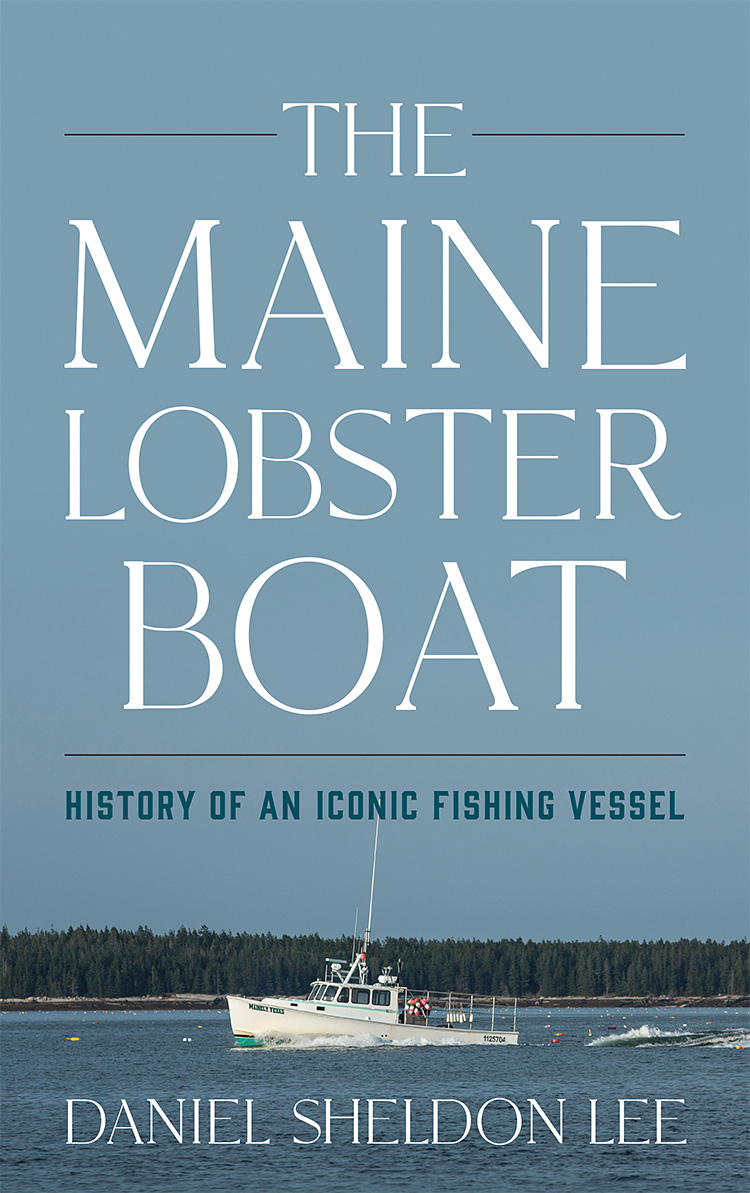
Book cover for The Maine Lobster Boat.

The Maine Lobster Boat: History of an Iconic Fishing Vessel, by Daniel Sheldon Lee. Down East Books, www. downeastbooks.com. 508 pp., illus., index, $35.

Available from The WoodenBoat Store (www.woodenboatstore.com)

There is something beautiful to be found in the lines of the modern lobsterboat and in the simple and efficient process of managing the more than 800 traps that a lobsterman uses. Such boats, and the lifestyle of operating one, create the economic foundation of many a Maine coastal town.

The lobsterboats moored in many harbors may appear, to the untrained eye, to be very similar to each other, but if you look closely you will discern a startling variety of hull shapes, sheerlines, and deckhouses. A “codger,” or old lobsterman, can see a whole history in the lines of a boat. They know who built it and why it might be different from those their father built. They can tell whether a boat was built by two brothers who worked together, or later, after they fell out and worked in separate shops.

Will Frost of Beals Island took a giant leap forward in the transition from sailing lobsterboats to powered ones, introducing speed, economy, and elegance to the rather awkward process of incorporating the make-and-break engines first used in powered fishing boats. The development of the powered lobsterboat was, however, a group effort—an evolution moved along in small shops by dusty men with shavings in their hair.

There aren’t a lot of books about lobsterboats out there. Royal Lowell wrote the definitive one about building a wooden lobsterboat in 1976. It’s a no-frills breakdown of the exact process and order of operations. There are almost no anecdotes or history included after the introduction. There is also no handholding; Lowell’s book requires a decent knowledge of boatbuilding before you open it.

Maine Lobsterboats, by Virginia Thorndike, and Boatbuilding on Mount Desert Island, by Laurie Schreiber, take the opposite tack in that they are mostly about the cultural history of boatbuilding in Maine. They are slim but delightful volumes filled with family histories, stories of growing up in the boatyards, and humorous tales of life in coastal Maine. (The most interesting stories take place during Prohibition.)

The Maine Lobster Boat: History of an Iconic Fishing Vessel, by Daniel Sheldon Lee, takes a middle path through these methods. This is a cultural history, yes, but it is all woven through with the technical details of how lobsterboat design changed over the years. Lee carefully explains why boatbuilders made changes and why those changes mattered.

This is an assiduously researched book. It is larger than all three of the previously mentioned books put together. The bibliography is wide-ranging in its sources but as a whole owes a great debt to the work of Richard K. Lunt, who traveled around Maine in 1970 interviewing boatbuilders for a doctoral dissertation on lobsterboat building. Lunt was particularly skilled in drawing out interesting conversations with frequently laconic men. Lee also spent a great deal of time talking to the current generation of the Lowell family, who have a genuine interest in their industry and family history.

BELVA M (1937).Penobscot Marine Museum/The Maine Lobster Boat

BELVA M (1937) was the first lobsterboat that Harold Gower built after he opened his own shop.

Throughout this review, I refer to fishermen and boatbuilding men. In the historical record, they really are all men. There must have been some women in the earlier industry somewhere, but they are not found in the research. It’s getting better; today, we see considerably more women on the boats and in the yards. In this book’s historical narrative, however, one does find women saving their husbands from insolvency. There are a surprising number of boatbuilders here that couldn’t turn a profit if their lives depended on it. Many of them survived only through the bookkeeping prowess of their wives. At one point the Lowells referenced a family saying that they would rather give you a boat than sell you one. This attitude seemed to be somewhat pervasive, with only Harold Gower and Peter Kass claiming anything like financial stability, though Kass mentions that it is only by the skin of his teeth. Being a boatbuilder myself, I can attest to this condition personally.

Lee’s book charts a path through some of the state’s prominent boatbuilders, starting with Kass as the modern wooden boat builder. Kass explains what a boatyard looks like today and how it differs and more often resembles the boatyard of Will Frost’s day. He offers a breakdown of the industry and where he thinks it’s going. Then we jump back to Will Frost and look at when he first arrived in Maine and how his innovations shaped the future of lobstering. Every change had a specific, practical reason behind it. Every change in engine, the ever-growing number of traps, and the development of the pot-hauling winch required a new way of thinking about the boat.

Frost came to Beals Island from Nova Scotia. The book works through his family tree, and like the book of Genesis it seems like everyone can trace their bloodlines back to him. It’s not so strange to imagine this, though, when one considers that these small shops were all family affairs and were in small communities such as Beals Island where every family tended to be interlinked with another.

The book then moves on to Will’s son Bert Frost, Harold Gower, and Doug Dodge, who are all interesting personalities. Lee manages to flesh out these families and their work without being dull or repetitive, and without getting trapped in the listing of facts—a difficult task.

Ralph Stanley (1929–2021).Southwest Harbor Public Library/The Maine Lobster Boat

Ralph Stanley (1929–2021) specialized in building Friendship sloops and wooden lobsterboats.

Lee then moves on to the Lowells, who could well fill a book on their own. Riley Lowell was Will Frost’s son-in-law and worked with Bert Frost in his shop before they fell out. His son, Royal Lowell, might be the most famous lobsterboat builder, with Ralph Stanley certainly challenging him for the title. Royal’s grandchildren are keeping his shop and designs alive to this day.

The 30′ LORNA R was designed by Riley Beal and built in 1972.Maine Coastal News/The Maine Lobster Boat

The 30′ LORNA R was designed by Riley Beal and built in 1972. In 2006 she was officially clocked at 53.6 mph, which is the current speed record for a wooden lobsterboat.

There is a wide variety of Beals in the second half of the book. They may share a name, but their philosophies of boatbuilding vary widely. (I have a special place in my heart for the small boats of Willis Beal. He builds perfect models around 5′ long, and I would live in a house full of them if I could. They’re fascinating.) We also meet the Stanleys, the Riches, Bunker & Ellis, Jarvis Newman, and Glenn Holland. There’s a gentle shift into fiberglass boats here, but don’t turn away, because it stays interesting with the thoughtful discussion of wood versus fiberglass and Richard Stanley’s innovative mixing of the two.

Ernest Libby Jr.Maynard Bray/Penobscot Marine Museum/The Maine Lobster Boat

Ernest Libby Jr. holds the half model of the strip-planked boat behind him.

There is a thread of lobsterboat racing running through this book, which is appropriate, because very few fishermen are completely uninterested in racing. Many innovations originate with these competitions. The book ends with an extended conversation with Jon Johansen, publisher of the monthly newspaper Maine Coastal News. The author and Johansen discuss the state of the industry—both boatbuilding and fishing. The book closes with some hope for the future to accompany the appreciation of the past.

The Maine Lobster Boat is an excellent book. I appreciate the great deal of thoughtful research that went into writing it. A somewhat disconcerting conservative dogma pops up every once in a while, but it doesn’t detract too much from the narrative. There’s an essential pleasure in getting to know the people of the Maine coast and their history through this book.  Article ends.

Adam Palmer is a wooden boat builder at Brooklin Boat Yard in Brooklin, Maine.