Introduction coming from MATT…
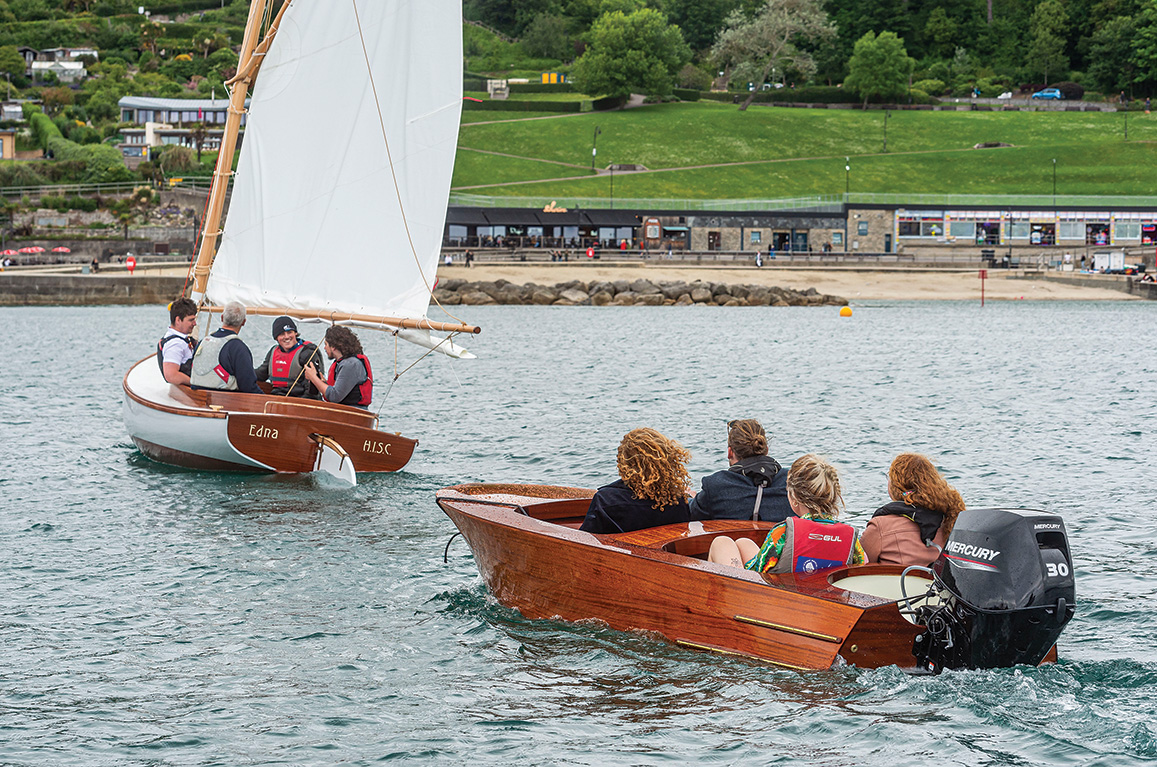
EDNA and the Riva Scoiattolo
Photos by BNPS
The graduating class of the Boat Building Academy of Lyme Regis, England, had much to celebrate in June 2024 at their annual end-of-year launching. The 16 students had completed a 40-week class that culminated in the construction of three new boats and the renovation of a fourth. All the students worked on all the builds, but each boat was the commissioned project of one of the graduates. And, while the overall lengths of the new boats are the same, their design and construction are significantly different from one another.
- Andrew Streeter commissioned EDNA, a 14′ glued-carvel catboat, constructed from lines taken from the Wilton Crosby catboat, TRIO, of 1880.
- Tom Thorley commissioned an outboard-powered 14′ carvel and cold-molded Riva Scoiattolo, designed and built by Riva in the 1950s.
- Ginny Harvey commissioned a 14′ glued-lapstrake Walkabout Lug Yawl designed by John Welsford for singlehanded cruising.

While Ginny’s yawl was not quite complete on launching day, the other two new boats were launched alongside Ben Short’s restored and relaunched CROW, a traditional 20′ lapstrake launch from Looe, Cornwall, once used as a passenger ferry.
BLUE
Photo by Neil MacAlpine
BLUE is a Solace 16XL stitch-and-glue touring kayak designed by Don Moore and built by Neil MacAlpine of Edmonton, Alberta, from a kit by BoatCraft. The kayak is 16′ LOA with a beam of 23¾″ and is described by BoatCraft as ideal for beginning paddlers but also for experienced paddlers for touring. Neil built a strip-planked canoe more than 30 years ago, but this was his first stitch-and-glue experience. He says the manual and videos that came with the kit helped him get the project from dream to reality. BLUE was built for Neil’s grandsons, who report that she “paddles great.” She was launched in Telford Lake, Leduc, Alberta, in July 2024, and will be used on Buck Lake.
MISS KITTY
Photo by Terry Clark
The Clark family of Fairfax, Virginia, launched their Chesapeake Light Craft Jimmy Skiff II in June 2024 in Churchtown, Maryland. She was built by John Staub and donated by him to the charity auction, “Night to Fight Friedreich’s Ataxia (FA).” FA is an inherited debilitating life-shortening degenerative neuro-muscular disorder affecting about 1 in 50,000 people in the United States; two of John’s stepdaughters are sufferers. The Clarks submitted the winning bid for the boat and named her MISS KITTY. They will be using her to catch “Jimmies” (male blue crabs), explore Broadwater Creek, a tributary of Chesapeake Bay about 15 miles south of Annapolis, and introduce grandchildren to boating skills and safety.
MEAN WENDY
Photos by Russell Melin
This Chesapeake Light Craft Annapolis Wherry, 17′9″ × 3′2″, was scratch-built by Russell Melin of Portland, Maine. Working in his basement on weekends and evenings after work, he took about four months to complete the project. Russell built the hull in 6mm okoume plywood on 9mm okoume-plywood frames. The thwarts, transom, and skeg are also 9mm okoume, while the rubrails, breasthook, quarter knees, and worm shoe are mahogany sourced from offcuts of new planks recently installed in the 1924 Alden schooner BAGHEERA. Russell also used some of the mahogany offcuts as accents in the blades of the oars, which he built. He also used mahogany for his outrigger and sliding seats, which he built to plans from Angus Rowboats, because he wanted “traditionally styled accessories to match the classic good looks of the wherry.” MEAN WENDY was launched in Portland in June 2024.
SULA
Photo by Daniel Friesen
At the end of June 2024, the Oarlock and Sail Wooden Boat Club (OLAS) in Vancouver, British Columbia, launched SULA, an Iain Oughtred–designed Gannet. She is 14′5″ LOA, has a beam of 5′8″, and can carry up to five people or, says Daniel Friesen, the club’s vice president, “two people and a generous picnic basket.” SULA’s hull is glued marine-plywood lapstrake on a black-locust stem and Douglas-fir keel. Her floors and deck framing are yellow cedar.
SULA was built in the OLAS floating boat shop in the Vancouver Maritime Museum’s Heritage Harbour by club members. The project, says Daniel, “consumed 18 months of Saturday workdays and gallons of alarmingly strong coffee.” SULA joins the club’s existing fleet of two other club-built boats and two “restored hangers-on.” Daniel expects her to become a favorite for outings on the waters of Burrard Inlet’s Outer Harbour.
KAREN JOY
Photos by Aaron Macqueen (top); Pat Macqueen (bottom)
Pat MacQueen of Hancock, New Hampshire, built this epoxy-lapstrake Albury Brothers Runabout from plans supplied by Hylan & Brown Boatbuilders of Brooklin, Maine. Typical construction, as described by Doug Hylan, is strip-planked or cold-molded on laminated frames, but Pat had previously built three other boats all with glued-lapstrake hulls, so he decided to use the same method here. He says the build was quite involved and it took him about two years to complete. The runabout, named KAREN JOY for Pat’s wife, is 19′9″ LOA with a 6′10″ beam and was launched in Franklin Pierce Lake, Hillsborough, New Hampshire in September 2023. She is now the “official tubing boat for the grandchildren.”
ISLE O’VIEW
Photos by Phoebe Oetting
In 1995, Dave Hopkins of Monroe, Washington, purchased The Expectant Father’s Cradle Boat Book, by Buckley Smith, thinking he would build a cradle for his baby daughter. As so often happens for a new parent, life got in the way, and the cradle construction never happened. But Dave says that in 2023 he “got a second chance with the impending arrival of my new grandson.” Working with Alaska yellow cedar strip planks and mahogany for the keel, transom, breasthook, knees, and gunwales, Dave completed ISLE O’VIEW in time for his grandson, Walter, to use it. “She was officially ‘launched,’” Dave says, “in Athens, Georgia, in August 2023.” ISLE O’VIEW is Dave’s first full-hull build. He has previously built only half models.
RUNCIBLE SPOON
Photo by Robert Blair
Some 30 years ago, Robert Blair of Kendal, England, built a workshop onto the back of his house and ordered plans for a 9′6″ Nutshell pram from the WoodenBoat Store. To avoid the shipping costs, he had an American colleague hand-deliver both the plans and some bronze fittings, and Robert set to work. The shop, he recalls, was so small that he had to crawl beneath the boat to get from one side to another. He finished the boat, varnished the spars, but then couldn’t decide on the hull color. He put the boat in storage.
Over the decades that followed, Robert built several other small wooden boats and renovated a 25′ steel narrowboat and a 16′ fiberglass Wayfarer dinghy. Then, during one of the Covid-19 lockdowns, Robert had an epiphany: pale green! The Nutshell was pulled out of storage and painted. Robert cut and sewed a sail, and in July 2020, RUNCIBLE SPOON was finally launched in Glasson Dock Basin, Lancashire. “Of all the dinghies I have built,” Robert says, “she is the nicest to sail and the easiest on the eye.”
RAKAIA
Photos by Kyle Abingdon
Kyle Abingdon of Abingdon Marine Carpentry in Trenoweth, Cornwall, England, built this Iain Oughtred–designed 15′11″ × 5′3″ Penny Fee for a customer in nearby St. Anthony’s. Her glued-lapstrake hull is built of 9mm marine plywood on an iroko keel and stem with an 18mm-plywood transom. Her spars are solid Douglas-fir and the 110-lb centerboard is steel; she draws 23″. Oughtred offered several different rigs for the Penny Fee and RAKAIA’s owner chose the 104-sq-ft gaff sloop. RAKAIA was launched in Cornwall in July 2024 and now swings to a mooring near her owner’s home.
ZEPHRA
Photo by Alison Langley
In June 2024, students, staff, and friends of The Apprenticeshop of Rockland, Maine, gathered for the relaunching of the Dublin Bay 24, ZEPHRA. The boat is one of an original fleet of eight built to Alfred Mylne’s design for the Royal Alfred Yacht Club of Dublin, Ireland. Building began on the Isle of Bute in Scotland in 1939, but the boats were not delivered to Ireland until after World War II. The fleet raced in Dublin Bay for many decades but was finally disbanded in 2004, when the surviving boats were sold. The first restoration, PERIWINKLE, was undertaken by Skol ar Mor in Brittany, a boatbuilding school run by former Apprenticeshop Director Mike Newmeyer. In 2018, lofting of ZEPHRA began at The Apprenticeshop, and later, in 2021, the original keel was shipped from France to be connected with the new hull.
At the end of the six-year-long rebuild, all that remains of the original ZEPHRA is her ballast keel and some of the rudder hardware. Shop Director Kevin Carney reports that ZEPHRA was “pretty much built as original except for laminated frames, some laminations in the backbone timbers, and a plywood deck with teak overlay. We used sipo for the keel, frames, planking, and deck framing. White oak was used for the steam-bent intermediate frames and some structural pieces. We also used epoxy as an adhesive, which was not in use when the 24s were originally built.”
Two more of ZEPHRA’s sisterships, ADASTRA and ARANDORA, were scheduled for restoration at boatbuilding schools in Europe. Following her successful relaunching, ZEPHRA will be returning to Dublin, Ireland.
ELSIE
Photo by Elizabeth Branco
Jason Branco of Vermillion, Ohio, restored his 1955 Lyman Leader over two winters. Despite her age, the 13′6″ runabout was in remarkably good shape. The hull was structurally sound except for four of the original steam-bent white-oak frames, which were replaced by Mike Couts of Wood Master Marine near Sandusky. Jason stripped the boat of many layers of paint and varnish, refinished her, and replaced all the wiring. Her outboard is a fully restored 15-hp Evinrude Super Fastwin, also from 1955. Her Attwood steering wheel, in custom “baby blue,” is original to the boat. ELSIE, the Branco family’s third Lyman, was relaunched in the Vermillion River in May 2024 and will be homeported on the Lake Erie shore, some 20 miles from Sandusky, Ohio, where she was built almost 70 years ago.
BELLA
Photo by Len Anderson
Len Anderson of Victoria, British Columbia, built his Joel White Shellback dinghy from plans between 2009 and 2011. Intent on making BELLA his “own,” he added some individual finishing touches. The thwarts are all single-piece 1″-thick Douglas-fir reclaimed from an old workbench and trimmed in mahogany; a removable mainsheet block is mounted on a wooden pad that slots into the forward end of the offset centerboard trunk, and Len made the trunk cap oversized so that it appears centered when installed for rowing. Len launched BELLA in 2011 and spent many happy years sailing and rowing her on lakes, ponds, and in the ocean near his home. In 2023, Len decided it was time for a simple “touch up.” Over the winter he made floorboards—also of reclaimed fir, repainted the interior, and stripped and revarnished the gunwales and rubrails. BELLA was relaunched in 2024 as good as new and Len is looking forward to many more years of use.
These pages, along with the Boat Launchings section of www.woodenboat.com, are dedicated to sharing recently launched wooden boats built or restored by our readers. If you’ve launched a boat within the past year, please email us at launchings@woodenboat.com, or write us at Launchings, WoodenBoat, P.O. Box 78, Brooklin, ME 04616.
Please include the following information:
- The boat’s length and beam;
- The name of its design class or type;
- The names of the designer, builder, owner, and photographer;
- Your mailing address along with an email address or phone number;
- The port or place of intended use;
- Date of launching; and
- A few sentences describing the construction or restoration. Send no more than five photographs (jpg images at 300 dpi) and enclose a SASE if you want anything returned.
Hints for taking good photos of your boat
- Set your camera for high-resolution images. We prefer jpg format, at 300 dpi minimum.
- Stow fenders and extraneous gear out of the camera’s view. Ensure the deck is clean and uncluttered.
- Take your photographs in mid-angle sunlight for best results. Mid-morning or mid-afternoon usually work well.
- Keep the horizon level and the background simple and scenic so your boat stands out from its surroundings.
- Take some pictures of the boat underway and some at rest. Often a vertical format works well for sailboats. Shoot a lot of images, then send us your five favorites.
We enjoy learning of your work—it affirms the vitality of the wooden boat community. We receive so many submissions that there is not room in the magazine for all of them to be published. Launchings not printed in the magazine can be seen at www.woodenboat.com/boat-launchings. ![]()