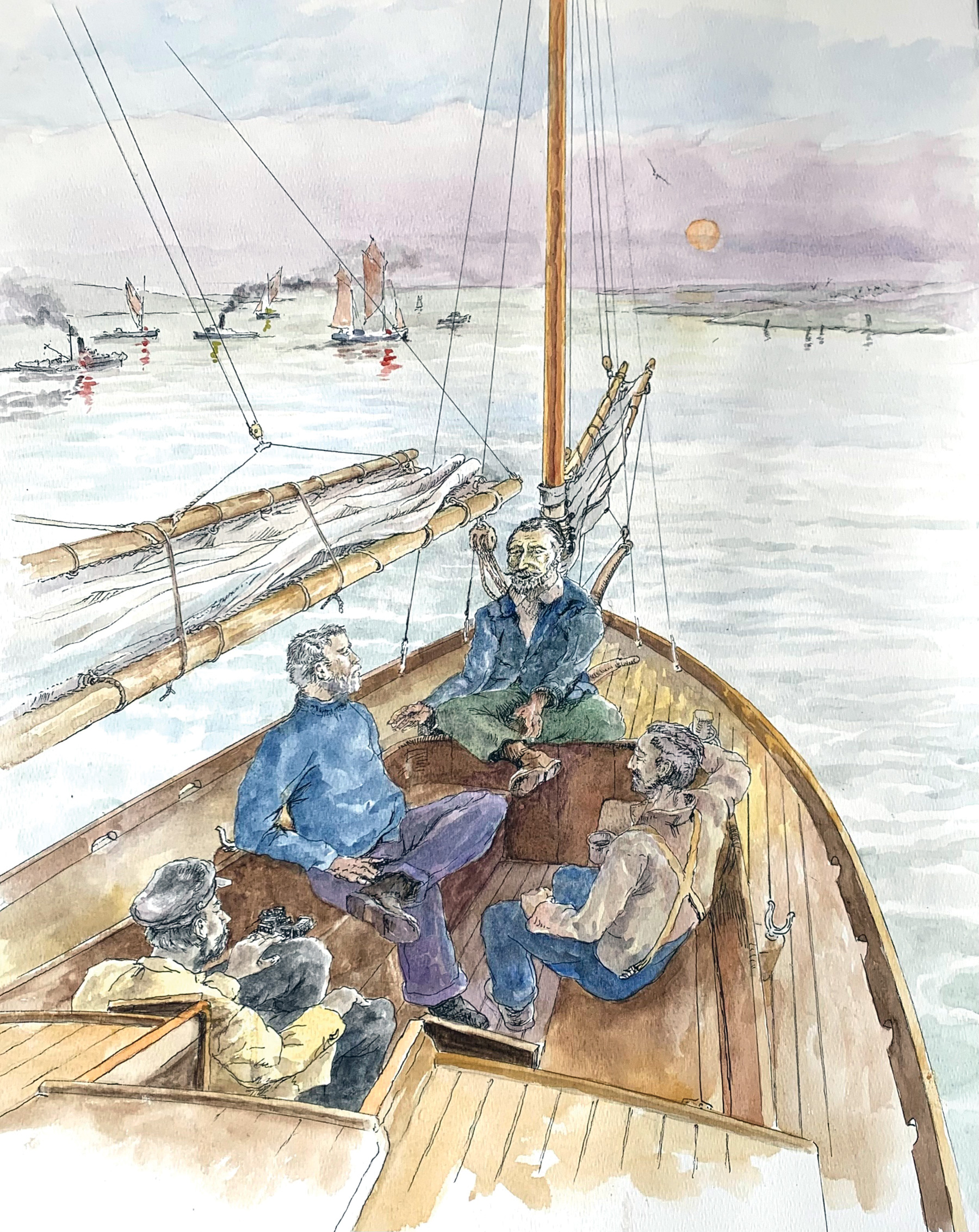
The 33′ cruising yawl NELLIE anchored in the lower River Thames.

The opening scene of Joseph Conrad’s Heart of Darkness is set aboard the 33′ cruising yawl NELLIE anchored in the lower River Thames. The four characters in that scene—and the yawl itself—are based on Conrad’s personal experiences.

It is among the most evocative first lines in literature: “The NELLIE, a cruising yawl, swung to her anchor without a flutter of the sails, and was at rest.” Thus, the scene is set and, as a windless twilight descends upon the lower reaches of the River Thames, a seaman named Marlow spins a yarn for his shipmates. It is the 1890s, just before the coming of small, gasoline engines suitable for yachts, and NELLIE’s captain and crew adapt to nature’s dictates, the ebbing and flooding of the tide, as sailors must.

“The flood had made, the wind was nearly calm, and being bound down the river, the only thing for it was to come to and wait for the turn of the tide…the tanned sails of the barges drifting up with the tide seemed to stand still in red clusters of canvas sharply peaked, with gleams of varnished sprits.”

Joseph Conrad is painting with words. Only a writer who was also a thorough sailor could have composed such lines or imagined the cockpit of a 33′ yawl as just the place for his characters to relax while their shipmate relates his adventure as skipper of a small steamboat on the Congo River. Like Conrad himself, the fictional Marlow had once been in the employ of a Belgian trading firm exploiting native tribes in its quest for ivory. There was, however, a price to be paid for such endeavors. Conrad explored that price in his 1899 novella, Heart of Darkness, which opened with those lines about NELLIE.

The story behind this story raises questions to which readers, particularly those fascinated by sailing craft, would relish answers. Why did Conrad, always precise in detail, specifically set the stage aboard a yawl, not a cutter, or a schooner? Was NELLIE a real yacht owned by Conrad or a fictional creation? If real, what was she? Are the characters aboard NELLIE besides Marlow—the “Director of Companies,” the “Lawyer,” and the “Accountant”—also based on real people?

The simple answer to all these questions is that Conrad based his writing on personal experience with ships and people he knew during the 19 years of his seafaring career. In his story Youth, for example, Conrad adapted his voyage aboard a worn-out bark named PALESTINE to the fictional voyage of an ill-fated ship he named JUDEA. In fact, the two vessels may as well have been the same, because Conrad understood that PALESTINE and JUDEA were Roman names for the same place, today’s Israel. Just as PALESTINE caught fire and sank when her coal cargo began to smolder for a time before bursting into flame, the same thing happens in Youth aboard JUDEA. Fortunately for Conrad, his open-boat voyage to safety lasted 13 hours. JUDEA’s crew endured “nights and days” before reaching port.

Born in 1857 in Ukraine, which had long been part of the Kingdom of Poland, Jozef Teodore Konrad Korzeniowski unaccountably found that he possessed what he called “a great passion for the sea.” He first shipped out in 1875 when he was 18 years old, signing aboard the square-rigger SAINT-ANTOINE as an apprentice on a voyage from Marseilles to the Caribbean. He was so focused on pursuing his career as a merchant seaman that he later wrote, “Beyond the line of the sea horizon, the world did not exist for me….” Conrad passed his second-mate’s exam in 1880 in England. Six years later, in 1886, he earned his master’s certificate on his second try, and also became a British subject.

Conrad’s career at sea began too late for him to find berths exclusively in the sailing ships he loved for their beauty and the challenges they posed to the skill and judgment of captain and crew. Instead, he was forced to also voyage in steamships, although they, too, would provide fodder for his writer’s imagination, most notably in the amazingly conceived novella Typhoon. It was during an interlude in his deep-sea voyaging that Conrad was hired to skipper a little stern-wheel steamboat with the grandiose name ROI DES BELGES (King of the Belgians) on the Congo River. This boat, which Conrad would later refer to as a “tin-pot steamer” became the model for the decrepit sternwheeler in Heart of Darkness. Conrad lasted six months in the brutal heat, humidity, and rampant disease of the Belgian Congo. He arrived on June 1, 1890, and returned to England in January 1891 suffering from dysentery and malaria. The latter remained an affliction throughout his life.

In 1894, after a planned merchant voyage was canceled, Conrad devoted himself full-time to writing. But the transition to life ashore was difficult, and he entered what he called a “dark time.” This did not mean, however, that he remained entirely shorebound. He occasionally went sailing with pals, including his closest English friend, whom he had met in 1880 in the office of a shipping agent. The friend’s name was George Fontaine Weaver Hope (G.F.W. Hope), a well-to-do businessman with interests in South African mining ventures who became the “Director of Companies” and “captain” of NELLIE in Heart of Darkness. In fact, NELLIE was a real yacht owned by Hope.

Another shipmate aboard NELLIE was the “Accountant,” the one “who had brought out already a box of dominoes.” This was William Keen, a real-life accountant and Conrad’s financial adviser, who also played dominoes with the writer’s children and grandchildren and whose name appears in some of Conrad’s correspondence in 1904 and 1905. Unfortunately, Keen’s papers were lost during World War II in the Blitz.

The identity of the “Lawyer—the best of old fellows”—who appropriated NELLIE’s only deck cushion, remains unknown.

As for Marlow, who narrates Heart of Darkness while sitting with his back against NELLIE’s mizzenmast: he is clearly modeled on Conrad. He is a “seaman” and a “wanderer” whose “sunken cheeks [and] yellow complexion” likely reflected the writer’s appearance during bouts of malaria.

Joseph Conrad.

Joseph Conrad was born Józef Teodor Konrad Korzeniowski in Ukraine in 1857.

Conrad’s nonfiction Mirror of the Sea, published in 1906, may be the most comprehensive offering of his thoughts on handling both square-rigged ships and fore-and-aft-rigged yachts. He noted: “The fore-and-aft rig, in its simplicity and beauty of its aspect under every angle of vision is, I believe, unapproachable.” Conrad listed the virtues of the three principal fore-and-aft rigs known to English yachtsmen: “For racing a cutter: for a long pleasure voyage, a schooner: for cruising in home waters, the yawl, and the handling of all of them is indeed a fine art.”

Of course, Conrad had his priorities straight. Big, narrow cutters dominated 19th-cenutry English yacht racing and several made vain attempts to win the AMERICA’s Cup. Schooners were a staple of both cruising and racing sailors. But for smaller yachts, particularly in that time before auxiliary power, the yawl with its sails of manageable size, and with a mizzen to aid maneuverability, was a clear choice. “The yawl,” Conrad wrote, “one comes to love. It is, I should think, the easiest of all to manage…. For racing I don’t care at all. That’s why I prefer the yawl rig.”

The yawl NELLIE was built in England in 1869 by the Plymouth-based boatbuilder John Glanville Hicks in his boatyard located close by the Tamar River at 19–20 Cremyll Street in a section of town known as Stonehouse. There is still a boatyard there, but specializing in moorings and service. NELLIE appeared in Lloyd’s Register of Yachts of 1889–90 and was listed at 9 tons Thames Measurement, a figure derived from a formula based on length and beam. The Thames Measurement Rule was conceived in 1855 to calculate port dues and, later, racing handicaps. Unfortunately, referring to a yacht according to tons is not a good way of describing the boat’s real proportions (at least to today’s reader), yet the unhelpful tendency of citing a vessel this way rather than according to her actual displacement and dimensions continues in all-too-many articles and books.

However, we might conjecture that, as NELLIE’s particulars were 33′5″ length from stem to stern, 8′ beam, and 6′ draft, her displacement was probably similar to L. Francis Herreshoff’s 33′× 8′6″×5′ ARAMINTA ketch, around 5,950 lbs. So, NELLIE was of a practical size, a boat that offered adequate but certainly not luxurious comfort levels expected by small-boat sailors of that time or, for that matter, an unpretentious, practical sailor of any time. Nor would she have required excessive muscle power when raising, trimming, or furling the sails, or in her general handling and steering.

NELLIE was a canoe yawl. These double-enders had found popularity in England from the Victorian period up to World War I. Initially developed from workboat types, such craft ranged in size from what were essentially sailing canoes of 14′ or so up to bigger boats such as NELLIE. But, whatever the size, the double-ended hull was favored as offering a well-balanced, seaworthy shape.

“These ‘Canoe yachts,’ as they came to be called,” wrote Rick Powell in The Canoe Yawl (Lodestar Books, London, 2016) “were mostly small, around 25 feet overall, but there were much larger versions designed and built. They were all of similar hull form and came in centerboard, fixed and fin bulb keel versions.”

Among the best-known designers of such craft in England were George Holmes, whose 21′ EEL proved especially noteworthy, and Albert Strange. Both men were capable of producing evocative illustrations of their boats as well. Strange was a fine artist and his paintings and elegant yachts were so impactful that the Albert Strange Society (www.albertstrange.org) was established in 1978 to maintain his legacy.

Whether the hull had a deep keel or a centerboard, the rounded stern and handiness of the rig were the canoe yawl’s most distinctive features. The only known contemporaneous image of NELLIE is an illustration provided by a G.F.W. Hope descendant to Conrad biographer Norman Sherry, author of Conrad and his World (Thames and Hudson, London, 1972). The illustration shows a typical canoe yawl sailing in rough seas with a deeply reefed gaff mainsail, working jib, and furled mizzen.

The NELLIE, a cruising yawl.

“The NELLIE, a cruising yawl, swung to her anchor without a flutter of the sails, and was at rest.”

Not only is the mizzen a benefit for leaving one’s mooring on the desired tack, but the yawl rig offers the advantage of reasonably sized, easy-to-handle sails that can be lowered or reefed depending on wind strength while still maintaining a nicely balanced helm. These are all very good reasons for the type to have been popular in Conrad’s day. Such inherent advantages also account for some renewed popularity these days thanks in part to preservationists in England and also to more-recent yacht designers such as William Garden in the Pacific Northwest, who developed his own version of Holmes’s EEL, and Iain Oughtred in Scotland.

The output of NELLIE’s builder, John Hicks, does not seem to have been prolific. Besides his boatbuilding, Hicks spent some of his time as a member of the Stonehouse Urban Sanitary Authority. He built several cutters, the largest a 35-footer, and converted a 25′ cutter into a 27′ yawl for his own use. He also built or modified seven smaller yawls and cutters before his death in 1889 at age 52.

lthough details of Conrad’s yachting activities are sparse, what little exists indicates he enjoyed sailing. Georges Jean-Aubry, a French music critic who lived for years in London and was a friend of Conrad, edited Joseph Conrad: Life and Letters (1927). In one letter, Conrad wrote: “I have done some [yachting] with a friend in a 12-ton yawl, and an 18-ton cutter before I wrote a line for print.” Conrad recalled that he edited the proofs of his first novel, Almayer’s Folly (1892), which marked the first use of his anglicized name, while aboard a friend’s 40′6″ cutter, named ILDEGONDA after a popular Italian opera.

Jean-Aubry himself noted that “Together with his friend G.F.W. Hope, he [Conrad] indulged in the pleasures of yachting…. It may be that Conrad actually told the story of his African experiences on this yacht [NELLIE] more or less as he makes Marlow tell his.” This means that Conrad would have been recalling a story he first conceived between 1889 and 1892, for that appears to be the period when Hope had NELLIE. Heart of Darkness was first published in 1899 in London in Blackwood’s Magazine and has been the subject of diverse criticism and an inspiration for academics, writers, television shows, and film creators ever since.

In 1893, Hope acquired a new boat, the 30′4″× 6′6″×3′ VELELLA. It may be that Hope ordered this yacht himself, because NELLIE would have been 24 years old by then. VELELLA was designed by Linton Hope (no known relation to G.F.W. Hope), who won a gold medal in yachting for England at the 1900 Olympics in France and went on to create the Fairy One Design for the North of Ireland Yacht Club among many other intriguing boats (see WB Nos. 296 and 299).

VELELLA was built by the Stone Brothers at their yard in Erith (pronounced ear-reth), then a small, Thames-side town about 17 miles southeast of London. She is described in Lloyds’ Register only as being sliding-gunter rigged. However, sliding-gunter rigs were not unusual on canoe yawls; given VELELLA’s shallow draft, it’s likely she was such a boat. With half the draft of NELLIE, VELELLA may well have been a more useful yacht for exploring the lower reaches of the Thames with its adjacent creeks and the sandflats and mudflats that had for centuries posed dangers for vessels leaving or entering the great river.

In fact, Conrad invokes those dangers in both a literal and symbolic way in Heart of Darkness. Thus, we learn that NELLIE is anchored in a spot with a good view of the Chapman lighthouse—“a three-legged thing erect on a mud-flat.” This red-painted structure, built in 1851, would have been well-known to Conrad and any mariner navigating the Thames until it was demolished in 1958. As Marlow sets the scene for his story, he recalls a time 1,900 years before when the Romans came to England, to them a place of darkness, in their triremes, “a kind of ship,” Conrad thoughtfully imagines “about as rigid as a concertina.”

Yet with the arrival of the Romans, gradually, what became England began to become a place of light. “Light came out of this river since,” Marlow says in Heart of Darkness. Then, as the green, red, and white navigation lights of river traffic pass by the anchored NELLIE, Marlow tells his compelling tale.

The captain of NELLIE, G.F.W. Hope, died at age 76 in 1930. In Heart of Darkness, Conrad took care to note that “Like any watchful skipper,” the captain made sure he was “satisfied the anchor had good hold” before he made his way aft to NELLIE’s cockpit and sat down to await Marlow’s narrative. What records exist suggest NELLIE was broken up by her subsequent owner in 1896.

Conrad, suffering from rheumatism and heart disease, not to mention his recurrent malaria and depression, died at age 67 at his home in the English village of Bishopsbourne on August 3, 1924. By then, Conrad’s stories and novels—with key themes that explored man’s struggles with nature, colonialism and racial prejudice; hypocrisy and ambition; and the search for enlightenment amidst darker forces—had made him a world-renowned novelist.

“We live in the flicker,” Marlow tells his shipmates aboard NELLIE, “may it last as long as the old earth keeps rolling!”  Article ends.

The author thanks Richard Temple, archivist at the University of London, and Professor Robert Hampson of the Joseph Conrad Society (UK), www.josephconradsociety.org, for assistance with research.

Stan Grayson is a regular contributor to WoodenBoat. His most recent book, Boat Crazy, the collected WoodenBoat stories of Stan Grayson, is available from The WoodenBoat Store.