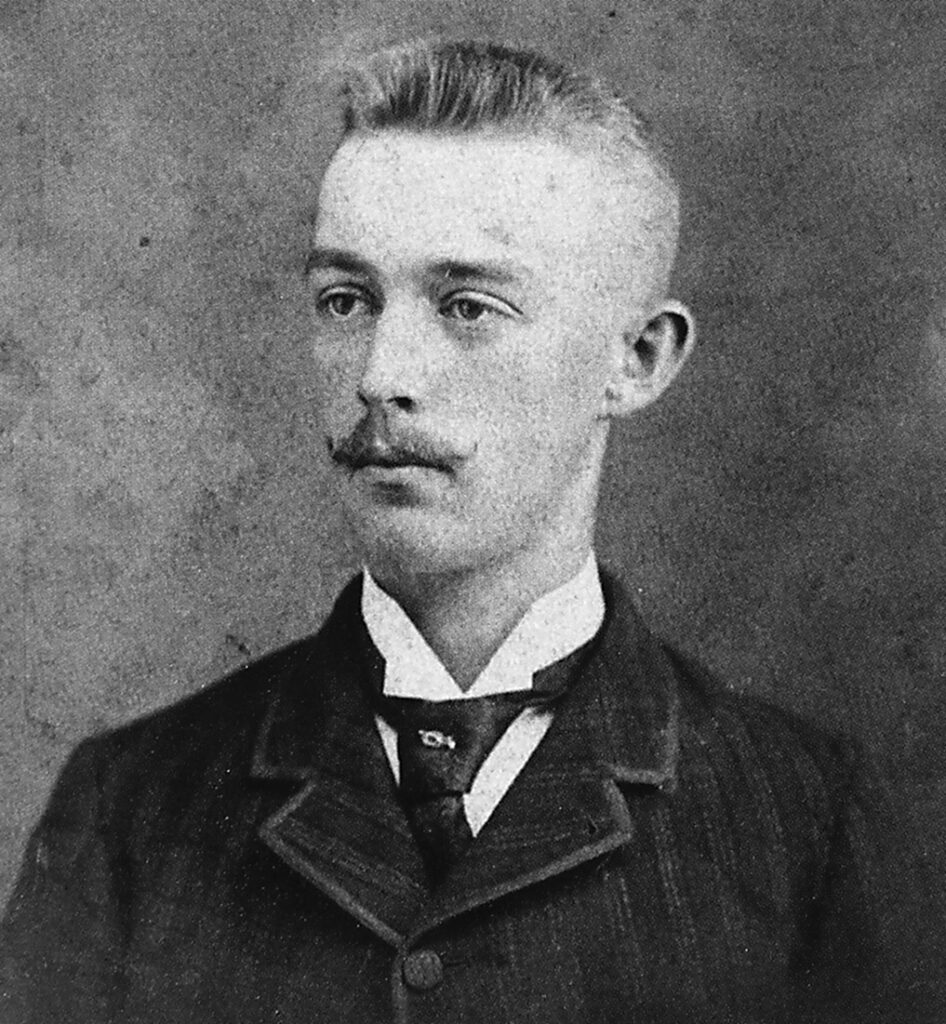
Osterville Historical MuseumH. Manley Crosby, who was born in 1872, was an innovator from a family of Cape Cod, Massachusetts, boatbuilders that is still active in wooden-boat construction. When he was in his mid-20s, Manley set up shop in Brooklyn, New York, to be close to a hotbed of catboat racing.
Of the seven unique villages that make up the town of Barnstable on Cape Cod, Massachusetts, there is one that enjoys, if such a thing is possible, an over-abundance of geographic blessings. In addition to 5 miles of Nantucket Sound coastline, Osterville abuts or encompasses seven ponds, a river, and four bays. The most important bays relating to this story are North Bay and West Bay, for it is on the passage connecting these two enticing bodies of water, fringed with trees, marsh grass, and sand, that the Crosby boat shops once flourished.
It is a pleasant exercise, now, to imagine Osterville as it was during the latter decades of the 19th century. The village was then home to perhaps 400 residents, but it was also attractive to increasing numbers of summer visitors who arrived by train at the West Barnstable station and then took an hourlong stagecoach ride to their destination. Osterville was, and remains, a genteel place of tree-shaded streets and, especially in the years before the automobile, it offered a full measure of peace and quiet. At night, nothing detracted from the darkness and starlight except for the oil lamps of neatly kept homes and inns. Summer visitors relaxed and socialized, went bathing, or visited the reading room in the shingle-roofed library that, in 1882, had a collection of 1,209 books.
Osterville Historical MuseumThe Crosby crew on Cape Cod, circa 1900. H. Manley is at the far right.
For many, though, the waterfront represented Osterville’s picturesque centerpiece. This was the place to rent a rowing skiff or hire a skipper to take you fishing or for a pleasant daysail around the bays in a catboat built by one or another of the Crosbys, whose shingled boatshops fringed a wide swath of the shore. Here, catboats of all varieties lay alongside boatyard docks, were moored, or hauled out on the sand. Among these shops was Horace Manley Crosby’s. According to the yachting historian William P. Stephens, it was in 1892, “when the business was growing, that a steam power saw was installed in the shop…and he was the first to use steam-bent oak frames in place of the grown pitch pine.” Manley, who Stephens would come to know to some extent personally, was just 20 in 1892, but in the years ahead he would further prove himself to be both a versatile and innovative designer and open to new technologies.
As the popularity of yachting grew steadily during the 1880s and 1890s, Crosby catboats enjoyed increasing demand, and their reputation attracted customers from well beyond Cape Cod. Among these devotees was a New Jersey and New York businessman named Frank M. (Mortimer) Randall who, in December 1893, had been elected vice commodore of the Pavonia Yacht Club in Bayonne, New Jersey. Randall had enjoyed racing success with his unusual Crosby cabin catboat HIT OR MISS, winning, among other events, Class 5 in the New York Yacht Club’s 1893 annual regatta.
Library Of Congress/Detroit PublishingBrooklyn, New York, had a bustling waterfront when H. Manley Crosby briefly set up shop there around the turn of last century.
What made HIT OR MISS (27′1″ LOA, 18′10″ LWL, 9′9″ beam, 3′ draft) unusual was her departure from the expected catboat form with its plumb or canoe-style bow and barn-door rudder. Designed by Herbert F. Crosby (Manley’s older brother, 1853–1936), HIT OR MISS had an underhung rudder and sweeping “GLORIANA bow” with a long overhang. The popularity of the shape, which reduced the measured waterline and wetted surface by comparison to the clipper-style bow then common on large sailing yachts or, presumably, the typical catboat’s bow shape, followed its introduction in 1891 by Nathanael Greene Herreshoff and the success of the 70′9″ GLORIANA.
Randall’s victories in well-publicized regattas with HIT OR MISS prompted him to order a new catboat, WIN OR LOSE, from Herbert Crosby for the 1894 season, and he soon won his class that July in a regatta at Greenville Yacht Club in Jersey City, New Jersey. Yet WIN OR LOSE was not the only boat that Randall sailed that season. On March 31, 1895, The Boston Globe reported that “Crosby sent the ALLEGRO to New York last fall to race the crack cat KITTY, and was successful, beating the New Yorker by five minutes over a 15-mile course. ALLEGRO was sailed by Frank M. Randall, who bought [yet another Crosby catboat], the 21-fotter EXILE, and she will be raced again the coming season.”
Library Of Congress/Detroit PublishingManley Crosby’s shop was adjacent to the Atlantic Yacht Club house in Brooklyn, seen here with a pair of racing catboats at the float.
A year later, reflecting on the success of these boats, The Boston Globe reported that “H.F. Crosby, one of the family of boatbuilders, was one of the first to send the new type of catboats to the races in and around New York Bay, and the success…won him much praise.”
Randall financed the purchase of each new boat he acquired by selling the current one, and his enthusiasm was noted by others. On July 9, 1895, The Brooklyn Daily Times reported that the commodore of the newly organized Huntington (Long Island) Yacht Club had taken delivery of a 27′ overall catboat “designed and built by H. Manley Crosby, the designer and builder of the smart little Mischief and is going, it is said, to make the fast boats of the club look to their pennants.”
Such publicity suggested to Frank Randall that a ready market would exist if a Crosby would open shop right in the heart of it all in Brooklyn. Among other things, this would improve builder-client communication and do away with time lost delivering boats in unpredictable spring weather from Cape Cod to New York. William P. Stephens concluded that the “popularity of the Class [race-oriented catboats] about New York was due mainly to the efforts of one man, Frank M. Randall.”
Library Of Congress/Detroit PublishingManley designed the 22′-waterline catboat PRESTO for Frank M. Randall, the patron who inspired his move to Brooklyn.
Details regarding a Crosby opening shop in Brooklyn are regrettably sparse, yet there are clues that Manley Crosby grew to seriously consider a move. Randall had, in April 1894, joined the Atlantic Yacht Club (AYC) in Brooklyn, where he and pals occasionally entertained with impromptu songs and vaudeville acts. Randall’s connections with other AYC members were probably viewed as a kind of built-in market that could enhance the potential success of a new Crosby boatbuilding business. The club’s roster included very wealthy members, among them J.P. Morgan and George Jay Gould, son of financier Jay Gould, but the rank-and-file was well-to-do and able to afford the sorts of boats Crosby would offer.
As for Manley Crosby’s connection to the AYC, The Brooklyn Daily Eagle reported on September 12, 1895, that members of the club had chartered the steamer GAY HEAD to watch the AMERICA’s Cup races between DEFENDER and VALKYRIE and that Horace Manley Crosby was aboard as a guest. By then, in fact, 24-year-old Manley had already made the decision to open shop in Brooklyn, assisted by his brother Joseph and boatwrights Oliver Coffin and Frank Williams. He’d shipped his household goods from Osterville in the schooner LUELLA, owned by his friend Capt. C. Nickerson.
By the close of the 1895 yachting season, everything was in place to establish a Crosby boatbuilding operation in Brooklyn at the foot of 56th Street close by the AYC. The new business became official on January 24, 1896. Then, the Brooklyn Times Union reported: “The following new company was incorporated today: The Crosby Catboat and Yacht-Building Company of Brooklyn. Capital, $10,000 [about $370,000 in today’s money]; directors H. Manley Crosby, Joseph C. Crosby, Frank Williams [and] F. M. Randall of New York City.”
According to William P. Stephens, Randall was “instrumental” in organizing the company.
Library Of Congress/Detroit PublishingThe 25′-waterline STEP LIVELY, also designed and built for Randall, represented “the extreme development of the Class under the stimulus of keen racing,” according to the yachting historian W.P. Stephens.
With his move to Brooklyn, Manley Crosby; his brother, Joseph; and the boatwrights found themselves in a world far removed from quiet, bucolic Osterville. Although still comparatively rural, the Bay Ridge area of the city where they established themselves was on the precipice of rapid growth, and Brooklyn was already the fourth-largest city in the country, with a population approaching 839,000. Manley and his wife, Velina, who were married June 1, 1893, set up housekeeping aboard a decommissioned steamboat, presumably in or near the 56th Street boatyard that would be the company’s initial address. The yard was adjacent to the AYC and leased from the well-established, 55-year-old, German-born boatbuilder John Mumm.
During that era, it was common for newspapers to report not only regatta results but also ongoing work at local boatyards. On April 29, 1896, The Brooklyn Daily Eagle reported that the Crosby Catboat and Yacht-Building Company…is having a busy time just now. There are two boats in the shop, work on one of which, a racing cat, has begun…. The new cat is to have hollow spars and will be a very fast boat…. The other boat in the shop is also a cat…designed both for cruising and racing.” The newspaper reported that the new yard had received orders for five more boats to be finished by the incredible deadline of July 1.
The “new cat” with hollow spars was another commission from Frank Randall and would promptly become noteworthy as STEP LIVELY (34′5″ LOA, 25′ LWL, 11′3″ beam, 1′9″ draft, board up). Manley Crosby’s conception for this boat was a very far cry from the typical Cape Cod cat. Of STEP LIVELY, Stephens wrote that she “represents the extreme development of the Class under the stimulus of keen racing, with a reverse [curve] at each end of the waterline and no outside keel or deadwood.”
Matt Cooper/m.a. Cooper Design 2015STEP LIVELY had a balanced rudder, no outside keel or deadwood, and a colossal mainsail (1,050 sq ft) set on a hollow mast supported by shrouds and a forestay.
If all that wasn’t dramatic enough, Stephens failed to mention that STEP LIVELY had neither a barndoor nor underhung rudder but instead a balanced rudder. A plan view drawing published in The Rudder shows a mast that looks roughly half the diameter of the usual catboat spar. In contrast to the type’s typical heavy mast rigged with only a forestay, STEP LIVELY’s comparatively lightweight mast was rigged with single shrouds in addition to a forestay, with all of this rigging supported by a forward-facing spreader. The massive 1,050-sq-ft sail was mounted to a sail track rather than mast hoops.
The Brooklyn Citizen reported in June 1896 that the boat “won every one of the dozen or more races in which she sailed.” That wasn’t entirely accurate. In the AYC’s opening day regatta on May 30, STEP LIVELY finished second to the Gil Smith catboat SQUAW while Manley Crosby, sailing a catboat he’d previously designed and built for Randall, PRESTO—similar in general concept to STEP LIVELY but shorter, with a 22′ waterline—won Class 2. STEP LIVELY, though, handily won her subsequent races, and Randall even took her on the AYC’s cruise.
Such performance attracted attention. When Randall was approached by fellow AYC member George Hill, who wanted to buy STEP LIVELY, he named a seemingly outrageous price only to be shocked when Hill promptly accepted. This news even resulted in a headline in The Brooklyn Citizen on June 28: “Step Lively sold.” The boat, renamed DOROTHY, continued her career with rather less success under her new owner. One speculates she was a very rewarding yet demanding boat to sail.
Unsurprisingly, Frank Randall was not left without a boat after selling both STEP LIVELY and PRESTO. He took delivery in July of yet another Manley Crosby catboat. This was the 25′ SCAT, 20′ on the waterline. Randall won races and then sold SCAT, too. Under the ownership of a Canarsie (Brooklyn) Yacht Club member and with a professional skipper handling her, SCAT did well in 1900. This might have been the end of what we know about SCAT were she not purchased, probably by the summer of 1902, by Edwin Schoettle, a yachtsman from Barnegat Bay, New Jersey.
In his book Sailing Craft, published in 1928, Schoettle recounted the illuminating and perhaps surprising seaworthiness that SCAT demonstrated at the hands of her delivery skipper, who sailed singlehanded down the East River and then 100 miles along the Jersey Coast to Atlantic City without charts. The boat was loaded with extra spars and three sails in the cabin and had a skiff in tow. This skipper must have been not only courageous and a clever navigator but also a great sailor, because Schoettle recounted that “he was caught in a storm on the ocean and was three days going from Sandy Hook to Atlantic City [and] made port with boat and cargo in good shape.” In Barnegat Bay, SCAT continued her winning ways.
Right from the first news reports about the Crosby Catboat and Yacht-Building Company, it was obvious that business would not be limited only to catboats or only to boats of Manley Crosby’s own design. When George Hill sold DOROTHY (ex-STEP LIVELY), Manley was completing a 30′ sloop of Hill’s design. Earlier, in April 1896, The Brooklyn Daily Eagle reported that the Crosby yard was completing a 31′ catboat designed by the well-known New York naval architect Henry J. Gielow, another AYC member. In May, the shop was putting the finishing touches to an 18′ × 3′4″ “bicycle boat” designed by its owner to be light weight, with thin cedar planking on slender oak frames. In that era when bicycles were a dynamic growth industry, a “bicycle boat” was bound to attract attention. This one was steered by conventional handlebars connected by chains to the tiller. The boat seated two riders in tandem.
The Crosby business continued into 1897 at a brisk pace. In February, The Boston Globe reported on a 52′ steam yacht that Manley had designed with a “spoon bow” (rather than clipper-style or plumb), narrow 7′ beam, and what appeared to be a fantail stern that increased the waterline by 4′ to 48′. The boat drew attention less for its design than its 150-hp steam engine, which drove the propeller shaft through what its inventor called a “wheel and roller-bearing movement” that he vainly hoped would revolutionize how even big ships were propelled.
More conventional boats remained the core business. The comparatively large size of the catboats being ordered seems surprising these days, but it was probably considered routine at the time when paid hands were still common. Crosby built another Gielow-designed catboat, STREAK, for AYC member C. Harold Lary, that measured 31′9″ LOA × 21′5″ LWL × 10′5″ beam × 2′5″ draft with the board up. A 32-footer was ordered by a sailor on Shelter Island. Several knockabouts were also under construction.
During this period when the one-design knockabout concept was becoming ever more popular as a means of controlling costs and leveling the playing field for Corinthian (amateur) sailors, a committee representing several area yacht clubs gathered in November at the Grand Hotel in New York to solicit ideas from local designers for a new model. Manley Crosby’s design wasn’t chosen, but his experience in thinking through such a yacht would ultimately have a far more long-lasting result than anyone could have imagined.
Although the great majority of news about Crosby’s yard involved the various yachts being built, it was reported without comment in May 1897 that the yard had moved to a new location at the foot of 43rd Street. What occasioned the move can only be a matter of speculation, but the sale by John Mumm of his boatyard was a likely factor. That area of Brooklyn waterfront was becoming ever more commercial, with docks and warehouses. In fact, in 1898, the AYC abandoned its beautiful clubhouse and the area became home to a drydock company. A new AYC clubhouse was built in exclusive Sea Gate on Coney Island.
Manley and Velina Crosby, meanwhile, were still living aboard the steamboat, where, in 1898, Velina gave birth to their third son, Wilton. But the urban environment, which had been a challenge even before the relocation, was an ever-present reminder that Bay Ridge wasn’t Osterville. Manley’s older brother, Joseph, had rather quickly become homesick and returned to the village, where he bought a shallow-draft schooner and established an oyster business. The Barnstable Patriot reported that Velina’s mother paid regular visits to her daughter and son-in-law in Brooklyn and also noted the visits to Osterville of Velina, and boatbuilders Williams and Coffin.
Despite these challenges, business remained seemingly robust. More big catboats were built, plus a 75′ launch for Philadelphia’s pioneering Globe Engine Company in 1898 and a fleet of 15 one-design, 13′6″ cat-rigged skiffs. Those intriguing sounding little boats were destined for the Penataquit-Corinthian Yacht Club in Bay Shore on the Great South Bay.
Osterville Historical MuseumH. Manley Crosby in his later years. He resumed business on Cape Cod after his foray into the big city and would go on to design the enduringly popular Wianno Senior–class sloop.
On April 5, 1898, The Brooklyn Daily Eagle reported, again without comment, that the Crosby company had a new name. H. Manley Crosby was “successor” to the Crosby Catboat and Yacht Building Company. For reasons not given, Frank Randall was no longer involved in the business, which carried on into spring 1899. Then, a surprising headline appeared in the May 10 edition of The Brooklyn Daily Eagle: “Mammoth House Boat: Local Builder is Transforming an Old Steamer into a Pleasure Craft.”
Apparently having concluded that the boatbuilding business would not be a long-term success because the 43rd Street yard, like Mumm’s, would soon be threatened by development, in the winter of 1898 Manley Crosby bought at auction the stripped-out hull of a 250′ × 45′ Hudson River steamer named the WALTER BRETT. His plan was to convert the vessel into “a floating summer resort with a dance floor and a café” to be moored in Gravesend Bay, where guests would arrive by launch. The result of this decision, and possibly other business factors, was that Crosby’s name began appearing in newspaper lists of debtors in March 1899. The unhappy situation wasn’t resolved until The Brooklyn Daily Eagle reported on June 2, 1900, that Horace Manley Crosby had been discharged from bankruptcy. Two years later, today’s sprawling Bush Terminal of piers and warehouses was founded where Crosby had been building boats.
At Cotuit and Osterville, many new and costly residences have been built…and it is predicted that the greatest season in the history of those places will be the coming one,” reported The Boston Globe upon the opening of the 1900 season on Cape Cod. By then, Horace Manley Crosby was back home. He put the Brooklyn experience behind him and quickly re-established his boat shop, which had been leased to an acquaintance from Barnstable, Vaughan D. Bacon. A land surveyor, small-boat designer, and a fine draftsman, Bacon’s work appeared from time to time in The Rudder.
On May 26, 1901, the Globe reported: “Manley Crosby, who has resumed boat building in Osterville, has had a very busy season and is now working on a 25-foot cat that is to be fitted with a gasoline engine.” But that was merely one of many orders Manley had in hand. The volume of business prompted him to both enlarge the shop and add electric lighting, “the first,” noted The Barnstable Patriot, “to appear in this part of the country.”
As the first decade of the 20th century progressed, the sort of boats being ordered from the Crosby’s changed. In April 1907, the Globe noted “the drop in output of cats,” but the ever-versatile Manley was reported to be working on a variety of 45′–60′ launches and cruisers. (Catboats weren’t altogether forgotten. In 1909, Manley launched CONJURER; see WB No. 236.) Meanwhile, interest in one-design knockabouts continued to grow, and this trend would soon be embraced in Osterville by the Wianno Yacht Club (WYC), which had been established in 1885.
In 1901, shortly after Manley’s return, the WYC was formally chartered by the State of Massachusetts and was holding races for five classes of boats. But as time passed, the idea arose to commission the design and construction of a new one-design knockabout that would do away with the need to handicap individual boats in different classes. Such a boat could be designed expressly to meet the requirements of the club and local waters. The local waters of Nantucket Sound were what The Rudder aptly described as “everywhere astonishingly shallow.” The entrances to West Bay and East Bay then had controlling depths of 3′.
In September 1913, The Barnstable Patriot announced: “A large class of one-design knockabouts is to be built this winter from designs of H. Manley Crosby.” Fourteen gaff-rigged “Wianno Yacht Club One Design” boats were built for the 1914 season. In April 1915, The Rudder published an article about the boat together with a profile drawing and the gaff-rigged sail plan by Vaughan D. Bacon. What would become known as the Wianno Senior (25′ × 17′6″ × 8′ × 2′6″ board up) soon proved to exceed all expectations in terms of sailing ability and seaworthiness.
Even as more Seniors were built—a high-point of 11 in 1930—Manley busied himself with other boats, and the family business grew. Yet he also found time to lead for 50 years the Osterville Silver Cornet Band and tutor youngsters in model-yacht building, handling a boat, or what went on inside a marine engine. As an older man, “Uncle Manley” could be seen in his boatshed in a rocking chair watching the goings-on on the water and doubtless reflecting on a life well-lived and, perhaps, on his distant interlude in Brooklyn. Horace Manley Crosby died in his Osterville house in January 1959. He was 88.
After his association with The Crosby Catboat and Yacht Building Company, Frank M. Randall’s intense racing activity with exotic catboats ended. He competed in a “smaller class” in 1902. Perhaps the newspapers’ last mention of him related to boats was in 1905, when he participated in a yacht club cruise to Staten Island in a launch named SUNSHINE.
John Gaffen/alamy Stock PhotoThe Wianno Senior VICTURA was owned by John F. Kennedy and is today on display at the entrance to the JFK Presidential Library and Museum in Boston.
In January 1910, The New York Times published an article about the newly built 12-story Randall Building on West 52nd Street, noting that “Mr. Randall will occupy the greater part of it for his furniture warehouse, leasing the upper lofts to other business concerns.” But this effort of Randall’s ultimately fared no better than had Manley Crosby’s steamboat-resort idea. Although Randall’s customers included several of Manhattan’s finest hotels, creditors entered a bankruptcy petition against him in November 1914. A large quantity of high-grade furniture was sold to repay Randall’s debts.
Frank M. Randall had been born at Mattapoisett, Massachusetts in July 1858. Growing up on the shore of Buzzard’s Bay, he would have gained his first sailing experience with catboats. The enthusiasm he developed during those formative years ultimately contributed to the passion he developed during the 1880s and 1890s. By the time of his death at age 64 in Owego, New York, in 1922, Randall had commissioned and sailed some of the most innovative designs to appear during the golden age of catboat racing.
A plausible time for when Manley Crosby carved the half model that became the Wianno Senior was 1913, 13 years after his return to Osterville. Considering all the experience he’d had by then with so many boats of different types and sizes, it’s unlikely that he would have initially imagined the devotion this particular one-design would engender. Still, Crosby lived to see 45 years of class history for himself and he knew the Wianno Senior that was presented to John F. Kennedy as a spectacular 15th birthday present in 1932. The future president cherished VICTURA all his life, and little doodles of the boat from his time in the White House survive. VICTURA is still displayed seasonally at the John F. Kennedy Presidential Library and Museum in Boston. ![]()
The death of the boat’s designer was recognized by the historically minded Wianno Senior Class as a sad yet important milestone. In 1960, to commemorate the occasion and honor the memory of the beautiful knockabout’s creator, a silver-plated Revere bowl was commissioned. This trophy remains among the hotly contested class’s most revered awards: the H. Manley Crosby Memorial Trophy.