
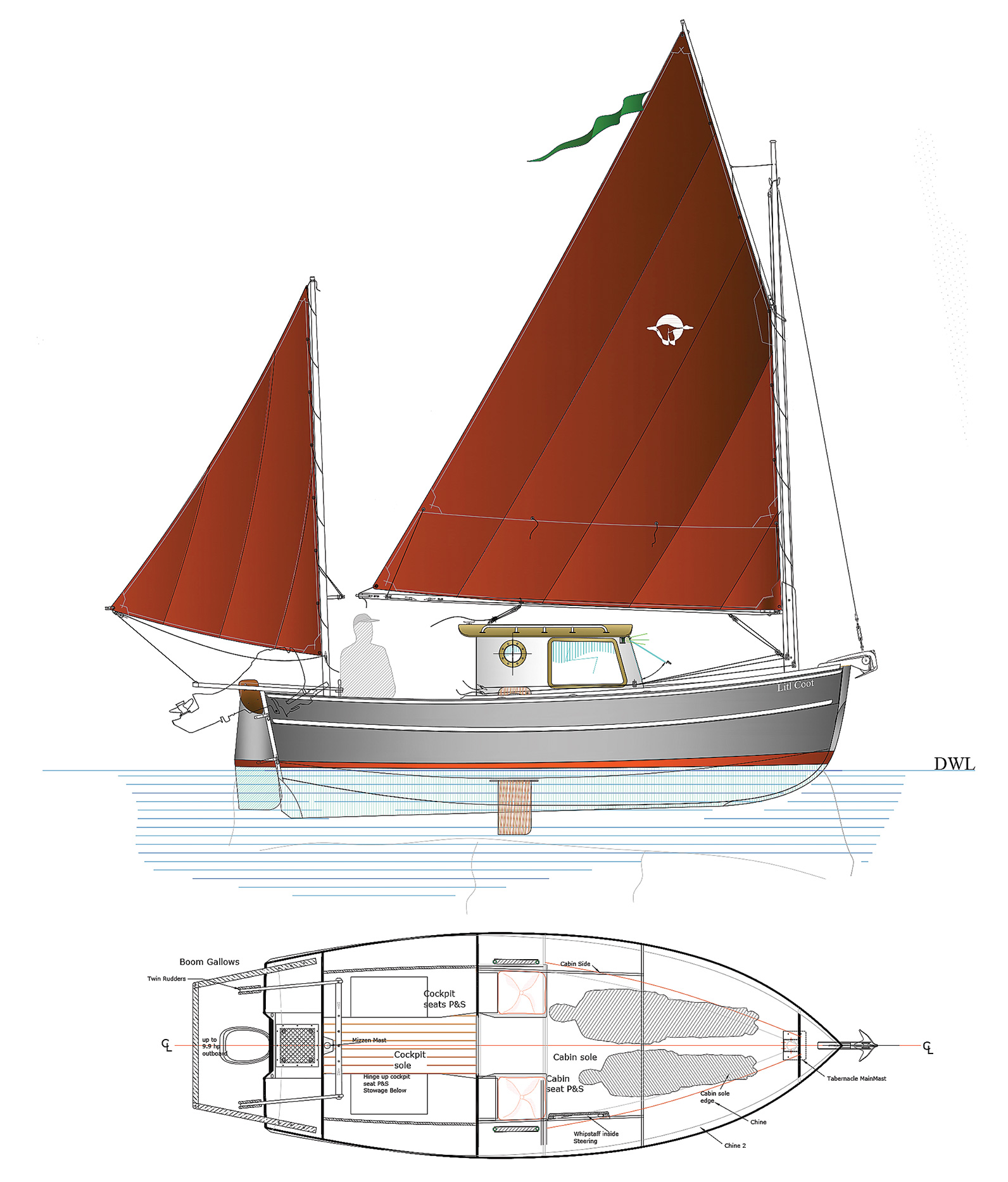
The compact Litl Coot, a true 50/50 motorsailer, will run happily when propelled by her cat-yawl rig or a 9.9-hp outboard motor—or both. Litl Coot’s cabin holds simple and pleasant space for two. Twin-daggerboard trunks rest near the sides of the hull, where they don’t interfere with the accommodations.
If a designer were to promise us a motorsailer that measures less than 18′ on deck, we might expect to find a miniature caricature. Yet in the case of Litl Coot, we would be wrong. Please, read on.
Particulars:
- LOD: 17′11″
- Beam: 6′11″
- Draft Boards up: 1′6″
- Boards down: 2′0″
- Displacement: 2,300 lbs
- Sail area: 156 sq ft
- Engine: 9.9-hp
Sam Devlin has drawn a particularly appealing and practical boat. Litl Coot should sail and motor equally well when pushed by her cat-yawl rig or a 9.9-hp outboard—or both. Her stitch-and-glue hull will go together in our back yard and might live happily on a trailer. She’ll be easily singlehanded, yet her accommodations offer simple comfort for a couple.
A gaff-headed mainsail will provide most of the power after we shut down the engine. The well-peaked-up gaff won’t slough off much to leeward, and it should help keep the sail well set as we work to windward—perhaps with assistance from the engine.
That boom vang specified on the sail plan is not mere affectation. It will be needed to hold the boom down, thereby avoiding excessive twist in the sail. Too much twist can decrease efficiency on all points and lead to scary rhythmic rolling when we’re running off in a fresh breeze. Devlin suggests that we lead the vang aft to the main bulkhead, where it will fall readily to hand for a solitary crew. Let’s employ rope that stretches little under tension.
The tiny leg-o’-mutton mizzen will fine-tune balance under sail and increase maneuverability. It also will help keep Coot’s head into the wind as we fuss with lunch or some such. All of this will be accomplished without a single piece of standing rigging, and no mizzen boom vang will be needed; as that sail’s clew starts to lift, tension along its foot will stop it. The triangle created by the sprit boom (in compression), the mast below it, and the sail’s foot form an automatic boom vang. We can control this “vang” by adjusting the tension in, or location of, the snotter (the line that secures the boom to the mast).
When working with a sprit boom, we should ask our sailmaker to cut the lower edge of the sail dead straight. Any convex curvature to the foot of the sail eventually will result in stretching and folding along that edge. I’ll admit that a little of this roach does look nice on the sail plan drawing. In any case, let’s sew the tiny mizzen flatter than the mainsail. We might leave it standing for much of the season, whether under sail or power or at anchor.
Those of us not bothered by lateral asymmetry might consider stepping the mizzenmast at the starboard quarter. The boomkin could then be simplified to a single stick. Access to the motor and after portions of the hull would be improved. Experience has shown that the boat will take little notice of this move, although the relocation might disturb some observers.
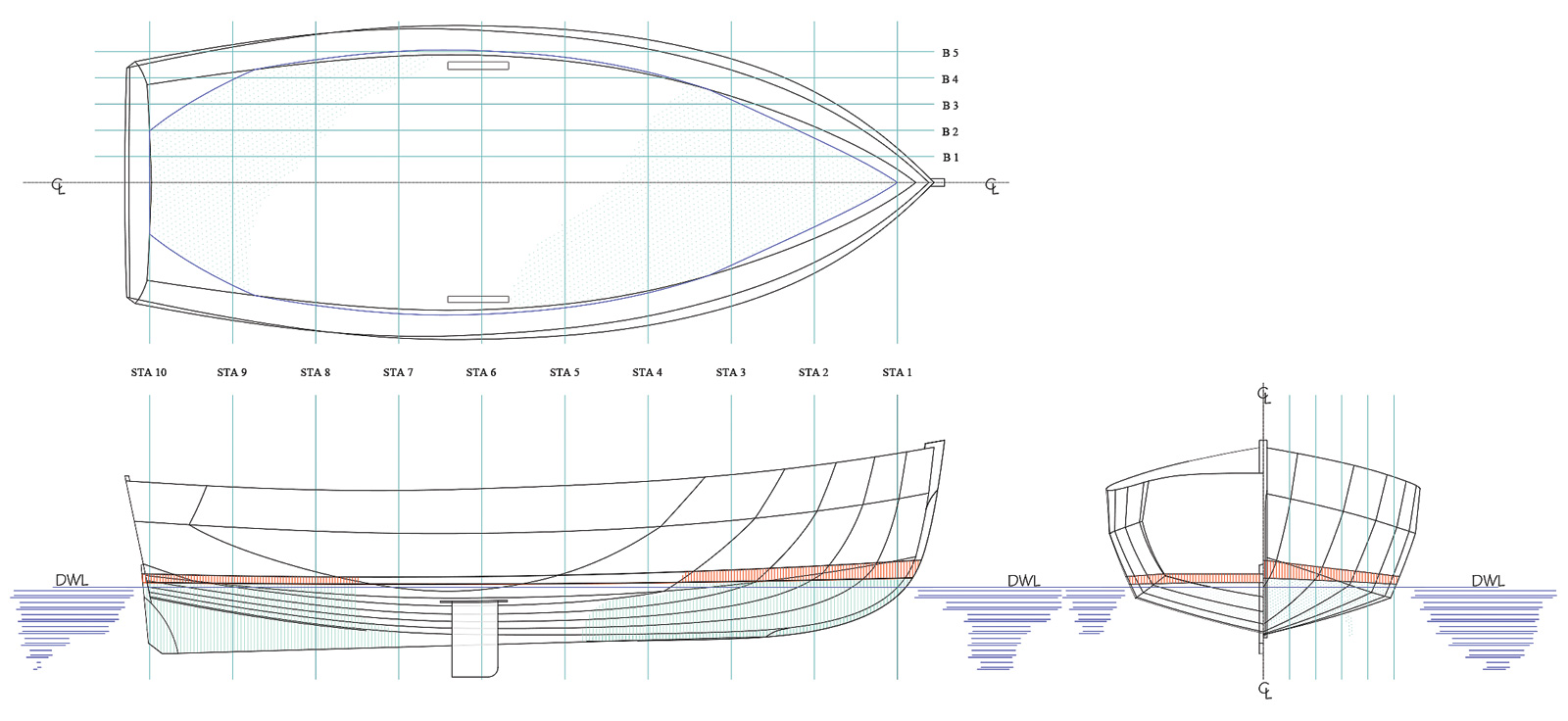
This shoal-draft hull will be easily driven by sail or power. Retractable twin daggerboards will help Litl Coot get to windward. When it’s time to rest, these boards will allow her to ground upright on uneven terrain.
Devlin describes Litl Coot as a “pure 50/50 motorsailer” and reckons that a 9.9-hp Yamaha four-stroke outboard motor will make for an ideal power plant: “It’s a great little engine, barely sips fuel, and is almost soundless at idle.”
Where should we locate that motor? Many small stock sailboats employ a centerline rudder, and their outboard motors hang off-center clamped to bolted-on transom brackets. If he were to follow this path, the designer fears that even with the engine tilted for sailing, its lower unit would drag through the water when on the lee side. I’ll add that this bracket arrangement, while common, often looks to be an ugly afterthought.
Coot’s motor will hang perfectly on center, clamped directly to the transom over a self-draining well. A pair of linked rudders will flank it.
Devlin also suggests that electric power might offer a good alternative to internal-combustion machinery. He believes that a Torqeedo Pod Drive should prove a good choice for Litl Coot.
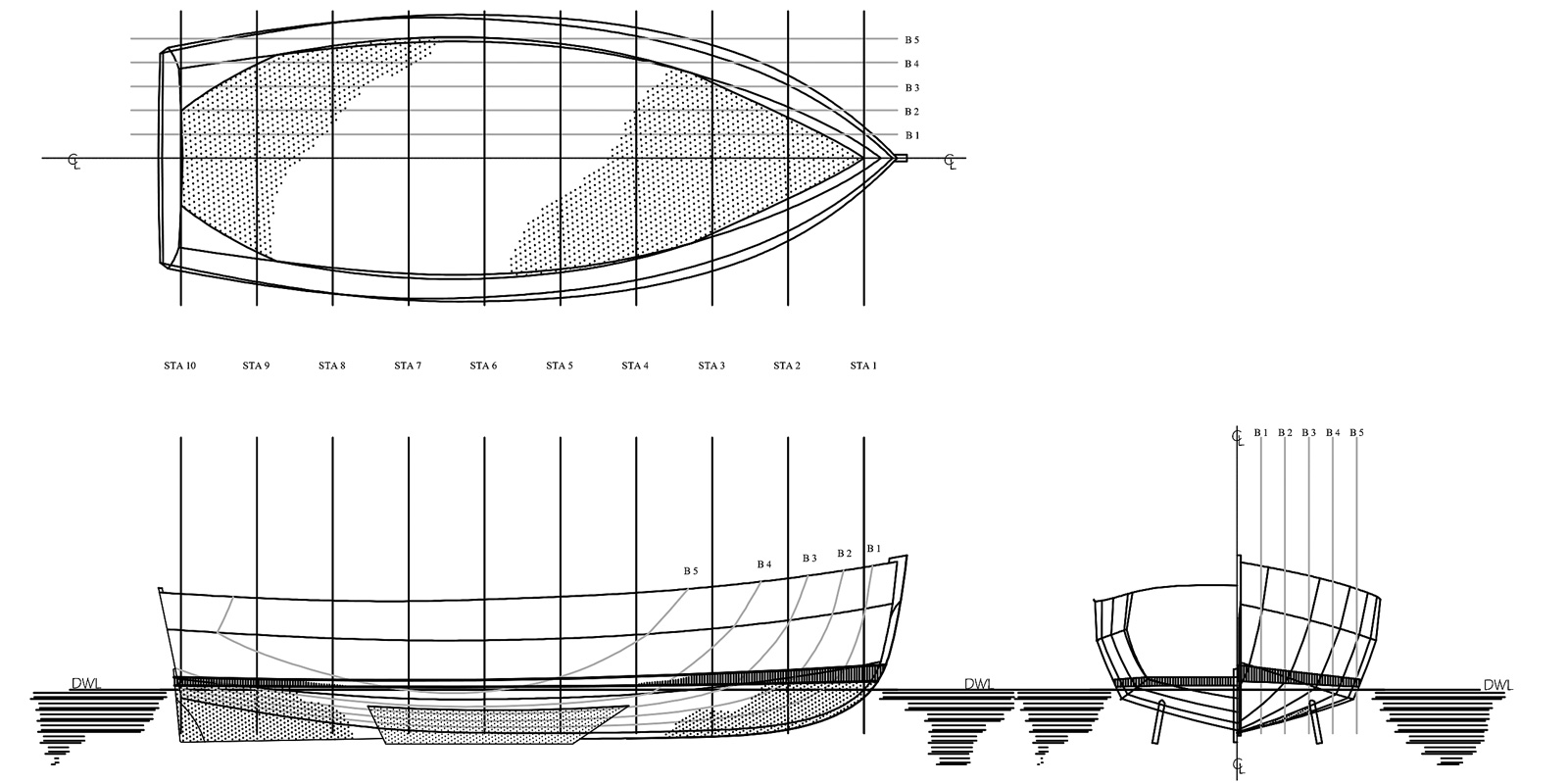
For lateral plane, designer Sam Devlin originally drew the shallow twin keels shown here. He recently added a twin-daggerboard alternative, which has become his “new favorite option” for Litl Coot.
For lateral plane, the designer at first chose shallow twin keels. He reasoned that a centerboard trunk would have spoiled the accommodations. And leeboards, for all their advantages, can be a nuisance to handle. The desired shoal draft and ease of trailering ruled out a deep centerline keel. Will these twin keels prove efficient when we’re hard on the wind? Probably not, but Litl Coot is indeed a motorsailer. The Yamaha or Torqeedo will get us home for supper no matter where that meal might lie.
The designer later added a full-keel version of Litl Coot for skippers who wanted better windward sailing ability and increased righting moment. Of course this option will draw more water and, unlike the twin-keel version, the boat won’t dry out upright at low tide.
Devlin recently has drawn a twin-daggerboard option for this hull. It seems to hold several advantages. Litl Coot now will be able to ride happily on an ordinary powerboat trailer, whereas the original twin keels tended to require custom trailer arrangements.
The twin daggerboards can be set at different depths, which will allow the boat to dry out bolt upright on uneven terrain. We can retract these boards entirely to reduce hydrodynamic drag when Litl Coot sails off the wind or runs under power. Indeed, Devlin describes twin daggerboards as his “new favorite option” for this design.
The designer likes his comfort, and he gave Litl Coot simple but pleasant accommodations. The cockpit is plenty deep, yet the hull’s great freeboard allows it to self-drain. We’ll steer with the twin-linked tillers. For even more comfort, I might be inclined to rake the seatbacks just a wee bit.
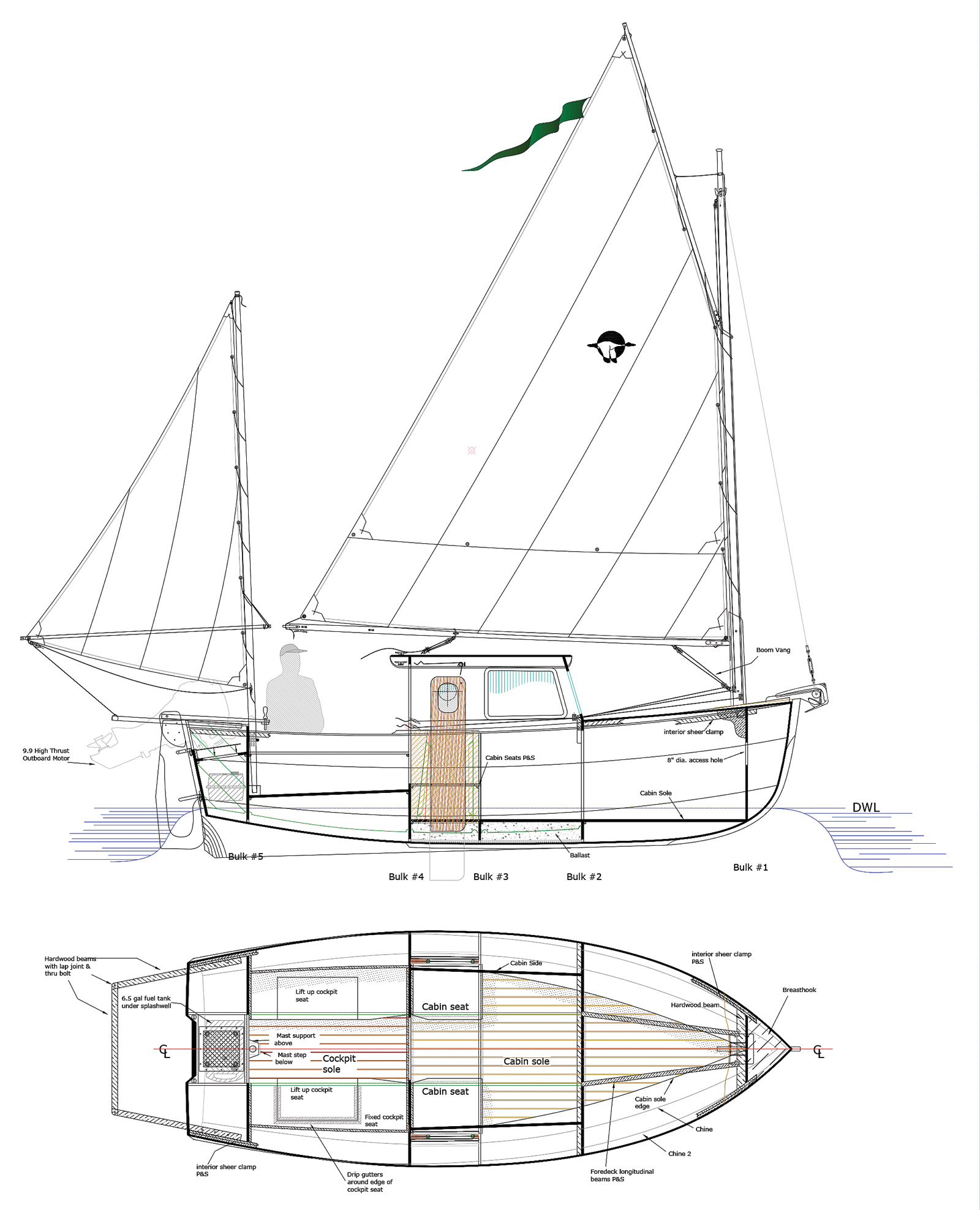
This pocket motorsailer offers economical cruising for two. We can steer from the cockpit or cabin.
In the cabin, two forward-facing seats afford protection from bad weather, and we can steer using the vertical stick mounted to starboard. The flat cabin sole forward will serve as a bed. Because our head and shoulders will reside in the airy and well-lighted trunk cabin, rather than under the foredeck, claustrophobia should not be a concern.
Coot’s accommodation drawing shows no hint of a head, so we’ll need to make our own arrangements. Perhaps a cedar bucket or portable commode….
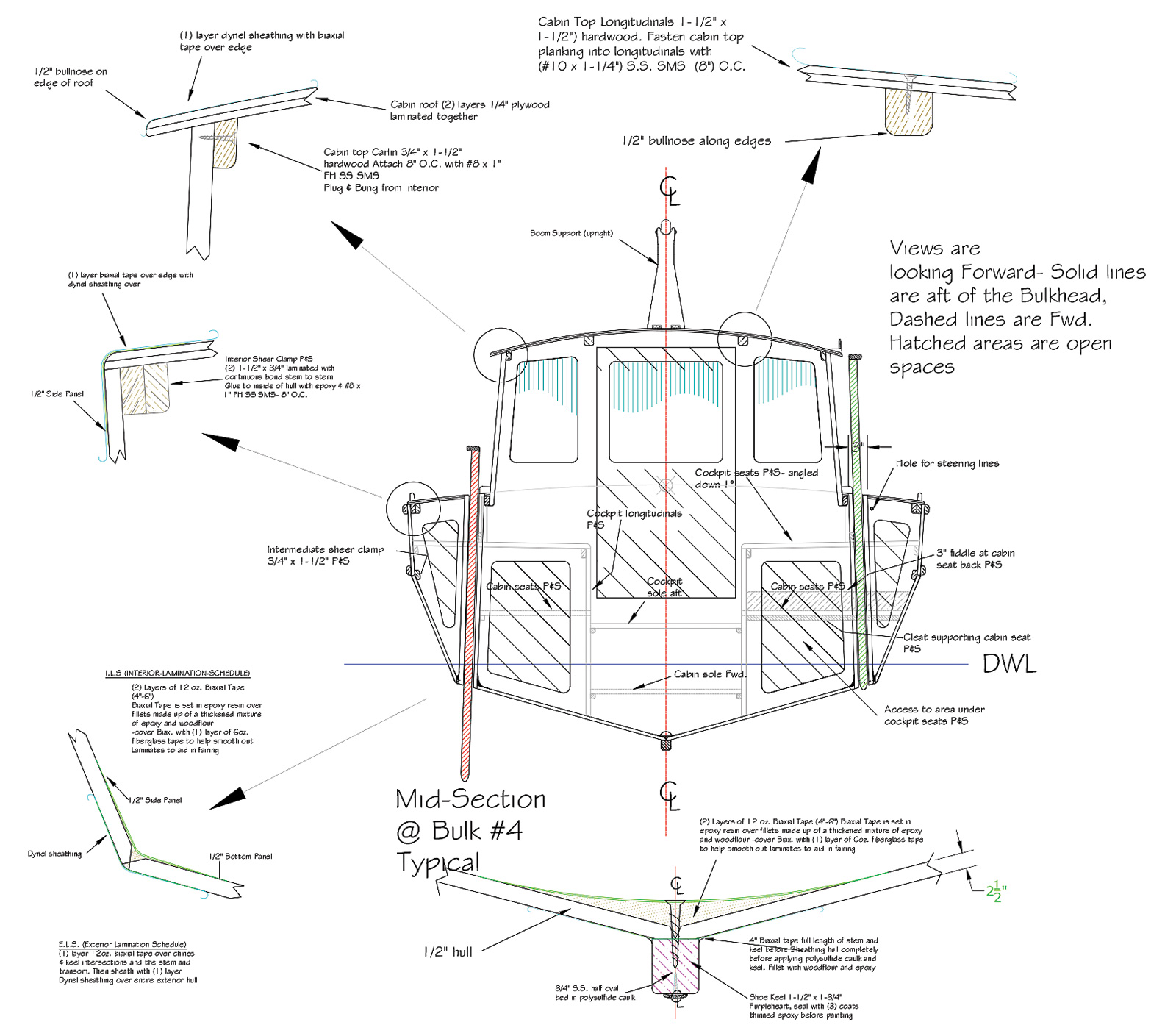
Many of us consider Sam Devlin to be the father of modern stitch-and-glue construction, and we’ll use that technique to build the hull for this pocket motorsailer. We’ll cut panels of 12mm-thick scarfed-together plywood to the “expanded” shapes supplied by the designer. We’ll then stitch together these panels with wire ties passed through tiny holes drilled along their perimeters. Experience with boatbuilding will help, but it’s not absolutely necessary here.
As the hull rests upside down, we’ll reach inside and tab the interior seams with 3″ squares of biaxial fiberglass cloth set in epoxy over wood-flour/epoxy fillets to “lock everything together.” By the end of the third day, a nicely shaped hull should sit in the middle of our shop floor. But we won’t want to launch it just yet.
We’ll need to remove the wire ties. Then we’ll fill the exterior seams and cover them with layers of epoxy-saturated ’glass tape. The entire exterior of the hull later will be covered with fiberglass cloth. After the hull has been turned right-side up, we’ll form epoxy fillets in all interior seams. Then we’ll apply layers of epoxy-saturated tape over them. Finally comes the hard work of fairing and smoothing. If we persevere, the result will be a light, strong, forever leak-free hull of yacht finish.
The stitch-and-glue construction employs high-quality plywood and epoxy. If we take care with fit and finish, the result should be a light, strong, and leak-free hull.
All of Litl Coot’s ballast (600 lbs) will rest in her bilge. Here’s how Devlin gets it there: “I buy recycled lead shot from a local trap- and skeet-shooting range. It’s nice to work with, and comes all cleaned up in small canvas bags that weigh 30 lbs each…ready to be mixed with epoxy and set into the bilge.” He plans to cast about 75 to 80 percent of the lead-epoxy before launching and then complete the ballasting after checking the boat’s trim in the water.
When asked years ago by an impressed onlooker just how he drew boats that always floated precisely on their designed lines, Devlin modestly answered that it was easy. He paid for that aw-shucks reply when the very next boat he launched floated down by its stern: “We had to add some (read quite a lot of) extra chain in her anchor locker.” Lesson learned: the mistake never happened again.
Litl Coot promises to be a good boat that will carry us to adventure along the coast and up shallow creeks that disappear out back of beyond. Sam Devlin created this design for his most demanding client: himself. He seems intrigued by the results. So am I. 
Mike O’Brien is boat design editor for WoodenBoat.
Plans, kits, and completed boats from Devlin Designing Boat Builders, 3010 37th Ave. S.W., Tumwater, WA 98512; 360–866–0164; sam@devlinboat.com; www.devlinboat.com.