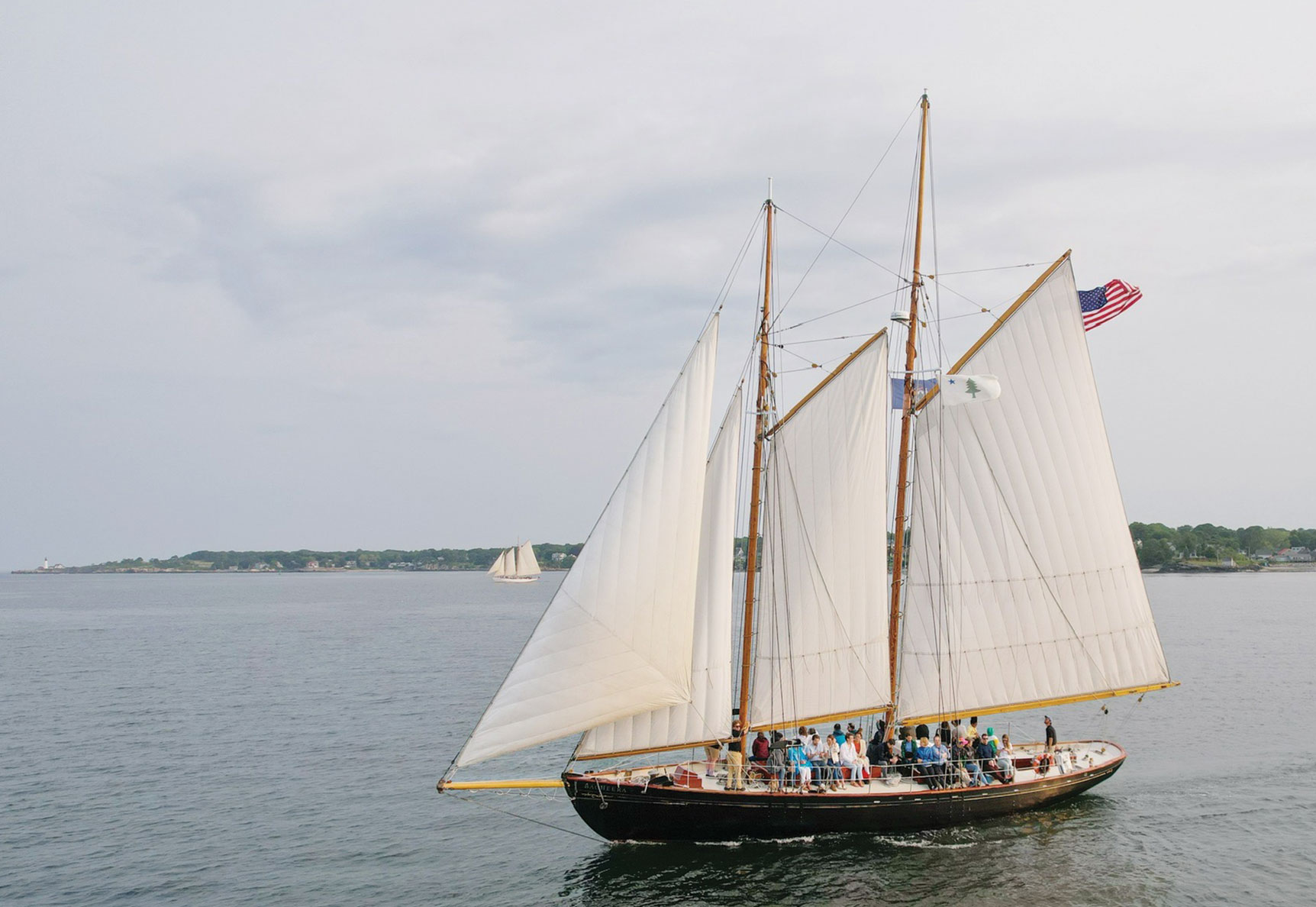
Courtesy Of Portland Schooner Co.The schooner BAGHEERA, launched as BEACON ROCK in 1924 by Rice Bros. Shipyard in East Boothbay, Maine, was saved from oblivion in the early 1980s by a rebuilding in Southern California. Today, she is the centerpiece of a charter business in Portland, Maine.
In 1985, I had just started my career as an apprentice marine surveyor with the Lloyds agent in San Diego, California, when I took a call from a rather distraught boatowner seeking advice on what he should do with his 1924, 72′ Alden schooner, BAGHEERA. Intrigued, I agreed to meet at the boat, which was docked behind the Carl Eichenlaub Boatyard on Shelter Island.
BAGHEERA’s owner and I met at the head of the dock, and I looked down at the blue-plastic-tarpaulin-covered black schooner, and could tell from a distance that the boat was in terrible shape. Half of the caulked teak deck had been removed, corrosion in the chainplates had affected large areas of rotten planks, and the hull planking had open seams everywhere. The spruce masts had long checks, the paint was shot, and the standing rigging was barely there.
A closer look at the partially removed deck revealed rotted deckbeams and knees, and with half the deck missing the interior had been exposed to the elements for a long time. The boat had been fitted with a 110-volt automatic bilge pump that was cycling every 15 seconds. It was clear that the boat was sinking at the dock.
Once aboard, I immediately noticed that the cockpit engine hatch had been removed. The Perkins engine below was lying on its side, and its cylinder head had been removed. The Monel fuel tank had also been taken apart, and the forlorn yacht had no functioning electrical system.
The once-beautiful mahogany joinerwork in the saloon had scrape marks on every surface, as if someone had gone around with a hook scraper trying to see how difficult it would be to remove 61 years of accumulated varnish. It was heartbreaking to see a boat of this historical pedigree in such terrible condition.
My first impression was that the schooner was in such bad shape that the cost of even minimal repairs would be prohibitive. I was struck, however, by all the custom brass and bronze fittings and the superior craftsmanship of her original builders at Rice Brothers Boatyard in East Boothbay, Maine. I told the owner that I needed to conduct some research and possibly come up with some prices for a “rescue renovation.” I soon realized that the neglected yacht was pedigreed and historic and might be worth the serious effort involved in saving her.
Rice Brothers had built BAGHEERA in 1924 for Marion Eppley, a research chemist who made important advances in cadmium battery technology and production during World War I and served as a naval officer in both world wars. He named the schooner BEACON ROCK, after his estate in Newport, Rhode Island. Eppley sold his schooner in 1928 to Robert Benedict, who moved her to Chicago and renamed her BAGHEERA after a character in Rudyard Kipling’s The Jungle Book (The word “bagheera” is Sanskrit for black panther). John “Bud” Snite owned the yacht in 1935; he was a Chicago banker and was one of the founders of the Great Lakes Cruising Club. She raced there until about 1938, when she was requisitioned as a training vessel during World War II. She returned to private hands after the war and was owned by the Weir family from 1948 through 1973; they sailed the boat out of Detroit, and changed her original gaff rig to Marconi the first year they owned her. By the early 1980s, she had come to California and was in decline.
Courtesy Of The Weir FamilyBefore arriving in California, BAGHEERA hailed for many years from the Great Lakes. In this 1949 photograph, she lies alongside the Chicago waterfront.
A First Look
I spent the next several days studying the value of vintage wooden schooners. I informed the owner that the boat needed to be hauled; it was taking on a lot of water, and we had to assess the extent of damage to the underwater planking.
Adding up the visible damage and making a very long list of all the things that would be required to make the vessel seaworthy, my initial estimate put the repair cost at about $150,000, or nearly half a million dollars in today’s money. I thought that would put the project out of reach; however, much to my amazement, the owner didn’t even raise an eyebrow. He said that he was in the oil- and gas-leasing business and could raise that money in a heartbeat. He suggested a limited partnership, in which I would be one of the general partners if I agreed to manage the project.
Realizing that saving the boat would require complete replacement of the electrical system, fuel system, rigging, and other components, I suggested that we may as well explore getting her U.S. Coast Guard certified to carry passengers for hire. We could then take advantage of the upcoming AMERICA’s Cup races in San Diego.
We hauled the boat and quickly discovered that some 60 years of bottom paint had accumulated. Stagnant black water was leaking from dozens of locations, and planks were sprung, cupped, and leaking. We decided to wet-sandblast the bottom to further assess the situation. Despite the boat’s condition, the limited partnership was funded, and BAGHEERA Charters was born. Because this was clearly going to be a major project, the masts and rigging were removed, and the boat was loaded onto a truck and taken to San Diego Boat Movers’ inland yard.
Having originally moved to San Diego in 1973 to build strip-planked Doug Peterson–designed ocean racers at Carl Eichenlaub’s yard, I had arrived at what was then the center of the West Coast boatbuilding universe. Driscoll Marine was down the street, and the Kettenburg Brothers Boatyard, Kohler Kraft Marine, Hawthorne Marine, Mauricio Brothers, and Knight & Carver Marine were all building boats. Kettenburg Marine had just finished the last of their K-38 and K-52 carvel-planked yachts just before the yard shut down new-boat construction, so several experienced shipwrights were available to moonlight until their pink slips arrived. As word got out about this yacht rescue, a lot of talented and skilled people joined the project.
I had decided that the only way to undertake restoration was to gather a team of shipwrights, boatbuilders, mechanics, and painters. We soon pulled a team together, splitting into an A group that would focus on the hull planking and a B group that would focus on
removing the remains of the deck and assessing the deckbeams and other structure. They would also eventually remove the interior.
As the planks started coming off the bottom—first two planks, then 10—the extent of required repairs came into focus. The same thing happened with the topside planking: as we wooded it to determine the extent of the rot, the list of suspect planks grew from six or eight around the chainplates to 14 on each side of the boat. In the end, about half of the hull planking had to be replaced.
Then came the bad news. As several of the replacement bow planks were removed, it became apparent that the entire stem was rotten to the keelson and would have to be replaced. We laminated a new one from eight layers of 1″ white oak, glued with epoxy. In the end, the entire bow was renewed.
Todd Allen SchwedeAs planking was removed at the bow, it became clear that the stem was rotted and would require replacement.
Todd Allen SchwedeAs part of the initial assessment of the work required, the schooner was hauled out and the bottom stripped of paint to reveal the original longleaf-pine planking.
Todd Allen SchwedeThe list of suspect planks grew as the topsides were wooded. About half of the hull planking eventually required replacement.
It quickly became evident that we would have to fabricate new frames for almost the entire starboard side. The port-side frames, on the other hand, had been replaced after hurricane damage in Tortola, and were in good condition. To replace the frames, the interior had to be removed; all of its components were carefully labeled so we could reinstall them after the structural repairs were completed.
Todd Allen SchwedeNearly the entire starboard side required reframing. The port-side frames, however, were still serviceable, having been replaced following hurricane damage in the Caribbean.
Todd Allen SchwedeThe new stem was built of laminated oak.
The extent of damage to the deckbeams and structural members became apparent as the deck planking came off. A leaking deck has spelled death for many a classic wooden boat by allowing fresh and saltwater to infiltrate the interior structure and substructure, promoting rot and fastening deterioration. We were determined to replace the deck with plywood and epoxy to ensure that it would never leak again. First, we replaced four main deckbeams and their associated knees. All of the other deckbeams were sistered with new white oak tops. Together, these repairs raised the deck 1″.
Because we had to replace the entire deck, we removed the original forward and main deckhouses, which were undamaged, in their entirety. We then proceeded to epoxy-laminate two ½″ layers of okoume plywood. The new deck was treated with penetrating epoxy and permanently sealed with a layer of fiberglass cloth set in epoxy and extending up the bulwarks to the underside of the caprail. The finish system used epoxy primer with silica sand poured into the wet epoxy for a nonskid texture; after the loose sand was vacuumed away, the entire deck was painted with linear polyurethane paint.
Todd Allen SchwedeLeft—Four deckbeams were replaced outright; the rest were given a 1″ laminate of white oak, raising the deck by that amount. This was covered in two layers of ½″ plywood with berglass-andepoxy sheathing. Right—The extent of BAGHERA’S structural overhaul is evident in this photograph of her bilge before the sole was reinstalled. The schooner received new ceiling planking and crash bulkheads to meet U.S. Coast Guard certification standards. Her original interior was refitted after the hull refurbishing.
The hull was originally planked with longleaf pine. That species was rare by the 1980s, so for the replacement planking we chose Honduras mahogany; at the time, there happened to be a glut of cheap Honduras mahogany on the market, but today it also is rare. Following the planking repairs, the entire hull was wooded, refastened, recaulked, faired, epoxy-primed, and painted with black linear polyurethane paint.
Because the hull contained a mixture of the very few remaining original longleaf pine planks and new ones of Honduras mahogany, we decided to treat the bottom with multiple layers of coal-tar epoxy. We applied four coats, thinned 50 percent, with an airless sprayer, with each successive coat chemically locking before cure. We then applied two coats of coal-tar epoxy at full strength, and then the bottom paint.
At the relaunching—and after hundreds of charters in Southern California—neither the decks nor the hull planking ever leaked a drop, creaked, or groaned.
While the hull was under construction, the masts were taken to Bill Clark, the last remaining wooden-mast builder in San Diego, for repairs. Both the mainmast and foremast were wooded, and approximately 800′ of tapered splines were epoxied into the checks before the spars were primed and painted with linear polyurethane. The standing rigging was replaced with new stainless-steel wire, and new bronze turnbuckles joined it to new chainplates. All of the original bronze mast fittings and cranse irons were sandblasted, and inspection found them to be in good shape, which was a testament to the quality of their fabrication at Rice Brothers 62 years earlier.
The interior bulkheads were replaced, with the addition of a crash bulkhead to meet Coast Guard certification. New ceiling planking was fitted, and the original interior was returned to its original position, completely refinished. Ten coats of exterior varnish were applied to the exterior brightwork, and during the boat’s subsequent tenure in California, she would receive a fresh coat every three months.
The custom Dorade ventilators and hatch frames were polished and placed back in their original locations. BAGHEERA’s Perkins diesel engine was rebuilt, an Onan generator added, and she was entirely rewired to meet Coast Guard requirements. On deck, stainless-steel stanchions and lifelines were installed and all the required equipment was provided for the schooner to be certified to carry 49 passengers.
The entire project took 10 months. The initial budget was blown out to just under $200,000—about $625,000 today. The paid construction crew numbered 15, and there were dozens of volunteers on the weekends.
Todd Allen SchwedeThe renewed BAGHEERA received U.S. Coast Guard certification to carry 49 passengers and entered the charter trade in Southern California for several years.
Ready For Charters
We were in business! The boat looked like new, and we won an award from the San Diego Historical Preservation Society for our restoration. During the course of the reconstruction, seasoned mariners jumped on board as captains and crew. We fully embraced the Jungle Book theme and dressed the crew in pith helmets and khakis. The boat sailed like a dream. She was fast, perfectly balanced, quiet, and stable in all conditions.
In 1989, BAGHEERA Charters sold the boat to my friend Tom Gay, and the company was renamed BAGHEERA Sailing Adventures.
As a result of the publicity—the relaunching party had drawn tremendous media attention with television coverage and newspaper articles—I started getting phone calls from previous owners and people who had been involved with BAGHEERA over the years. Dick Davies, a naval architect who had retired to San Diego, contacted me and requested a set of her plans; during his time as commodore of the San Diego Radio Boat Club, a fleet of six radio-controlled models of BAGHEERA raced as a one-design fleet. It turned out that Dick had taught me speed-skating when I was 10 years old in Rocky River, Ohio. He was also the naval architect who changed BAGHEERA’s original gaff rig to Marconi in 1949, when the boat was in Detroit.
I got a call from another schooner owner, Paul Plotts, who owned DAUNTLESS, a 1935, 75′ Alden, who wanted to challenge us to a match race, which again attracted tremendous media interest. Bud Snite, who was 86 at the time and lived in La Jolla, a little north of San Diego, called and asked if he could join us for the race. My captain, Rich Gobin, visited Bud’s home and reported that the entire den was covered in half models of BAGHEERA and lined with racing trophies.
Bud was delighted to be aboard BAGHEERA once again, but, during the race, as DAUNTLESS passed us, he lamented the fact that we did not have a fisherman staysail, and generously had one made for the boat, rounding out the five-sail plan. We still lost the next race, but only by a boat length.
We invited the local hotel concierges to the boat for sunset champagne cruises, and the charter business started to take off. We soon began doing three charters per day during whale-watching season; we later sailed five per day during the AMERICA’s Cup races.
One night in 1997, while watching on television Dennis Connor’s STARS & STRIPES win the AMERICA’s Cup back from the Australians, at 2:30 in the morning, at the famous Kona Kai Club, my friend Dave Rozier suggested that we start the AMERICA’s Schooner Cup.
Stumbling our way out of the hotel lobby, we spotted a very tarnished giant brass flowerpot, had an “ah-ha” moment, and clandestinely sneaked the pot into the trunk of Dave’s truck. I had a plate-glass top made, using the sail plan drawing for BAGHEERA, and turned it into a trophy.
The Kona Kai International Yacht Club was thus formed, with Dave Rosier as its first commodore, and in 1988 the AMERICA’s Schooner Cup became a charity event for the Navy Relief Society and Make-a-Wish Foundation. The first year, 12 schooners showed up, including DAUNTLESS, KELPIE, (now KELPIE OF FALMOUTH), Richard Straman’s ASTORand the replica schooner AMERICA. The next year, 24 raced. The Kona Kai International Yacht Club was subsequently absorbed by Silvergate Yacht Club, which continues to host the AMERICA’s Schooner Cup as a charity event to this day.
Kerry DalyAfter her career in the charter trade in Southern California, BAGHEERA moved to Portland, Maine, where she continued the same work under the aegis of Portland Schooner Company. She has recently undergone another major hull refurbishment.
Continuing The Legacy
During her time in San Diego, BAGHEERA took thousands of people on whale-watching and sunset cruises. Dozens of people were married aboard her, and from her decks dozens more had their ashes committed to the deep. I can’t describe the amount of fun and wonderful memories, and the deep feeling of satisfaction knowing that now, 39 years later, and after she passed the 100-year mark in 2024, BAGHEERA continues to write her story.
As Greg Rössel notes in his article Returning a Wooden Boat to the Water, “Anything can be fixed. The question is, do you really want to. How much time do you have? How much money?” The BAGHEERA project came to us 40 years ago in a rare confluence of motivation, skill, vision, time, and money. The work accomplished in 1986 saved the boat from a sure trip to either a dumpster or to the bottom of San Diego Harbor—and set her up for a career that continues to this day.
Today, BAGHEERA is the centerpiece of the Portland Schooner Company in Portland, Maine, where she sails day charters. She has been listed in the National Register of Historic Places and recently underwent another refurbishment that promises to keep her going for at least another 40 years. ![]()
Todd Allen Schwede has been in the marine industry for almost 50 years. He started as an apprentice boatbuilder with Carl Eichenlaub in 1973, and later became a partner in Eichenlaub Marine and Shipbuilding. He transitioned to marine surveying in 1984, and is now an accredited marine surveyor, certified professional insurance investigator, and certified marine investigator. He is also the author of the book Rockin’ the Boat: Adventures of a Marine Investigator.