
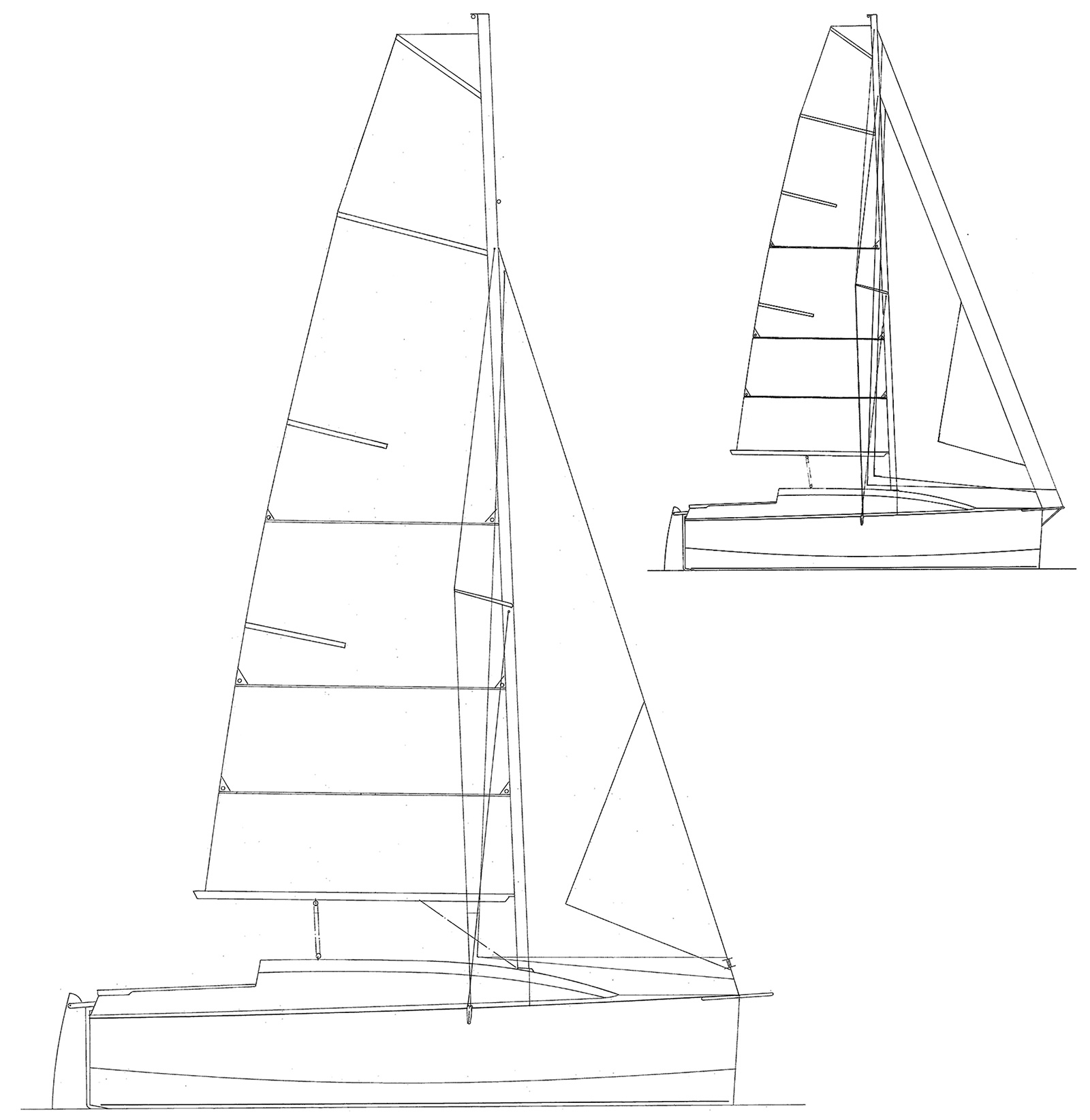
Janusz Maderski’s Osemka packs a lot of capacity into 26′ of length. She can be set up as a coastal cruiser with a fractional rig, or as a bluewater yacht with a two-headsail Solent-cutter, or “slutter,” rig (inset).
Particulars
- LOA: 26′3″
- LWL: 25′3″
- Beam: 10′10″
- Draft: 4′1″
- Displacement: 6,380 lbs to DWL
- Ballast: 1,980 lbs
- Sail area: 425 sq ft (fractional rig)
Osemka is the word for “eight” in Polish, the native language of this boat’s designer, Janusz Maderski. This little yacht measures 8 meters overall, and its name is fittingly simple. Upon examination, I think we’ll find this to be a very straightforward boat that’s the result of considerable design effort and experience.
The creation of a small, dual-use cruiser that can be owner-built with the possibility of excellent sailing performance is no easy task. The Osemka 8 can be finished out for coastwise weekending or as an oceangoing yacht. The obvious difference between the two modes is the choice of rig, but there would be dozens of less-obvious detail differences in hardware and systems, with potentially vast differences in materials cost.
These wide, shallow-bodied, high-sided, and blunt-ended forms are here to stay, and the main reason for them is utility. They offer less boat to build and moor or store while offering relatively large interior and cockpit volume, decent sailing ability, and conventional aesthetics. It’s a hard combination to fault. As a measure of how far we’ve come, I was recently looking at a 1930 Q-boat design by Frank Paine. This boat measures 52′x 9′, and has lovely long overhangs and facilities similar to Osemka’s, except the cockpit is much smaller; there’s less headroom, and there are no double berths. The Q-boat would cost millions to replicate today, while Osemka can be built for a fraction of that.
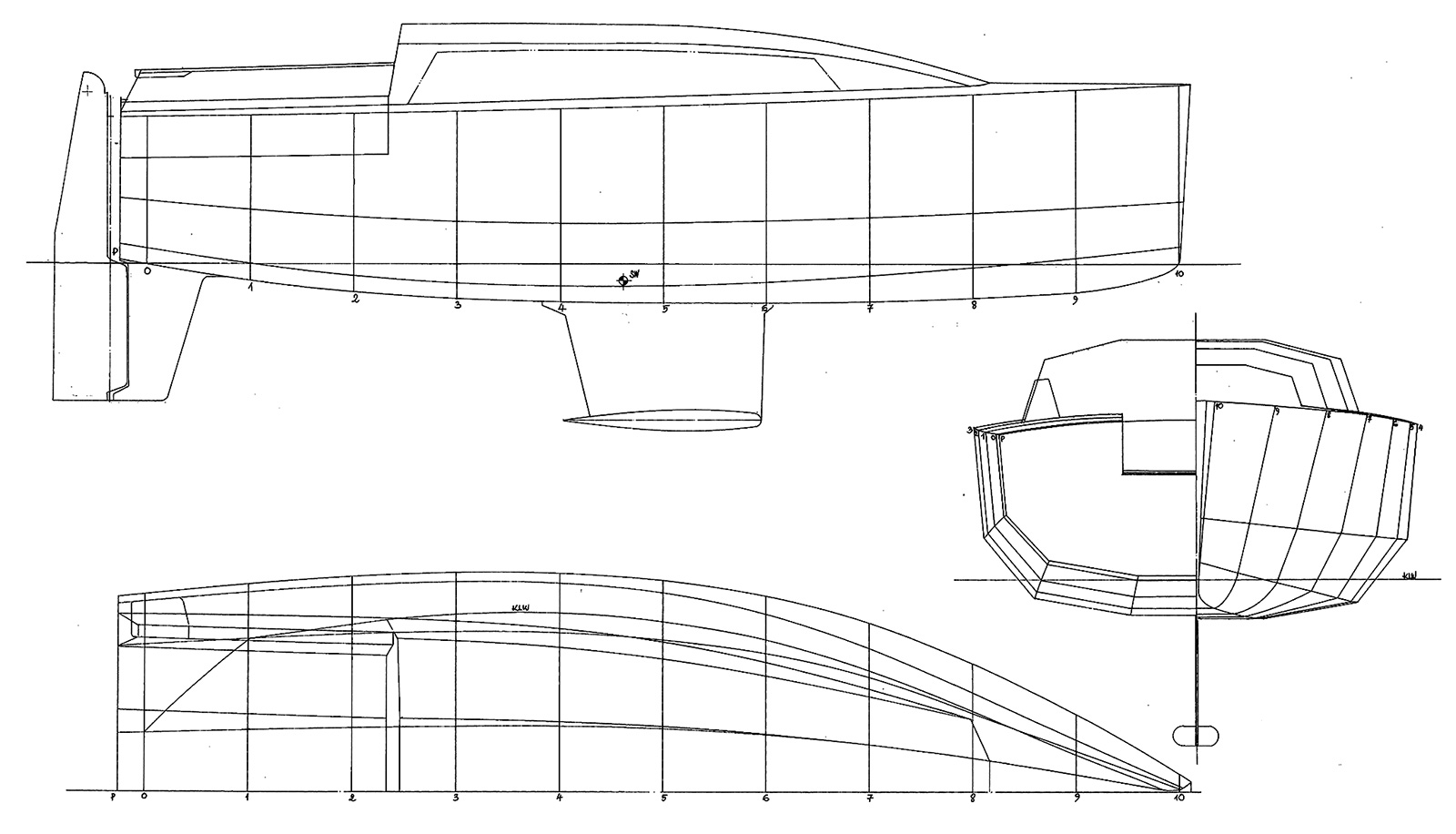
Osemka’s wide, blunt-ended form provides ample volume, good sailing ability, and conventional aesthetics. U-shaped forward sections provide buoyancy critical to lifting the bow in oncoming waves.
In photographs of completed boats, Osemka appears sleeker than the drawings would suggest. The traditional curved sheer profile, carefully shaped forward deck line, and curved and sculpted cabin trunk all work together. Chines in topsides have become fashionable, so her hull’s appearance is right up to date, and a sympathetic contrasting paint scheme can reduce bulk. Extending the after topsides by about 18″ to form a swim-step, or sugar-scoop stern, would soften the appearance of the vertical transom and add utility.
I very much appreciate designer Maderski’s professionalism in posting on his website a stability curve for this design. The curve indicates a limit of positive stability at about 140 degrees of heel and a maximum righting arm at about 50 degrees of heel. Both of these numbers indicate a forgiving boat well suited to offshore sailing. The designer mentions key elements in achieving these characteristics: high topsides, a ballast bulb, and a large-volume cabin trunk. The modern aesthetics add to safety as well as interior volume.
Looking at the hull lines, we notice the wide, flat centerline panel and then two panels making the bilge turn to a single, almost vertical, topside panel. The body plan indicates a U-sectioned forefoot with a lot of curvature in the lower bilge panel. The resulting volume in this location is important in adding buoyancy down low to lift the bow as the boat works through a wave. This much shape in ½″ plywood will be impossible without either kerfing the panels or using thinner plywood in multiple laminations; I would favor kerfing, with exterior fiberglass sheathing and careful filling of the kerfs with thickened epoxy.
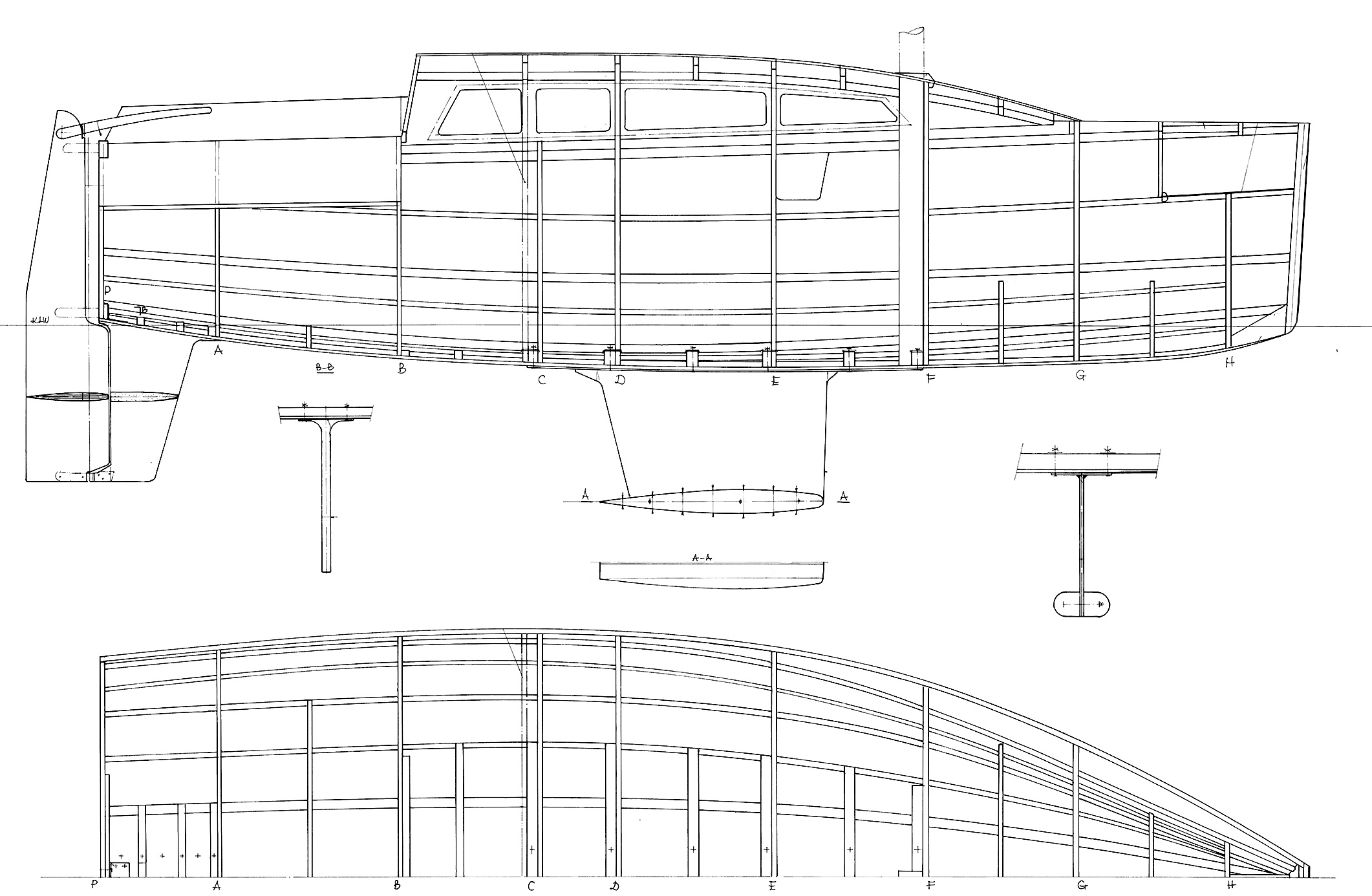
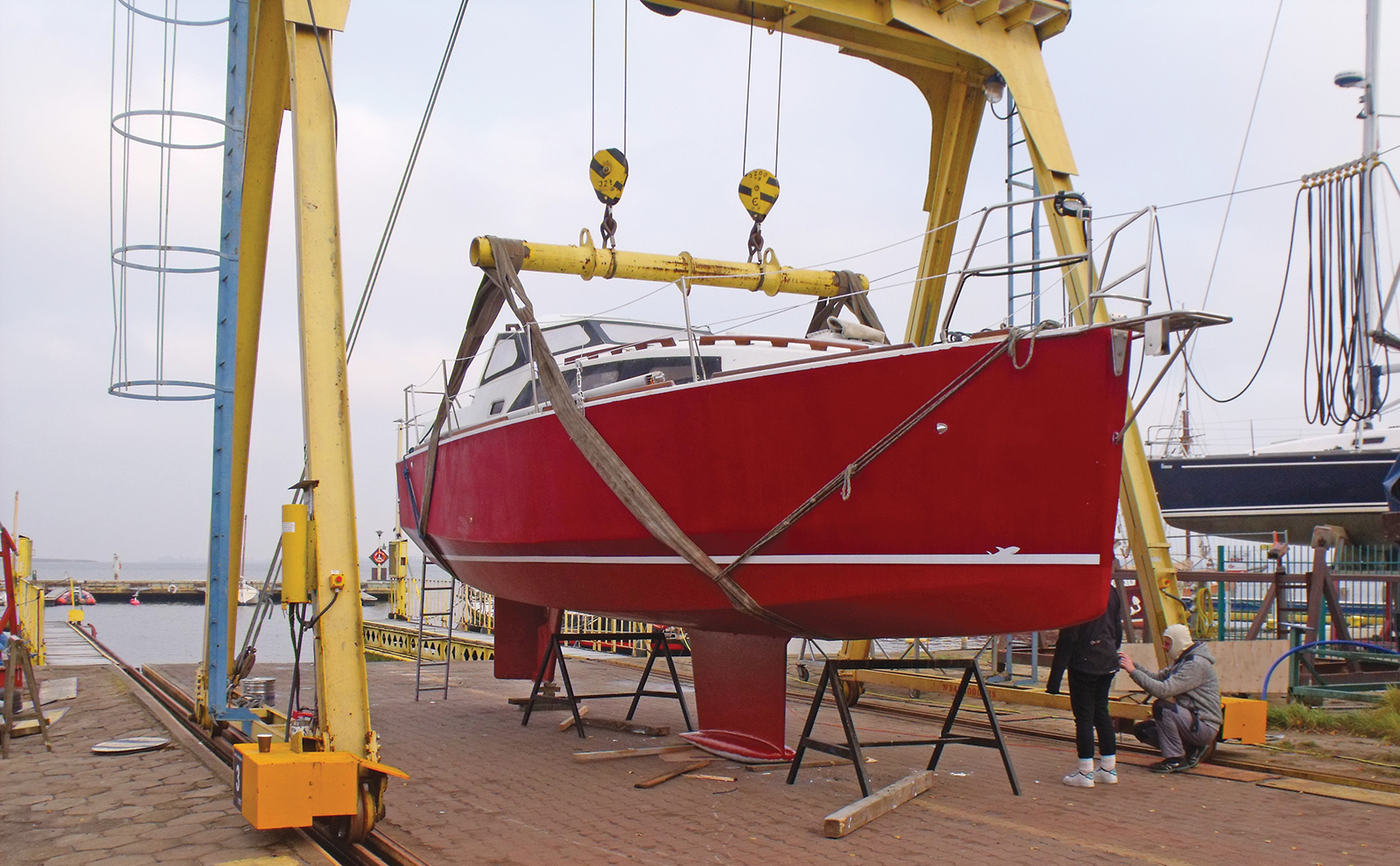
The plywood hull will go together relatively quickly. The keel bulb is attached to a simple steel plate, which can be modified to a foil shape to improve performance.
That flat centerline bottom panel is composed of two layers of ½″ plywood, producing a rugged attachment point for the steel fin keel and wooden rudder skeg. The keel consists of a ½″ steel base plate shaped to fit the bottom rocker, with the 1″-thick steel vertical plate welded to it. The keel base plate is through-bolted to six 2″×4″ oak floor timbers.
The drawings show leaving the flat steel plate keel as it is—a simple solution that will work. But it can be upgraded. Gluing wooden foil cheeks to the plate and then wrapping the assembly in fiberglass will improve tacking and pointing measurably. The flat plate works okay at speed, but stalls easily when tacking and speed drops; the foil keeps flow attached at low speed, and the boat doesn’t drift off sideways in a tack.
Steering systems deserve serious consideration; after keeping the water out, being directionally controllable is one of a boat’s most important functions. Osemka’s steering is accomplished with a tiller connected to a balanced rudder hung on a fixed skeg. The 2⅜″-thick skeg has a high-density foam core and heavy fiberglass skin with a large-radius fillet at its root where it mates to the hull. The skeg-rudder creates more wetted surface than a straight spade rudder but offers a stronger and lower-cost system that is more forgiving of inattention at the helm.
Maderski offers us two alternative rigs for Osemka: first, a light, two-sail fractional sloop of 425 sq ft and, second, the Solent or “slutter” offshore rig of 398 sq ft in the main and jib that can be increased by adding a genoa of 225 sq ft mounted on a 20″ long aluminum-tube bowsprit. The fractional rig, with its smaller deck-stepped mast tube, will be perfect for coastwise use with the boat lightly loaded. In the Solent rig, the mast is farther aft, where it can be keel-stepped, and it’s a heavier tube better-suited to offshore work. The two good-sized headsails are more versatile than the single small jib. If rigged with a pole on one side, running in the tradewinds under the two headsails would be an ocean sailor’s dream, especially if those sails are both on roller furlers so they can be reduced at night or when the wind increases.
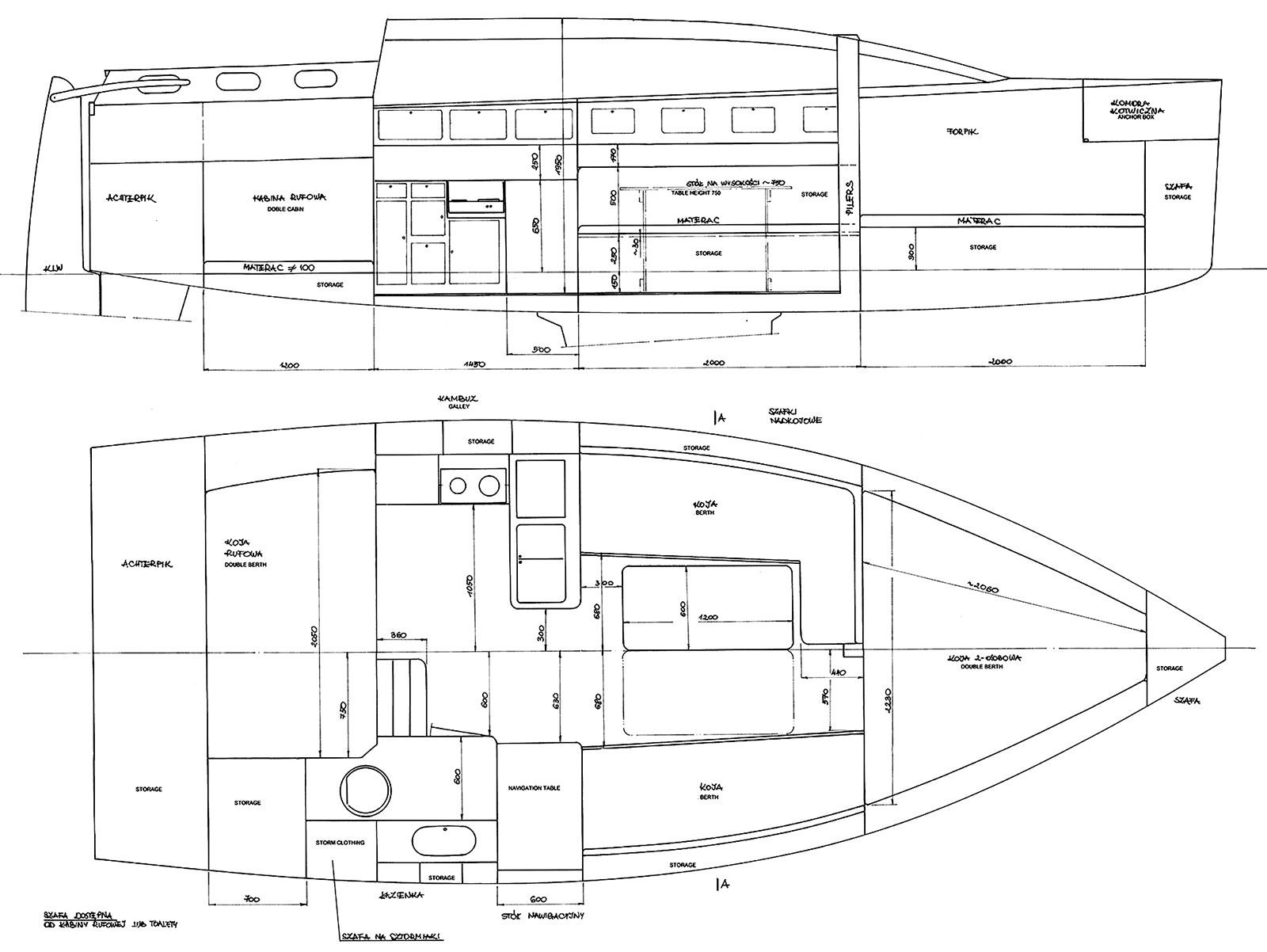
The spacious interior has double berths forward and aft, and 6′ cockpit seats that will accommodate off-watch napping. Auxiliary power is provided by an outboard motor.
Speaking of tradewind sailing: The cockpit seats are 6′6″ long, which is perfect for off-watch napping. There’s plenty of room for a big, fixed cockpit table with drop-leaves, and the hard dodger shown in the photos is a superb addition. All sheets and halyards lead to two small winches mounted on the cabintop port and starboard of the main hatch.
Finding a good argument for an inboard diesel auxiliary in Osemka is almost impossible given the availability of modern four-stroke or electric outboards. The outboard motor is simple to install and easy to remove or replace, and its propeller drag can be eliminated under sail. The outboard’s main drawback is poor battery charging, but solar panels, wind generators, and modern “power stations” can get around this.
The boat’s interior is impressive in extent and versatility. There are double berths both forward and aft, so the saloon-area settees can be free to sit on without having to pack up or unpack bedding. There’s an actual chart table, which today is just a desk for the laptop or tablet, but a designated location for navigation gear is unusual in a 25′ boat. The galley is small, but there’s space for a sink and two-burner stove; instead of an icebox, there’s space for a portable chest to be slid under a settee.
There are so many advantages to this modern cruiser that I can easily imagine getting under way for a couple of weeks in the islands. This is an attainable and very capable small package. 
Tad Roberts is the boat-design editor for WoodenBoat.
For more information visit www.maderski.pl.