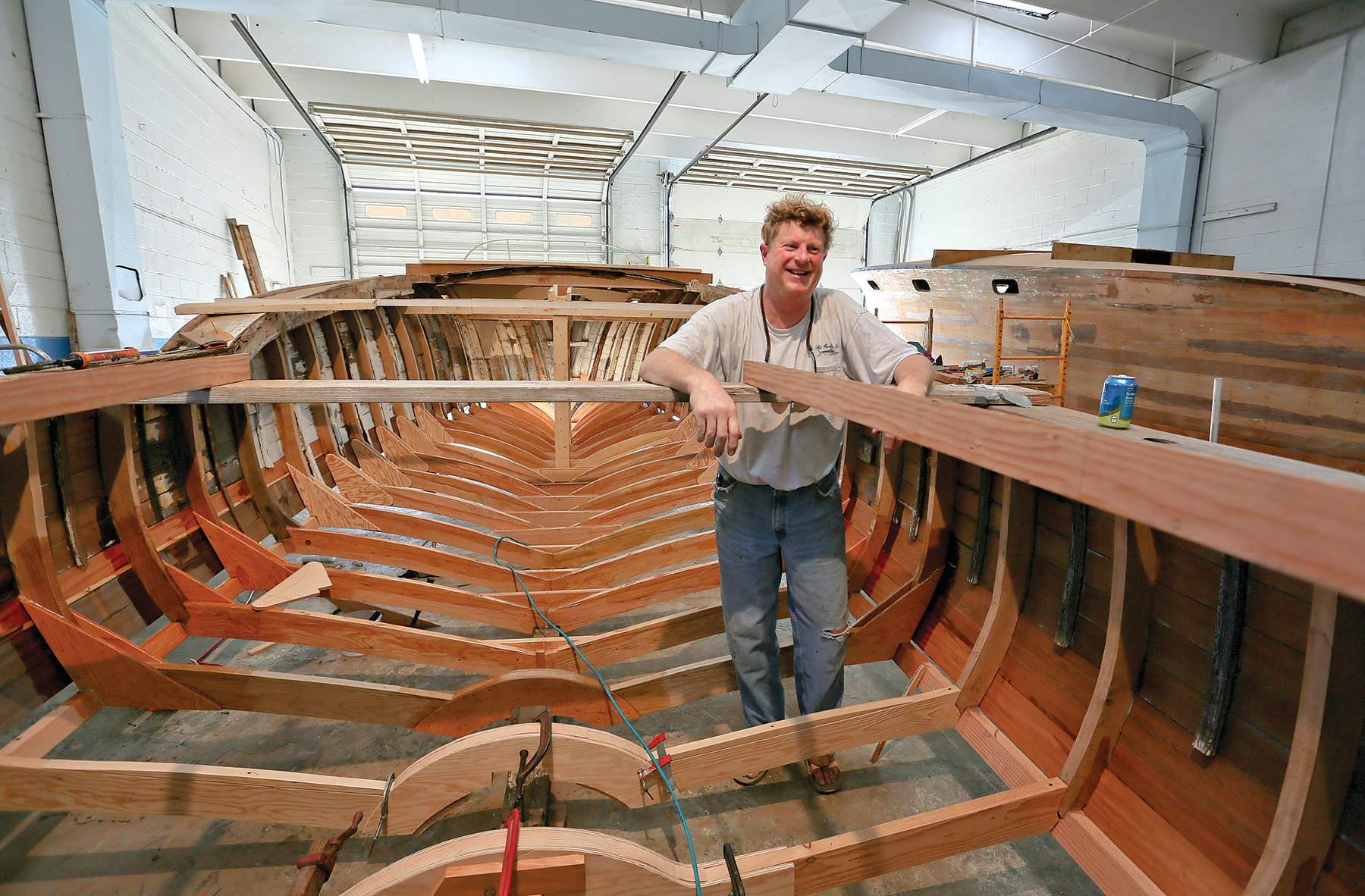
Reid Bandy is an expert in composite boatbuilding but he retains an admiration for classic wooden-hulled sportfishing boats, especially those carrying the Rybovich name.
Reid Bandy was a front-row art-class student in grade school who was captivated by lessons in perspective, scale, form, function, and sketching. He was also obsessed with boats, and his drawings looked like Rybovich sportfishing yachts. “I don’t think I had ever seen a Rybo in person,” he says. “It’s just what I thought a cool boat should look like—the broken sheer, trunk cabin, outriggers, and tournament cockpit.”
Bandy grew up in a do-it-yourself household under the guidance of his dad, who built their houses and handled the relentless maintenance and upgrades required for the family’s Cal 25 sailboat—even designing and making their own racing sails. They won three national championships in the class.
In high school, he developed a passion for sportfishing and would pool odd-job money with his friends to buy bluewater tuna trips out of Ocean City, Maryland. He was also able to wander the docks and board the serious sportfishing machines built by Ocean, Viking, Egg Harbor, North American, Hatteras, and Post—as well as Carolina-style boats. Among this fleet was one in particular: a pink Rybovich, which somehow is at the heart of this story.
“These boats propelled me to get out my sketchbook and see how things would fit together and look good…asking the questions, ‘Can you live in this? Can I make it open and airy? Where does everything go?’” he says.
The sketchbook came with him during his engineering studies at Drexel University in Philadelphia. Although he enjoyed the puzzles and the math for a couple of years, he came to realize that he didn’t much like the idea of a desk job. Preferring hands-on work, he returned to Maryland and got a job in an auto-body shop, where he learned about work pressure, customer service, production, restoration, sanding, fairing, and paint. In 1981, he opened his own shop. The business grew into two robust locations, allowing him the time and wherewithal to buy a used 40′ Jersey Dawn sportfishing boat and join the Ocean City scene on every spare weekend. Around the docks and on the water, he came to appreciate the elegant dominance of the custom boats coming from the Carolina Outer Banks. “I saw the wisdom of the Carolina evolutions. The boats had lines similar to those of the old Ryboviches, and they performed well. I wanted one,” he says. But first, he wanted to learn something about boatbuilding.
In 1991, Bandy found a forsaken 40′ Hooper Island draketail with a beam of 6′6″, one of the few remaining examples of the skinny boats that in the 1920s brought engine power to Chesapeake Bay commercial fishing, crabbing, and oystering. Her bottom was cross-planked with local loblolly pine and white cedar on oak frames, and the hull wasn’t in terrible shape. “It was amazing just how well built she was,” he recalls. “I used old-growth wood to replace some planks, refitted her, and painted her—figuring generous coats of Kirby’s red lead paint each year might protect her. But, in the long run, nothing could save her from the rusty iron drifts that held the planks together. The project stoked my fascination with wooden boat construction and the realities of time and deterioration. I donated her to the Annapolis Maritime Museum & Park and started learning how to build boats with modern materials that would last,” leaning heavily on the wood-epoxy methods that Meade Gougeon described in The Gougeon Brothers on Boat Construction, first published in 1979.
In 1996, after 15 White Marlin Open Tournaments and about 1,000 additional hours searching and catching billfish, tuna, and striped bass, he realized his next dream by replacing the Jersey boat with a 53′ Jarret Bay convertible, carvel-planked with juniper, from an Oregon Inlet charter captain. He ran her back to Ocean City, and the next winter he brought her to Annapolis and worked on basic repairs and modifications.

Among Bandy’s composite construction experiments was this frameless 24′ fishing skiff of carbon fiber on foam. He adapted experience gained on such projects to aspects of his restorations of wooden-hulled Ryboviches.
In 1998, Bandy sketched an idea for a 26′ Carolina-style fishing skiff and took it to Mick Price, a designer and CAD software jockey in Bruce Farr’s yacht design office, with an idea to build it like a racing sailboat but using strips of DuraKore, a composite of fiberglass and end-grain balsa. Price worked out the weight and laminate details and introduced Bandy to the magic of RHINO 3D modeling software. Together, they arrived at the scantlings to meet Bandy’s goal of a Carolina-style boat, but much lighter.
He erected a tent in his yard and began learning about epoxy, fiberglass, DuraKore, and large-scale fairing and sanding. “My car shop experience helped with all that,” he says. “It took me about a year to build the boat, then I put a used Evinrude 225 on her and ran it to death.” He put more than 2,000 hours on her without any issues and sold her to a customer on the Eastern Shore of Virginia. “He brings it back for basic service every year, and the boat’s holding up quite well,” he says.
That boat led Bandy into the world of lightweight composite construction, venturing into Corecell foam, carbon fiber, and E-glass instead of balsa. He bought a RHINO license and learned the program with tutoring from the folks at AeroHydro, a 3D modeling company based in Southwest Harbor, Maine, which had a Maryland sales and support office at the time. In 2003, he rented shop space in a marina on an open-ended lease, not knowing where all this might go. His first major project was the design and construction of a 35′, 38-knot, ’glass-and-Corecell express fishing boat. He ran her straight to Ocean City to fish and demonstrate how she could go quickly out and back to the Canyons—some 140 miles—on 45 gallons. She turned some heads. He followed that project with other innovative boats, including a 50-knot, open, 27-footer and an experimental 24′× 6′ frameless carbon-fiber-on-foam fishing skiff.

The top speed of TIMID TUNA, a 1955 36-footer, increased from 25 knots to 35 knots after Bandy reimagined her for his own use, greatly reducing the weight of her upper structure but respecting the Rybovich styling.
Boat repairs, antique outboards, and cars filled the shop for a while, but at the same time Bandy rekindled a fascination with the Rybovich legacy and these beautiful boats that defined the Florida sportfishing genre. The tribal nature of social media had become a reality, and Bandy readily joined the classic-boat conversations, especially any posts with the Rybovich keyword. In 2016, he heard about a couple of 36-footers languishing in a shed in Florida, both of them owned by a former Rybo employee and fellow fanatic named Bob Bingham. Bandy calls this “just dumb internet luck.” He flew down to have a look and found the partially restored BUTTERBALL of 1954. The other boat, built in 1955, was in sorry shape, with traces of her fading pink paint deep in the grain of her mahogany topsides underneath shrink wrap, which was basically holding her together. She was the very same boat that Bandy had admired as a teenager.
“I wasn’t interested in BUTTERBALL,” Bandy says, “but the pink boat was so far gone that it presented an opportunity to modify and improve with modern materials and concepts—a modern single engine, ’glass-on-foam decks and superstructure, reduced prop-shaft angle, improved weight distribution, and new deck and cabin layouts. My thinking was to rebuild her to modern standards to provide durability and low maintenance while preserving her essential Rybovich look and integrity. This wouldn’t be a restoration but a reimagination.”
Bandy’s boatyard friend, Mark Hall, who has a robust historic home restoration business, took an interest in BUTTERBALL. The two of them negotiated a package deal and brought the boats to Maryland for side-by-side restorations.

Left—For TIMID TUNA, Bandy built a cold-molded tunnel into the hull bottom aft to accommodate the propeller-shaft’s angle reduction from 12 degrees to 6 degrees. Right—DRIFTER (ex-BUTTERBALL) also had a stern tunnel built into the hull; as seen in this photograph it is sheathed in fiberglass cloth set in epoxy as is the rest of the hull.
Bandy’s boat—the pink one—was originally TIMID TUNA, built for an Al Capone associate named Tony Accardo, also known as “Tony the Tuna.”
“Her keel was just mush,” Bandy says. “The ends were gone, the bottom was shot, jackstands had pushed through in places. There was just enough planking left, glued together with resorcinol, to hold her together.” The first steps were to stabilize her and replace the failed 1″×3″ oak frames with 2″× 6″ Douglas-fir, then replace about two-thirds of the topside planking and refasten those that could be saved.
Then both boats needed to be dried out, which Bandy monitored with moisture meters, first outside under a tent to bring them down to 11 percent, then moving them indoors to get down to about 8 percent, which, in Bandy’s assessment, is about what you would find in wooden household furniture.

TIMID TUNA was repowered with a 600-hp Cummins diesel engine, and at the same time a new 215-gallon fuel tank was installed.
While the boats were drying out, Bandy entered their particulars into RHINO to begin the redesign work. “The design phase is critical in ensuring the outcome,” he says. “There’s a weight study and calculations of center of gravity and center of buoyancy. In two words, it’s hydrostatics and weight. That’s what allows you to have faith in the outcome. When these boats were built, they weighed 18,000 lbs dry. In the water they would soak up to become 20,000 to 22,000 lbs. Our plan was to dry them out, replace what needed to go, seal them inside and out by laminating epoxy and E-glass, replace the twin drive trains and gas engines with single 600-hp Cummins diesels, install new bottoms with cold-molded prop pockets to reduce the shaft angles from 12 degrees to 6, and build lower engine placements forward to account for the changes in buoyancy due to the new prop pockets—and launch them into new careers.” BUTTERBALL would be renamed DRIFTER and would retain her previously replaced decks, but her cockpit sole, bridge, house, and furnishings would be rebuilt with Corecell, fiberglass, and epoxy. “But in TIMID TUNA, I replaced everything other than the structure of the wooden hull, frames, and stringers with high-density foam and E-glass panels to save weight and ensure strength and low maintenance while preserving the classic Rybovich look and details. The composite stuff weighs about half that of wood,” he says.
After four years of sawing, sanding, fairing, laminating, painting, sweating, angst, and money, they launched the boats. And Bandy said, “I’ll never do another project like this again.”

For TIMID TUNA, a new deckhouse and flying bridge assembly was fabricated of Corecell to reduce weight.
When the work was done and the boats were relaunched, BUTTERBALL weighed 14,500 lbs; TIMID TUNA is 12,500 lbs. “The net horsepower is about the same as the originals, but the boats are faster and more efficient. TIMID TUNA’s top speed increased from 25 to 35 knots. Plus, they are essentially sealed and their coatings have been maintenance-free for four years now,” Bandy says.

The distinctive shape of a Rybovich handrail was built with foam and E-glass instead of wood.
Meanwhile, Bandy continued to sketch boats and collect projects to satisfy his compulsion to create and restore things—including a 32′ carbon-on-foam yacht weighing 4,100 lbs fully loaded and capable of a top speed of 40 knots and cruising in the mid-20-knot range burning about 6 gallons per hour with a single 300-hp outboard engine.
Ten months ago, I visited Bandy’s shop to see what kind of madness was brewing. He always has a seemingly endless collection of projects waiting for attention, or not. He says, “I look for the most complete old thing with a good story.” Previous visits showed collectibles such as a 1957 Flying Dutchman one-design sailboat that someone dropped off there instead of the landfill; a 1926, 40′ long-deck motor launch by Hutchinson Brothers of Alexandria Bay, New York; an 18′ power canoe built in 1910 by B.N. Morris of Veazie, Maine; a couple of vintage hydroplanes once owned by national racing champion Tiger Petrini; a 1905, 35′ cedar-strip and mahogany Leyare Gold Cup Racer; a 1958 Volkswagen Bug; various collectible motorcycles—and, now taking up most of the indoor space, two more Rybovich classics in rough shape: LUCAYAN, a 1962 31-footer; and MYKONOS (ex-BANGEE), a 1956 42-footer. I reminded him of his vow to never do this again. He said, “I don’t know. I don’t go looking for these projects. They just find me.”

DRIFTER retains her outboard appearance and original paint scheme, and her new and lighter composite house follows the original 1954 styling.
MYKONOS had popped up on Bandy’s eBay radar in 2019. Bob Bingham had her for sale, and he agreed to a trade—a 42′ Rybo in exchange for a single-owner 1967 Camaro SS, fully restored and freshly painted. MYKONOS was not in great shape—just what Bandy likes.
Then, in 2022, another Rybo fanatic told him about a boat stuck inside a private airplane hangar in Florida, part of an estate sale. Bandy went to have a look, worked out a deal, then hauled her back to Maryland. “I wasn’t planning on doing anything, but I didn’t want these boats to get chopped up and thrown away,” he says.
LUCAYAN was built as a long-range resort taxi to run gambling parties from Palm Beach to Grand Bahama without refueling. Rybovich had installed a large fuel tank to feed a pair of gas engines on the round-trip and glued and screwed a 4″-thick, wedge-shaped mahogany fairing plank on the bottom to counteract the extra weight and correct the trim. This was the first thing that would have to go. Bandy knew that he would be installing a more efficient single diesel engine in place of the old gas engines, and it would go farther forward and lower to allow a reduced propeller shaft angle into a prop-pocket, as with the earlier projects. All this would be worked out in RHINO.

Building Corecell cabins and superstructures reduced the boats’ dry weight from the original 18,000 lbs to 14,500 lbs for DRIFTER and even less, 12,500 lbs, for TIMID TUNA.
He chose a marinized 570-hp Fiat Performance Technology engine, “the highest horsepower-to-weight engine in its class,” he says. He designed the prop-pocket and established the new buoyancy and running characteristics. As he recalls, “Since the boat was going to be faster, the hull bottom would need to be stronger to take the pounding. I increased the size of the frames and glued down a layer of 9mm okoume plywood over the existing bottom to secure stiffness and create a substantial substrate.” This also allowed him to use shorter and wider stringers to keep everything low and tight in the new engine space. He ordered a 165-gallon fuel tank based on an estimated 10 hours of consumption at cruising speed. “This was one of the earliest cold-molded Rybos. The original bottom is two layers of solid ⅜″ mahogany veneer. It’s badass. The topsides are planked mahogany—just beautiful,” he says.

After the TIMID TUNA and DRIFTER projects, Bandy turned to yet another project involving a Rybovich—the 1962, 31′ LUCAYAN. The work started with stripping out the hull and excavating rotten wood.
He laminated the interior with 17-oz biaxial E-glass set in epoxy and then painted it with snow-white Awlgrip linear polyurethane, the same color as the original. Then he rolled her over. For the bottom planking, “Getting her upside down was critical to orienting the laminates longitudinally to avoid any chances of hydraulic delamination underway at high speed. I have 40-knot expectations, so delamination has to be taken seriously.”

LUCAYAN’s hull has been rejuvenated with a structural restoration and a cold-molded overlay; her superstructure will be reconstructed to the original shape using Corecell to save weight.
He applied three layers of 17-oz fabric on the topsides and four layers on her bottom, overlapped like shingles along her chines and keel to have as many as eight layers where needed. He then brought in a coating, fairing, and painting team, which used Awlfair LW fairing compound followed by Awlquick and Ultrabuild high-build primers before spraying on antifouling bottom paint. With the bottom work completed, he rolled her back upright for the topside and interior finish work.
He completed the interior wood repairs using E-glass on Corecell foam. Using epoxy, he sealed and ’glassed the coaming, side decks, cockpit, house, trunk, and the trim around the windshield.
He is not planning significant changes to her interior layout or appointments, but her cockpit will be an open fishing area instead of the long-distance water taxi accommodations she once had. Bandy hopes to have her in the water by summer, and then he’ll start thinking about MYKONOS.
I asked Bandy a question: What is the end game?
“I see classic boats languishing at the docks and marinas to a point where recovery is not feasible. It’s kind of crazy, but what I’m trying to achieve is a test to prove that these great boats, done right, can be a good value. They are low-maintenance and will perform as well as something brand new that comes along.”

DRIFTER of 1954, at left, and TIMID TUNA of 1955 were bought simultaneously from a single owner in Florida and restored side by side in Bandy’s boatshop. Their home waters are now on Chesapeake Bay.
But now he has three Ryboviches, one finished, one nearly done, and one waiting for attention in the shop among other interesting projects. “I enjoy having them and seeing how they perform and last. TIMID TUNA has been in the water and running well for more than four years with no issues. I would hope to find sensible custodians for them, of course. Someone who appreciates the legacy of the boats, which now includes what I’ve done to preserve and improve them. My goal is to make the boats robust enough to withstand generations of ownership, requiring the minimum maintenance of modern composite boats and having contemporary performance characteristics. I know I can’t keep them forever…I’m just expressing what the Lord gave me.” ![]()
Joe Evans was a sail designer at North Sails before building and repairing performance boats, including designs by Bruce Farr, German Frers, and Rob Humphreys. He subsequently produced films and articles for National Geographic, CuriosityStream, HBO Max, and various sporting magazines. He also served as editor-in-chief of Chesapeake Bay Magazine.