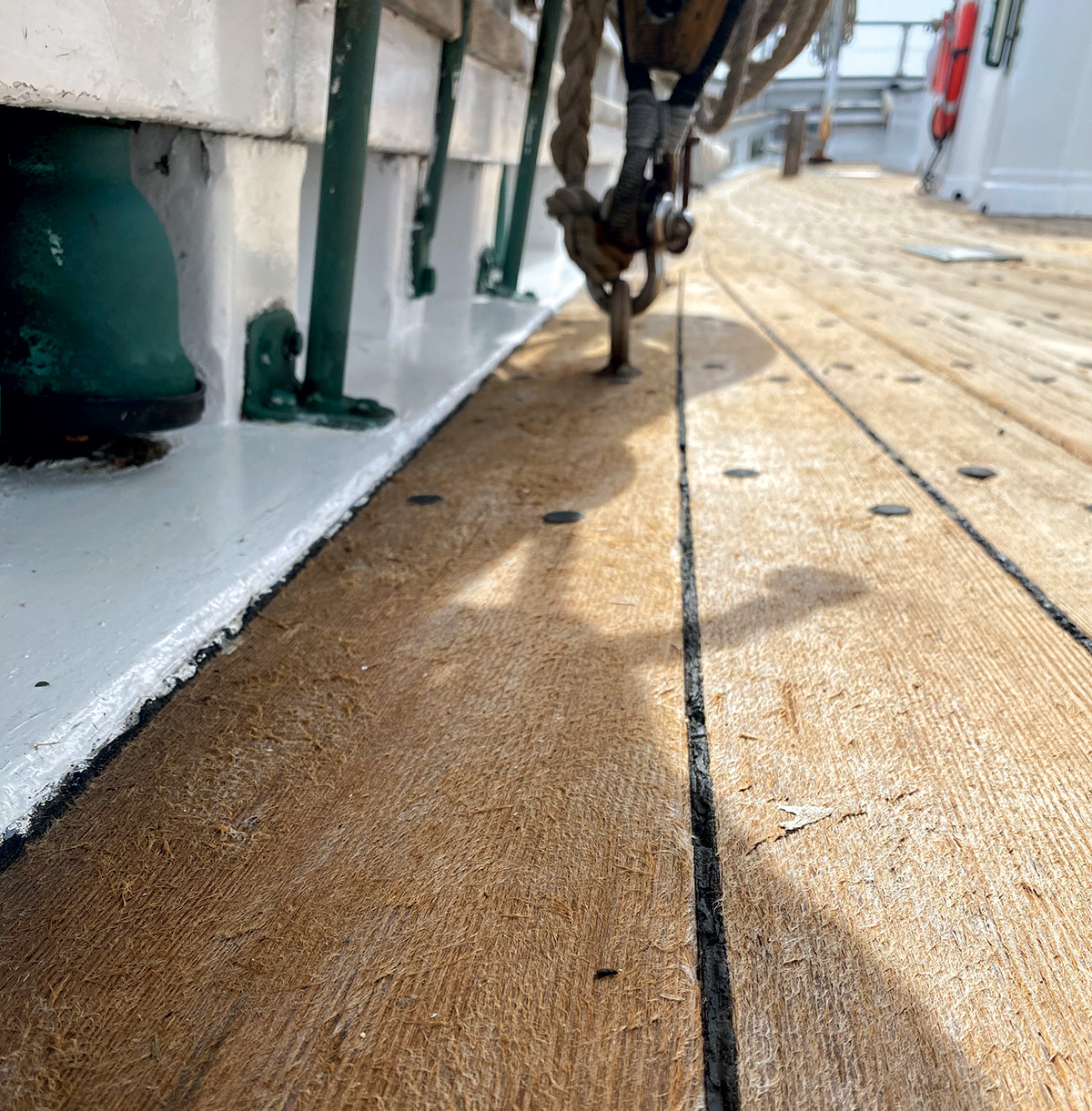
Courtesy of Capt. Michael PattersonThe Douglas-fir deck planking of the IRVING JOHNSON served well for 27 years in Los Angeles, California, and with a gentler cleaning regimen should survive for years to come.
A drive down any back road in America is likely to showcase vistas that often include gray, weathered barns—some once holding paint, now long gone, and others never touched by a painter’s brush. As these barns teeter on the brink of collapse, enterprising scavengers hover, waiting to secure and resell the weathered barn boards to the decorative-paneling market. The graying and surface roughening of barn siding is caused by ultraviolet (UV) sun rays and cyclical wetting and drying of the wood.
A similar process occurs on the decks of wooden ships to which no finish has been applied. Capt. Michael P. Patterson, director of operations for the Los Angeles Maritime Institute in San Pedro, California, recently wrote: “I am writing to ask some questions about preserving the wood decks on our tall ships, the EXY JOHNSON and the IRVING JOHNSON [see WB No. 176]. We are experiencing some delignification of the Douglas-fir decks that are approximately 27 years old. We are going to be reefing and recaulking these decks next year, but I need to be able to apply some sort of product to preserve the deck from the delignification (lots of fuzzy wood fibers coming off the deck).”
A follow-up phone conversation with Capt. Patterson revealed that the Douglas-fir decks still had plenty of thickness left, but seams were now so shallow that he would need to pull out the remaining caulking, rerout the seams, and replace the caulking. The decks had survived 27 years without any preservative or finish and appeared to be rot-free.
Patterson did say that the decks were daily washed with seawater using a high-pressure hose that he described as fire-hose strength and swabbed with fiber-bristle brushes. He was concerned with how rapidly the wood had worn away in the past few years under this vigorous assault.
Salt in Wood
Unlike most barns, ship decks are not only exposed to rainwater but, through salt spray and swabbing, are regularly doused with seawater. According to a 2011 Techline report from the USDA Forest Products Laboratory in Madison, Wisconsin, wood absorption of salt water when followed by evaporative drying leaves deposits of salt crystals between the wood fibers. The process of crystallization can mechanically separate wood fibers, leading to a fuzzy wood surface.
Salt crystallization, like UV delignification, produces a fuzzy surface on wood but without the gray appearance. This is because lignin has not been degraded by crystallization. A 2017 research paper (doi.org/10.1007/s00107-017-1268-6) tested the effects of seawater exposure and UV light exposure, separately and together, on the mechanical properties of thin wood veneer. Seawater exposure reduced the mechanical strength of thin wood veneer, but in combined tests it provided some protection from UV degradation of lignin.
Boat decks suffer surface degradation from both UV rays and salt crystallization. The process often begins with UV rays weakening the lignin (glue) that bonds cellulose fibers. This creates crevices, which leads to salt crystallization as water evaporates. Together, these processes cause defibration that is revealed as a stringy surface.
The process is somewhat self-limiting if not disturbed. However, foot traffic on a deck abrades these weakened layers, allowing UV light to penetrate deeper. But the most egregious assaults on this weakened layer for the EXY JOHNSON and the IRVING JOHNSON seem to be the combination of high-pressure hosing and aggressive swabbing with stiff-bristled brushes.
Old-Time Practice
Ship decks have been swabbed with salt water for centuries, but the seawater was applied gently from buckets and the swabs were made from old, natural-fiber rope yarn that had been softened and unraveled with age, or, occasionally from pieces of old, worn canvas. I can find no evidence that stiff-bristled brushes were routinely used.
It is true that if decks became especially soiled, particularly with tar that leached from rigging and dripped onto the decks, an occasional, more-aggressive process called “holystoning” was practiced. In this process, decks were scrubbed with sand and water while applying pressure with a large flat sandstone (holystone). Decks were then rinsed and swabbed dry.
Deck Preservation
Capt. Patterson’s initial email asked for advice on applying some product to preserve the deck. But as we spoke on the phone, it became clear to me that the decks on his tall ships were sound and, despite loss of some thickness due to defibration, still retained sufficient thickness after 27 years of service. Therefore, my recommendation was to resurface the deck to sound wood, rerout and recaulk the seams, and expect 20 years or more of service before any further major deck work would be needed.
Once you begin applying a surface coating, you become locked into reapplying it every year or two. Oil-based products don’t offer much UV protection, and polymer coatings generally require skid-proof additives. Additionally, the more that surface coatings repel water absorption, the greater the potential for deck boards to dry below fiber saturation point, after which wood shrinkage may lead to seams opening up and water leaking through the deck.
Except for epoxies, deck coatings are not impervious to moisture penetration. If this moisture is rainwater, the potential for decay increases, especially under heavy foot traffic, as I suspect is common with tall ships that frequently offer passenger cruises. On small watercraft with light foot traffic, some kind of deck coating may be an appropriate solution so long as routine maintenance and recoating are practiced.
At the end of my phone conversation with Capt. Patterson, I think we were in agreement that “keeping it simple” was the best solution—as amply evidenced by the previous 27 years of service. The only change would be to put the brakes on his zealous fire-hose and bristle-brush swabbing crew. ![]()
Dr. Richard Jagels is an emeritus professor of forest biology at the University of Maine, Orono. Please send correspondence to Dr. Jagels by mail to the care of WoodenBoat, or via e-mail to Senior Editor Tom Jackson, tom@woodenboat.com.