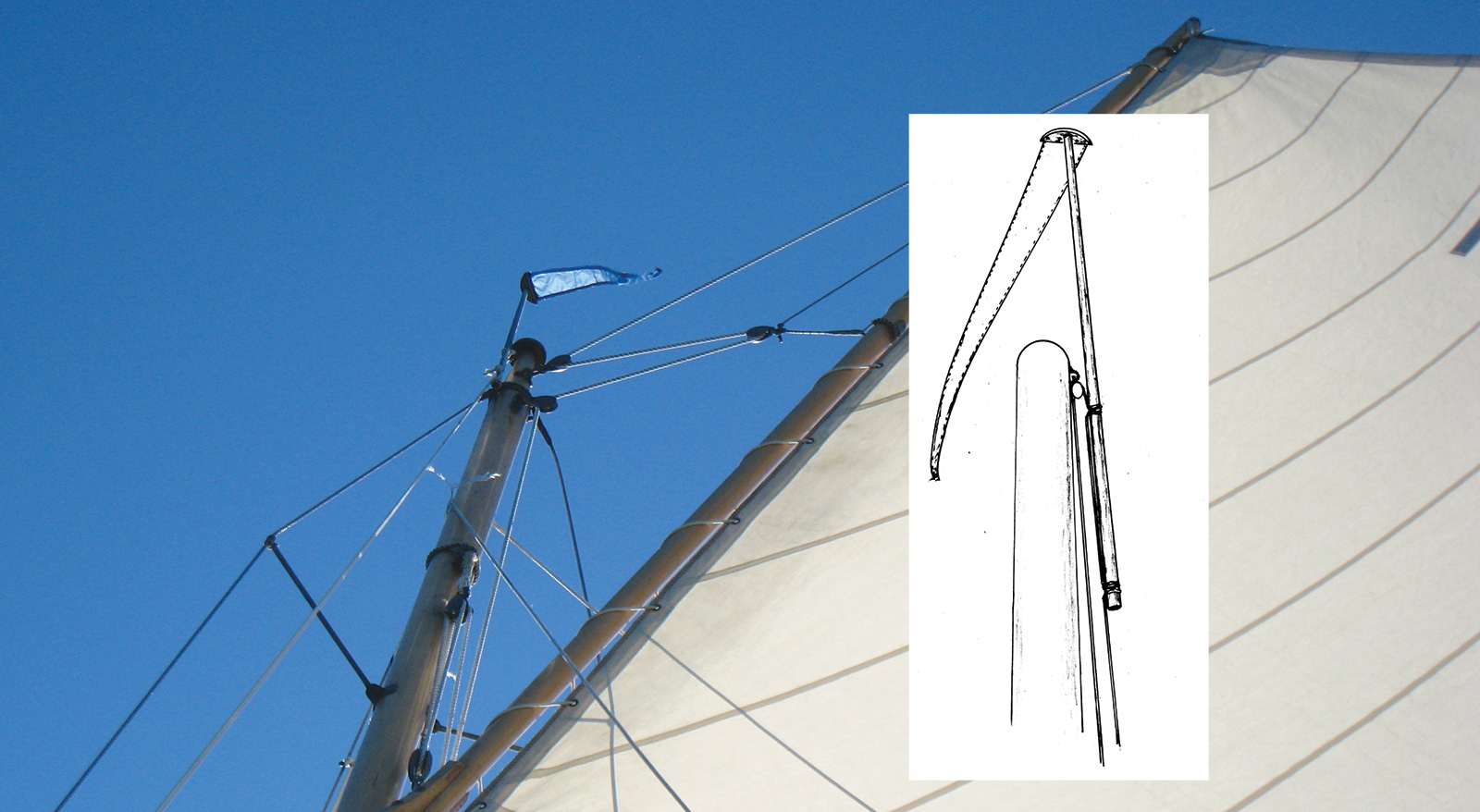
A masthead wind pennant.

In order to sail safely and efficiently, a sailor needs to know the direction of the wind relative to his boat. A dinghy sailor will find sufficient information in the ripples on the water or in the flutter along the luff of the sails. The skipper of a larger craft needs more precise information, particularly when the wind is dead astern, where a miscalculation can result in an unexpected jibe.

There are numerous devices that indicate relative wind information, and each of us seems to have a favorite. These wind indicators vary in complexity from a piece of yarn tied to a shroud to an electronic windvane connected to a readout near the helm.

Over 30 years ago, when our family sailed to Australia from New Brunswick, I had the opportunity to assess the equipment of some of our fellow voyagers to see, after thousands of miles, which devices stood up to the rigors of long-distance cruising and which ones had either failed or were not as useful as hoped. The sailing aid that seemed to fail most often was the masthead wind indicator. Usually, the problem was in the electronics that allowed the wind direction and speed to be displayed in the cockpit.

The wind pennant presented here, and detailed in the construction drawing, is a design that has proven itself on three boats I have owned over the course of more than 50 years. Two features in particular recommend it. The first is that it is easy to make and therefore easy to repair. The second is that, unlike most pennants, its leading edge is horizontal, an orientation that allows the light rip-stop fabric to catch the lightest breeze. Also, it is less likely than a traditional pennant to foul on its staff, even when damp with rain or fog. A pennant flown horizontally will, in a zephyr, give a clear indication of increasing wind speed as the fabric lifts away from its staff but before it begins to flap. I find this most useful when looking from shore and trying to decide if there is enough wind for a sail.

Drawing for masthead wind pennant.

  1. Hardwood stick, 2′2″ long, ⁹⁄₁₆″ in diameter at the bottom end, tapering to ⁷⁄₁₆” at the top.
  2. Rotating base for pennant’s leading edge, made of ¼″-thick hardwood as shown, with ⅛”-diameter holes for sewing on fabric pennant. Connection to the stick is a No. 8 x 1″ round-headed screw with washers top and bottom allowing the base to rotate freely.
  3. The pennant is made of lightweight rip-stop nylon, with a starting dimension of 4″ at the leading edge and 21⁄4″ at the trailing edge, with a length of 15⅝″. With hemmed seams, the finished dimensions are 2¾″ at the leading edge, 1″ at the trailing edge, and 14″ long.  Article ends.

Harry Bryan, a WoodenBoat contributing editor, lives and works off the grid in New Brunswick. For more information, contact Bryan Boatbuilding, 329 Mascarene Rd., Letete, NB, E5C 2P6, Canada; 506–755–2486.