COASTAL QUEEN

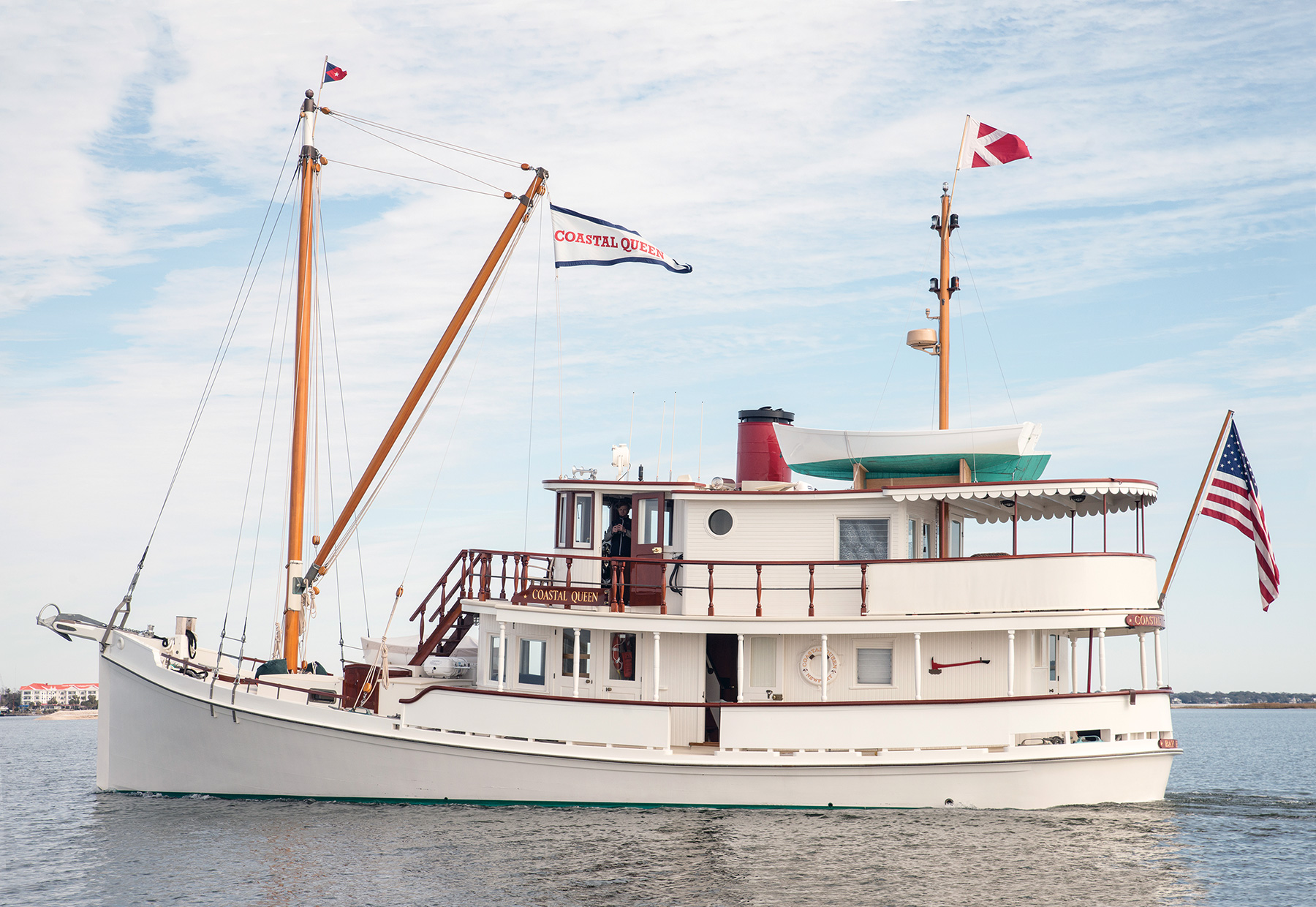
COASTAL QUEEN, originally launched in 1928 as a Chesapeake Bay buy boat, was converted to pleasure use in the 1950s and underwent a thorough restoration and modernization completed in 2024 at McMillen Yachts in Rhode Island.

In 1928, a Chesapeake Bay workboat, 65′ LOA with a beam of 21′ and draft of 5′6″, was launched near Cambridge, Maryland. Named A.G. PRICE, she was a typical boat of the Bay, hard-chined with a cross-planked bottom, and she immediately set to work as a buy boat, gathering oysters from all manner of dredging and tonging boats for delivery to packing houses.

Some 30 years later, her sweet sheerline caught the eye of Slade Dale, an experienced yachtsman and businessman who was looking for a boat well suited for passages between Florida and New Jersey along the Intracoastal Waterway (ICW), a route that was then overlooked by pleasure boaters. He bought the boat and in 1959 had a boatyard in Oxford, Maryland, convert her for pleasure use with the addition of a two-level deckhouse including numerous staterooms. He renamed her COASTAL QUEEN and began running ICW charters, the only boat to do so at that time.

Five years after COASTAL QUEEN’s conversion, the writer Anthony Bailey joined her for a northbound passage in 1963; his article about the experience spanned 32 pages in The New Yorker’s October 31, 1964, issue. He described the beauty and solitude of the coastline, which was then largely undeveloped, and also wrote about Dale and his crew’s pride in COASTAL QUEEN.

In October 2022, a massive rebuilding of COASTAL QUEEN for her new owners, Peter and Cynnie Kellogg, was begun at McMillen Yachts in Portsmouth, Rhode Island. Many luminaries of the region’s wooden-boat trades were involved in this project: the white oak for her new timbers was felled and milled by Duke Besozzi of New England Naval Timbers (see WB No. 213); her replanking, using double-planking for her cross-planked bottom, was supervised by Clark Poston, the yard’s head shipwright; Schell Custom Boatworks of Andover, New Jersey, built new Sitka-spruce spars to replicate the gear originally used for hauling oysters aboard; and de Rouville’s Boat Shop of Bayville, New Jersey, built the rig’s silicon-bronze hardware.

In the refit, all of her systems were substantially upgraded, including the installation of a Seakeeper gyroscopic anti-roll stabilizer, which necessitated structural reinforcement using stainless-steel floors. But the new technology was hidden wherever possible, and elements of her original systems—for example, her cable steering visible in the main saloon and the afterdeck—were retained.

The wheelhouse

The Wheelhouse.The array of curved drop windows allows panoramic views and abundant fresh air in the wheelhouse. The layout, which dates to the 1950s conversion, was inspired by the buy boat’s original aft wheelhouse, which had similar windows. New custom joinery was designed to conceal Garmin electronics, including a pair of matching 8612 chart plotters, a Fantom 18× dome radar, three 315 VHF units, an autopilot, and a GMI 20 multifunction display, plus an Airmar WX120 weather station, GPS heading sensors, sonar, and AIS. When not underway, the look of this space is vintage, with only the engine control and compass visible.

Blending the old and the new

Bending the old and the new.The binnacle and engine-order telegraph pay homage to the 1920s but are not original to COASTAL QUEEN. The telegraph no longer signals an engineer belowdeck to change direction or speed; instead, it now houses a potentiometer that is connected to a handle, more efficiently relaying commands to the modern electronically controlled engine.

Stadium seating

Stadium seating.The raised, custom built-in seat behind the helm station can’t be beat for viewing the landscape. When COASTAL QUEEN frequently traveled the ICW starting in the 1960s, the high seating and helm station allowed charter passengers to see over the foliage and trees that predominantly covered the landscape in that era. At right, a passageway leads to the master stateroom aft, and a companionway leads below.

Built-in seating aft

Built-in seating aft.The custom curved seating on the promenade deck was designed at McMillen Yachts to accommodate large gatherings. It was a tricky design due to the camber and sheer of the deck. The existing scalloped canopy was restored, and overhead lighting was installed. A new built-in refrigeration system forward of the seating accommodates any soiree.

The owner’s stateroom

The owners stateroom.

The owners stateroom.The stateroom is aft of the wheelhouse and has expansive views; it also has access to the seating area aft on the promenade deck. The drop-down shades have three settings: open, diffused light, and blackout. This stateroom originally had two twin beds, and one of them tilted up to reveal a full-sized, brass bathtub—one of Slade Dale’s “showpiece” features. Today, it has a full-sized berth and a well-appointed head with a shower. Dale’s original lockers, dresser, and writing desk remain in beautiful condition.

Centrally located galley

Centrally located gallery.The galley is not a utilitarian space tucked down below or separated from the guest areas; rather, it is on the main deck, right in the middle of the boat. It spans the full width of the deckhouse and communicates directly with the main saloon and dining area forward, like a kitchen in a well-designed modern home. Among the galley’s equipment are a separate electric oven and cooktop, refrigeration, dishwasher, stainless-steel countertops, custom lockers, and wine racks. The backsplash displays custom hand-painted tiles with lines drawings of sailboats and motor yachts sentimental to the owners. The traditional cork sole in the galley provides a forgiving surface for standing—and for mishaps with the fine china used for serving.

Multiple heads

Multiple heads.Two of the four heads aboard COASTAL QUEEN date back to the 1950s conversion, and two were designed for the latest accommodation. The original ones are ensuite in the VIP stateroom on the main deck and the owner’s stateroom on the upper deck. They both were upgraded with new fixtures and plumbing, but the layouts were retained. The new heads serve not only the guests and crew in the multiple cabins forward but also guests or visitors during day outings. For increased capicity, new waste and supply lines were installed, along with a custom stainless-steel holding tank.

A large main saloon

A large main saloon.A built-in dinette (above), original to Slade Dale’s conversion for ICW cruising, is still a key feature of this sociable space. It has a pass-through to the galley aft, allowing for easy serving. The saloon is adorned with a reproduction of a famous AMERICA’s Cup painting. Looking forward (below), a half-round, oversized settee makes for a spacious and comfortable living space for entertaining. The burgee plaques above the windows were hand-crafted by Paul White, a Massachusetts woodcarver noted for his American Eagles, and they reflect the owners’ history in yachting. The steering cables, which are original to the 1950s conversion and still are used today, are visible overhead.

Engineroom

Engineroom.The new engine, a diesel-fueled 404-hp Cummins QSL9, was lifted by a specialized crane through a forward deckhouse. Wheels were bolted to its mounting points and a track was constructed belowdeck to guide the engine aft into its new home. The old engine was a Detroit Diesel 6-71 that developed about 270 hp. It was one of the most reliable marine diesel engines in history, but parts were proving hard to find, it was very loud by modern yacht standards, and it couldn’t match the horsepower or efficiency of the new engine. The Cummins is in the same place as the old engine, but with rebuilt and reinforced hull structure and bedlogs.

Converted hold

Converted hold.The former hold has been transformed to accommodate a guest stateroom (at left) with a private head, a berth for the steward (at right), and an additional head. Throughout, the trim is sapele. The stateroom’s berth can be lifted by a hydraulic mechanism to reveal hidden storage, reminiscent of a similar mechanism that once revealed a brass bathtub under the berth in the owner’s stateroom.

Captain’s quarters

Captain's quarters.The captain’s quarters, while not spacious, are quite comfortable, with a built-in writing desk, a closet, and plenty of outlets and charging stations. COASTAL QUEEN operates with a full-time professional captain and steward.

At home again in the ICW

Slade Dale no doubt would be honored that the boat he converted in the 1950s has returned to her roots and that her restoration has been so well executed and her history so well documented—living proof that it takes hard work, homage to tradition, and time to become a beloved queen.  Article ends.

Laura Zylinski is a professional captain whose current post is BARNEGAT, a 50′, 1962 motoryacht undergoing seasonal restoration work at de Rouville’s Boat Shop in New Jersey.

Peter Slack’s 41 videos covering the COASTAL QUEEN restoration can be viewed at his YouTube channel; search his name and the boat’s name.