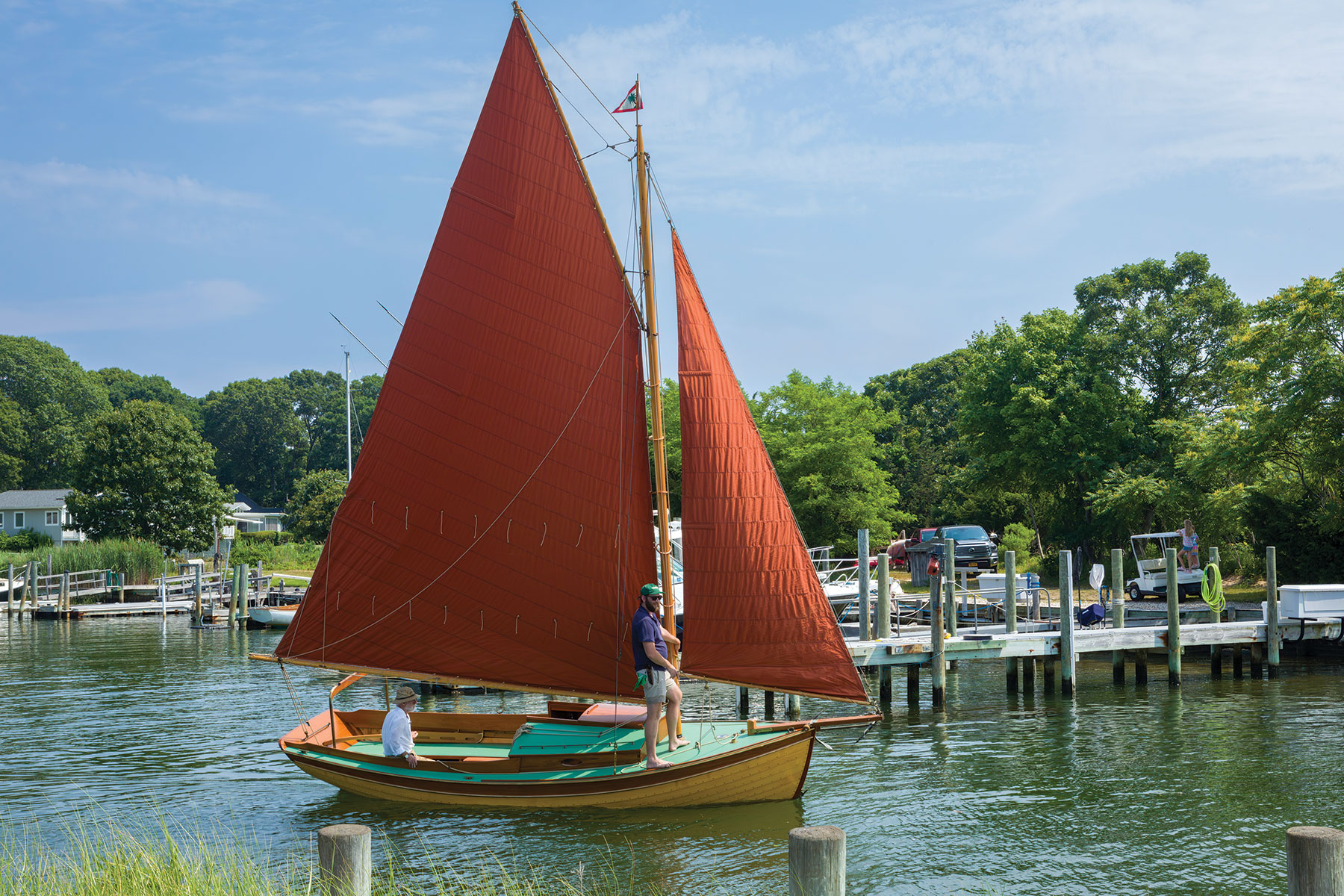
Peter BraunéWhen boatbuilder Donn Costanzo (at the helm) sought a pocket cruiser, to be named DATESY, for his retirement, he considered a number of designs before settling on Harry Bryan’s Katie. Donn brought to DATESY’s construction exceptional skill gained from a career working on some of the world’s finest yachts.
Donn Costanzo is a highly evolved wooden-boat expert. He has built, restored, and become an authority on an impressive array of yachts since launching his career five decades ago. So when the decision to retire from the company he founded, Wooden Boatworks in Greenport, New York, began to occupy his attention, the search for a suitable boat to build for himself began in earnest. Harry Bryan, a regular contributor to this magazine, soon rose to the top of Donn’s short list of designers. Harry’s 20′ pocket cruiser KATIE, which he had designed for his own retirement, captivated Donn.
Donn knew at the outset that the boat would be named DATESY, his nickname for his wife, Linda. But the choice of design required more thought. The usual practical considerations of size, design, and materials came into play, but how does a lifetime of experience with exquisite yachts influence the choice and construction of a 20-footer? Donn is an expert on Gil Smith boats, which are designed for elegant shallow-water sailing on Long Island’s Great South Bay (see WB No. 177). Smith’s material choices and building methods clearly influenced Donn’s construction decisions. At the other end of the spectrum, Donn is also an authority on William Fife III, having completed a structural rebuild of the 108′ Fife gaff schooner ALTAIR and Fife’s own personal yacht, SHEEVRA (now named CLIO), among other notable Fifes. His tastes and expectations of quality workmanship are top-tier. Nostalgia played no small role too—consciously or not—as Donn hoped to create the kind of small boat that would rekindle the joys of his youth.
Peter BraunéThe hull was built right-side up, with steam-bent oak frames clamped to ribbands.
When asked to recall the first boat that really moved him, Donn recounted his early years exploring the shallows of Great South Bay. He described the effect the Smith-designed P-class yacht KID had on him when he first saw it. “I was only seven years old, but I still get a little tingle when I think about it.” Building a boat to recapture memories of an uncomplicated youth and simple delight made a wonderful retirement gift to himself—a flexible little cruiser built to slip away, for gunkholing around the bay, for afternoon swims and reading and perhaps taking a nap afterwards. The agenda being, quite simply, having no agenda at all. The contentment of watching the reeds slip by and simply admiring the sails. That’s what Donn was after.
The marine historian Roger Taylor wrote in his book Good Boats, “The key to choosing the right boat is perhaps self-knowledge more than it is expertise in naval architecture.” No truer words could describe Donn in considering his priorities.
Peter BraunéWhile the design was originally for carvel planking, DATESY is lapstrake-planked in ⁹⁄₁₆″ Alaska yellow cedar—stock that Donn had stored for many years for this very project.
“Don’t get me wrong, I love my previous boat,” the impeccable Winthrop L. Warner design No. 36, the 42′ ketch SANDPIPER built by Gordon Swift and Bill Page in 1979. “But I knew I wanted a smaller, more direct experience. It took me over an hour to get SANDPIPER off the dock, removing covers and so forth; the same at the end of the day. Plus, I could sail alone and often did, but if the weather got kind of funny…it was a bit much for a 72-year-old guy to handle alone. I’m fit, in good shape, but I’m not 25. It took a lot out of me,” Donn said.
Peter BraunéThe V-matched bulkheads are of local cherry.
Despite having once rubbed shoulders in the cockpit with some of the world’s most privileged yachtsmen, Donn is by nature attracted to simplicity, and more so the older he gets. The “less is more” principle took on a whole new meaning for him, combining his lifetime in wooden boats, his intimate appreciation of the artistry in their design, the increasingly meaningful considerations of mobility and strength that come with age, and the realization that the amount of joy derived from a boat is often inversely proportional to its size.
Harry, who is 79 years old, has designed and built small boats for more than five decades. He has lived on 40 waterfront acres in Letete, New Brunswick, Canada, since 1972. His aesthetic is similar to Donn’s. He has a reverence for the creative experience of using hand tools in his off-grid workshop. He and Donn share similar views on the value of quality hand tools, voluntary simplicity, and creative expression through minimal consumption. Harry says, “I feel very strongly that our satisfaction comes from creativity, from using our hands and minds to create. If you don’t enjoy what you do, you should probably be doing something else, and if you do enjoy the work, why rush it?”
Peter BraunéWith the hull and deck complete, attention turned to the cabin-trunk construction. Its sides and front are of teak, as are the sheerstrakes.
When asked about his own retirement, Harry laughed and said, “I used to start working on my design work and writing at 5:30 in the morning. Retirement? It’s not much different from before, except I walk across the yard to the shop whenever I want now.” He thought for a minute and then added, “I don’t see much difference between work and retirement. But my wife, Martha, and I cook and heat with wood, have a composting outhouse, and now that we’re older, things do take a little longer these days.” It helps that they have two grandchildren, 14 and 16 years old, across the road to help—though he’s not so sure his grandchildren will take an interest in building wooden boats. “They seem to be more enamored by high-tech things and A.I.,” Harry said.
Harry’s boat carries the attitude of a 40-footer in just 20′. She has a playful, spirited, can-do functionality. The sweep of her sheer from stem to transom is a pleasing arc of a circle conveying an optimistic capability and a certain harmony with the environment. Harry managed to balance cruising space with the demands of hull shape, sailing performance, and handling. A deep cockpit, even though it’s not self-bailing, is an important feature giving a secure feeling of being confidently “in” the boat, especially with guests aboard. The bunks are long enough for a comfortable night’s sleep, and there’s plenty of stowage.
Peter BraunéThe cozy cabin has ceiling planking of Alaska yellow cedar and hanging knees of cherry. The well-cambered overhead offers ample sitting headroom.
Displacing 2,800 lbs and carrying 850 lbs of outside ballast, the boat is stable and trailerable. A centerboard was necessary because Donn plans to explore shallow waters; the Katie design draws only 1′8″ with the centerboard up. She has round bilges, moderate deadrise, and just enough room for napping and getting in out of a rain squall. The short bowsprit aids in anchoring but does not require venturing out on it: “Harry and I both agree,” Donn said, that “the last thing we need at our age is having to go out on a bowsprit for anchoring.” DATESY and KATIE both carry a fisherman-type stock anchor rigged and stowed in a saddle on the port side of the sprit. The whole arrangement can easily be reached from the foredeck for effortless deployment and retrieval without any drama or fuss. KATIE thus met Donn’s list of functional requirements. That was no easy feat in a small boat.
Peter BraunéThe Katie design displaces 2,800 lbs and has 850 lbs of outside ballast. A centerboard allows trailerability and shallow-water exploration; the hull draws only 1′8″ with the centerboard up. Designer Harry Bryan was influenced by Joel White’s flatfish design, which in turn was heavily influenced by Nathanael Herreshoff’s Fish-class sloop.
KATIE was designed and built with no drag to her keel, since Harry’s home cove dries out at low tide and he wanted the boat to stand upright and settle easily into his trailer’s cradle; for DATESY, Donn added 6″ of keel depth aft. “Everything’s a compromise,” Donn said, “especially on a 20-footer.” The lead ballast was modified accordingly, and this change improved the boat’s tracking.
Harry swears by the addition of a boom gallows on KATIE, and Donn agrees. “It eases the possible chaos of a quick reef in an unexpected blow,” Harry said; “I can’t imagine having a boat without one now. For reefing, you can let the boom down and sheet it into the gallows…so you can carry on all your work without any fear of the boom knocking you overboard or hitting you in the head in a seaway. Plus, it’s a wonderful thing to hold onto when you’re standing up, which we all do at some time.” He wryly adds, “Men particularly.”
Peter BraunéDATESY’s ingenious tabernacle mast allows for simple singlehanded stepping at the launching ramp.
Donn is drawn to KATIE’s modest cuddy cabin, cambered coach roof, and lively sheer. “Art! That’s one of the reasons we’re intuitively attracted to certain boats. I think your boat has to tickle you,” he said. KATIE’s hull profile was also a big attraction to Donn. “Harry really nailed it for me. I wanted a lapstrake boat, mainly for dry-boat trailering, and lapstrake planking is only successful with a jaunty, perky sheer, especially on a small boat,” he said. The spring of KATIE’s sheer was one of the design’s dominant features for him, knowing lapstrake planking was the method he’d choose for his own construction. Donn has compelling opinions on the planking style. “Lapstrake planking is stronger and lighter. It gives lift. It adds a saucy look to the sheer in a small boat. And, most important, it stays tight when a boat is trailered.”
Peter BraunéUnlike many tabernacle arrangements, which have clunky on-deck mechanics, DATESY’s is a simple and strong hinge engineered into the mast’s designed profile.
Being easily trailerable was a must on Donn’s list of requirements since he wants to do some remote explorations. Plus, he plans to store DATESY in his barn. Considerable contemplation went into Harry’s harmonious centerboard design on KATIE. He said he was inspired by the Joel White–designed Flatfish, a centerboard version of Nat Herreshoff’s Fish Class (see Designs, WB No. 302), which itself evolved from the ever-popular Herreshoff 121⁄2 (see WB No. 300). Donn really related to Harry’s concern about the centerboard trunk dominating the modest cabin of a 20-footer. To mitigate this, Harry shaped the centerboard so that its after end fans out and houses in a centerboard trunk nestled under the cockpit bridge deck. The board’s slender forward end houses in a very low-profile portion of the centerboard trunk inside the cabin, only a few inches above the cabin sole. The result is a centerboard trunk that is hardly an obstruction at all. It even serves a double purpose as a small step from the cockpit into the cabin.
Harry and Donn share a deep respect for fine building stock and appropriate hardware. Aware of dwindling resources in our modern world, Donn began buying and collecting choice wood early in his career, much of it on the stump, and milling it himself. The materials list for DATESY resulted from both his personal preferences and his prescient collection.
When it came time to actually build the boat, Donn continued his career-long practice of mentoring and apprenticeship. He wanted to give 30-year-old Stephen Worsham the opportunity to shine in a medium Donn knew he would excel in. Only half-jokingly Donn said, “When people ask me about building DATESY I always say Stephen built the boat. I just did my best to get in the way.” In a more serious tone he added, “Stephen has a very active mind and explores every aspect of things. You can’t wing anything when building a boat. We spent three weeks lofting. You can’t top proofing by eye, and Stephen really has the eye. I also love the way he embraces the complexities of boat puzzles, and he recognizes that some projects take on a magic life of their own, like when the grain of the cabin sides led directly into the dovetails. Plus he’s easygoing and a joy to be around.”
Peter BraunéWith fellow builder Stephen Worsham, Donn motorsails DATESY home after an early outing in 2024. Auxuliary power is supplied by a Torqeedo electric outboard hung on a removable bracket.
Stephen said it goes both ways. “I have so much respect for Donn’s knowledge and experience. And I like his emphasis on doing everything ourselves.” Stephen was raised and homeschooled in Virginia by parents who were architectural historians, so problem-solving in boatbuilding comes naturally to him. A 2016 graduate of the IYRS school of Technology & Trades, Stephen has been a key person in Wooden Boatworks’ restoration and historical new-build projects. Most significantly, Stephen took part in building a new 1930-designed Fife 8-Meter at Wooden Boatworks. “In that project, super-accuracy was very important. We used a feeler gauge on her planking. And that transom!” Clearly, that was a transformative project for Stephen.
DATESY’s planking stock was clear ⁹⁄₁₆″ Alaska yellow cedar, which was stickered for decades patiently awaiting Donn’s retirement project. The ceiling planking was fashioned from the offcuts. Her garboards and sheer planks, centerboard trunk, transom, cabin, and coamings are of teak. Her floor timbers and deckbeams are of locust. Framing is of white oak. Cabin beams, hanging knees, stem, and transom knee are of local cherry.
Donn is a huge devotee of cherry, having taken apart and rebuilt so many Gil Smith boats over his career. “Gil Smith’s WINDWARD, over 100 years after she was built, had natural-crook cherry frames that were hard as a rock,” he said. “Cherry is dimensionally stable and rot-resistant, glues well, holds fasteners, and it’s local. We took down a huge 6-ton cherry tree nearby in East Hampton. It had a big 90-degree branch, which was perfect for DATESY’s stem pattern. I’m a big fan of eliminating apron stock, of making the stem one piece—one less joint. DATESY’s hanging knees and cabin beams came from the same tree.”
Peter BraunéDATESY’s sails were made by Traditional Rigging Company of Appleton, Maine, using a cotton tanbark cloth. Donn chose this because it enhances DATSEY’s color scheme. “I love watching the sails underway,” he said.
Stephen said, “I did all the spiling and planking prep work. The only screw-fastened planks are the teak garboards. The rest are the purest of pure cedar—incredible to work with. Donn fitted the planks on the starboard side, and I did the port side. He drove and backed the rivets while I peened them on the inside. Since the topside planking would be oiled, we didn’t want to have to bung or fill holes. The end result looks like nails from the outside.” The topside finish is a mixture of linseed oil, pine tar, and turpentine.
The camber of DATESY’s coach roof is spry but not overly so, highlighted down below by the extraordinary natural-crook cherry hanging knees and cherry cabin beams. Her ceiling planking is strikingly serene and harmonious, the clearest Alaska yellow cedar. Her two bunks are comfortable for overnighting, and there’s lots of stowage. She has a gorgeous sliding companionway hatch.
The decks are 5⁄8″ marine plywood and the coach roof is strip-planked in cedar with a thin layer of plywood atop that, both sheathed in Dynel cloth set in epoxy—the only epoxy used on the boat. Donn has strong opinions about glues, but Dynel was a straightforward choice for deck sheathing driven by the reality of the times rather than aesthetics: “Modern canvas is not what it used to be,” he said; “it just doesn’t hold up.”
Donn purchased a collection of vintage nickel-bronze hardware from the retired yacht broker Bill Page in 2010 and, looking forward to building a special boat for his own retirement one day, squirreled away the entire inventory of hard-to-find items needed for DATESY. Purpose-made metalwork was custom made by Kristian Inglesias of Greenport.
Donn said he “wanted to be able to raise and lower the rig by myself if I have to.” Stepping a 65-lb, 25′ mast alone is not an easy task; it typically requires three people for Harry to step KATIE’s mast. Donn and Stephen fashioned a Tufnol-lined pivot on the tabernacle mast. By rigging Harry’s two-piece Herreshoff-designed sweep oar as a controlled lever arm and hauling away or slacking off with a dedicated block-and-tackle, Donn manages the stepping task by himself.
DATESY’s sails are handmade using traditional cotton English tanbark cloth, which appears especially timeless on her gaff rig. Donn chose tanbark because it enhances DATSEY’s color scheme. The soulful teak cabin sides and transom and her cherry stem complement the hue of the sails. “I love watching the sails underway. For me, it’s a huge part of the enjoyment of sailing DATESY,” Donn said. Sailmaker Dayle Ward, along with her husband, Tom Ward, a rigger, operate Traditional Rigging Company in Appleton, Maine (www.traditionalrigging.com). They are the real deal for both classic yachts and working sail. Dayle is one of only a handful of traditional sailmakers expert in working with cotton sailcloth. “Dayle’s hand-finishing work is amazing,” Donn said. “She is a delightful person, and her work shows it.”
DATESY has no engine. Like Harry, Donn is content with the two-piece sweep oar and a Torqeedo electric outboard for occasional use if needed.
Mies van de Rohe, the pioneering modernist architect, once said, “God is in the details.” Designer, owner, and builder all collaborate, each with his own cumulative details that, combined, make a good boat.
A handcrafted boat is the product of not just accumulated details but also of the spirit of the craftsmen. The mutual affection and admiration between Donn and Stephen are riveted into the boat for sure. When DATESY was launched, Donn asked, “Is she taking on any water?”
Stephen replied, “Only on your side!”
When asked about his own professional development and what he learned from building DATESY, Stephen said, “You really think about it before starting. You think about it after it’s finished. But when you’re building a boat, you’re just working…so in the moment you don’t think too much about it. You just focus. You just work.” On what he learned from Donn he said, “I’d like to think I’ll be like Donn at his age. I have so much respect.” I asked Stephen if he regards himself as a shipwright, and he was quick to reply, “That’s a moniker others bestow. I guess if the apprentice system describes a lifetime devotion to learning skills, I’m definitely in that category. I think of myself as craftsman, that’s all.”
Donn was thoughtful too when asked about what he learned from building DATESY. He agreed with Stephen. “Building a boat really makes things sink in. You think. You process. You invent. These things coincide with life changes and challenges,” he said. The topic of an aging fellow working with a young man naturally digressed into sharing a long list of solutions to boatbuilding and maintenance tasks in our older years—such as a preference for volleyball kneepads and foam cushions, the difficulty getting under and out from a boat on the hard, scurrying around the shop floor while lofting, and the need for getting just the right distance away for seeing details. Old-guy stuff.
Donn has been unwinding his business for a while now, having sold Wooden Boatworks in 2019 to partners Patrick Brennan and Steve Lubitz. That consolidated his remaining business, Avery’s Boat Shop, to all the trailerable boats—60 Beetle Cats, all the Gil Smith boats—plus the lumber and the hardware inventories. He will turn Avery’s over to Nick Falino in 2025. Asked why he chose to retire, Donn said bluntly, “Because I can. I had no idea retiring could be so wonderful, even though I love what I do. I’m having fun learning the boat, since we just launched DATESY.” After his first season sailing her on Great South Bay and Eastern Long Island, he said, “I haven’t had such a good summer since I was 12 years old.” ![]()
Pat Mundus is a former ship’s officer and offshore sailor. Now retired, she sails her Herreshoff Rozinante out of Greenport, New York.