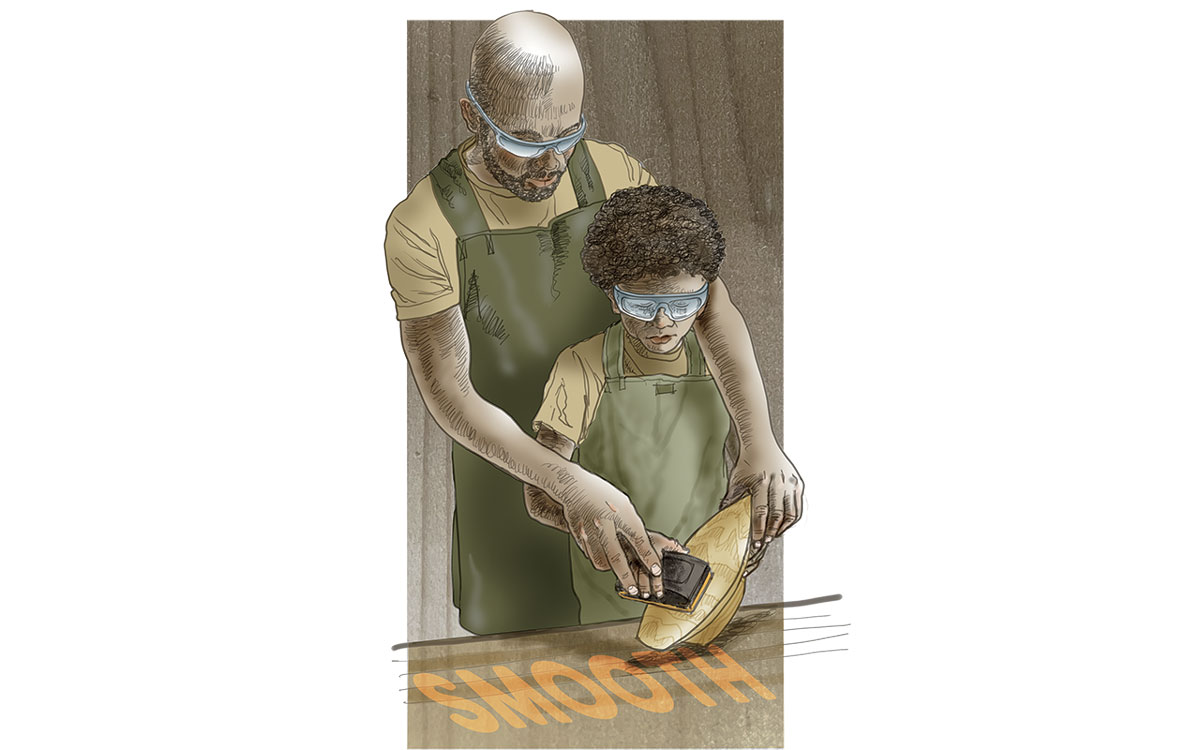
Fake beams in ranchburger tract houses emphasize the rough timber gouges of the primitive builder to strike a note of “Early American” authenticity. We shouldn’t insult our ancestors. Early American builders were not primitive. They took as much pride in their work as our boatwrights. If the old fellah’s toolbox was basic, you might detect the faint patterns of crosscut sawing to a struck line and smoothing with a broadax. But if he had an adze, the surfaces would be clean and even. Adzemen seldom kept all their toes but had a keen sense of finish.
Like your ancestors, you want your work to reflect your skill, and since much of what you do will be visible trim and cabinetry, you have a high standard of smoothness. Sandpaper resolves a multitude of sins.
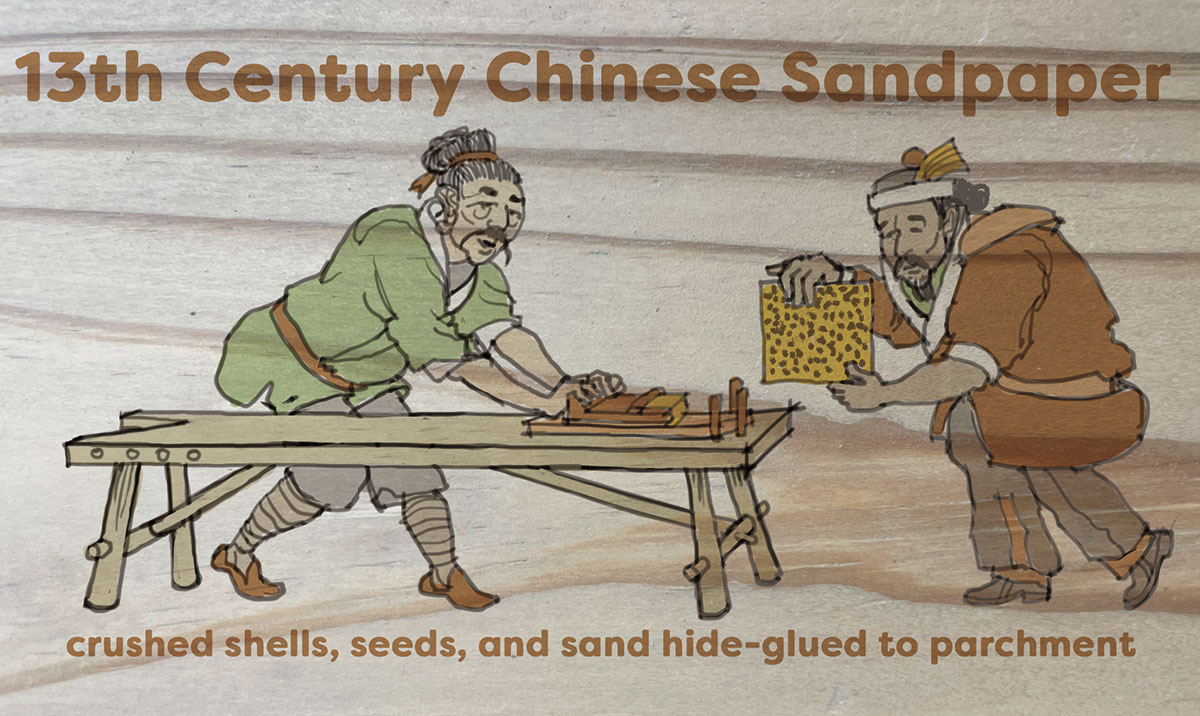
We know Egyptian craftsmen smoothed woodwork with actual sand (they had plenty of it). We know they used crushed emery (corundum, aluminum oxide with iron oxides) on dowels to drill holes in stone and to work detailed carving. Egyptian women probably even had emery boards to shape their nails just as modern women do. The earliest actual sandpaper we can recognize was used by Chinese woodworkers of the 1300s—crushed shells, seeds, and sand were bonded to animal-hide parchment with animal-hide glue. The skin of some sharks, rough with toothy denticles, was also used as an abrasive. In the 17th century, sand stuck to paper appeared, and sometimes crushed glass was the medium.
A chisel or plane or a dozen other tools we use today would be familiar to woodwrights from a thousand years ago. Like the shark, they didn’t need to evolve far from their purpose. We could say the same of sandpaper. What’s not to like? An abrasive bonded to a flexible sheet in several grades of aggressive or mild grit, used to smooth, delete, or bring a surface to a finish. It’s a timeless convenience. Only the names are anachronisms. We can’t find sand, ground glass, emery, or crushed shells in our sandpaper; technology made them all obsolete.
Crocus cloth was meant as a sanding advance for specifically gentle finishes such as jewelry and precision machine parts. Long-lasting, flexible cloth was bonded to a polishing abrasive, iron oxide, or rust, of about 2,000 grit. The rust color resembled saffron, which was crocus in Latin, krokus in Greek. The delicate grit has been supplanted by finely graded modern abrasive and the cloth is synthetic.
Wet and dry sandpaper was invented in 1931 by 3M; it’s a precision grit bonded to a waterproof backing so the product can be used with water to flush away the ground particles and continue cutting. It is especially useful for finishing automobile paints. Today, the backing is mostly polyethylene film.
Disc, pad, and roll backings may be multiple layers of polymer-impregnated paper in weight ratings A to F (A<F). These are more rigid deliveries, cutting faster and best adapted to smooth surfaces. Cloth backings conform more easily to complex surfaces commensurate with their thickness, J, X, Y, T, M (J<M).
Grit is the measure of abrasive materials’ particle size; larger grit (denoted by a smaller number) means more-aggressive cutting and a coarser finish. You may suppose that the marked grit is accurate and consistent; the importance of abrasives worldwide has obliged international cooperation in standardizing grits. The only exception is cheap sandpaper marked with coarse, medium, and fine. Actual grit size is determined by a forgettable abrasive/area formula (the physical size of 100-grit abrasive is 0.160mm, 0.0064”). You’ll easily learn what your grit numbers should be for jobs requiring coarse-to-fine sequence “sanding.”
We no longer use sand, rust, emery, or glass. Modern abrasives are aluminum oxide, aluminum zirconia, and silicon carbide. Sheet abrasives are rated open or closed. The surface of closed-coat paper is 90 percent to 95 percent covered with abrasive grain. This concentration is good for hand-sanding and hard stock. The surface of open coat has a lower area count of abrasives, 50 percent to 70 percent abrasive grains; it’s more flexible but less consistent, making it best for soft materials. Another flat-sheet distinction: sandpaper may be stearated (soaped), which means that dry lubricant is added to the abrasive to discourage clogging and increase the working life of the sheet. This can be good for some applications, but if you plan to finish your surface with varnish, the soaping may cause “fisheyes” long after sanding.
Recently, technology in synthetics has created an improved sanding medium: mesh. Instead of a closed, flat sheet with abrasives, tough fibers of polyester, nylon, or rayon are woven into a mesh and coated with abrasive. Mesh abrasives are provided in a full range of grit size and hardness, even new ceramic abrasive for metal. Beyond chemically improved abrasive bonds, the open mesh allows a through-flow of air carrying the dust of abraded material away from the surface and, in a well-conducted shop, into a dust-extraction system.
Sanding dust is serious business your great-grandfather didn’t fully understand. Carpenters and boatwrights were expected to live with their dust. Don’t you believe it. We know now that sawdust is more dangerous than an occasional cough. Your lungs are direct connections to your circulatory system via thin-walled transfers. Repeated inhalations of sawdust make existing breathing problems worse but can also initiate new allergies in lungs and eyes, as well as cause skin rashes. Several common woods are known carcinogens: the documented cancer-causing properties of oak and beech should scare you. Western red cedar is an initiator of asthma. Cocobolo, ebony, and rosewood can give you rashes, nausea, and eye problems. Add to internal disasters the fact that sawdust is a fire hazard and in fine suspension an outright explosion hazard. Mask up, look to air flow, work up a dust-extraction system.
Power tools that serve niche needs are essential parts of your tool array. We haven’t shown all of them with dust-capture connections because they get in the way of recognition, but you have an obligation to your work and your health (and your workshop) to control airborne dust.
Power your specific tasks by using tools of appropriate work patterns. The random-orbit sander (A) is a workhorse with a whole range of grits for smoothing or just taking down a layer of finish. A big powerful disc sander (B) is indispensable for shedding a layer of old bottom paint and for rough corrections in surfaces. A belt sander (C) is hard to use delicately and can lurch in the wrong direction easily, but it takes down stock aggressively.
A detail sander (D), shown here as an attachment on a multitool, is a nimble and quick tool for trim and tight spots. Gauge their power outputs and abrasive patterns judiciously. (E) Velcro-backed sandpaper allows easy disc changes.
Foam blocks in varied grits are relatively recent additions to the sander’s toolbox. They conform well to complex surfaces, reach into crannies, and have the welcome capability of grab-and-go without any sheet or disc installation. ScotchBrite is another 3M innovation and overlooked as an abrasive, though it comes in several grades of attack; when your task is to roughen an existing finish to add a coat, ScotchBrite is an apt tool, adapting to complex surfaces and never gouging.
Surfaces must be made smoother even after the most skillful planking. Aggressive grit backed by a single-flex “block” and force-amplifying handholds can modulate a hull shape. The operator should be wearing a mask!
Bench tools, such as stationary disc and belt sanders, are precise, deft tools for small pieces. The degree-adjustable table and rests associated with the belt and disc ensure crisp, correct angles.
Adhesive rolls of mesh and paper abrasive are convenient for several designs of sanding block. ![]()
Jan Adkins is a regular contributor to WoodenBoat. Visit his blog, Dockwolloping, for more insightful illustrated discussion of all sorts of maritime matters.


