
 Richard Jagels
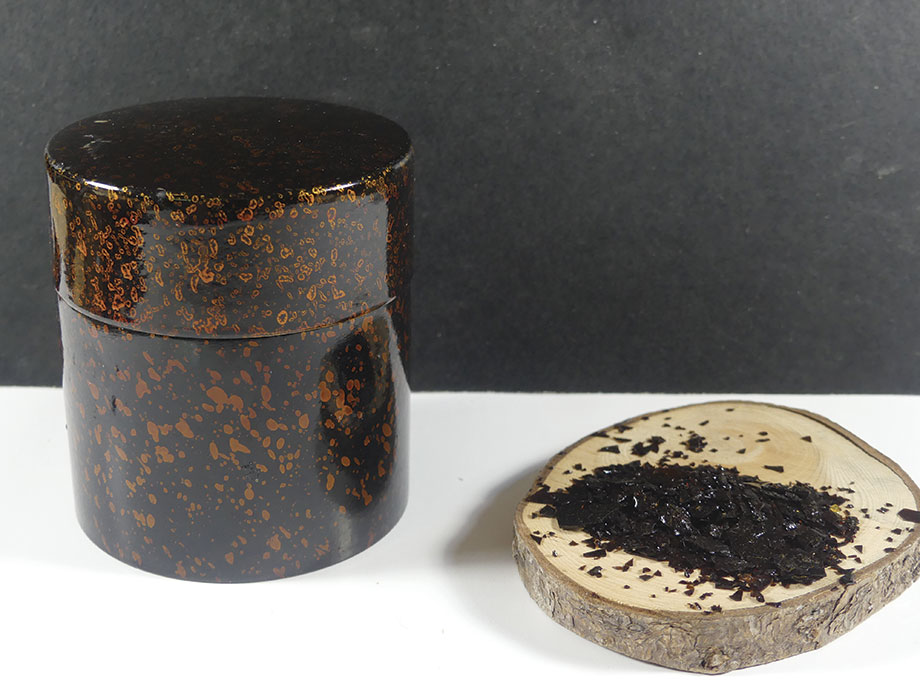
The tea caddy on the left is an example of Japanese lacquer work in which a dye and gold particles have been added. On the right are dewaxed garnet lac flakes. Dissolved in alcohol, they produce amber shellac. “Blond” flakes produce a lighter-colored finish. Because mixed shellac has a shelf life of six to nine months, preparing your own alcohol-based solution from lac flakes guarantees freshness.
A couple of old yacht tenders built by George Lawley & Sons recently caught the attention of Harry Bryan (WB No. 303) and Tom Jackson in his Currents section (WB No. 305). Part of the discussion centered on the aging interior clear finish on these two Lawley tenders. Bryan’s boat was built in 1925, while the one Tom reported on was built in 1913. In each case, the tenders predate the earliest synthetic finishes, which consisted of nitrocellulose lacquers, that came to market in the 1930s and ’40s. Bryan suggested that the Lawley he examined might have been finished with shellac.
This got me to thinking about the history of wood varnishes and what options were available to boatbuilders in past centuries. My research revealed, as might be expected, that for many centuries wooden boats, like barns and houses, were left unfinished. Only in the past few centuries were finishes regularly applied to watercraft.