
 Chris Reardon
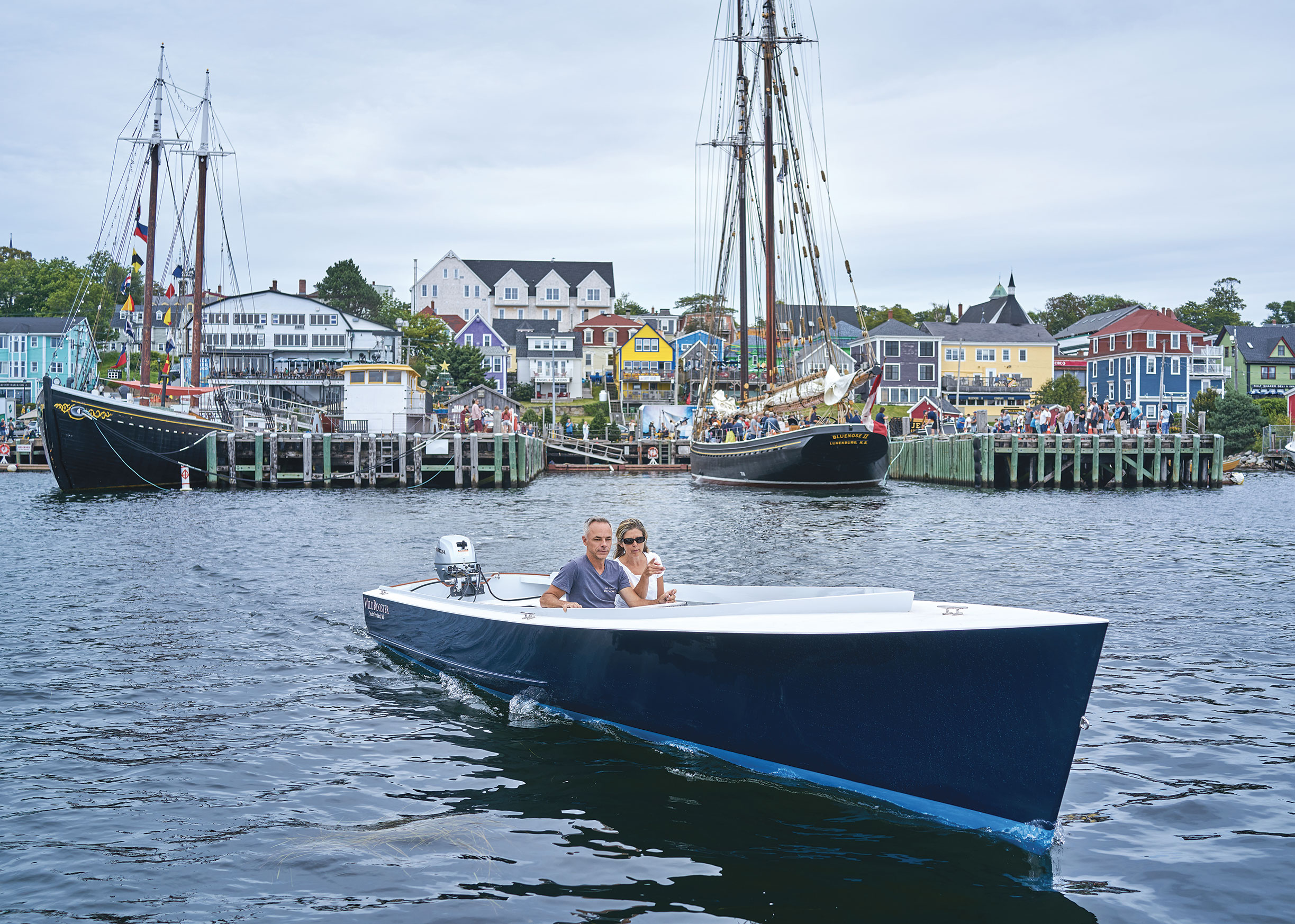
WILD ROOSTER is a recently launched copy of ANKLE DEEP, a 25′ open powerboat designed by Uffa Fox and launched in 1970. She was built and launched in Lunenburg, Nova Scotia, and now hails from Portland, Maine. The original boat is on display in Cowes, England, at the Classic Boat Museum.
It was a beautiful spring day as I strode down Montague Street in Lunenburg, Nova Scotia. My wife, Melissa, and I had recently moved here and gotten off to a promising beginning with a fine cast of friends and acquaintances. It was thus with high spirits that I set off on my walk through town with a set of boat plans under one arm and a book under the other.
I was on my way to meet with Paul Baskett, a local boatbuilder. A graduate of the boatbuilding program at The Landing School in Arundel, Maine, Paul had worked with the acclaimed boatbuilders at Spirit Yachts in Ipswich, England (see WB Nos. 284 and 135) for five years before opening his own shop, Old Town Boatworks, in Lunenburg. He’d recently moved to a space that was bigger and better than his previous one, and I needed to talk to him about my urge to have a boat built.
I don’t say this easily: to have a boat built requires much more money, mystery, and stress than buying an existing one. But the boat I wanted wasn’t easily approximated by anything on the market. Inexplicably, I really wanted this boat. I’ve been fairly profligate in my boat-ownership history—a history I don’t quite understand. But maybe this boat would be my last.
The boat, a 25′ open launch named ANKLE DEEP, was designed and built in England by the legendary Uffa Fox in 1969–70. She was the last of Fox’s designs and is the only powerboat in his ample design catalog. (His primary focus, and greatest success, was with fast and lightweight planing sailing dinghies; see WB Nos. 221–224.) The original ANKLE DEEP has been restored and is on display in England at the Classic Boat Museum in Cowes, Isle of Wight.
Uffa Fox described the “fine lined” ANKLE DEEP as being able to “cut her way easily and cleanly, without waste of energy, through and over waves. She is the largest launch that can be handled easily by one [person] in all conditions of wind and sea….”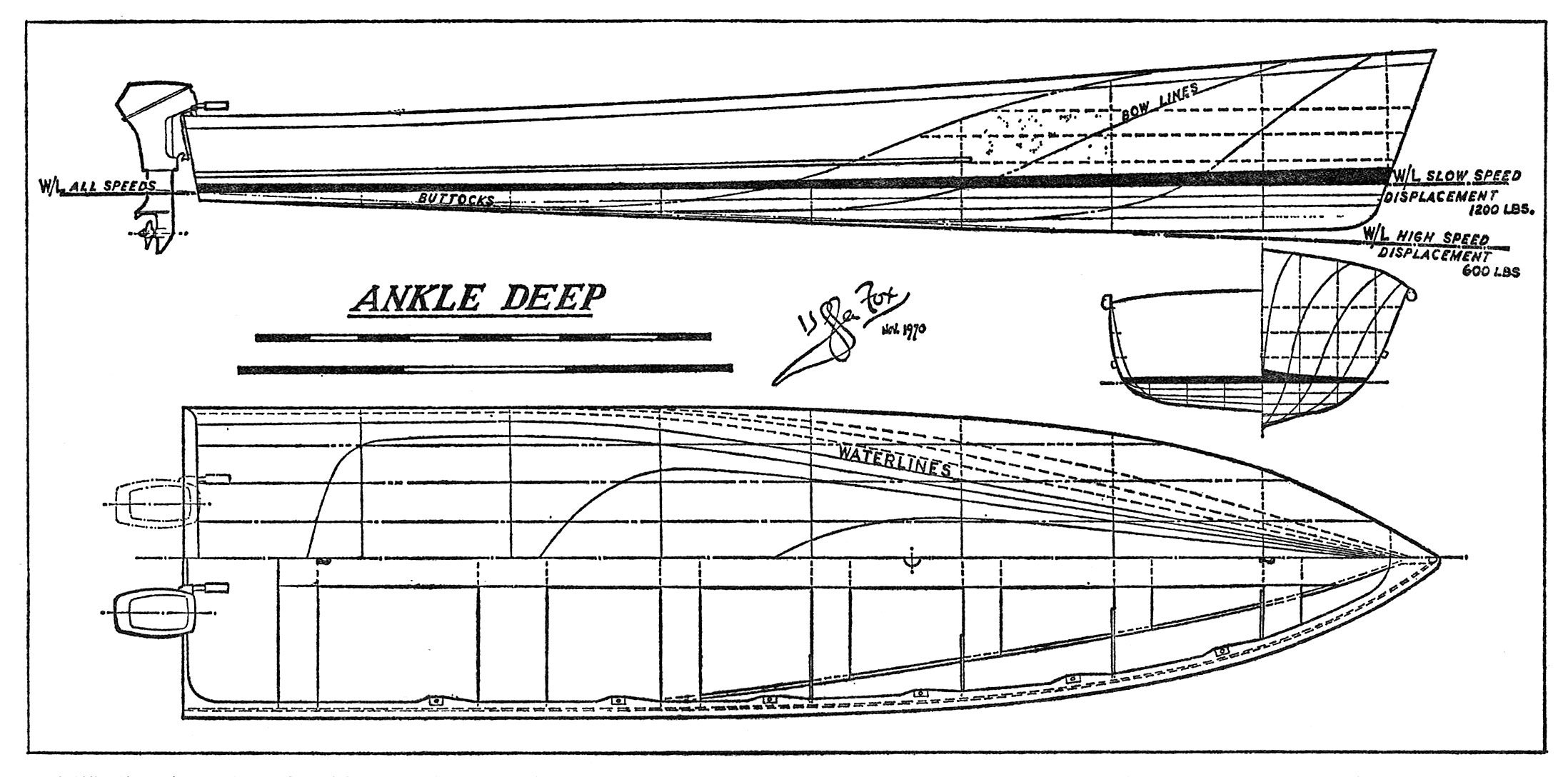 "More Joys of Living," by Uffa Fox
She is a very pretty boat, and I found her design to be just what I wanted. Her lines are easy and clean, and she is simple, lightweight, and strong. Uffa wrote of her lines: “…I designed ANKLE DEEP with a lovely set of fine-angled sections which combined the ease and graceful entrance of rowing boats, a very fine entrance, with dead-straight waterlines. The bow lines, with a 3 degree angle of attack forward, flow into dead stright [sic] buttock lines as they sweep aft to the stern, a set of lines combining straight waterlines in a fine wedge from the stem with dead straight buttocks (over the aftermost three-fifths of their length) which causes the boat to run level and steady at all speeds.”
I liked how Fox had kept her beam all the way aft, and I was drawn in by that tremendous flare at the bow—not to mention the quote about the seas uniting the land and ANKLE DEEP’s seakeeping ability.
I’d already asked Paul to build the boat, and my purpose in going to his shop with the book and the plans was to iron out the details of the construction. Epoxy wasn’t readily available when Uffa designed and built ANKLE DEEP in 1970. So, she was built with ½″ × 2″ double-diagonal mahogany, glued and screwed, which is relatively heavy. My iteration of the boat would be cold-molded in two layers of ¹⁄₈″ western red cedar glued with epoxy for a significant weight saving.
In Paul’s office on a dock in Lunenburg Harbour, we unrolled the lines and construction plans and weighed them down at the corners, and I presented Paul with his own copy of More Joys of Living. We agreed that a foredeck was necessary. Uffa had used two 9.9-hp Evinrude outboards. We’d use a 20-hp Honda.
Next came the seating. Uffa chose thwarts; I preferred fore-and-aft seating as a more sociable arrangement, because people sit facing each other. The construction drawings show large areas for flotation foam near the bow and stern. They are blank spaces on the drawing, and they take up a lot of room. I have an old, poor-quality photo of ANKLE DEEP tied up to a dock, and there doesn’t appear to be any flotation foam in the boat. Perhaps Uffa, characteristically, ran out of time or money, or just didn’t want to give up the valuable space. One of the drawbacks of the design is that there’s very little storage space—none in the plans for an anchor, life jackets, a bucket, or even lunch. She’s a quintessential day boat, with no frills, meant for day-cruising in good weather. We would add some storage, but Paul and I agreed there would be no electronics—only paper charts and a VHF.
The workday ended, and we closed up the shop and adjourned to one of Lunenburg’s award-winning pubs. This part of the agenda was where I would explain to Paul what I wanted out of our version of ANKLE DEEP, which was to be named WILD ROOSTER.
The name had originated in Amsterdam. I had worked for WoodenBoat Publications for many years, and in that capacity attended a marine trade show in The Netherlands annually. After the show one year, we visited a spectacular collection of Van Gogh paintings in the east of the country, at the Kröller-Müller Museum. The trip leaves Amsterdam by train, then a bus, and then a short bicycle ride. Just as we approached the museum, there was a sign warning of a slippery cattle grate. It showed a car skidding, and the word wildrooster—Dutch for “cattle grate.” One of us forgot that the brakes weren’t on the handles but on the pedals. A humorous accident ensued, with no injuries reported. The word lived on.
I lived in Brooklin, Maine, in those days and, after retirement, we sold our house there and bought the one in Lunenburg. But I am not Canadian and neither is Melissa, so we couldn’t stay longer than six months per year. We had thus also bought a small, non-luxury condo in Portland, Maine, which was perfect: Lunenburg in the summer and fall, Portland in the winter and spring. WILD ROOSTER, it seemed, would be ideal for exploring the nooks and crannies of great Lunenburg. We committed to building her during our fourth year there.
The Covid-19 pandemic arrived a few months later, and Canada and the United States agreed to close the border. While we were forced to rethink our future in Lunenburg, Paul and his crew began building WILD ROOSTER. Emma May, Paul’s partner and primary finisher, bookkeeper, and doer-of-everything, would send me photos every week. It was beyond exciting. But the border showed no signs of reopening, the pandemic was raging, and life in a small condo was stifling. We made some hard decisions: we sold the house in Lunenburg and bought one in South Portland. WILD ROOSTER was to become a Maine boat.
Portland is on Casco Bay, which is characterized by long peninsulas joined (not divided!) by rivers and long inlets. To a kid of 15 with an inflatable and 5-hp outboard, or a geriatric sailor with a big, open powerboat, they represent the same thing: adventure! I imagine cruising these rivers in WILD ROOSTER, maybe spending the night at an inn or motel for a hot shower and dinner, and then being on my way again the next day. The boat can cruise easily at 20 knots, but I’m more a 7.5- to 10-knot person.
 Chris Reardon
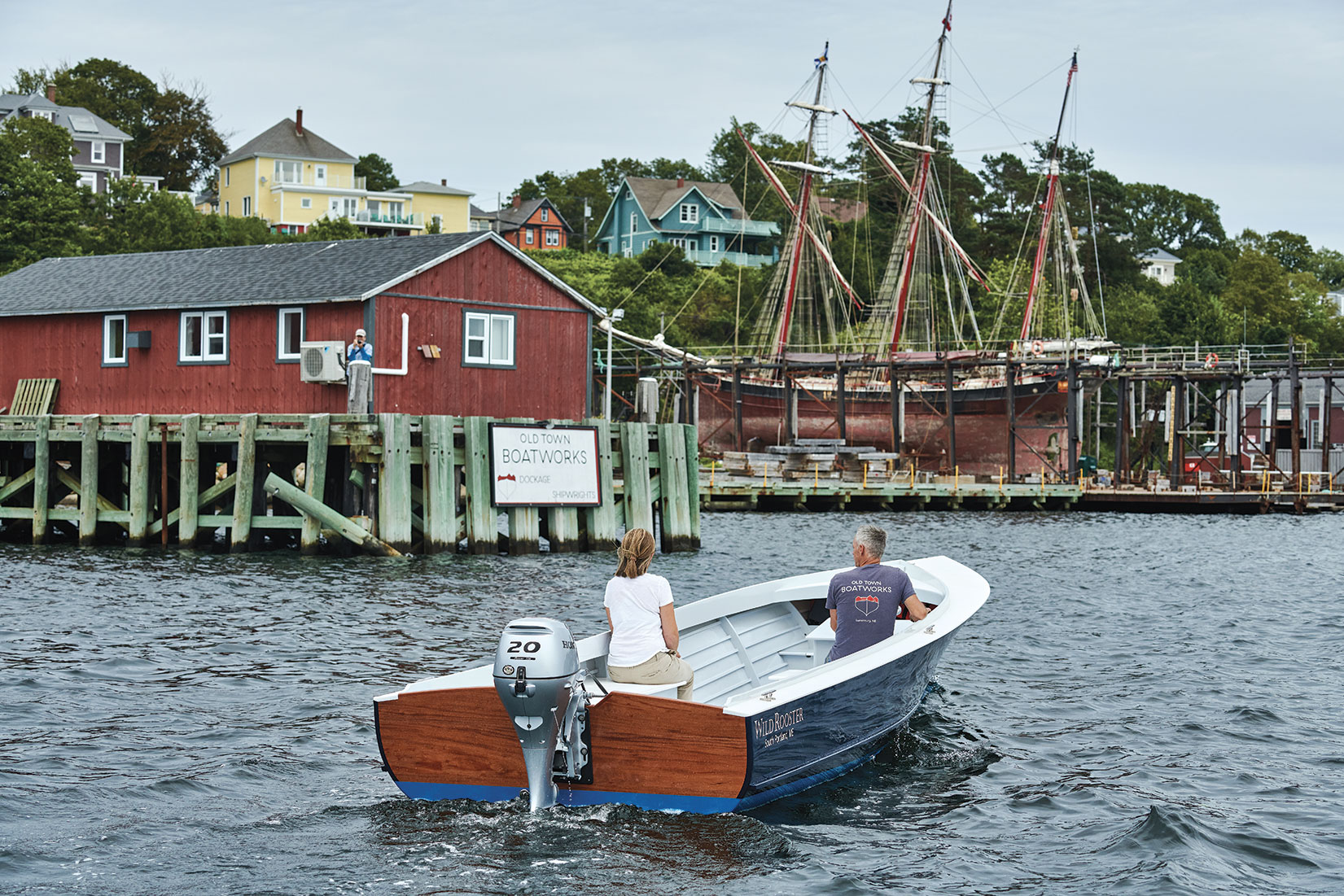
ANKLE DEEP was sea-trialed in Lunenburg, Nova Scotia, in autumn 2023.
The pandemic had ended by launching day, but we couldn’t be there due to a scheduling problem. Emma kept me fully apprised with photos, as did the photographer Chris Reardon. WILD ROOSTER had some propeller ventilation problems, meaning the propeller was too close to the surface and sucking air, resulting in a loss of power. There was no time to remedy this; that would have to be done in Maine, after the boat’s delivery. The problem was caused by a mismeasurement of mine that resulted in a short-shaft engine rather than a long one, and it has now been remedied by some delicate transom surgery by Maine Yacht Center in Portland.
Due to the late-season launching and the surgery to WILD ROOSTER’s transom, I’ve only been out on her twice, but they were two very informative outings. The first was in flat seas in protected waters, with overcast skies and no wind. She was a rocket until the ventilation kicked in when we turned to either port or starboard.
The second time, post–transom surgery, was perfect: We had good friends aboard, it was windy, and we ran between the islands, venturing seaward into unprotected waters for a brief spell. She took the 4′ seas in stride, whether they were coming straight ahead, abeam, or a bit astern. She performed flawlessly.
When I set off on a career as a young journalist more than four decades ago—a career that lasted one article until this one—an old professional, George Putz, advised me: “Whatever you do, don’t fall in love with your subject.” As I write this, WILD ROOSTER is on the hard, looking pent-up but gorgeous under her shrink-wrapping. I can tell she’s storing up energy, raring to get in the water, growing her inner beast. I can’t wait. You can see why I failed as a journalist. 
Carl Cramer was publisher of WoodenBoat and Professional BoatBuilder magazines from 1989 to 2014.
Plans for Uffa Fox’s ANKLE DEEP design are available at UffaFox.com.
Building WILD ROOSTER
Text by Paul Baskett
Construction photographs by Old Town Boatworks
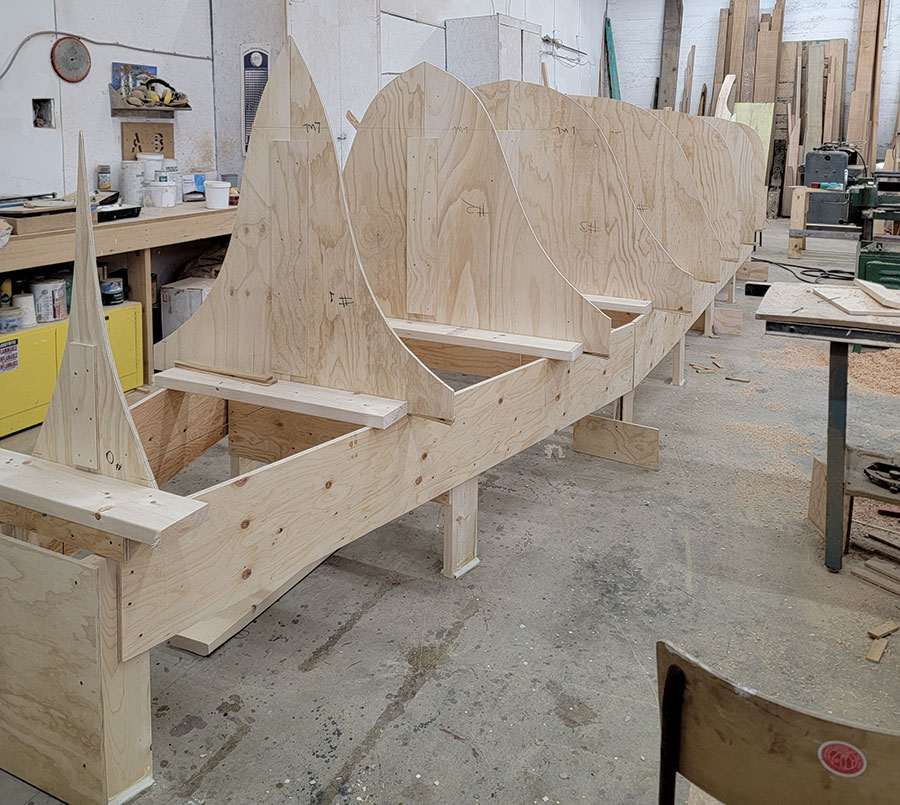
With the lofting complete, the molds were laid out on plywood, cut out, and set up on the strongback. The strongback was built at a sensible height for working on the topsides, which would need the most time during fairing. Except for the transom, all molds were removed after the frames, longitudinal stringers, and planking were completed.
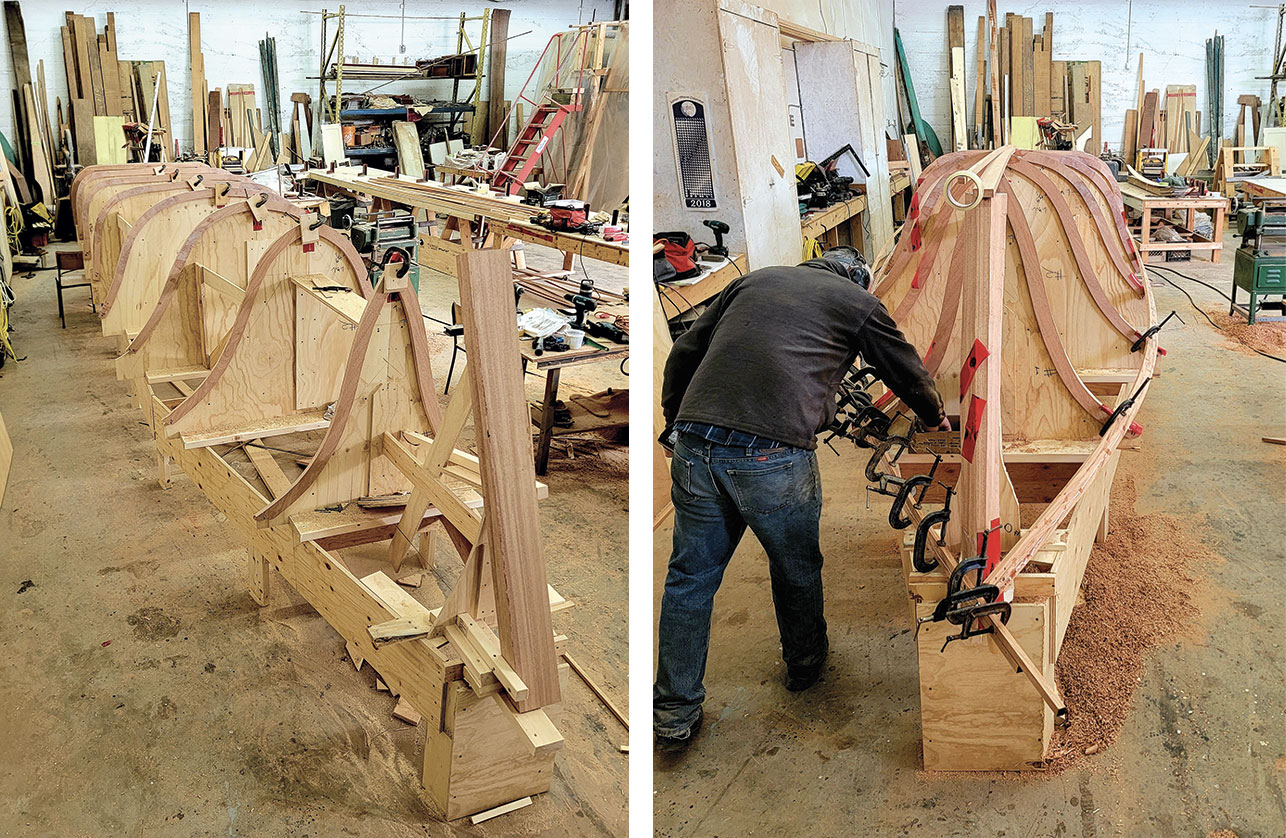
The mahogany frames were attached alongside the outboard edges of the molds and the blank timber for the stem was built into the setup. The stem timber would soon be refined and shaped to receive the planking.
After all the frames were in place, they were notched to receive the sheer clamps, which were laminated in place. When these timbers were dry-fitted, the stem was faired to receive them—and so it started taking shape.
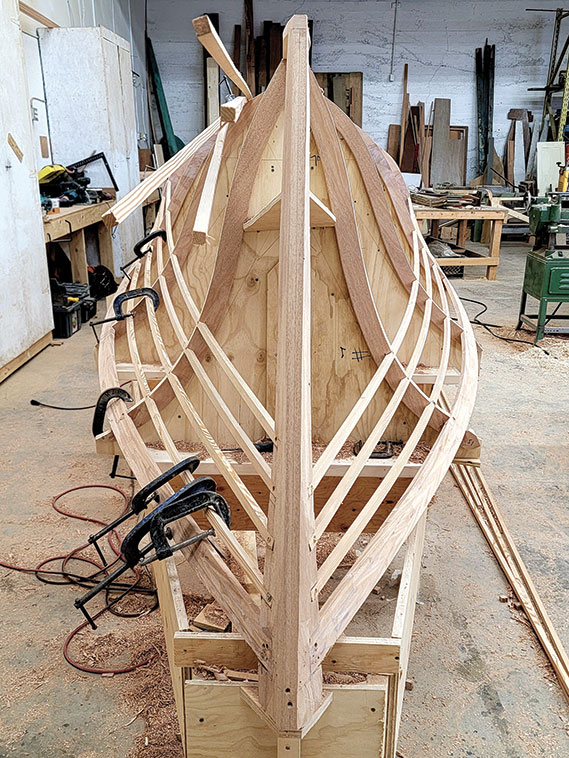
The longitudinal Douglas-fir stringers were notched into each frame, the stem, and transom. The planking was bent around these and glued to them. This construction technique would have been very familiar to Uffa Fox from his work with the Royal Air Force during World War II. The method achieves a tremendously light and stiff structure with minimal materials.
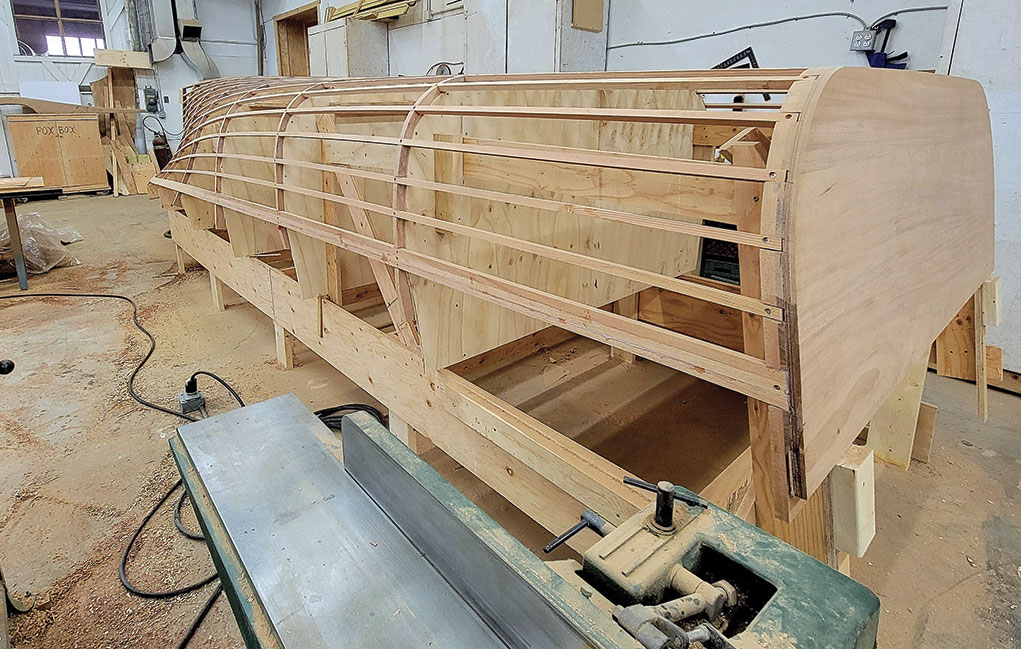
In preparation for planking, the stringers and sheer clamp are all faired into the frames, stem, and transom. The transom was made of a composite of ¹⁄₂″ BS1088 marine plywood in the middle with a ¹⁄₄″ layer of mahogany veneers laminated onto its forward and after faces. This created a strong, stable transom that could deal with the loads of an outboard engine. It also gave us the option of having a varnished transom.
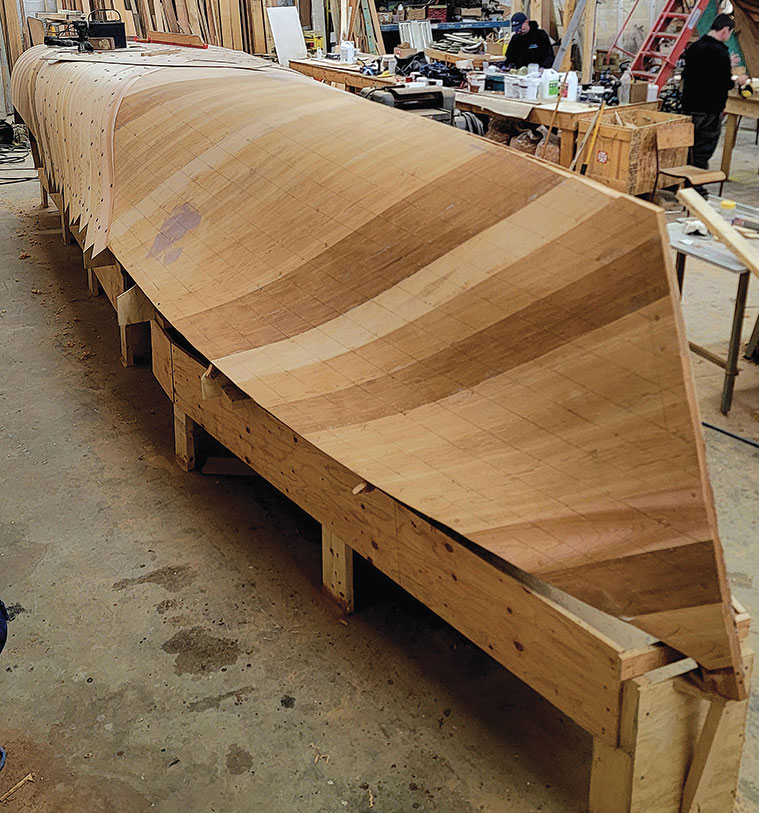
Here we see the second layer of planking well on its way. The first layer of ¹⁄₈″ western red cedar was glued with epoxy to the longitudinal stringers on a 45-degree angle. This layer of planking was faired lightly before the next layer went on. The second layer was laminated to the first with epoxy. Plastic staples held the planks in place while the glue cured. Pencil lines show the stringer locations for staple placement. An errant staple would have easily gone right through the ¹⁄₈″ plank and made a mess.
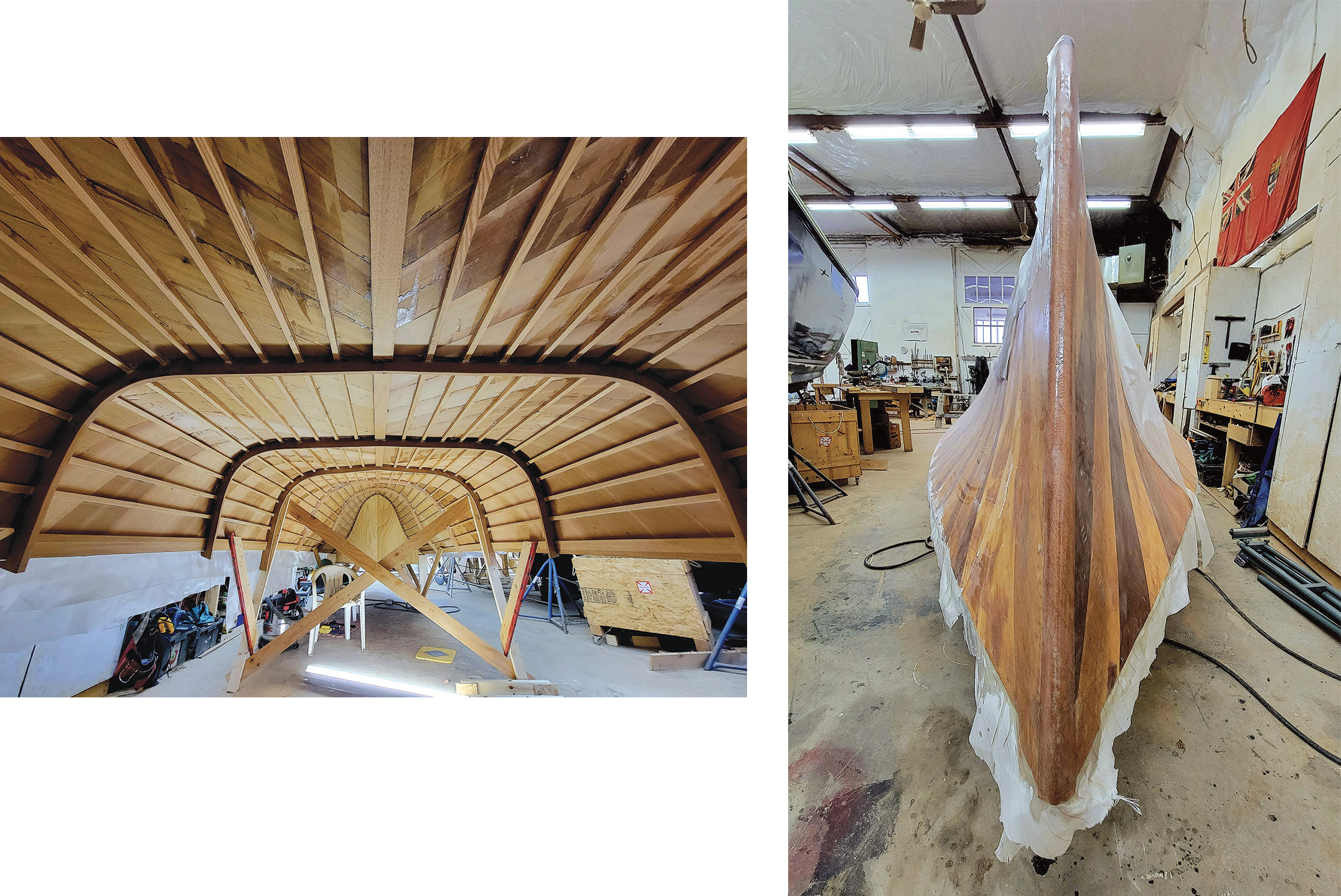
While the second layer of planking was being installed on the outside of the hull, the inside was cleaned up and prepared by the finishers. The height of the strongback allowed easy access for this. Sanding and scraping upside down is tough on the shoulders, but it has the advantage of the dust falling free of the work surface. Note the work light and chair.
After the second layer of planking was lightly faired, one layer of 8-oz fiberglass cloth was set in epoxy over the entire hull. The visible edges of fabric in the photo are the peel-ply that allows us to remove the waxy amine blush from the surface of the epoxy after it has cured so that fairing compounds can be applied directly to the fiberglass without first sanding the surface. The layer of fiberglass protects the cedar planking from wharves and the abrasion of fenders, ropes, and trailers in her future. It also adds structural stiffness to the hull.
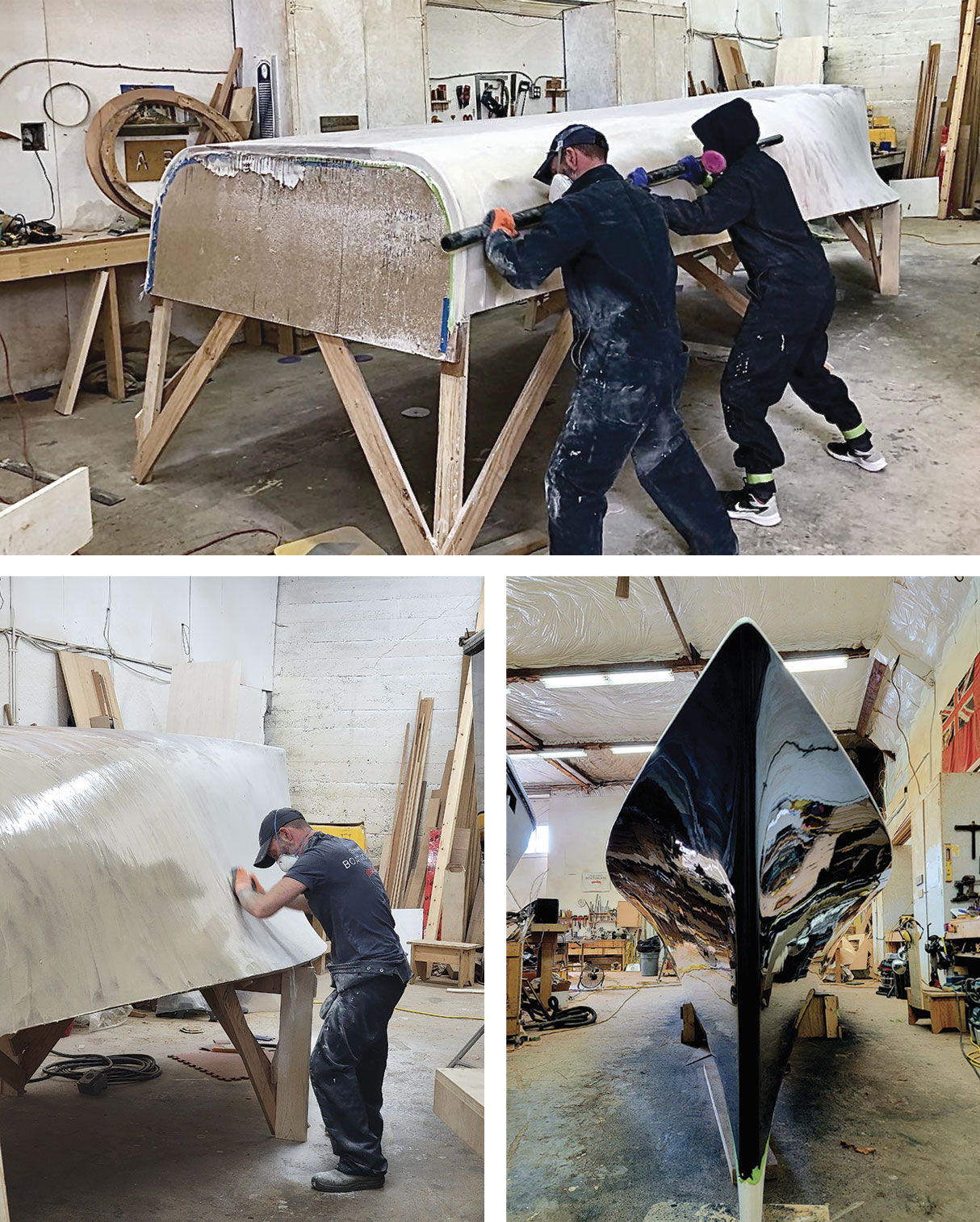
No power sanders were used in fairing the hull’s surface. Here you can see Old Town Boatworks’ finishing team of Trevor and Lauren “torture-boarding.” This cross-hatching method of sanding the hull creates a perfectly smooth and fair surface that is ready to receive paint.
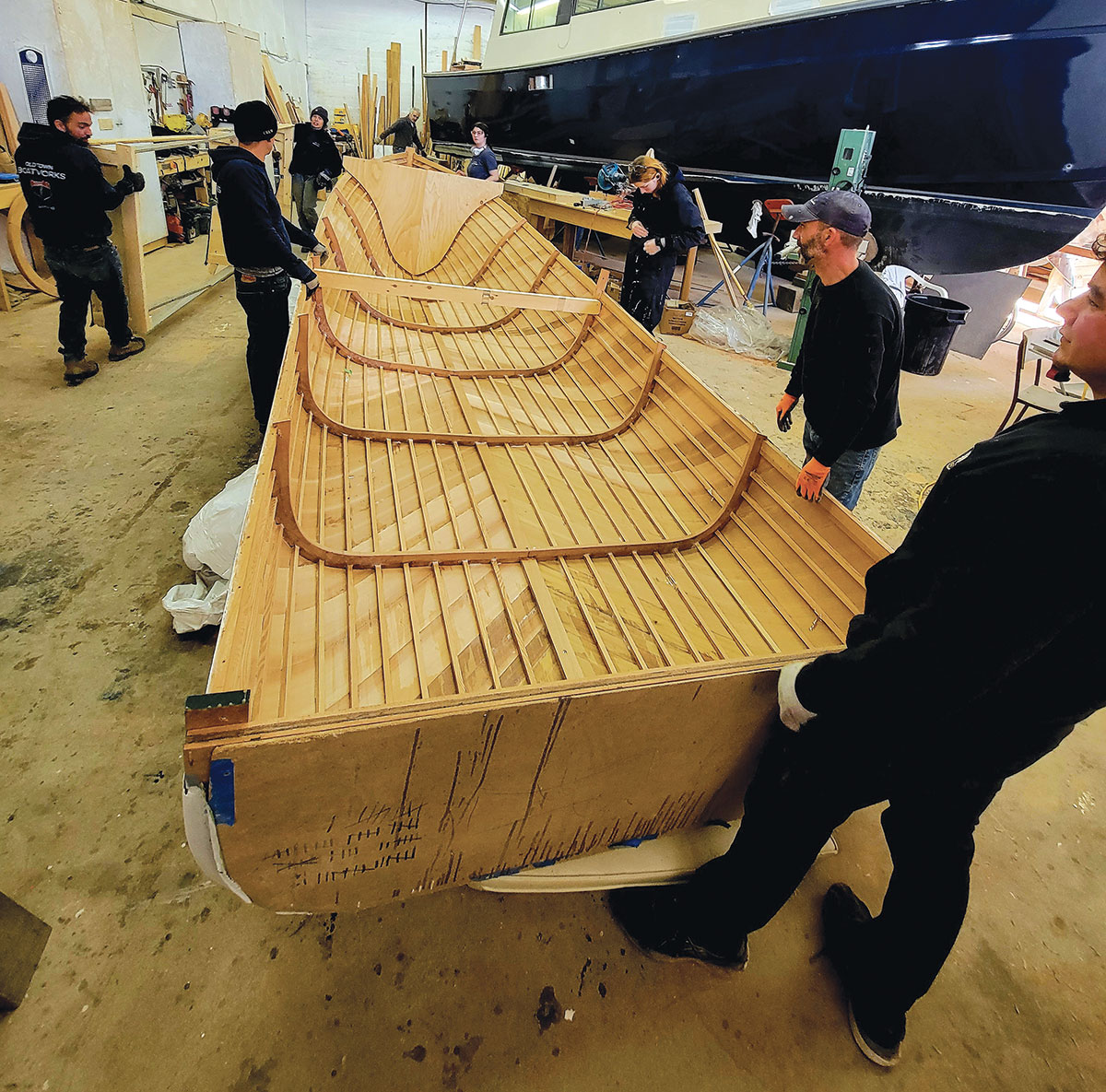
Eight of us easily lifted the boat off its strongback and flipped it right-side up. Uffa Fox also built his ANKLE DEEP upside down (on the ground floor of his house). The interior of Fox’s boat was made up of buoyancy tanks and simple thwarts with a long plank in the middle to ease walking forward and aft. For Carl’s boat, the plan was to build in more specific seating and a foredeck with space for covered storage and buoyancy tanks.
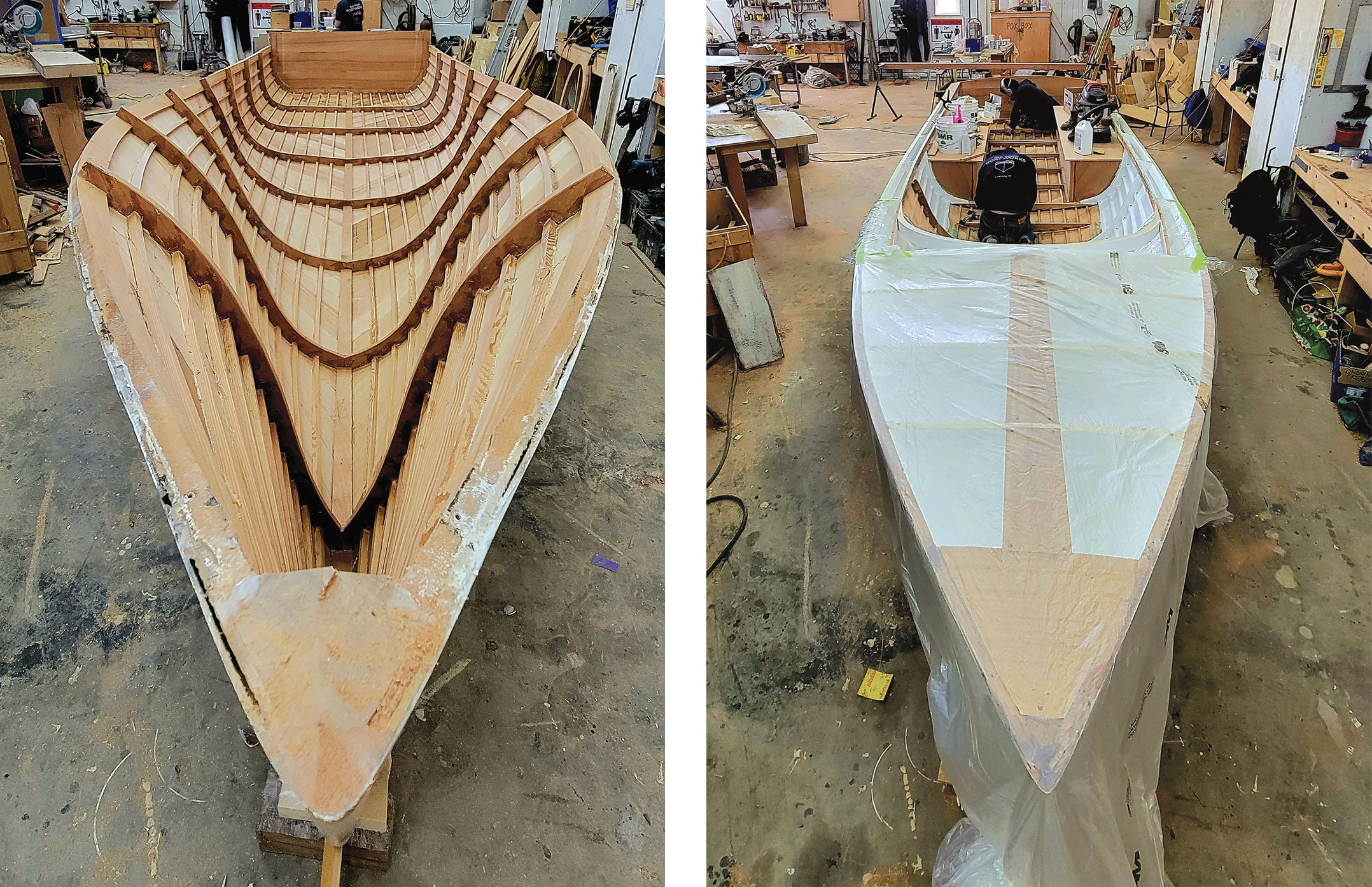
Uffa’s drawn hull shape comes to life with a view from the bow. We began with laying out the forward bulkhead enclosing the buoyancy tank and then did a few mock-ups using thin plywood to see what a foredeck would look like.
Here we can see the buoyancy compartments have been built into each side of the hull, in addition to the forward one. At this point the carlin has also been installed around the entire perimeter of the cockpit. Also visible is the blocking between the gunwale and carlin ready to receive mooring cleats. Forward, the laminated carlin curves over the bulkhead and receives the kingplank for the foredeck’s beams.
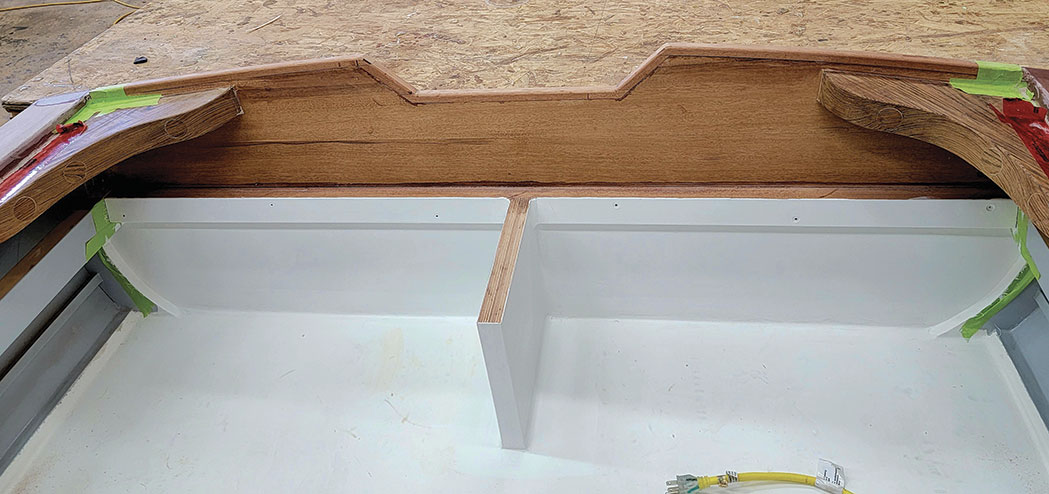
The transom was reinforced with through-bolted quarter knees and a central marine plywood support that tied the sole, transom, and after seat together.
All of this should easily handle the stress of the engine in the water—and when it bounces on the transom when under way on the trailer.
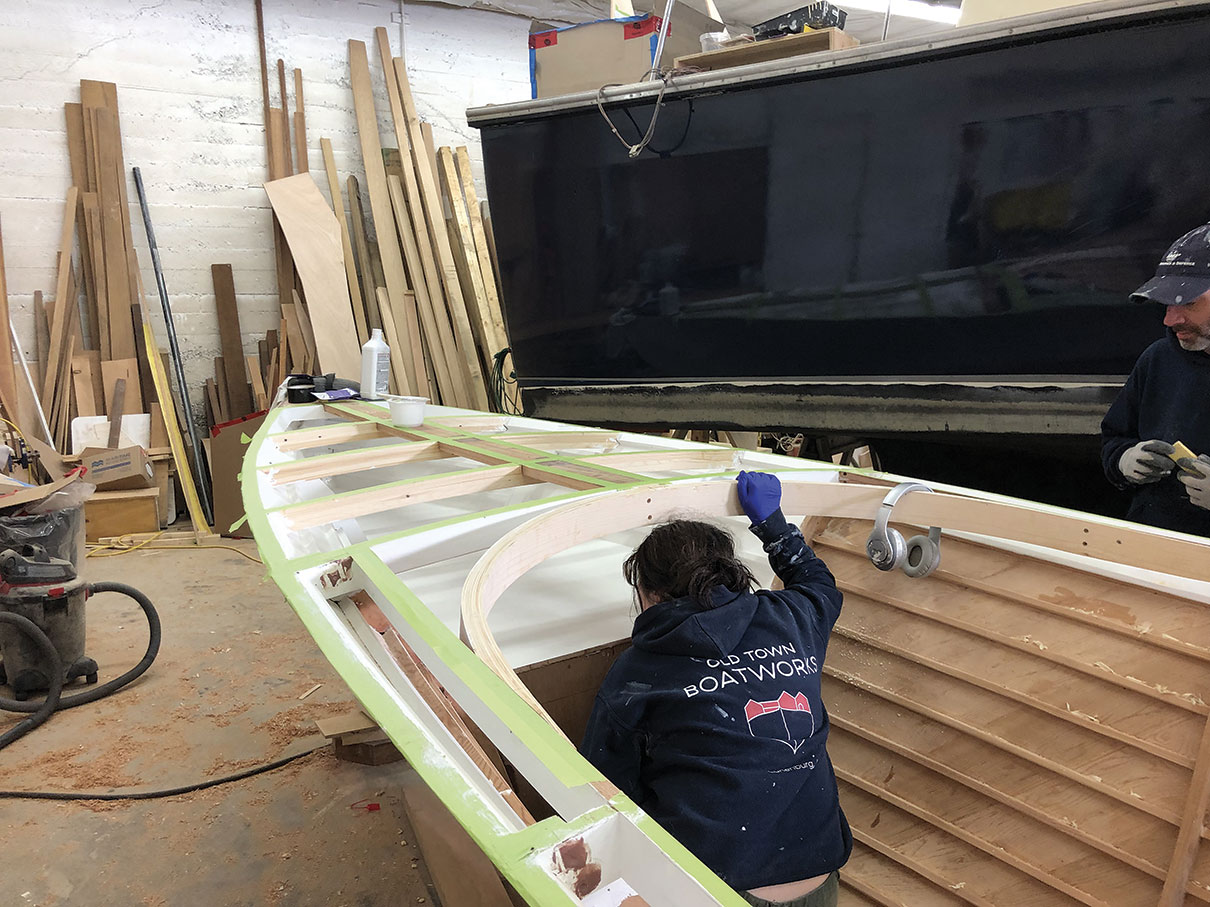
Here is a view of the foredeck and carlin arrangement. Fox’s ANKLE DEEP was an open boat all the way forward. Carl decided a foredeck of some sort would be a good idea. The design process consisted of a quick sketch and an email approval. The forward storage compartment is visible under the curved carlin. A bench seat across the forward end of the cockpit also has storage underneath a hatch with gutter drain.
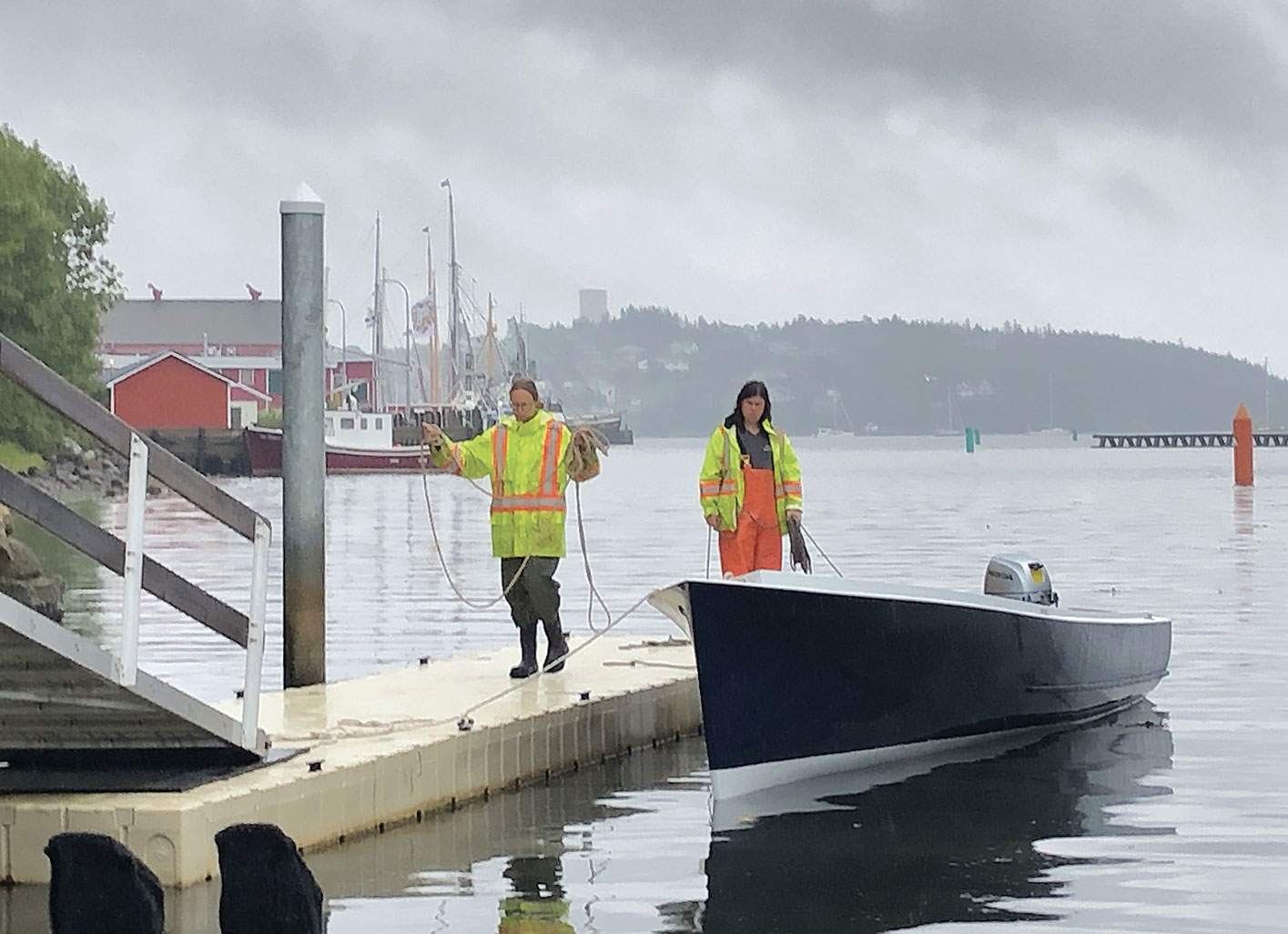
We had no idea whether WILD ROOSTER would sit on the waterline drawn on Uffa Fox’s lines plan or not. With only one outboard and a lighter hull than the original construction, we just popped her in the water and made a few marks with a crayon in the rain as a guide for masking off and painting the final waterline.
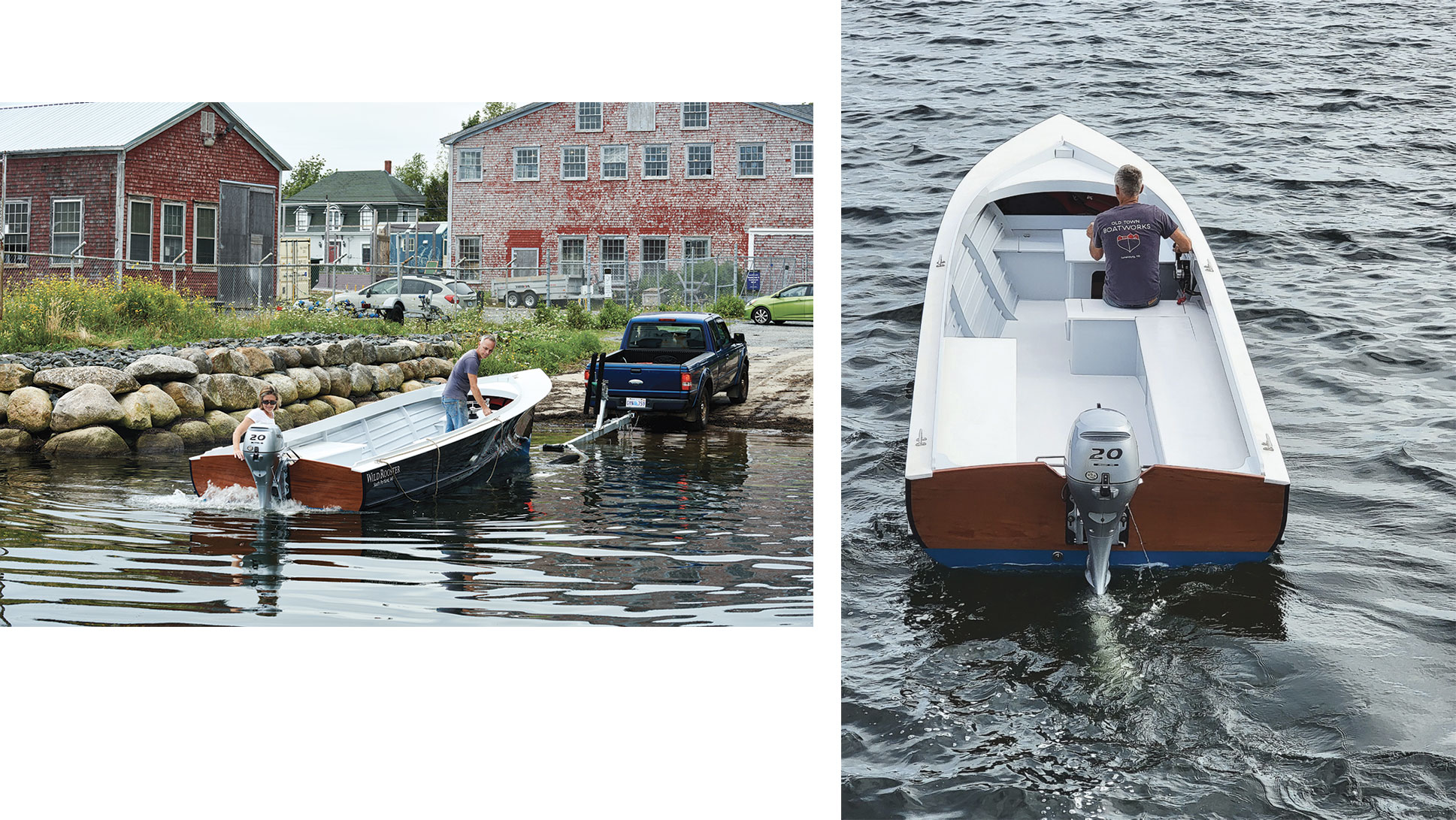 Chris Reardon (both)
WILD ROOSTER launched for sea trials
WILD ROOSTER was launched for sea trials at Lunenburg in the autumn of 2023. There was some tweaking of the layout during construction, but the boat ended up close to the originally agreed-upon concept—the biggest change being to locate the steering station farther forward than planned.
After sea trials, WILD ROOSTER was hauled over the road to her new home in Portland, Maine.