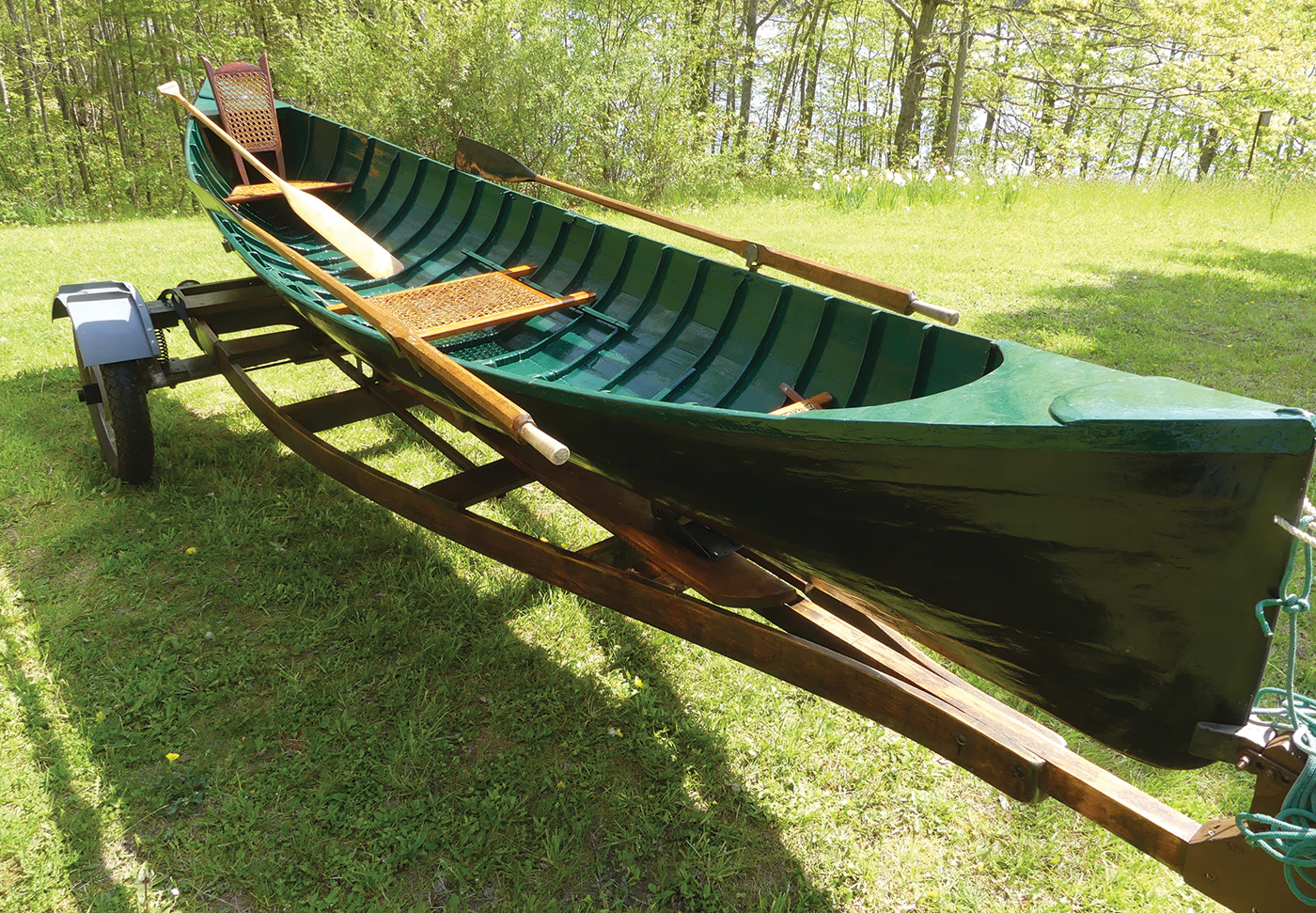
The author's restored Adirondack guideboat.Richard Jagels

The author found and bought a derelict Adirondack guideboat in the early 1970s, then restored it using the fiberglass cloth and polyester resin common at the time. He went on to build the wooden trailer shown here, which he wrote about in WB No. 101.

Half-a-century—how time flies! My column missed WoodenBoat’s launching by four years: My association began in 1977 with a phone conversation with Jacqueline Michaud, who was then the managing editor, in which I proposed writing an article about my recently completed restoration of an Adirondack guideboat. In the course of a long conversation, I mentioned my educational background in wood science and forest pathology. Unknown to me, an article on building an Adirondack guideboat was already in the works and was published in WB No. 18. Tactfully, without discouraging my guideboat proposal, Jacqueline suggested that I might consider writing a column on wood technology and encouraged me to submit a few examples. That suggestion loosed the mooring line and set my sails on a life voyage that continues more than four decades later.

I never wrote that article about my guideboat restoration, but since I still own the boat and recently gave it a fresh coat of paint, I am including a photo. More on its history later.

My second column for WoodenBoat delved into wood modification, a topic that has intrigued researchers for decades. As I noted in that column in WB No. 21, a boatbuilder’s dream might be to create chemically modified wood that would be “dimensionally stable, rot-resistant, fire-resistant, need little upkeep, resist weathering, and still retain all the qualities so endearing to a wooden boat.” We are still struggling to meet any of those goals. Part of the problem is that the chemicals that have been tested—among them anhydrides, isocyanates, acid chlorides, and alkyl chlorides—are all expensive and can lead to negative properties such as increased weight, reduced strength, corrosion of metal fastenings, and production of toxic waste during manufacture.

In many ways, wood is already such an ideal boatbuilding material that chemically tinkering with it often creates more problems than it solves. Due to its porous structure and oriented tensile strands, wood is stronger on a weight basis than almost any other construction material. Yes, it can be degraded by bacteria and fungi, but if that didn’t happen, the world’s forest floor would quickly fill with debris and eventually smother the planet.

Nevertheless, it is wood rot that plagues wooden boats more than any other deficiency. This has led to a different approach among wood researchers: Find a way to prevent wood decay without changing the positive attributes that wood provides and do so in a way that does not introduce chemicals toxic to humans, or, if leached into waters, does not foul those waters or harm the organisms living in them.

In general, the trend has been to move away from oil-borne preservatives such as creosote, pentachlorophenol, and copper naphthenate and toward waterborne preservatives. The key impediment in this approach is the solvent. Water that can carry fungi-toxic chemicals into wood can also leach it back out, especially when the object being treated has water as its natural home. Copper, at high enough doses, will thwart decay fungi, molds, bacteria, and algae. If combined chemically with other compounds in a treatment process involving pressure and often heat, the new compound will be water-insolvent and fixed within the wood structure. Compounds combining chromium, copper, and arsenic (CCA); ammoniacal-copper arsenate (ACA); copper-zinc arsenate (ACZA); ammoniacal-copper citrate (ACC); copper azole (CA); and alkaline copper quat (ACQ) are some of the treatments used. However, pressure-treatment requires sophisticated equipment, and only some woods will allow sufficient penetration. Many boatbuilding woods are poor contenders for pressure-treatment. Softwoods, especially rapid-growth southern pines, are the most amenable to the technique. If you can make use of this wood, I would recommend either CA or ACQ treatment, because these are more environmentally benign than the others and both are registered for freshwater or marine use. Stainless-steel fastenings are recommended, but the life of fastenings is shorter than with untreated wood.

Nanotechnology

In recent years, nanotechnology has entered the wood-preservation arena with micronized copper in the form of basic copper carbonate, CuCO3Cu(OH)2. Testing has revealed that performance effectiveness is similar to, or superior to, the older, ionic copper formulations and has lower cost and higher resistance to leaching and corrosion of stainless-steel or hot-dipped galvanized fastenings. Micronized CA and ACA and nanoparticle formulations of copper oxide and zinc oxide are now beginning to appear on the market. These wood products, however, are harmful to the environment upon disposal.

Borates

The use of boron, generally in the form of borax (disodium octa borate tetrahydrate), has a long history as a wood preservative that is effective against fungi and termites. (See my column in WB No. 16 for more details.) On the plus side, while borates have high toxicity against fungi and termites, they have low toxicity for mammals—including us. In aqueous solutions, they have high mobility by simple diffusion methods and therefore can be used to treat wood species that are classified as hard to treat—including many woods used by boatbuilders. Unfortunately, high aqueous mobility comes at a cost: it is highly leachable in wet situations.

In the past few decades, this more environmentally benign preservative has received attention, especially in regard to developing borate products more resistant to leaching. A patent was submitted in 2005 for a leach-resistant borate that could be used to treat wood exposed to ground contact. I have not seen this or other leach-resistant borates on the market yet, but I am hopeful.

Boron also can be found in other natural mineral conformations besides borax. Ulexite and colemanite are two forms that are abundant in nature. Recently, colemanite has been tested against termites in plywood manufacture in India. Unlike borax, it has low water solubility but bonds strongly with wood. When mixed with phenol-formaldehyde resin while bonding wood plies, the resulting plywood was very resistant to attack by powder-post beetles and termites. Tests against fungi were not performed, but toxicity is likely. A popular boatbuilding plywood is one made using the African wood okoume (Aucoumea klaineana). Okoume is not resistant to attack by fungi, but if colemanite were to be added to the plywood bonding resin, we might have an ideal rot-resistant boat construction
plywood.

Borax Now

While several lines of research suggest that we may see a time when leach-resistant borates will be available for wood preservation, we shouldn’t dismiss leachable borates from our arsenal against wood decay in boats. For above-waterline applications, where varnish or paint serves as a water repellent, a pre-soak in borates can offer useful protection. I should mention, also, that borates are much less corrosive to metal fastenings than copper-based preservatives.

In my opinion, another great use for borates is in plank-on-frame construction where fiberglass sheathing, set in epoxy, is applied to the exterior of the hull. Sealing the interior of a framed hull is generally not feasible, yet water accumulation often occurs. Soaking the bilges of large boats or the bottom few inches of open small craft with a borate solution for several days to a week will allow for deep borax penetration. Future wetting will drive the borax even deeper. If wetting of wood is not practical, glycol-based borates are an alternative (see WB No. 149).

I rescued my Adirondack guideboat from a Vermont lawn in the early 1970s. It was a derelict, with a price tag of $25—but the boat was in such horrible shape I wasn’t certain who should pay and who should receive the cash.

The bottom board was rotten, and the half ribs, where they crossed and were attached to the bottom, had incipient decay. I am quite sure the boat sat upright at a dock or for long periods was pulled up on shore, where it was drenched with rain showers. After removing the bottom board, I wrapped the crossed ribs with hemp twine and soaked them with polyester resin. (This was when the Gougeon brothers were just entering the epoxy market.) After replacing the bottom board, I applied fiberglass and polyester resin on the hull exterior.

If I had known about borates, I would have soaked the interior with borax before drying and painting. Over many years, I used the boat not only in the bayous of Louisiana, where the locals called it a pirogue, but also in Adirondack lakes and Vermont ponds. I never left it outside except on camping excursions, so it is still a structurally sound, swift rowing craft. Not bad for a boat crafted about 120 years ago—more than twice the age of this journal.  Article ends.

Dr. Richard Jagels is an emeritus professor of forest biology at the University of Maine, Orono. His Wood Technology column, which debuted in WB No. 20 in January/February 1978, is by far the longest-running department in WoodenBoat, which marked its 50th anniversary of publication with WB No. 300. Please send correspondence to Dr. Jagels by mail to the care of WoodenBoat, or via email to Senior Editor Tom Jackson, tom@woodenboat.com.