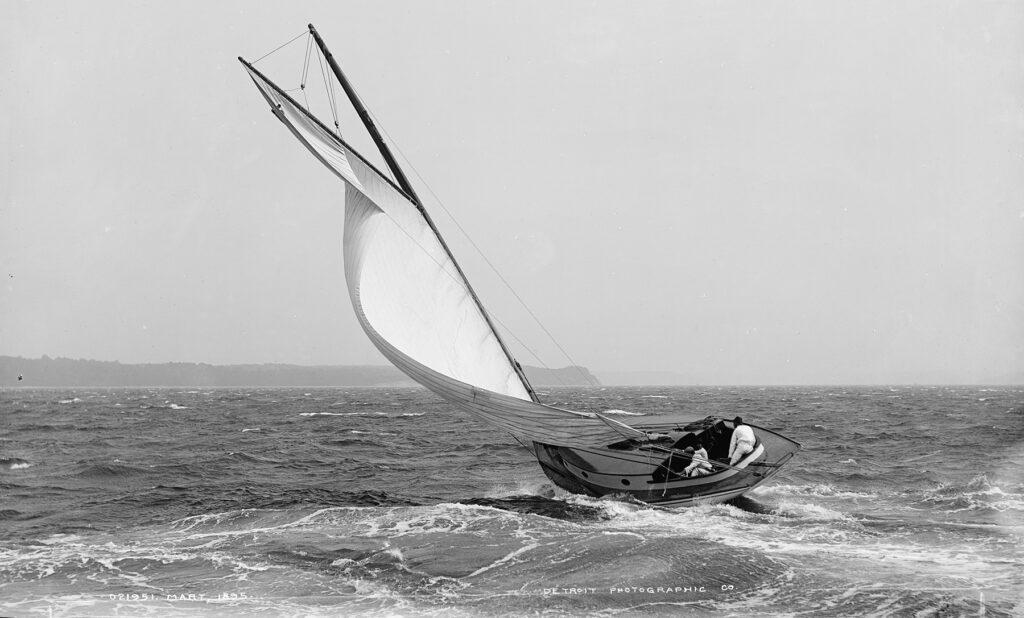
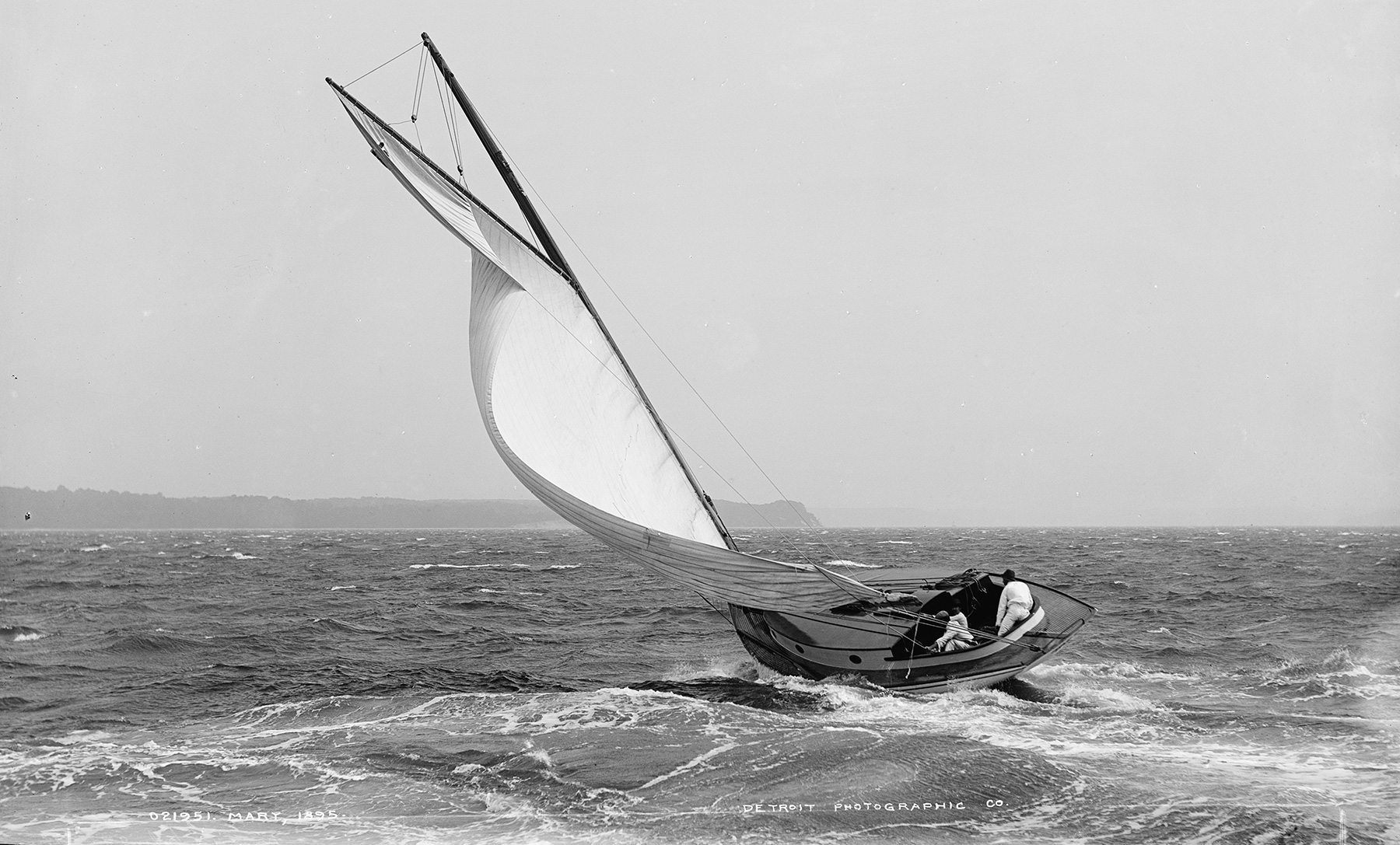
Big catboat MARY.
MARY

Johnston captured several amazing photographs of the big catboat MARY in heavy weather. The yacht’s sail is both reefed and scandalized, her heavy boom supported by the topping lift, a vital piece of rigging on a catboat. Enlarging the photo shows MARY’s sail attaches to the mast using a track rather than mast hoops, and she has elegant laid decks. The boat, which looks to be about 28′ long, was designed by Philip R. “Phip” Elsworth of Bayonne, New Jersey, and built in 1893 at Mariner’s Harbor, Staten Island, by L.N. Tonn.


In 1845, at the United States Military Academy at West Point, New York, a memorial was unveiled commemorating the loss, a decade earlier in Florida, of Major Francis Dade and some 100 soldiers during the second Seminole War. Although the memorial was later moved, it originally overlooked the Hudson River. That is where the photographer John S. Johnston found it sometime around 1890.

After positioning his 8″×10″ view camera on its tripod, Johnston framed the monument with trees and the far-shore hills. Then he waited until just the right moment and, when a Hudson River schooner sailed into what he judged to be the perfect spot, he clicked the shutter. The result was typical of Johnston’s work: a beautifully composed image with an object in motion but rendered clearly.

Photographs of monuments, buildings, bridges, and scenery in New York, Boston, Québec, and Puerto Rico were among Johnston’s best-known subjects. However, during a comparatively brief, roughly 14-year career, he also found a market for images of ocean liners, naval vessels, and boating subjects ranging from yacht clubs to dories and catboats, from steam yachts and racing yachts of many classes to AMERICA’s Cup contestants.

While Nathaniel L. Stebbins, Henry G. Peabody, and Willard B. Jackson were photographing the New England yachting scene, Johnston’s home waters were Long Island Sound and New York Harbor. He captured a fascinating variety of yachts and small craft not necessarily familiar to his celebrated Massachusetts contemporaries. Johnston also had a knack for both people-oriented pictures and, most impressively, “action shots” that were comparatively unusual in the 19th century.

Topsail schooner LOYAL.
LOYAL

On July 29, 1893, Johnston found the new topsail schooner LOYAL ashore near the Indian Harbor Yacht Club at Greenwich, Connecticut. Designed by Henry J. Gielow of New York City, the schooner was built in Brooklyn by C. & R. Poillon for Commodore Benjamin F. Sutton of the Atlantic and Brooklyn yacht clubs. Little damage was done by LOYAL’s grounding. LOYAL won several trophies before Sutton sold her in 1895 to banker Nathaniel C. Nash of Boston, who was then commodore of the Corinthian Yacht Club in Marblehead. LOYAL measured 79′×19′×7′5″.


Any photographer who’s used an 8″×10″ view camera can only wonder how Johnston got some of his images. Focusing on a view camera’s ground-glass lens while shrouded beneath a dark cloth is a quite deliberate process. The lens was fixed, not zoom, and the dry-glass-plate emulsions of Johnston’s day were a fraction of the speed of modern sheet film. Yet Johnston captured such images as a woman diving off a pier; crowded street and beach scenes with people in motion but not blurred; and, sometimes, yachts in rough weather.

Johnston found both commercial and editorial markets for his work. Some of his yacht photos appeared in Forest and Stream, which was publishing photographs using the half-tone process by 1897, several years before most newspapers. Johnston’s Forest and Stream pictures carried his byline. He also was careful to copyright his work. More important, Johnston had an apparently productive working relationship with the Detroit Publishing Co., which was founded in 1895. Detroit published popular colorized scenic postcards (including Johnston’s image of the Dade monument), and prints.

There is little biographical information about Johnston, a situation created by the man himself. His necessarily brief obituary in The New York Times carried the headline: “Dies Trying to Hide Identity.” He was born, perhaps around 1850, in England. A few weeks after Johnston’s death, the January 6, 1900, issue of Forest and Stream reported that “the yacht photographer was one of the old-time disciples of MacGregor [John MacGregor, famous for his Rob Roy canoe/kayak adventures and a book published in 1866]; taking up canoeing as a boy in England when the sport was still a novelty.”

“Half-Rater” ETGELWYNN.
ETHELWYNN

This extraordinary action shot shows electrical engineer Cornelius J. Field and his attorney brother Fred aboard ETHELWYNN. Designed by yachting writer William Piccard Stephens, ETHELWYNN was a “Half-Rater,” a British class corresponding to the 15′ waterline Seawanhaka Rule in the United States. Many, including Thomas Fleming Day of The Rudder, were dubious of ETHELWYNN’s then-revolutionary marconi rig, but she became the first yacht so rigged to win an international trophy. She defeated the gaff-rigged British SPRUCE to capture the Seawanhaka International Challenge Cup for Small Yachts in 1895. ETHELWYNN was built in Ogdensburg, New York, by the Spalding St. Lawrence Boat Co.—“Builders of High-Grade Pleasure and Racing Boats.”


How Johnston learned photography is currently unknown, as is the year he arrived in the United States. However, he was taking pictures here by 1885–86. He appeared in the New York City Directory as a photographer by 1887–88, his address changing several times over the next decade. He lived and worked primarily on the West Side but later had a studio on Broadway.

At some point, Johnston married; however, the Times’s obituary reported that the photographer “lived alone [and] had a grown daughter, but had been separated from his family.” He became ill while photographing the 1899 AMERICA’s Cup. Perhaps recalling the time when he’d photographed Niagara Falls, he went there to recover. Instead, he succumbed to heart failure, refusing to tell his caregivers his home address or the names of friends. Johnston died among strangers on December 17, 1899.

He is proof, perhaps, that an artist in any discipline is defined not by details of his or her life but by their work. Johnston left behind instructive photographs that speak to us of his now-distant era, his great talent, and his desire to beautifully portray subjects he clearly loved.

After the closure of the Detroit Publishing Co. in 1924, Johnston’s glass-plate negatives were among the 25,000 that survived several subsequent ownership changes. Today, some of the photographs may be viewed online at the Library of Congress, New York University, the New York Historical Society, and other sites. Search “John S. Johnston photographs.”

DEFENDER, victorious in the 1895 AMERICA’s Cup.
DEFENDER

Johnston photographed Nathanael Herreshoff at the moment he clambered aboard DEFENDER, victorious in the 1895 AMERICA’s Cup. Plated with Tobin bronze below the waterline and aluminum above, the yacht lived up to Herreshoff’s expectations for electrolysis. She was scrapped in 1899. DEFENDER’s revolutionary, cross-cut sails proved superior on the world’s biggest stage. In a 1935 letter to his son L. Francis, Herreshoff wrote: “This I consider to be one of the most important [achievements] and revolutionized sail making the world over.”


EL CHICO, The fIrst of Nathanael Herreshoff’s fin-keel designs
EL CHICO

The first of Nathanael Herreshoff’s fin-keel designs, EL CHICO (38′ LOA × 25′ LWL × 7′ beam × 6′ draft), created a sensation upon her appearance in 1893. “She has sailed passages of 60–70 miles single-handed and is altogether the most perfect little boat imaginable,” said her owner, H. Maitland Kersey. A wealthy Englishman, Kersey was the general agent in New York for the White Star Steamship Line. EL CHICO was comfortable enough for Kersey’s “man” to live aboard “although he had the choice of a bed ashore.”


A one-design dory class.
START OF DORIES

On September 25, 1897, The Greenwich Graphic reported that the Indian Harbor Yacht Club would follow the Riverside Yacht Club and adopt a one-design dory class. The centerboard boats were 17′ overall, 13′ on the bottom, and rigged with a leg-o’-mutton mainsail and a small jib. These dories—built in Swampscott, Massachusetts, by E. Gerry Emmons—were very popular (the flag officers of the Indian Harbor Yacht Club each bought one) and other local clubs adopted them, too. Johnston captured the start of this race at the IHYC during the 1898 season.


The centerboard schooner GRAYLING.
GRAYLING

On May 15, 1883, the banker and New York Yacht Club member Latham Avery Fish took his brand-new centerboard schooner for a tryout in New York Harbor. The 91′ GRAYLING seemed to justify all of Fish’s hopes until a fierce squall struck. Before sail could be reduced, GRAYLING capsized and sank, though with no loss of life. Yachting writer Charles Kunhardt, an outspoken critic of shallow-draft centerboarders, had called GRAYLING a “death trap” even as she was being built. Fish, however, promptly had his schooner raised and went on to win numerous races, including the important Golet Cup in 1884 and 1886. In 1887, however, Fish consulted with the yacht designer Edward Burgess on modifications to GRAYLING, which were carried out at George Lawley & Son in Boston. Her overall length was increased to 98′, including a 6′ overhang aft. A 15-ton lead keel increased her draft from 5′9″ to 8′6″. Her lower masts were cut down, by 10′ for the mainmast and 11′ for the mizzen, and an enormous bowsprit was added. GRAYLING had all of these changes by the time Johnston made this image on August 1, 1890.


PRESTO was one of several racing catboats.
PRESTO

PRESTO was one of several racing catboats commissioned by yachtsman Frank M. Randall, a Crosby catboat enthusiast and patron of the short-lived (1896–99) Crosby Catboat and Yacht Building Co. of Bay Ridge in Brooklyn. With overhangs at bow and stern that made them much longer than their waterlines (22′ in PRESTO’s case) these race-oriented boats were considered “freaks.” PRESTO’s tall mast is supported by shrouds and has height enough for a sail of perhaps 900 sq ft. PRESTO was launched in 1896. She suffered a broken tiller in a windy Larchmont Race Week, but also won her share of races; on June 6, 1896, in an Atlantic Yacht Club regatta, she received the equivalent of over $1,100 for her Class 2 victory. Johnston captured her reefed, cresting a swell, and showing her forward overhang on July 4, 1896.


The lapstrake, skimming-dish-style catboat PHYLLIS.
PHYLLIS

Johnston captured the lapstrake, skimming-dish-style catboat PHYLLIS and her seven-man crew, victorious in a July 12, 1890, race of the Riverside (Connecticut) Yacht Club. PHYLLIS has the enormous centerboard and rudder style that would have been familiar to sandbagger crews of the 1870s.


COLUMBIA's port spreader broke, bringing down her steel mast during AMERICA’s Cup trial races.
COLUMBIA

During AMERICA’s Cup trial races against DEFENDER off Point Judith, Rhode Island, on August 2, 1899, COLUMBIA’s port spreader broke, bringing down her steel mast. Fortunately, nobody was hurt. With a new mast, COLUMBIA beat DEFENDER for the Astor Cup on August 22 and, in September, defeated British challenger SHAMROCK to retain the Cup.


MAYFLOWER of the Eastern Yacht Club.
MAYFLOWER

Dubbed “the Boston bean boat” by rivals and detractors at the New York Yacht Club, the Edward Burgess–designed MAYFLOWER of the Eastern Yacht Club defeated all her rivals to emerge victorious in the 1886 defense of the AMERICA’s Cup. Here, Johnston has called for MAYFLOWER’s crew to pose before her launching in 1886 at George Lawley & Son in South Boston.  Article ends.


Stan Grayson is a regular contributor to WoodenBoat. He sends thanks to Nancy Lundy, Christopher Hofman, and Robert Solomon of the Indian Harbor Yacht Club.