Night falls.

By and large, we’re diurnal critters. Sunlight illuminates our environment.

As you get started in boats, most of your adventures will be day excursions. But life on the water can’t run on a timetable. Wind, tide, weather, and mechanics mesh inconsistently, and you’ll be night-running soon enough. With time and experience, cruising into the night will delight you more and more with an almost magical beauty. You’ll discover that you can adapt nocturnally using low technology to mime night-creature senses.

We can’t avoid dispelling the dark, however. Seeing visual marks of safety is a necessity. We need to see where we’re going, and we need to be seen. Your boat isn’t the only half-blind voyager on the water, so be sure to light up!

Land Time vs. Sea Time

Even though boating with friends is a prime joy, a prudent skipper will warn his crew and guests against the demands of land time. On a boat and under way, rigid schedules are invalid; old Poseidon keeps his own haphazard clock ticking and tocking unevenly as the sun and moon and wind gyres compete. The linear ratchet of meetings and dinners ashore is chancy. If one of your mates has a 4 p.m. shore appointment, strongly suggest that a boating adventure may be inadvisable. There are no timetable promises afloat.

Night Vision

If you could persuade your cat to talk, it might be an excellent mate for the night watches. Cats see well in dim light, even starlight. They possess six to eight times more dim-light receptors than you and have a special re-reflecting layer, the tapetum, that increases light capture. But don’t give cats too much credit; your eyes are more focused and more discerning than theirs.

Rods and Cones.

The sun puts out a full range of light at different wavelengths. We adapted over billions of years to utilize only a fraction of these wavelengths, and we’re blind to the rest. What we call “visible light” has wavelengths about the size of our eyes’ two receptor types, the rods and cones. Both are sensitive in different ways. Cones differentiate light by intensity and wavelength, allowing us to see in colors. Rods are more sensitive, but only to intensity; in dim light, we see in shades of gray, and a lack of rods around the center of our vision register as a central blind spot. In fact, because of this blind spot, sailors familiar with the graveyard watch learn to look not at a place or object but to one side for a more detailed view.

A remarkable thing about rods is that they improve in the dark. Your peak night vision develops over 15 to 45 minutes. The “reset” button is any glare of “white” light; a foolish shipmate turning on a flashlight or “white” cabin light will set your night vision calibration back to square one. You can’t underestimate hazards in the night watches. You need every advantage, so educate the whole crew on the importance of light discipline.

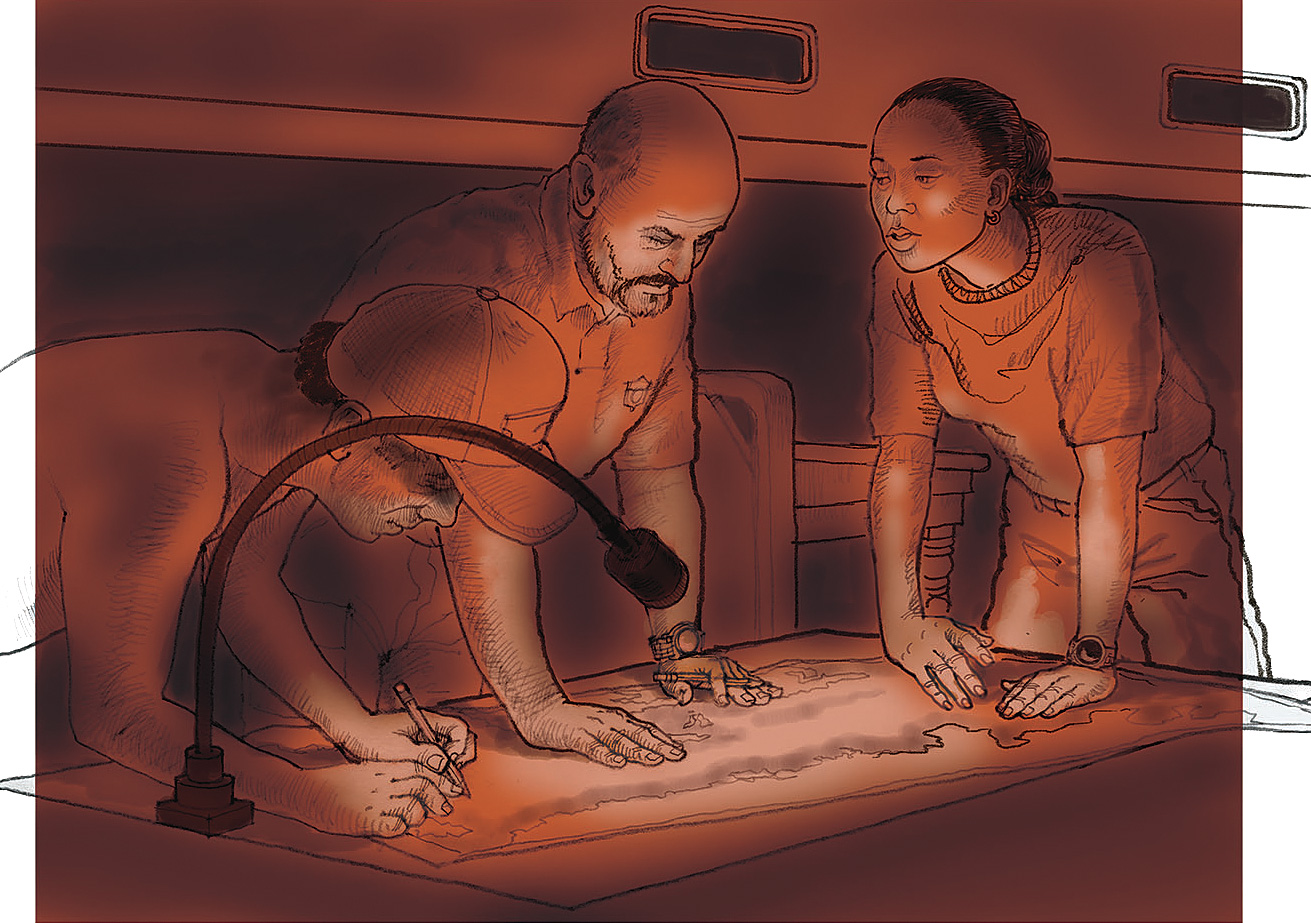
Rods and cones are sufficiently different to allow a useful deception. Rods are blind to visible light in the red wavelengths. Without compromising night vision, you can use a (dim) red light to examine charts, check the engine, read, and make coffee. Rods are most sensitive to blue-green light, so beware of electronics with green lighting, which will kill night vision. And beware of the full-color displays of a chart plotter. Submarine crews switch to red interior light before surfacing at night so it won’t take 45 minutes of adaptation to see danger from the conning tower.

See and Be Seen

Running lights and anchor lights.

Running Lights and Anchor Lights

Running lights and anchor lights.

Every boat venturing on the water near or after dark is required to carry lights to proclaim its presence and its course. Large boats require specific light combinations, but even a kayak out for a night paddle or a rowboat out for a row must present itself with a white all-around light, or a simple flashlight. We’ve emphasized in other Getting Started booklets that the light signals of commercial craft—fishing vessels, tugs, ferries, barges, tankers, and others—are distinctly lit to warn you away from danger. A comprehensive chart of commercial lights should be part of your cockpit gear. The simple chart shown here details required lighting for a few example boats, ranging from a kayak to a bluewater passagemaker, under way and at anchor. For an exhaustive list of regulations pertaining to navigation lights required on your boat, please refer to the International Regulations for Preventing Collisions at Sea 1972 (Colregs) or Parts C and D or this resource from the United States Coast Guard: www.navcen.uscg.gov/pdf/navrules/navrules.pdf.

See and Be Seen

See and be seen.


Kayaking at night.

When kayaking at night, you could voyage with just a flashlight at the ready. The paddler illustrated has gone above and beyond to stay safe on the water. Right—This catboat does not have a permanently installed masthead light, but has sufficiently followed the regulations with an all-round, battery-powered LED installed on a pig stick.

Searchlights

You round a mark and lay a new course, trending toward green can No. 5 (G5), which has no beacon light, almost half a nautical mile away. The chart suggests that wandering off course would be a rocky hazard. Seeing G5 is critical. You want a strong light with a tightly focused beam—not a task light, but a tool for piercing the dark. You’re in luck on two counts: (1) the current generation of searchlights is powerful and prices have come down; and (2) a bit of industrial magic is on your side.

Choosing a searchlight is not simple, and we can only suggest a few considerations. Do you want your searchlight to be battery-powered, rechargeable, or plugged into the boat’s power? Do you want a searchlight that floats? How sturdy should it be? What level of dollar investment can you make? How precise and efficient is the light’s reflector in focusing the beam?

We can relieve you of one decision: LED versus incandescent bulbs. Incandescent light bulbs, the Edison type with which we’re most familiar, create light by heating a thin, delicate filament to white heat. Most of an incandescent’s energy is consumed in heat production. The LED is a “cold” light, a product of quantum physics, requiring much less power for light, wasting very little in heat production. It has the additional advantage of being “solid state”: there’s no thin wire filament to break. LEDs have a phenomenal service life, measured in years and not hours. They were once expensive and dim, but their light output has grown enormously in the past few years and unit costs have plummeted. LEDs are simple, draw little current, and seldom break.

Light-Emitting Diode Theory

Electronically, a diode is a two-pole electric device that passes current in only one direction. Creating diodes from semi-conducting material (the basic and miniaturizable structure of computers and all modern electronics) reveals an unusual phenomenon. One side of a silicon matrix is mixed or “doped” with traces of elements that have a surplus of easily transferable electrons. Electrons have a negative charge so this is the “N” (negative) side. The other, “P” (positive), side is doped with elements that have incomplete electron orbit shells—spaces wanting to be filled, called “holes” by fanciful physicists. Current set up from the P to the N side repels both “holes” and negative electrons, so there’s no flow. Current from the N to the P side attracts both and flows merrily. With some diodes, however, when a positive “hole” meets a negative electron in a neutral no-man’s-land, a stable bond is formed, requiring slightly less energy than the sum of both components. This surplus energy is emitted as a photon, a particle, or wave, of visible light. (Is it a particle or a wave? It’s both. Ask a physicist and prepare for confusion.)

Personal Lights

Personal lights.


Through the night watches, a boat is an archipelago of night-vision-safe lights: compass, cockpit instruments, red navigation table lights, running lights, red bunk reading lamps, occasional “on” or “off” indicators. The crew moves from one island of light to another. But every crew member should be prepared to shed light on a specific task—a loose fitting on the foredeck, a protruding cotter-pin on a shackle. Experienced sailors carry such essential items as a knife, pliers, marlinespike, and perhaps a screwdriver. Add to these a personal light that will allow expeditious solutions to small problems.

Night watches aren’t the only times to carry personal light. Plenty of inquiry into bilges, engine spaces, lazarettes, and deep cupboards goes on through the day.

What are the criteria for a personal light? It should be small and lightweight, easy to grab, easy to put away. It should be battery-powered or rechargeable, and it should ride with you in a quick-draw sheath or be clipped securely inside a pocket where it won’t catch at shrouds or corners. Brightness and battery life count: it should be bright enough for long enough.

Headband light.

The breadth of choices in personal lights is daunting. Consider, however, that one light may not cover all situations. Danger to the helms­person’s night vision is an overriding factor: if a personal light is bright white, or if it won’t shift to night-red reliably without dithering, you may wish to keep a pair of personal lights in your duffle—a white task light and a red night light.

Some of the best task lighting is worn as a headband so it focuses directly on what you’re viewing, leaving hands free for work. Some headband lights have both white and red settings, but be certain the difference in control buttons is positive and straightforward.

Many personal lights have several settings for intensity, color, attention-attracting strobe, and even Morse SOS Mayday signals. These are just dandy, if the controls differentiate plainly.

Man-Overboard (MOB) Lights

Every crew member should wear or have immediately to hand a life vest equipped with a loud-as-hell whistle and a very bright light. Strobe lights use circuitry to concentrate maximum current for tiny moments of very bright light. When you choose the light that will call attention to you when you go overboard, you’ll be confronted with a steep range of prices. Make your decision with this in mind: just how much reassurance do you want with you on the dark water?

Additional Lighting

Spreader Lights

Spreader Lights

A Word on Kerosene

We’ve been hard-nosed scientific about LEDs in most marine applications, and we stand by it. But there is an argument for traditional kerosene lamps in some limited, controlled uses. Face it: it’s a flammable liquid, and that’s a contraindication. Still, the golden glow of a traditional tubular-wicked saloon lantern is charming and distinctive, and there are vintage boats that would sink of shame without their kerosene running lights and their hoistable anchor lanterns. We’re WoodenBoat, we are the keepers of the traditional flame, but in getting you started in boats we are obliged to urge prudence and safety. Be vigilant, be seen.