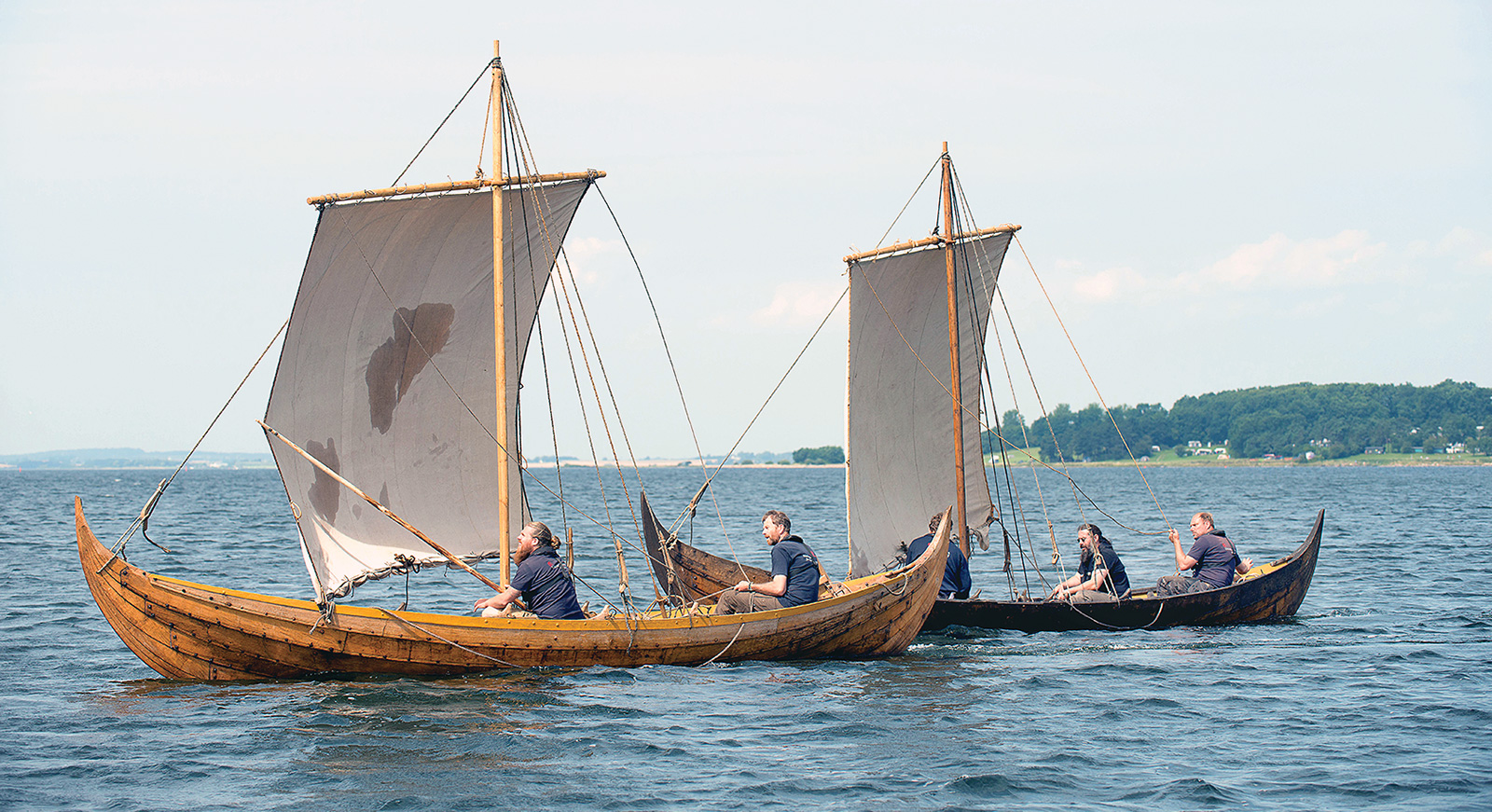
Courtesy of Viking Ship Museum, RoskildeLANGÖE of 2017 (left), the Roskilde museum’s third reconstruction, reflects a reinterpretation of the original archaeological finds. She has one more strake than GISLE of two years earlier (right). Such constructions are a specialty of the museum’s boatshop.
Gislinge, a small agricultural town about 40 miles west of Copenhagen, Denmark, was built on land reclaimed from the shallow waters of Lammefjord. So when a 1993 excavation for a drainage project there happened upon the remains of a boat, it came as no particular surprise. What was surprising was the boat’s remarkable state of preservation. It was a typical early medieval craft of the region, and its wood was dated by dendrochronology to about 1130 A.D. This put it well after the peak of the Viking Age, though its construction was nearly identical to the techniques used in that earlier era.
Particulars
- LOA: 25′3″ (7.7m)
- Beam: 5′3″ (1.64m)
- Draft: 7″ (0.25m)
- Sail area: 107.6 sq ft (10m2)
Scientists from the Viking Ship Museum in Roskilde determined that this discovery was a common workboat. It was most likely used for local fishing and general transportation. With a length of 25′3″, beam of 5′3″, and a draft of just 7″, it is estimated to have been capable of transporting ten sheep. She likely had a crew of four, one aft steering with the rudder mounted off to the starboard side and three rowing with two oars each. When the wind was fair, the crew would handle the rig; the boat’s maststep implied the typical single square sail of the period. The hull showed evidence of having been repaired again and again; the boat’s working life, estimated at 50 years, was a long one by any standard.
She was a simple workboat, and yet her elegant shape and proportions are rooted squarely in the great Nordic tradition of riveted lapped-plank boatbuilding that extended back hundreds of years before. The tradition survived in some areas into modern times and, it could be argued, even to this day. Large boats built in this “clinker” construction carried Scandinavian seafarers well over a thousand years ago west as far as Newfoundland; to the east, they reached Constantinople (now Istanbul) and into the Mediterranean Sea for trade, settlement, and, yes, raiding.
The tradition, even for the Gislinge workboat, is noted for double-ended hulls with forward and after stems that are essentially sculptures, large pieces of solid oak carved into curves in profile view and V-shapes in cross-section. Their inboard edges were stepped to receive the plank hood ends, with plank line continuations carved into them to emulate a final upward sweep of the strakes, resolving into fine, high stemheads at both ends. Like others of the type, the Gislinge boat had a steering board aft on the right side looking forward—the origin of our word “starboard.” The rudder itself did not survive, but the museum in Roskilde has made a close study of the shape, attachment, and use of the few that have.
With the documentation completed, the museum in 1995 built its first 25′ replica, ESTRID, and followed with another one, GISLE, in 2015. ESTRID was rigged entirely with cordage made from bast fibers from linden trees and also horsehair; she was sold to a buyer in Korea, and GISLE was purchased by a Viking enthusiast in France. In concert with the second boat project, the museum also shared its documentation in what they called an “open-source boatbuilding” project. Hundreds of plans sets have been downloaded free of charge from the museum’s website (www.vikingeskibsmuseet.dk). The technical details in the plans are exhaustive. A Facebook group (Gislinge Boat Open Source Project, now with 2,300 members) gathers information from enthusiasts around the world.
The museum’s documentation team consisted of Vibeke Bischoff, Tom Nicolajsen, and Morten GØthche, all of whom have years of specialized boatbuilding experience in re-creating Nordic hull shapes from archaeological remains. In 2016, they took a fresh look at the original Gislinge excavation records, further informed by the experience of building two boats, and gave the hull a bit more rocker and a bit more beam. The most significant difference was the addition of one strake per side, giving the boat more freeboard. The result was a second set of reconstructed plans; either plans set, or both, can be downloaded via the Roskilde museum’s website. The refigured plans, believed to more closely reflect the original boat’s construction, were used for the museum’s third Gislinge replica, LANGÖE, launched in 2017, continuing the institution’s impressive legacy of experimental archaeology.
Viking Ship Museum, Roskilde/vibeke Bischoff and Tom NicolajsenMuseum staff, who all have decades of boatbuilding experience, completed plans in 2016 for a reinterpretation of the archaeological finds. These drawings, and an earlier set, can be downloaded via the museum’s website (www.vikingeskibsmuseet.dk). Through the Gislinge Open Source Project, at least 10 full-sized boats and many models have been built worldwide.
By the end of 2016, 396 plans sets had been downloaded. At least 10 full-sized boats and a like number of models have been completed.
When builders such as Matthew Barnes have been willing to take on the challenge of building such a boat in the traditional manner, they have been free to do so through the open-source program. For Barnes, that meant using wedges to split oak planks out of logs and axes to shape them. Frames and floor timbers were hewn after the planking had been installed, just as done at the museum. At the opposite end of the building spectrum, John Harris of Chesapeake Light Craft used the technical drawings as the basis for his surprisingly effective glued-lap plywood interpretation of the hull. He set his mind to work out on his computer how the lovely hull, especially its challenging stem shapes, could be replicated in CNC-cut plywood, adding it to his extensive lineup of kit boats.
The museum’s boatyard has built working replicas of many archaeological finds. Boat guilds, organized as volunteer teams, are devoted to sailing them regularly and documenting their experiences. The central exhibit inside the museum is a collection of the remains of five ships that archaeologists excavated in the Roskilde Fjord off the town of Skuldelev in the 1960s. All five of them have been replicated full-size using traditional materials and tools; during the sailing season they lie alongside a quay outside. One of them, ROAR EGE of 1984, a few years ago was deemed to have reached the end of her useful life, so she was replicated for a second time; the new version was launched in 2022. Others have had repairs; for example, the 98′-long HAVHINGSTEN FRA GLENDALOUGH (see WB No. 206) this year had severely cracked planks replaced after 15 years of hard sailing. She will become an experiment in analyzing what a shortened rig, exerting less stress on the hull and requiring less ballast, would mean for an aging ship; every experience is an opportunity for analysis.
For the Gislinge boat, the goal could be phrased this way: Let’s put this out there and see what people do with it. It probably wasn’t in the predictions that a small boatyard in Connecticut would build an authentic reconstruction for a client whose organization has a medievalist bent. Nor could it have been foreseen that a restless tinkerer and boat designer in Maryland would use cutting-edge software to develop an epoxy-plywood version, possibly even as a kit for a boat that would do well for small-group outdoor adventure experiences. But for boats that have inspired awe in mariners for more than a thousand years, who could have foretold what a decade or two more might bring? ![]()
Tom Jackson is WoodenBoat’s senior editor.