Even with charts and vigilance, experienced sailors sometimes run aground. The more adventurous near-shore exploration you indulge, the more likely your acquaintance with the bottom will become. Even passionate gunkholers, slipping in under tree branches over paper-thin water, don’t want to run aground. They avoid it. But the possibility of an accidental grounding should be given credence and respect. When a bump announces that your hull has encountered the seafloor, know what to do and do it quickly.

Your boat’s particular underbody and propeller pose particular grounding factors. What is its profile and how well does it protect itself? Is the propeller retractable? Is it on an outboard motor? Is it protected above a skeg, or offset to one side? A spade rudder is a vertical cantilever, vulnerable to a rock strike or pounding. Does your rudder’s pintle extend below your skeg? Bilge keels may sit squarely on a bottom; fin keels may “hook” rock forms; wing keels may place extraordinary stress on the keel and its bolts. Lead keels may conform and “stick” to rock, while an iron keel may slide more easily. Keep these factors in mind when you visualize grounding problems.

A grounding chucks plans and certainties overboard. Forward motion ceases, new rules apply immediately, fresh priorities leap to the top rung. Recriminations won’t help. Salvation is quick action along planned paths with proper tools close to hand. Think slow, act fast, and be aware of all the natural factors of tide, wind, hydrography, and time. Who is waiting on your arrival? Grounding is an occasion for an informing and reassuring cell-phone call to shore. If you think your hull sustained damage, but aren’t sure, then a call to a tow boat is advisable—at least asking them to be on standby.

What Bottom?

Grounding.

There’s grounding, and then there’s Grounding. Chesapeake sailors speak of grounding fairly lightly, feeling almost brotherly toward mud bottoms in the great estuary. Maine sailors are grimmer around the chin-line about grounding on hard-rock ledges and uncompromising “bricks” (boulders appearing for no conceivable reason on otherwise sensible bottom). Caribbean sailors go positively unhinged when they consider grounding on coral reefs.

Location and weather are the key factors of risk assessment. There are places and conditions that strongly suggest an unimaginative mid-channel, no-nonsense course discipline. Some times, and some places, are less restrictive. Know your surroundings.

Mud, rock, and coral pose widely different risks and exit strategies. Acknowledge the appalling difference between gliding onto a sandbar on a calm afternoon, and pounding onto the same bar in an ugly chop. A skipper’s judgment shifts constantly with conditions. There is no single rule; the calculus of decision is flux. The best skippers we know are calm and assured but always wary.

Striking ground.

If you’re unsure of the bottom you’ve hit, and if conditions allow, get in your dinghy with your leadline in hand. You need to know the topography and depths of the bottom around your boat, with certainty. You may have a dandy depthsounder, but grounding favors a low-tech, depth-marked leadline—or a sounding pole, which may be a repurposed whisker pole, or some such. Survey the area from your dinghy. Be sensitive to the differences in “feedback” between a sounding lead or pole hitting sand or hitting rock.

You must also know your place on the tide cycle. If you expect a flooding tide to lift your grounded boat a foot, plan your exit…and wait. Use the time to work on your story of why you ran aground in the first place. To be doubly sure of getting free as soon as the boat is floated, run out a stern anchor and take up on its rode.

If you strike ground on a falling tide, hustle: Every second and every wave count (see “Escape Strategies,” below).

Escape Strategies

Escape stratecies.

Using the information from your quick survey of the area around your boat, chart your best exit path. This may also be an occasion for mask and fins and a firsthand look.

As your predicament becomes more clear, you may see that your boat must wait out the tide, and that it will be more stable and safe on one particular side. If resting on its port side will place the gunwale lower and increase the chances of flooding with the returning tide, shift to a starboard lie. Hustle, before more tide ebbs, to shift the boat to the favored side while it’s easy or even possible. Protect the grounded side as well as you can with fenders, cushions, and anything else to spread and soften the pressure. (The mast-lever technique described below may be adapted to gently roll the boat to the favored side.)

With the engine in reverse, rock the boat from side to side and fore and aft with the weight of your crew. Rhythmic motion often inches a boat aft in this way, and this is another use for your lead line: Tied off on a stanchion, it will give you a positive index of motion.

Heeling the boat lifts the keel and can set you free. Immediately sheet home the sails to heel the boat, if they won’t create forward “push” harder onto the grounding. Lean out on the boom. Use the spinnaker or jib halyard to heel toward the weight of your partially lifted dinghy, if it has reliable hoisting points.

A draft of less than 3′ may well allow you to walk right around your grounded boat. Two strong backs lifting up against the bow cheeks (efficiently, no strained backs!) can back a boat right off. Keep the engine off. There should be no one in the water with a whirling propeller.

Kedging.

Kedging

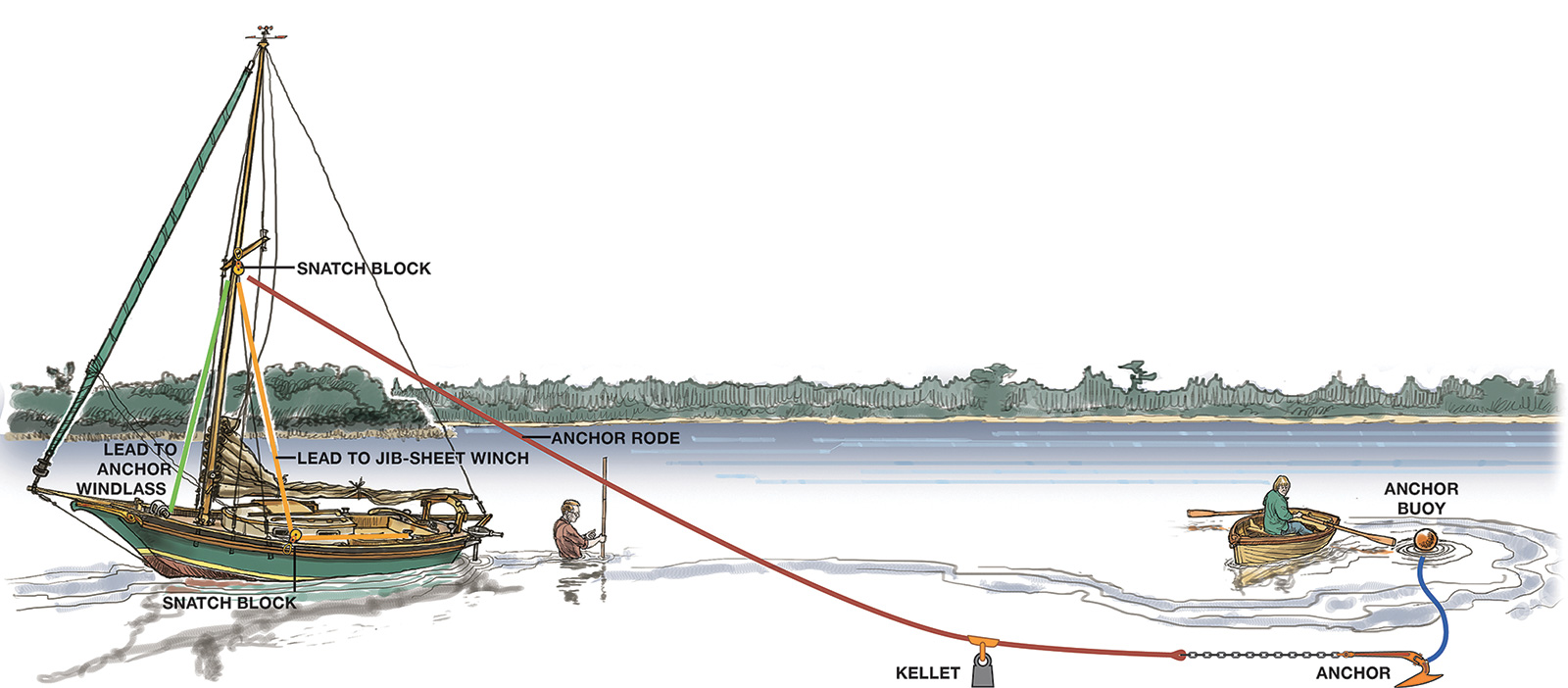
This is the traditional exit, and a basic cruising skill: pulling the boat to an anchor set toward your best path of safety. Take pains with your anchor setting, and get the best possible angle with your kedge anchor rode (the deployed anchor line) at maximum possible distance. This is an apt use of the kellet, a rode-rider bearing considerable weight toward but not too close to the anchor, to enhance the rode’s holding angle. If your kedging tools are close to hand, and your kedging drill practiced, you may be able to set up your gear within 15 minutes. A trip on the Intracoastal Waterway below the Chesapeake might make this drill tediously familiar.

Kedging.

It’s possible that a minor grounding may be overcome by reeving the rode to a bow chock and turning the boat toward safe water with the windlass. The rudder can be damaged no matter which direction you pull, but a broken rudder is a small price to pay compared to saving the boat. Incidental damage like this is really a minor detail if the tide is dropping, the bottom is hard, and the sea is, or will be, rough.


The Mast Lever

The mast lever.

Grounding fast will more likely require reducing the draft by heeling and hauling. Optimal anchor setting and a long rode are a premium. The rode is rove through a snatch-block hoisted to the first spreader. Haul against the kedge using the halyard winch or (with another snatch block) the windlass. Keep the engine in reverse, but be cautious: Your propeller and skeins of anchor rode are a dangerous combination. As soon as the boat pulls free into safe water, shift into neutral and retrieve your anchor gear.

You’ll be working with and among line, blocks, and winches under much tension. Line can fail and snap back along itself with aggressive force. Lumberjacks and riggers have a plan for this: They drape jackets, cushions, and blankets over lines under tension; in the case of a high-tension failure, air-resistance against the draped fabric will significantly reduce the flailing.

Afloat again.

Afloat Again

So you’re afloat in safe water, but the contact between rock or coral or hard sand bottom has breached your hull. There’s still hope. Clear away gear to expose the damage, assess your chances, and work on sealing the hole. If you have a catastrophic breach of hull integrity, stay safe: Locate a soft beach and run your boat gently onto it.

Otherwise, assess the damage: How much water are you taking? A large-bore emergency pump, like a Whale Gusher permanently bilge-mounted, or bolted to a stand-on board can pull a lot of water out of your bilge, and your bilge pump will help. An old maxim says, “The best bilge pump is a scared man and a bucket.” Can you keep up with the leak while underway?

Hammering in venerable wooden plugs

Can you staunch the flow by hammering in venerable wooden plugs? Can you wedge cushions against the breach with bunk boards or other rigid sections? Can you lash a collision mat over the breach? Your fix will be temporary, ad-libbed, and not complete, but it should be enough to reduce inflow to a manageable volume your pumps can evacuate.

How far on your “bad” tack (with the hole deepest) must you travel to reach the nearest boatyard? Don’t handle an emergency alone. Summon support via cell phone. If you’re making a passage across the sound or bay to reach repair, ask another boat to accompany you, just in case. Call ahead and have the yard’s hoist or marine railway ready for you.