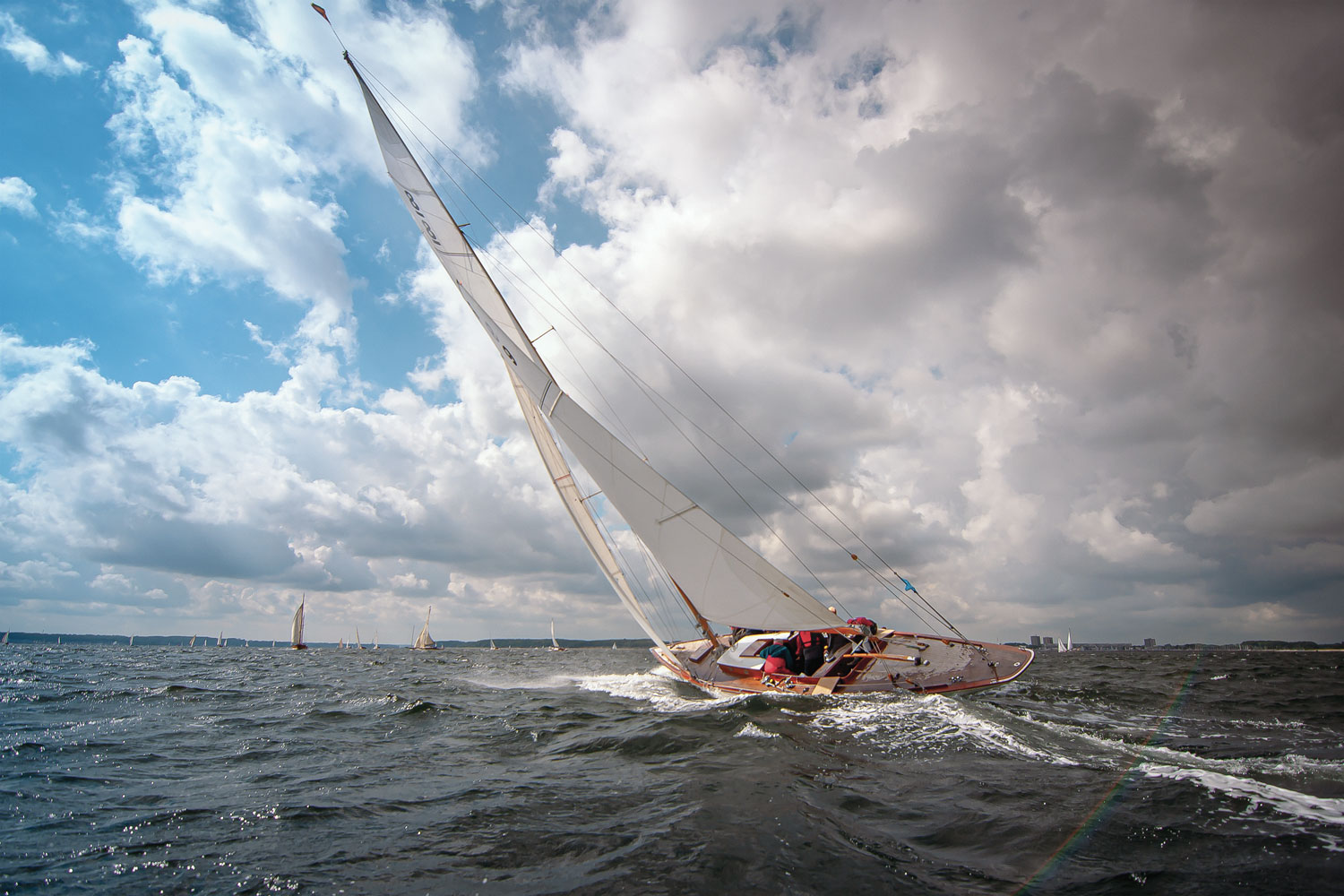
GERMANIA III racing in the 2017 German Classics.Ekke Erben

GERMANIA III, seen here racing in the 2017 German Classics near Laboe in the Kiel Fjord, today sails in the same waters where the Olympic sailing regattas were held in 1936.

The Baltic Sea off the yachting capital of Kiel, Germany, was a natural venue for the sail-racing competitions of the 1936 Olympic Games hosted by the country. On August 13 that year, the Kiel newspaper headline trumpeted, “Germany wins Bronze Medal in 8mR competition with GERMANIA III.” A yacht designed to win such races, as GERMANIA III was, could ordinarily be expected to have a short life and be superseded by design innovations and emerging classes. And yet, more than 60 years later, in 1998, the same yacht made headlines again: “French actor Alain Delon presents 8mR World Cup trophy to GERMANIA III crew.” And today, after a restoration that has made the yacht arguably even better than ever, she is still racing in the Baltic Sea.

Bernhard Kolbe, GERMANIA III’s current owner, purchased her in 1989. He owned a company specializing in steel-and-concrete structures, but woodworking and sailing were his passions. He and his brother-in-law were actively searching for a wooden boat when they found GERMANIA III at Lake Constance, on Germany’s border with Austria and Switzerland. The boat, having been altered for cruising, was in a tired state.

They brought GERMANIA III first to Duisburg, their hometown in western Germany, and Kolbe contacted Gerd Wegener of Wegener Shipyard in Hamburg, who is the grandson of Jonny Wegener, one of GERMANIA III’s previous owners. Wegener’s first impression of GERMANIA III was that with her old engine, her heavy tanks aft, and her cruising interior, she had turned into a “tired mule.” She was hardly the racing competitor first envisioned in 1935 by her designer, Henry Rasmussen of the Abeking & Rasmussen yard in Lemwerder, near Bremen, for racing sailor Alfried von Bohlen und Halbach (see “The Yachts of the Krupp Family” below). Kolbe had the boat transported to Hamburg, where Wegener took on the project. The pair would become friends and racing partners, with Wegener as skipper.

Black and white GERMANIA III from 1936.Scherl Bilderdienst Berlin / Courtesy of Bernhard Kolbe

Built specifically for Olympic 8-Meter-class competition, GERMANIA III crossed the finish line in third place on August 10, 1936, to earn a bronze medal during that year’s Olympic games in Germany.

After competing in the 1936 Olympics, GERMANIA III had been expected to be a contender for the German team again in the 8-Meter class, aiming for the 1940 Olympics in Helsinki, Finland. Alfried’s father, Gustav Krupp von Bohlen und Halbach, had also ordered a new 8-Meter, GERMANIA IV, from Abeking & Rasmussen, and both raced in the 1939 Kiel Week, after which they were sent via railway to Berlin on loan to a sailing club on Lake Wannsee. Then came the violence of World War II. The Olympics were canceled, and the 8-Meters never returned as an Olympic class. Both GERMANIA III and IV were stored in a shed close to Berlin, and both survived the war, though Krupp’s earlier 8-Meter, GERMANIA II, was destroyed. Krupp reportedly sold GERMANIA III in 1940, but by 1941 her ownership was unclear. She finally showed up again in Hamburg in 1948, when Jonny Wegener saw her by chance, recognized her, and traded his own modified rescue boat for her, even though GERMANIA III was in a deteriorated condition. In 1949 and 1951, Wegener sailed her to win the “Blue Ribbon of the Lower Elbe River,” a 54-nautical-mile race famous among German sailors. When not racing, Wegener typically sailed GERMANIA III alone, without an engine.

The boat went through a succession of owners—one of whom installed her first engine in 1952—and two name changes before being bought in 1973 by Prosper du Bois-Reymond, who undertook a full refit in 1976 and used her as a racer-cruiser for many years.

GERMANIA III from 1960s in the water near land.Courtesy of Bernhard Kolbe (both)

In the post–World War II era, GERMANIA III still raced at times but was increasingly used for cruising. In this 1960s photograph, life rings slung in the lifelines are visible. Her first engine was installed in 1952, and her deckhouse (inset), shown here in 1989 on Lake Constance, Germany, had been reconfigured for cruising comfort.

Gerd Wegener’s 1990 refit involved first replacing the sternpost, rudder, and all the mahogany planks below the waterline. A 30-hp Nanni four-stroke diesel engine, 100kg (220 lbs) lighter than the one it replaced, was installed.

“Originally, GERMANIA III was very lightly built for the time,” Wegener said. “We also replaced the floor timbers and the additional steel floors to provide strength. For the renovation, we removed the whole interior, and later we only rebuilt the saloon.” In a second renovation phase, a new mast, 19.3m (63′ 31⁄2″) long, was made to reconstruct the original 7⁄8 fractional rig.

Initially, Kolbe had intended to use GERMANIA III for cruising with friends and family. It turned out differently: With Wegener’s encouragement, Kolbe began racing, and GERMANIA III won trophies in the Elbe River race. In 1996, a new teak deck was installed, the large cruising cabin was reduced to a lower-profile version, and a cockpit with seats was built.

GERMANIA III always had a design issue: her stern lacked buoyancy. Once a heavy engine was placed, her trim problem worsened. Inspired by what he had seen at a boat show, Kolbe found a solution: moving the engine forward of the mast and using a hydraulic drive to turn the propeller shaft. GERMANIA III participated in the 1996 8-Meter European Championship in Travemünde, Germany. Although the yacht was not successful, Kolbe emerged from the race as an impassioned 8-Meter racer.

Wooden ship hull under repair.Courtesy of Bernhard Kolbe

Bernhard Kolbe’s 1990 restoration of GERMANIA III was at least the fourth documented full refit of the yacht. The project involved extensive hull work, including replacing the sternpost and much of the planking below the waterline.

By the late 1990s, 8-Meter racing was gaining adherents. In fact, the 1998 International 8-Meter World Championships in Geneva, Switzerland, was the largest gathering of the class since the 1936 Olympics. At the same time, Fred Meyer became president of the International 8-Meter Association and began his efforts to resurrect the 8-Meter class. Since then, the association has increased from a handful of boats to some 290 today, with typically more than 20 yachts competing in any single event.

For the Geneva regatta, Juliane Hempel, a renowned German yacht designer specializing in 6- and 8-Meter-class boats, had optimized GERMANIA III. Hempel had the engine removed for the races and adjusted trim ballast to bring GERMANIA III back to her design waterline, and she also took pains to confirm that GERMANIA III would pass the measurement formula for the 8-Meter class. Hempel stayed with the yacht for more than 10 years, time and again making improvements, tweaking sail plans, and designing renovations for optimum performance.

Six races had to be completed at the 1998 World Championships. Four prizes were awarded, and GERMANIA III, racing in the Vintage class, won the World Championship Cartier Cup, which was presented to Kolbe and Wegener by the famous French actor Alain Delon. “Geneva was one glittering party from start to finish,” Kolbe remembers with a smile.

Wooden boat deck under repair in the shop.Courtesy of Bernhard Kolbe

As his interests turned more to 8-Meter racing than cruising, Kolbe had a new teak deck installed in 1996 and gave the yacht a lower-profile deckhouse than the one used during her cruising years. He also reconfigured the cockpit.

For the 8-Meter World Championships in Italy in 2000, the propeller was removed and the rudder reconfigured, but GERMANIA III received penalty points for having some fittings not considered appropriate for her vintage. She finished third in the class for yachts in original condition. The conversion work continued: In 2001, the cabin roof was rebuilt closer to the original’s low profile, and the original cockpit configuration, divided and without seats, was restored. Consequently, GERMANIA III was awarded the 2001 restoration prize by Germany’s Freundeskreis Klassischer Yachten (Friends of Classic Yachts), a nationwide association of classic-yacht enthusiasts.

Sailors sit aboard GERMANIA III at the 2017 German Classics.Ekke Erben

As the popularity of 8-Meter yacht racing surged in Europe in the late 1990s, Kolbe regularly campaigned GERMANIA III. With the yacht designer Juliane Hempel, Kolbe took steps to improve the yacht’s performance starting in 1998, and that year she won the vintage-class world championships in Geneva, Switzerland. More improvements followed; here GERMANIA III is seen in a close duel at the 2017 German Classics.

The years went by, and GERMANIA III competed in several international championships. She won less often as more yachts entered the fleet, making the racing more competitive. The rebuilding effort toward a pure racing yacht continued, and in 2011 the saloon was removed and the lifelines, which had been added during her cruising years, were taken off.

Kolbe shifted gears again in 2018 by approaching the yacht designer Martin Menzner to take charge of GERMANIA III. Even as a kid, Menzner, now the lead designer at Berckemeyer Yacht Design (see WB No. 290), designed and built small boats, and he went on to study engineering and product design in Hamburg. He started racing sailboats successfully with J-22s and later J-80s. (Later, in 2000, he started racing the 8-Meter yacht SPAZZO, designed by Juliane Hempel; he placed third in the class’s 2002 World Championship in Helsinki, Finland.)

View of a wooden boat cockpit frame and restored cockpit.Martin Menzner (both)

In 2023, Kolbe had GERMANIA III’s original cockpit configuration restored, for which the boatbuilder Jan Bruegge used light framing (above left), omitted the seats, and installed a sole of teak-veneered paulownia (above right).

The class’s 2018 world championship on Lake Constance was Menzner’s first test with GERMANIA III.The yacht placed third in the Neptune class, which is for boats designed before 1960. “Against the winning CARRON II, GERMANIA III lost about 300m [about 330 yards] during each tack, sailing in light winds,” he said. “We had the smallest genoa of all boats and about 700 kg [1,540 lbs] too much weight aboard, with the built-in engine and all the deck fittings.” With all of the 8-Meters gathered at one jetty, he launched a drone to take photographs that he could later use to make comparisons. He came to the same conclusion that Henry Rasmussen had reached when he designed the yacht’s successor, GERMANIA IV: the boat’s J-value (the distance from the headsail luff to the mast) was significantly smaller than the competition, therefore the mast needed to be moved aft to accommodate a larger genoa for better performance to windward.

Line drawing for the GERMANIA III.

After the 2018 racing season, the naval architect Martin Menzner redrew GERMANIA III’s sail plan to move her mast from its existing position (shown in black lines) to one 1′11⁄2″ farther aft (shown in blue lines) for better windward performance.

Over the next four years, significant improvements were made to GERMANIA III’s competitive standing in the Neptune class. The class’s measurement formula’s primary factors are waterline length, sail area, and freeboard. The yachts are typically about 15m (about 49′) long. Working within the formula, Menzner directed the work on GERMANIA III toward reducing weight, which had the effect of allowing her to float higher on her lines, which in turn gave her a shorter waterline length and higher freeboard, which in turn allowed more sail area.

Sailors race the GERMANIA III.Ekke Erben

At the 2017 German Classics Race, GERMANIA III shows her configuration before Menzner’s alterations were made.

To make the weight reduction, the engine, fuel tank, pipes, and propeller shaft were removed. Except for a pipe berth, the forward cabin was completely stripped. The mast was moved aft by 34cm (1′ 11⁄2″) and the forestay was moved forward, increasing the J-value from 3.86m to 4.50m (12′ 8″ to 14′ 91⁄8″), which would accommodate a significantly larger genoa. After laser-measuring the yacht to confirm the new, shorter waterline, the rig’s E-value, or length of the mainsail foot, could be reduced from 7.2m to 7.08m (23′ 7-1⁄2″ to 23′ 23⁄4″) to bring the total sail area, counterbalanced by the shorter waterline and increased freeboard, into compliance with the measurement rule. The genoa’s area was increased from 20.9m2 to 24.3m2 (225 sq ft to 261.6 sq ft), while the mainsail was reduced by one square meter, from 57m2 to 56m2 (613.5 sq ft to 602.8 sq ft) a very acceptable trade-off. At the same time, several handling improvements were made, such as shifting the backstays forward and repositioning the spinnaker-sheet blocks.

Sailors aboard the GERMANIA III in 2022.Tobias Stoerkle

By the time of the 2022 World Cup on Lake Geneva, GERMANIA III, shown here at the windward mark, had decidedly improved her performance.

The cockpit was rebuilt to the original plans, with a flat sole instead of tub-shaped structures. This also simplified drainage and made room for sheet pockets under the deck. Jan Bruegge of Bruegge Boatbuilding planked the sole with teak glued over a paulownia subdeck. “Paulownia is a very interesting wood for lightweight boatbuilding, saving an additional 80kg (176 lbs) for GERMANIA III,” he said.

And, of course, the yacht’s equipment was replaced to conform to the Neptune class rules encouraging authentic vintage racing gear: for example, blocks can have modern ball bearings but must be wood-bodied and sheathed in leather; also, winches cannot be self-tailing and must be made of bronze or something that looks similar.

Interior view of GERMANIA III.Ekke Erben

In addition to the altered mast location, steps to reduce GERMANIA III’s weight—including removing what was left of the saloon joinery seen here, which was a remnant of her cruising years—allowed her to float higher, shortening her effective waterline length; this offset the rig changes under the 8-Meter rules.

With all these improvements, Kolbe and Menzner and their crew sailed GERMANIA III in the 8-Meter World Championships in Geneva in 2022. “GERMANIA III was really fast, foremost with lighter winds,” Menzner said. “However, the performance was best on a 15-knot day. The new sails are a blast! Initially we had some trimming challenges.” The stern’s design remained an issue; “we needed some trim ballast forward.” Penalties during racing—unfair ones, in the view of the crew—cost her dearly, but she still won the Neptune class preliminary races and finished third overall.

Rigging views aboard the GERMANIA III.Ekke Erben

GERMANIA III’s modern hardware marks her as a serious racing yacht. Over the years, restorations have taken her closer to her original concept, but improvements such as rig adjustments and weight savings have made her better than ever.

In the 2025 racing season, GERMANIA III will close the loop: from her origin as a pure 8-Meter racing yacht, to a cruiser, and finally back to a racing form that is as good as, or better than, original. The 8-Meter World Championships were due to be held in Turku, Finland, in August this year, and as of this writing the crew was already planning the long trip. Until then, GERMANIA III will be racing the exact same Baltic Sea waters off Kiel in which she first raced 90 years ago.

The Yachts of the Krupp Family

In 1935, Alfried von Bohlen und Halbach was the 26-year-old scion of a family of industrialists that extended back to the 16th century, when they emigrated from The Netherlands to Germany. The avid interest his parents, Gustav Krupp von Bohlen und Halbach and Bertha Krupp, took in yachting transferred easily to Alfried.

Two men aboard a boat in the 1930s.Courtesy of Alfried Krupp Von Bohlen Und Halbach Foundation

Alfried von Bohlen und Halbach, shown at the helm of GERMANIA III in spring 1936, sailed his yacht to Olympic bronze that August.

The Krupps had commissioned a 28m (92′) steel-hulled gaff-rigged cutter, KOMMODORE II, in 1896 and followed with a succession of six yachts that varied widely but were all named GERMANIA. The first was a gaff schooner whose hull was built with the company’s stainless steel. With Alfried’s intensifying interest in 8-Meter racing, GERMANIA II, III, and IV were all wooden-hulled 8-Meter racing yachts designed by Henry “Jimmy” Rasmussen and built at the Abeking & Rasmussen shipyard in Lemwerder, Bremen.

With her varnished hull, her name in gold-leaf letters on the transom, and a 17m (55′ 9″) mast of Sitka spruce bending slightly aft, GERMANIA II was a beauty when launched in 1934. However, during races in Germany, Denmark, Sweden, and Italy in 1934 and early 1935, she fared well in light wind but was left behind as soon as the sea got choppy. Over the winter of 1934–35, improvement efforts such as adjusting mast rake and altering the keel shape proved fruitless.

By June 1935, it became clear that GERMANIA II would not become the German high-performance statement that Gustav Krupp had envisioned for his son. He consequently ordered a new yacht, GERMANIA III, from Abeking & Rasmussen in late June, much to the delight of Alfried. The yacht was conceived with one objective: satisfying Alfried’s ambition to be a medalist in the 8-Meter class during the 1936 Olympic Games, hosted by Germany, and Alfried was directly involved in deciding the new yacht’s construction details.

She was built in only two months and cost 29,000 Reichsmarks (about $143,000 in today’s money). In mid-September 1935, she showed promise by winning her first two races, competing against GERMANIA II and one other 8-Meter yacht.

In spring 1936, the first 8-Meter-class races of the season were held on the Riviera close to Genoa, Italy. GERMANIA III won the prestigious Duke of Aosta Trophy. After a second-place win at the owners’ race and five wins overall, GERMANIA III was a serious contender.

GERMANIA II and GERMANIA III from the 1930s.Courtesy of Alfried Krupp Von Bohlen Und Halbach Foundation

GERMANIA II was built by Abeking & Rasmussen in 1935, but her performance proved disappointing—so, to Alfried’s delight, GERMANIA III was quickly conceived and built by the same boatyard in time for the 1936 Olympics.

The Olympic qualifying contests for German sailors were held in Kiel in May 1936. GERMANIA III beat her principal competitor, OLYMPIA, in six of seven races. The final decision about the Olympic entries was in the hands of the authorities in the capital, Berlin, who weighed opinions that OLYMPIA would perform better than GERMANIA III in heavy weather but GERMANIA III was clearly better in light conditions. Uncertainty remained about which would be better in mid-range winds. In the end, the choice went to GERMANIA III.

“The 8-Meters have traditionally been the dayboats of the aristocrats and captains of industry,” according to John Lammerts van Bueren, former president of the International 8-Meter Association and founder of the 8-Meter Register. “Royal families of Spain, Norway, and Sweden raced in these yachts, and the class has always attracted colorful people who had the funds to purchase the very best.” American yachtsmen also joined in, with members of the New York Yacht Club ordering 11 boats from Abeking & Rasmussen in 1928.

The Krupp family’s company became a steelmaking giant in the 19th century; it patented seamless railway wheels in 1856 and the first stainless-steel alloy in 1912—the famous art-deco top of New York City’s Chrysler Building of 1930 is made of Krupp’s stainless steel. The company, even in its early days, also made weapons, an expertise that translated into cannons during the 19th century and later the heavy armaments of World War I and World War II. In 1943, with his father suffering from dementia in the middle of the war, Alfried had to step up to take the helm of the family industry, at the same time taking the name of Krupp. After the fall of Adolf Hitler and the war’s end in 1945, he was convicted by an American military court on war crime allegations. He was imprisoned until 1951, when he was pardoned; U.S. High Commissioner John McCloy ruled that he was not in control of the company during the time of militarization. His personal assets were returned to him, and in 1953 he returned to the Krupp company as chief executive.

Alfried continued his yachting passion after his return to industry. He commissioned Abeking & Rasmussen to build the 65′ 6″ steel-hulled yawl GERMANIA V in 1955. Rasmussen died in 1959, so Alfried chose Sparkman & Stephens for his final yacht, the 72′ LOA aluminum-hulled yawl GERMANIA VI, launched in 1963. After he died in 1967, his assets were transferred to the Alfried Krupp von Bohlen und Halbach Foundation, including his final yacht, which is still used for ocean sail training.

For more information about the Krupp yachts, see GERMANIA—The Yachts of the House of Krupp, by Svante Domizlaff and Alexander Rost (Delius-Klasing, 2006), which is the source of the two historical photographs shown here.  Article ends.


Michael Sauter took up boatbuilding in retirement from his former life with a global consulting company. He spends most summers in the Penobscot Bay area of Maine, and he has taken several courses at WoodenBoat School.