
Table of Contents
INSTITUTE OF NAUTICAL ARCHAEOLOGY
By Tom Jackson
In the last fifty years the discipline of nautical archaeology has gone from non-existence to being recognized as one of the most vital tools in the search for past societies and cultures. Yet, had it not been for the ceaseless efforts and enthusiasms of a handful of men, the vision of the ina, and the support of Texas A&M University, the world’s shipwrecks might still be treasure trove, mercilessly and unscientifically plundered.
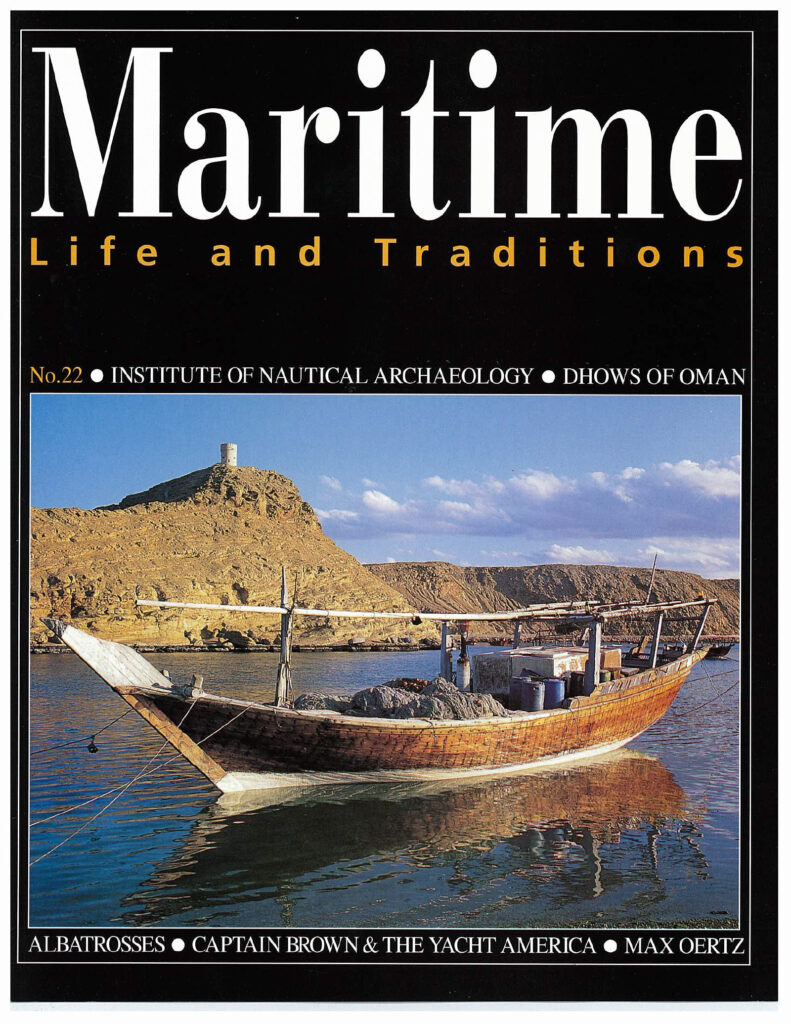
THE DHOWS OF OMAN
By Bruno Le Cour Grandmaison
An enduring image of the northeast Indian Ocean, the Red Sea, and the Persian Gulf, the sailing dhow has become a victim of modernity. Smaller examples are still used for fishing, but they are now exclusively power-driven; the larger trading dhow has almost completely disappeared, as have the yards that built them. Visiting Oman in the late 1990s, the author reveals the poignant tale of a dying craft.
‘WE HAD A GOOD BOAT’ — CAPTAIN BROWN AND THE YACHT AMERICA
By David W. Shaw
The America’s Cup was claimed for the first time in 1851 by a small schooner from the United States. The events of the race and the general appearance of the winning yacht are widely known, but what of the men behind the scenes? Who were the America’s designer? Her skipper? Her crew? History has largely ignored them, and yet, says the author, they were eminently respected by their peers — none more so than Dick Brown, pilot.
THE ALBATROSS – MYTHS AND REALITY
By Thierry Vincent and Bernard Stonehouse
Europeans first ‘discovered’ the albatross in the seventeenth century. For the next 300 years the great bird was the ever-present companion and prey of the southern-ocean sailing ships. The albatross’s mythological status has been sustained through art and fiction, but only in recent times has scientific study led us to a better understanding of these magnificent creatures, whose future is increasingly perilous — thousands are killed annually by modern longline fishing practices.
MAX OERTZ
By Klaus Kramer
While the likes of Herreshoff and Fife were gaining fame in their native lands and beyond, who was making the yachting headlines in continental Europe? In Germany one man stood out above all others: lauded by his peers, commissioned by his emperor, Max Oertz was one of the most successful designers of his day. Klaus Kramer tells a very human tale of youthful enthusiasm and adult genius, of far-reaching influence in naval architecture, and brilliance in aeronautical engineering.