
 Author’s Collection
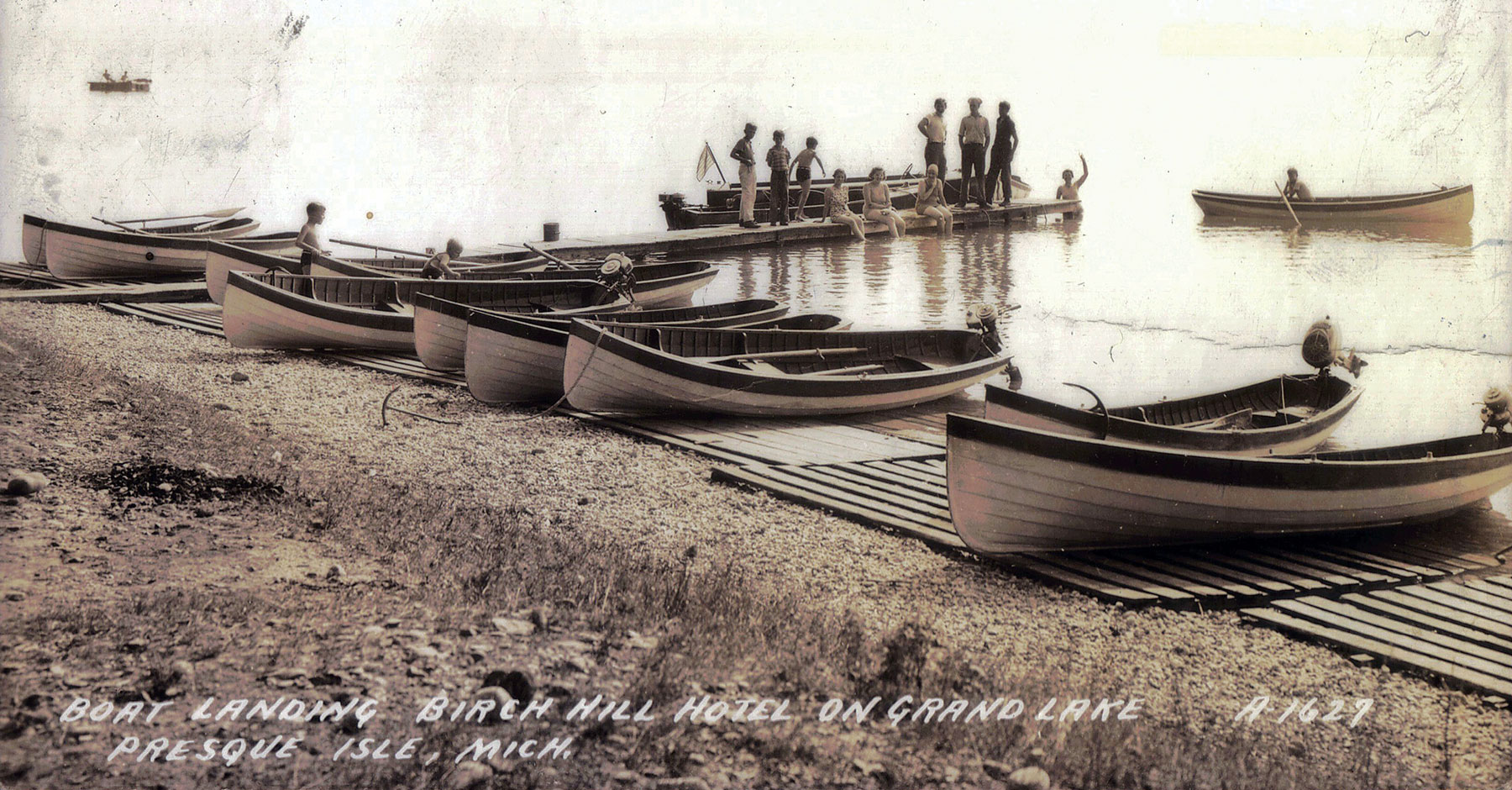
The early-20th-century transition from rowing craft, which were ubiquitous in the upper Great Lakes at the turn of the last century, to motor-driven boats is evident in this 1940 postcard from Birch Hill Hotel on Grand Lake near Presque Isle, Michigan.
Generations ago, boats such as those on the waterfront at Birch Hill Hotel in Grand Lake, Michigan, shown in the photograph above, could be found at almost any lake across the Midwest. Today’s diligent seeker of small historic boats might find a weathered pair of oars at an out-of-the-way antique barn near Grand Lake, but finding one of the boats would be a far greater challenge. Unfortunately, little has been done in the upper Lakes region to preserve and document these craft; we have no counterpart to the historian John Gardner or to Connecticut’s Mystic Seaport Museum to celebrate the glory days of such boats. What’s required instead is a careful perusal of historic sources and well-planned crawls through widely scattered archives and museums. The accompanying photographs show a few examples sifted from my 40 years of such activity.
Boats have always been part of life in the upper Great Lakes. Native Americans began using dugout and birchbark canoes at least 3,500 years ago and very likely much earlier. The first use of planked wooden boats on the northern Great Lakes is not much easier to date than the first native craft. Records from fur traders and missionaries as far back as the late 1600s name various skiffs, wherries, wooden canoes, Greenland shallops, and York boats, or bateaux, barques, chaloupes, and nacelles in French sources. Except for those of the fur-traders’ York boats (see WB No. 144), surviving details of these craft are typically limited to dimensions and brief descriptions.
Fortunately, with the advent of photography at about the time of the Civil War or shortly after, visual evidence of the upper Lakes watercraft began accumulating. Photographs provide the clearest record we have of the region’s watercraft, including the earliest images of working sailing craft, some of which the maritime historian Howard I. Chapelle categorized as shallops and the French knew as chaloupes à voile, or sailing shallops.
National origins provide clues as to who built some of these boats. Features of traditional French boats, especially of Mediterranean ports, bear a strong likeness to those of the planked sailboats that appear in the earliest photographs from North America’s northern waters. Either Hyacinth Chenier, a French Canadian at St. Ignace, Michigan, or Jean Veroneau, a French-born missionary on Manitoulin Island, Ontario, is a good candidate as the 1840s builder of the early double-ended, planked sailboats that locals called “Mackinaw boats.” But the development of this particular type is muddied by the badly abused “Mackinaw” name: as early as 1900, no fewer than 10 totally unrelated boats were called “Mackinaw boats” by one person or another, and the confusion continues today.
Other nationalities also played a role. William Watts, for example, began building his Collingwood skiffs on southern Georgian Bay, Ontario, around 1850, drawing on influences from his native Ireland. A 30′ double-ender built in about 1880 at Stonington, Michigan, by Christian Skaug shares traits with the faerings of Norway, where Skaug was born. Similar links show up in the work of other immigrant boatbuilders as well. And newcomers brought influences from elsewhere in the United States, too, with traces of classic eastern U.S. craft such as Whitehalls, St. Lawrence River skiffs, Rushton canoes, Rangeley Lake boats, and Maine peapods.
As leisure time and discretionary money increased at the end of the 19th century, skilled immigrant woodworkers met a blossoming demand for pleasure boats. Later, manufacturing companies such as Lyman Boatworks in Ohio and Rhinelander Boat Company in Wisconsin emerged, and with them the assembly line. Suddenly, recreational watercraft appeared on any water deep enough to float a canoe.
Despite outside influences in hull design, many small craft in the northern Lakes area can be attributed to local builders who produced original and highly utilitarian craft suited to local needs and conditions. The work of these builders has remained in relative obscurity and has been largely undocumented. One of the boats shown in these photographs—Paul Larson’s duck boat, built at Little Falls, Minnesota, in about 1913 (pg 77)—suffered such a fate. One fortunate duck hunter lucked into an intact Larson duck boat not long ago, but outside of internet photos I am unaware of documentation that would permit its accurate replication. There are other examples of watercraft lacking documentation: for one, small rowing boats used by members of the Huron Mountain Club at its 26,000-acre property in Michigan’s western Upper Peninsula have been largely unknown owing to the club’s heavy shroud of privacy; these boats have only recently come to light.
One exceptional recent effort in Great Lakes maritime historical documentation has been led by Dr. Ann Merriman and Christopher Olson of St. Paul, Minnesota, two ambitious underwater archaeologists who founded Maritime Heritage Minnesota (www.maritimeheritagemn.org). With the help of new technology, they have scanned and documented a number of watercraft whose existence and history might otherwise have remained unknown.
Certainly others have contributed to the understanding of upper Lakes small-craft history with their activities in boatbuilding, underwater exploration, published and unpublished research, half-modeling, recording oral histories, and documenting relic craft. Given that all this work has never been collected in one comprehensive effort, historic photographs and real-photo postcards represent a condensed but surprisingly rich trove of information.
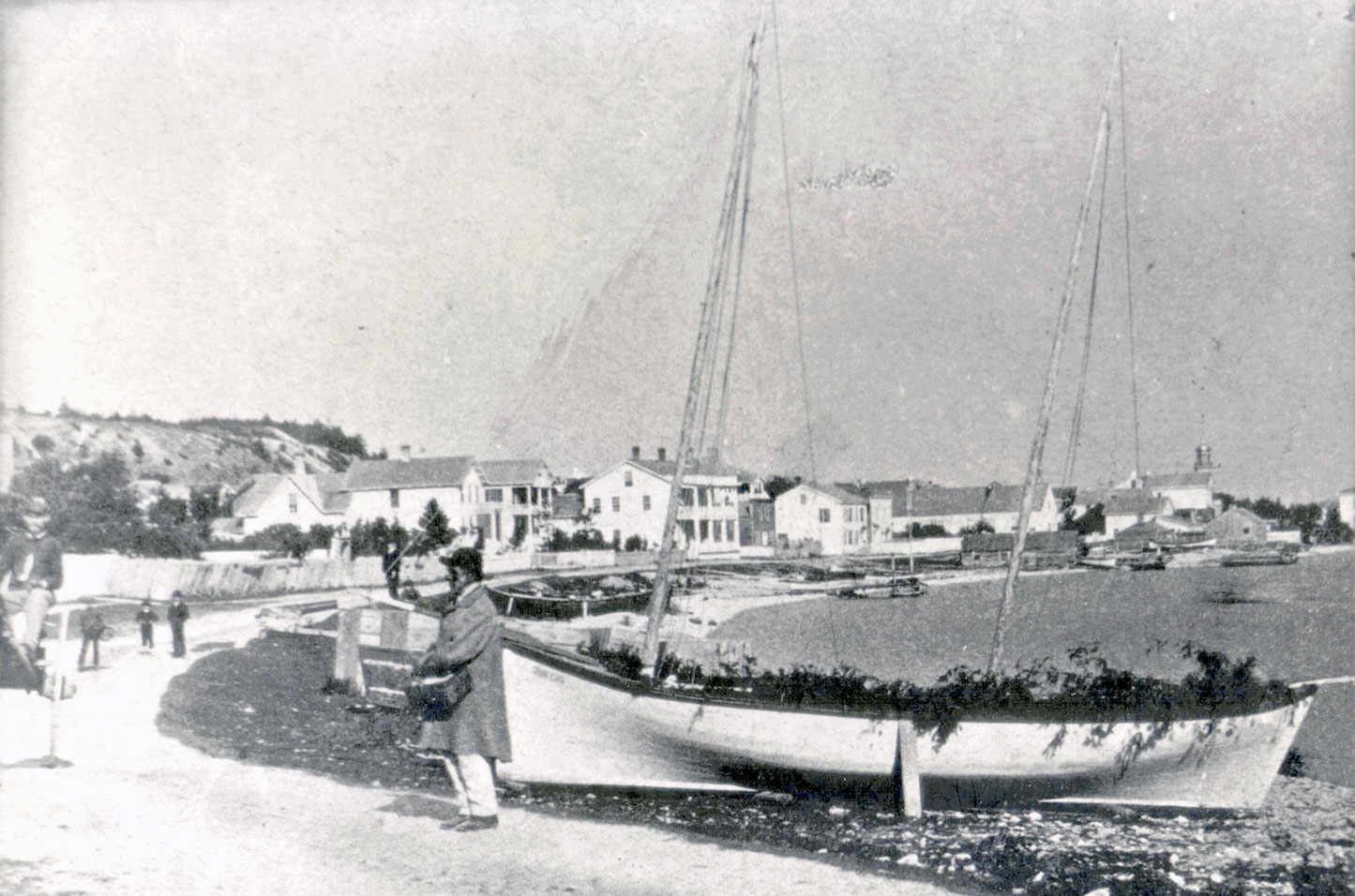 Few photos from the upper Great Lakes display more distinctly than this one, taken at Mackinac Island, Michigan, the essential characteristics of the “true Mackinaw boat,” described by Joseph C. Collins in his 1877 report on the status of fisheries in the United States (see WB No. 158). The boat, which appears to be 18′ to 20′ long, has a sharp, blade-like entry, a plumb stem, a raked sternpost, no keel rocker, and bulging appearance. The strongly upswept sheer corresponds with a profile view from Collins’s report and his description of the type.
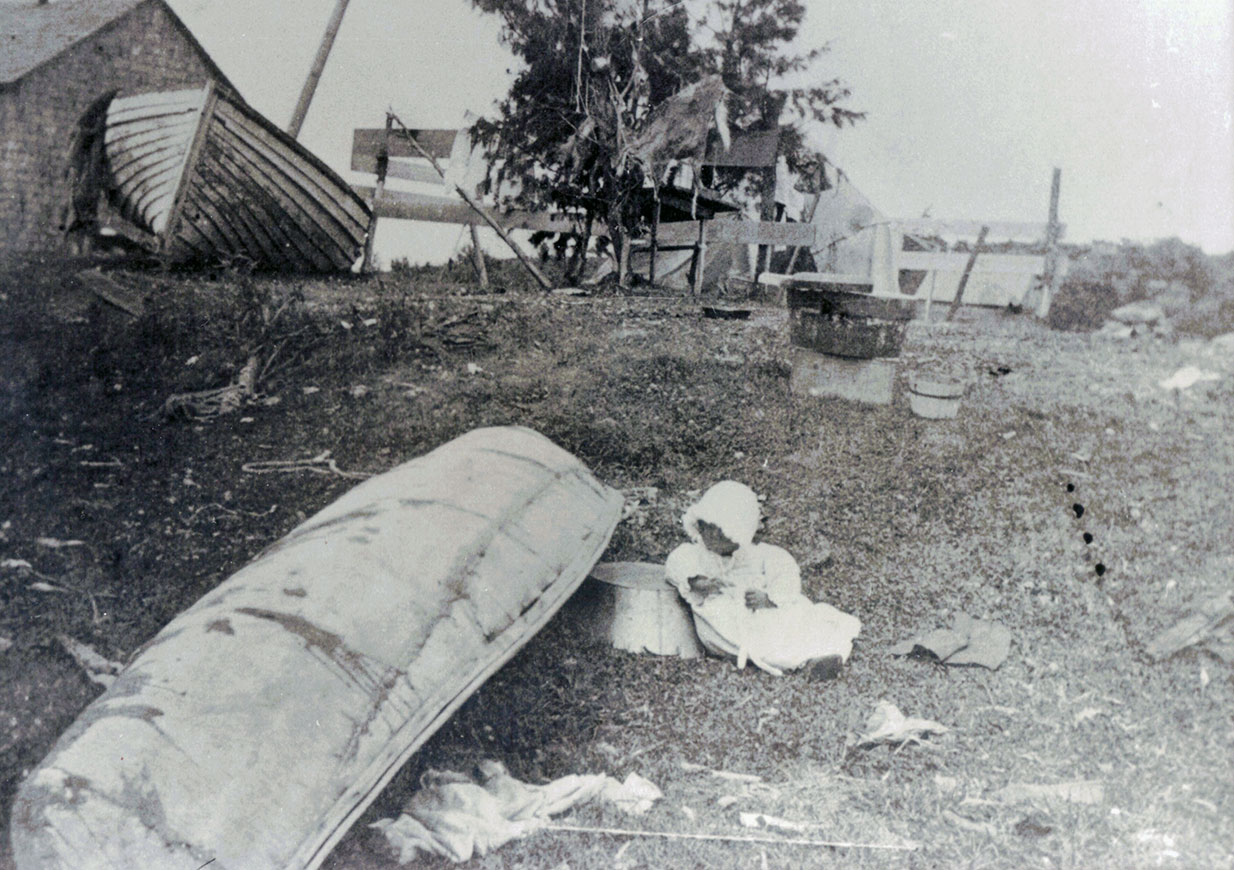 In 1992, Ted Wheatley, an elder of the Wausauksing First Nation on Parry Island, Ontario, told me he remembered sailboats being used in his youth by people of his community. Owing to the confined character of the waterways on much of Georgian Bay’s island-studded eastern shore, however, Wheatley said his people favored canoes over sailboats. He remembered only a dozen or so sailboats, a smaller number than those used by Natives across Georgian Bay at Manitoulin Island’s Wikwemikong First Nation. This unusual image shows both types of craft at Parry Island, probably in the early 20th century and close to the time of Wheatley’s recollection.
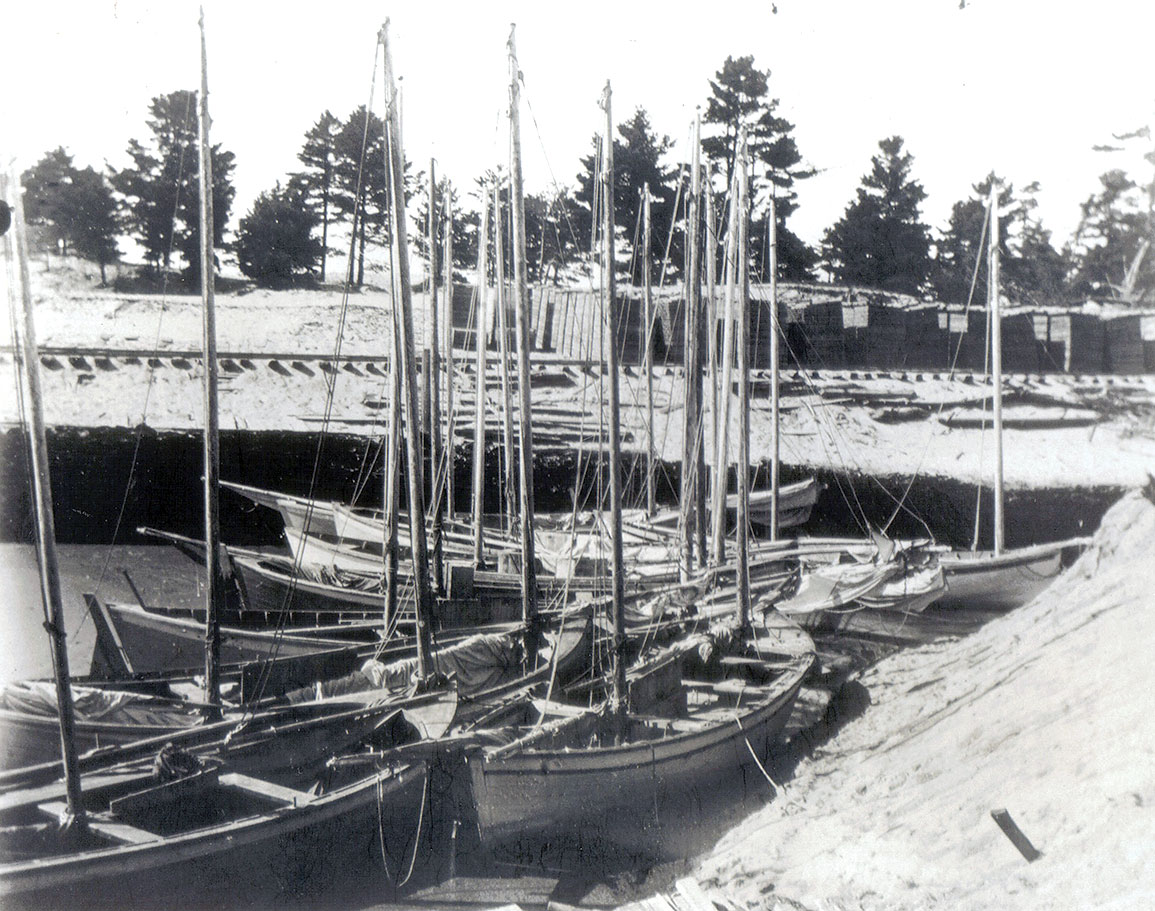 Early missionaries on northern Lake Michigan reported that Native Americans from the Beaver Island Archipelago were building and sailing planked wooden boats at least as early as 1845. In all likelihood, they were the first and last people on the American side of the Great Lakes to depend on such craft as their primary means of transportation. Here, the so-called “Indian fleet” is moored at Manistique on the Upper Peninsula. Native Americans regularly sailed there to shop, sell their handcrafts, and visit relatives.
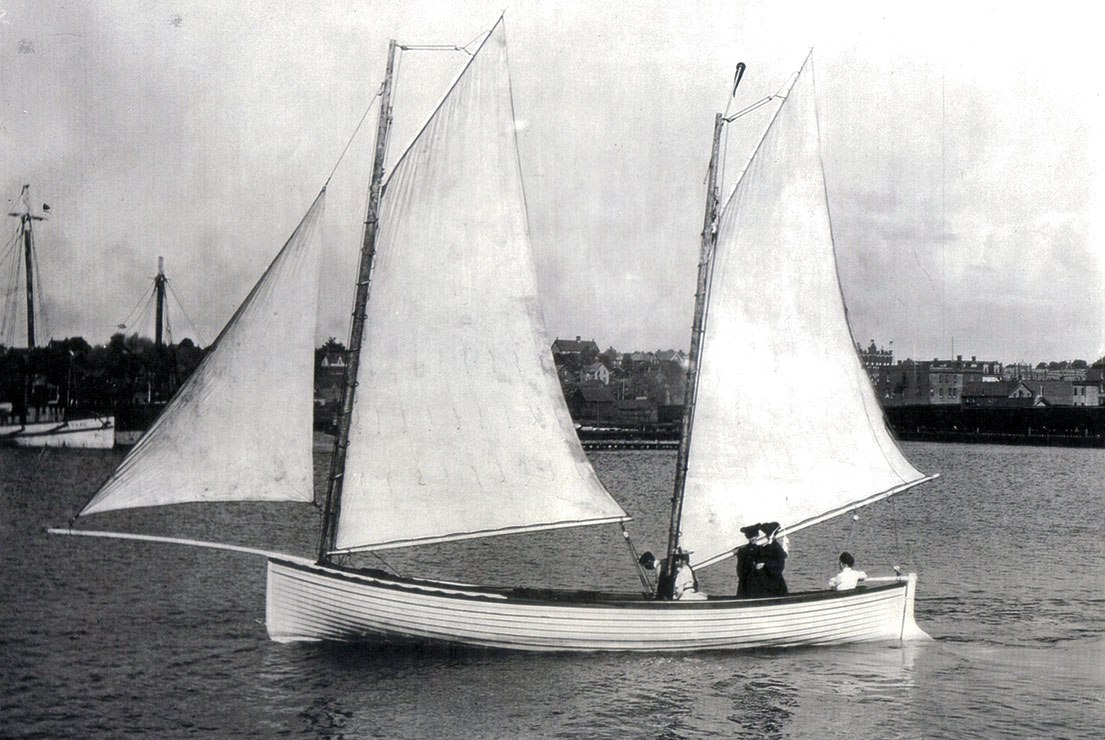 Few topics in the history of Great Lakes traditional watercraft have stirred such controversy as the relationship, or lack thereof, between the Mackinaw boat and the Collingwood skiff. This photograph shows a typical skiff in the Midland, Ontario, harbor around 1904. Both types appeared on the upper Lakes between 1840 and 1860. Some people are inclined to nominate one craft as the inspiration for the other. Those familiar with the two boats, their builders, historical documents, geography, and, most important, lines of various boats are firm in their belief that the Mackinaw as described in an 1880s U.S. Fisheries report and the Collingwood skiff were two entirely different craft.
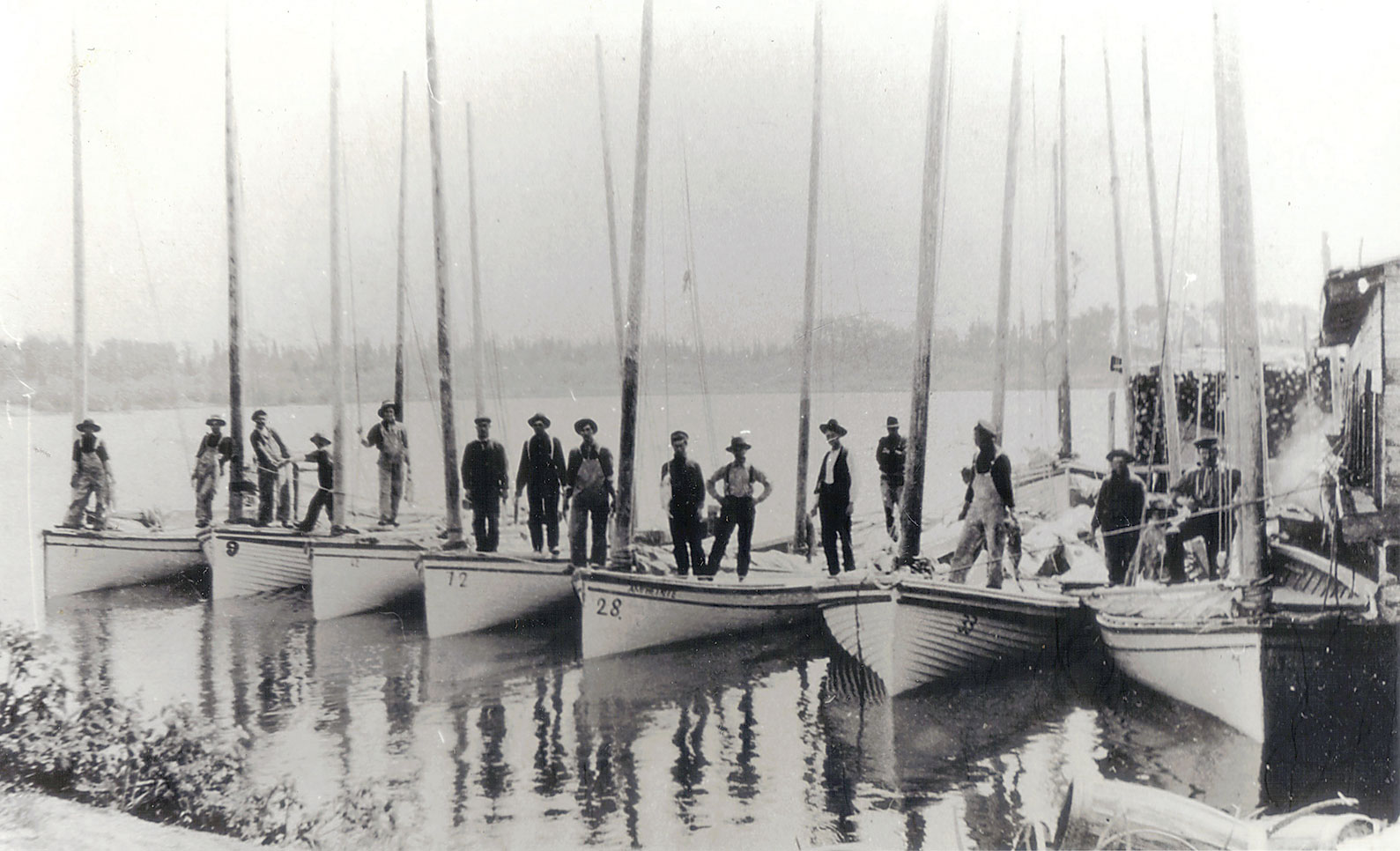 In addition to Mackinaw boats and Collingwood skiffs, the Huron boat was also a prominent fishing sailboat type used extensively on the upper Lakes during the second half of the 19th century. The boats shown in this photograph, taken at Cockburn Island, Ontario, in the late 1800s or early 1900s, show the cat-schooner rigs that were common in the region.
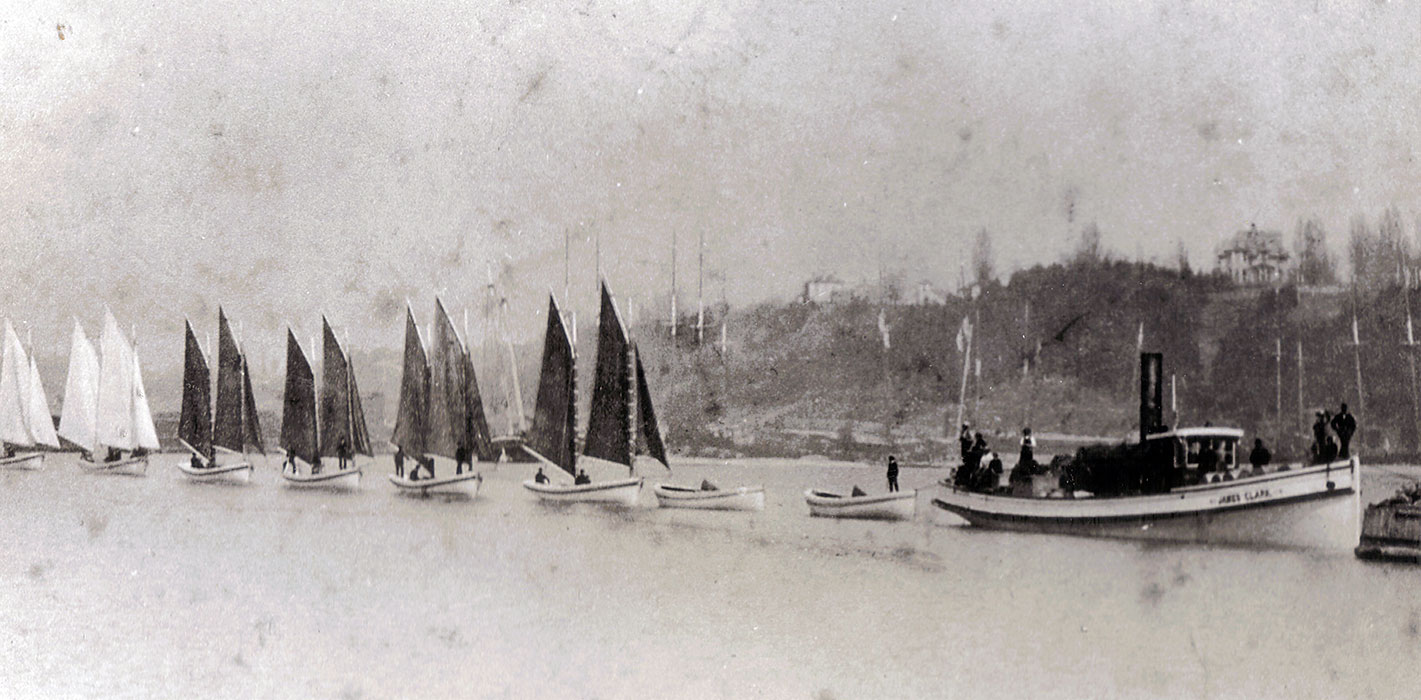 The steam tug JAMES CLARK, built in 1883 at Goderich, Ontario, tows a string of fishing boats on Lake Huron. Mostly transom-sterned, these boats fished in the vicinity of Duck Islands in northern Lake Huron, and at one time hauled enormous catches that were sold to the Buffalo, New York, market. According to local sources, the man James Clark was born in 1840 in Orkney off the northern coast of Scotland and emigrated to Canada in 1867. Locally, he became known for his classic rags-to-riches story, but whether he had any influence in the design or construction of these fishing sailboats has not been established.
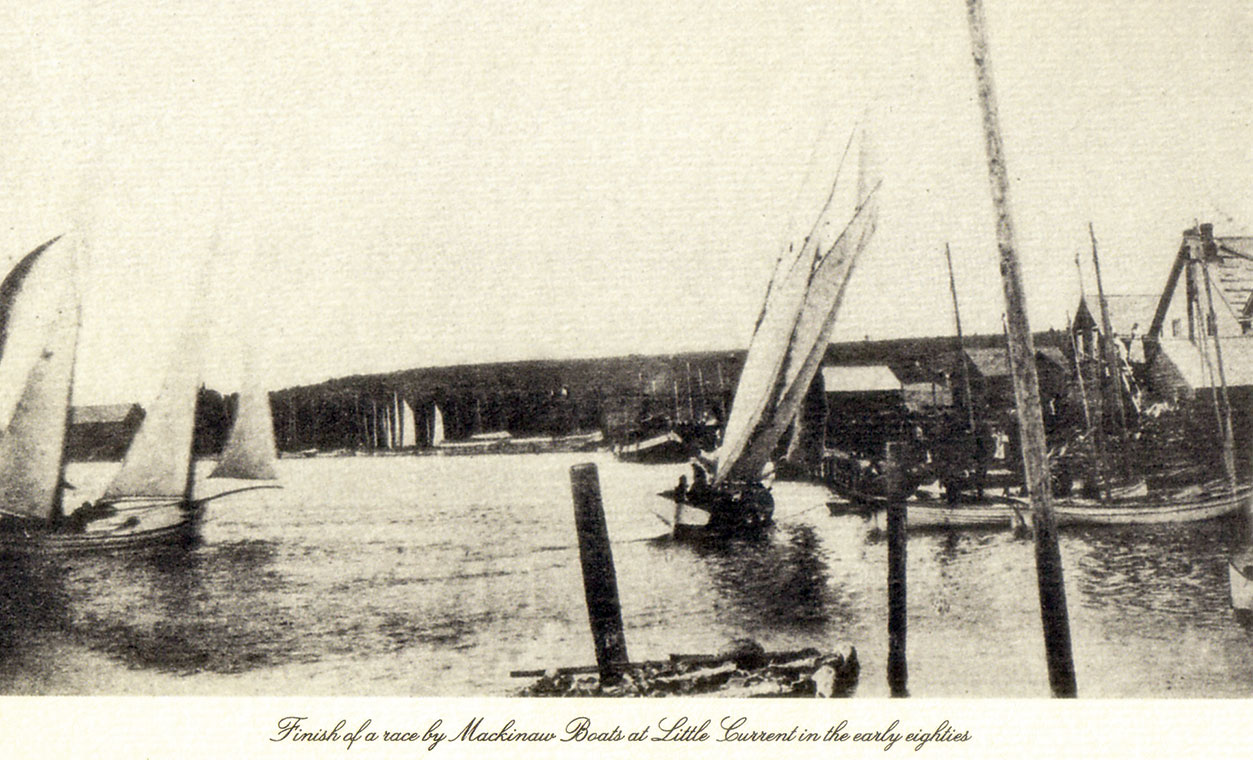 Sailboat races at Little Current, Ontario, marked Dominion Day (July 1, now known as Canada Day) on the North Channel at least as early as the 1880s. This photograph, printed on the textured paper of a 1936 Christmas card sent to friends by Grant and Freda Turner of Little Current, shows a diverse assortment of sailboats at the finish of a race. Most of the craft belonged to owners from either nearby Indian reservations or commercial fishermen from Georgian Bay and Lake Huron. The habit of calling all of these boats “Mackinaw boats” regardless of origin, size, or hull configuration, developed early around Manitoulin Island and extended even to Native-owned flat-bottomed skiffs. The only thing all these craft held in common was canvas. In more than one instance, Indian fishermen were so poor that “canvas” consisted of an old blanket tied to a pole.
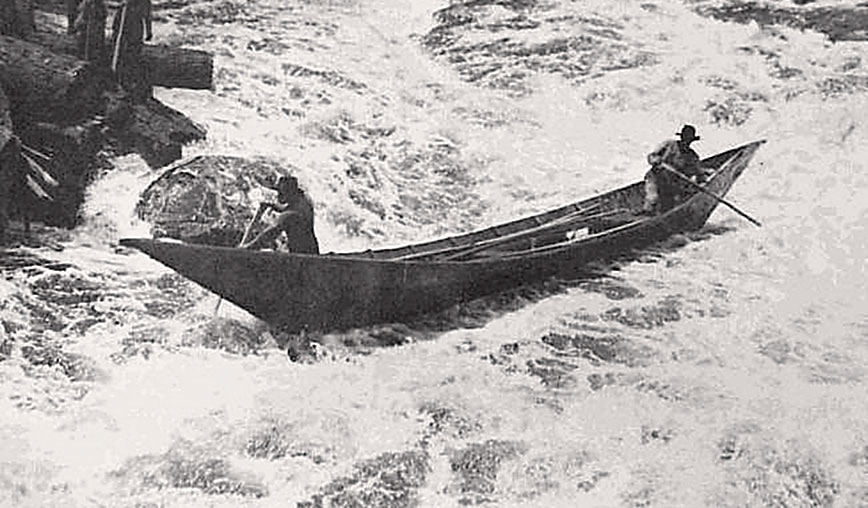
One of the earliest planked boats introduced in widespread regions of the upper Great Lakes was the lumberman’s bateau, sometimes referred to as a “pointer.” Their origin traces back to French settlers who brought the type to North America in the early 1600s. The crudely built workboats were used into the mid-20th century. Typically, they were 30′ to 50′ long, but bateaux (the plural form of the French word) as short as 12′ and as long as 84‘ are known to have been built. This photograph shows two men running the dells of Wisconsin’s Wolf River. Note the forward paddler’s “cross-bow draw,” a maneuver practiced even today by whitewater canoeists. An Indian acquaintance of mine told of riding pointers down wild Canadian rivers when he was a runaway orphan teenager desperate for work in the early 1940s. His position in the bateau was not an enviable one: he rode the “point,” with legs wrapped around the sharp bow. Few of these boats have survived. More than a few lumbermen lost their lives while trying to break up logjams from these unusual craft, using long poles carried aboard as seen here. The author Malcom Rosholt published this same photograph in The Wisconsin Logging Book, 1839–1939.
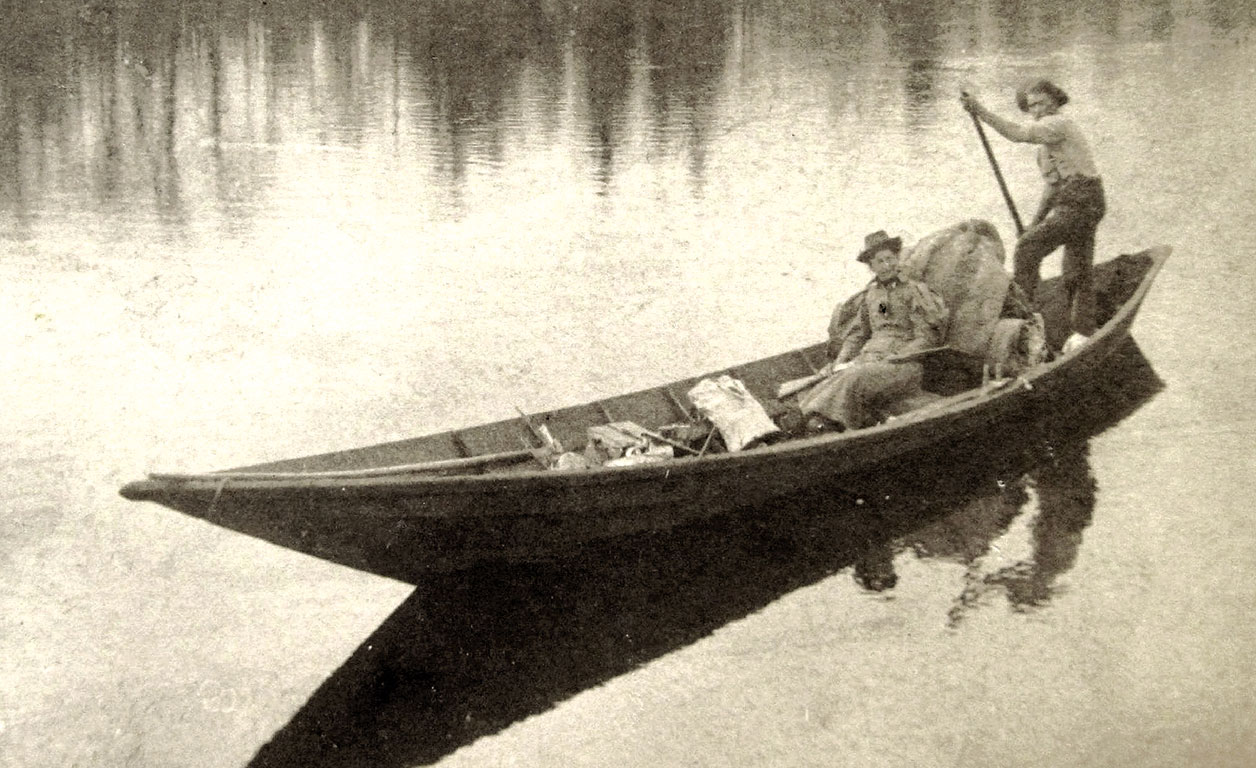 Around 1900, Truman Ward Ingersoll of St. Paul, Minnesota, became famous for his production of stereoviews. This was an unusual one, titled “Life on a Bateau,” showing a small “pointer” on the St. Croix River. Although somewhat shorter than the large boats used in the logging industry, this bateau worked well for personal transportation. Buffalo robes were still a popular item of comfort around the Great Lakes at that time, and the passenger—presumably the poler’s wife—might well be enjoying the comfort of such a luxury during what could be a hunting outing, judging by the rifle she’s holding.
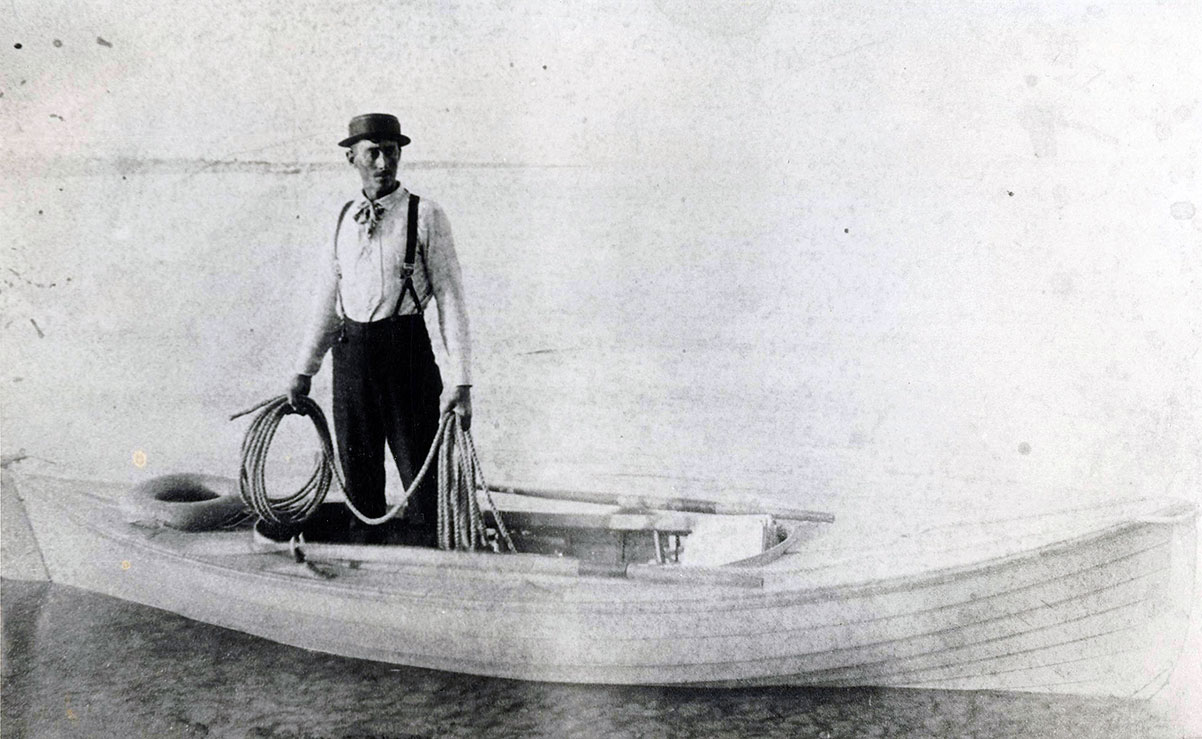 The 16′ “Dagwell message boat,” is one of a kind. She was used by Charles T. Dagwell, who was born in London, England, in 1864 and came to Mackinaw City, Michigan, in 1881; his job in the early 1900s was to record and report weather conditions at the sometimes-treacherous Mackinac Straits and to record ship passages. It was dangerous work at times, requiring him to row out to meet ships and to deliver mail, groceries, and changes of shipping orders. In addition to being a fearless oarsman, Dagwell was also a gifted craftsman; he built this boat (see WB No. 45) in a workshop next to his weather station. She reportedly carried a single mast at one time but was later partially decked.
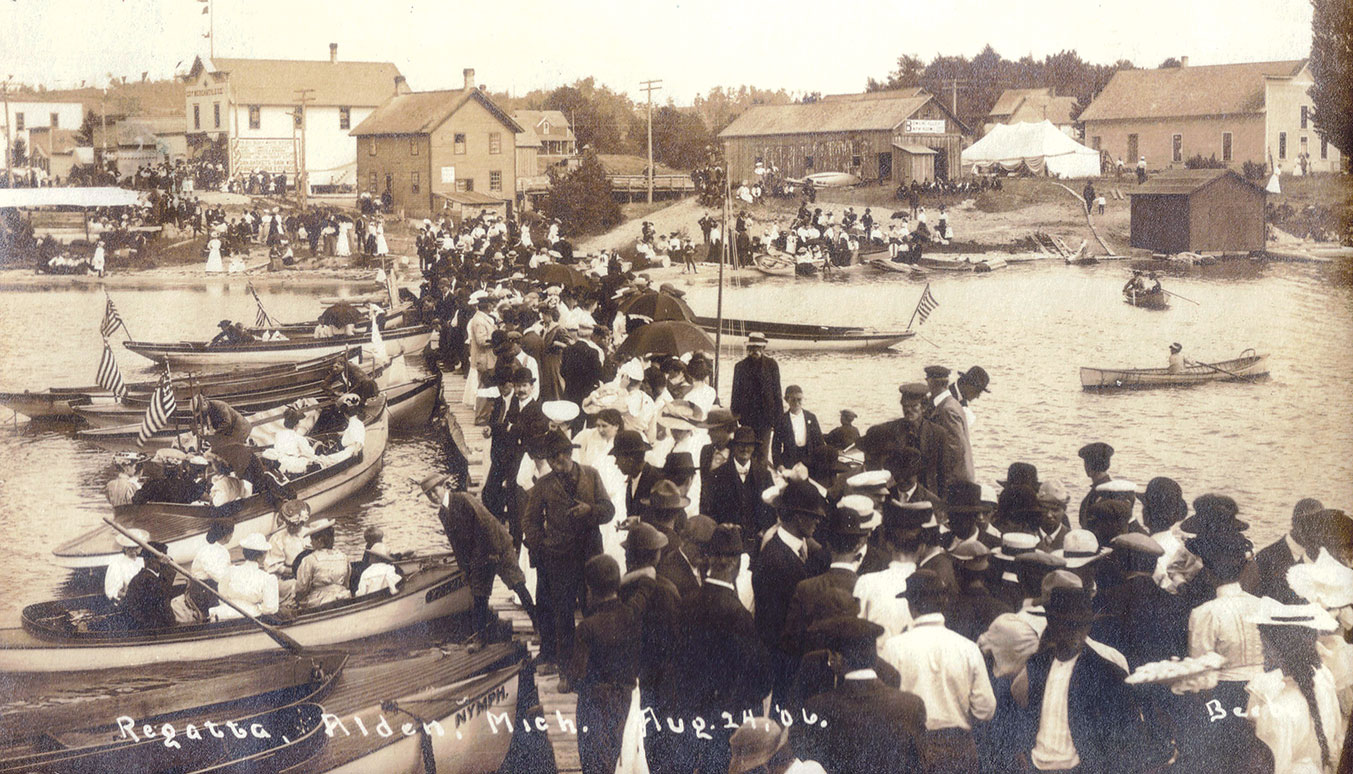 A regatta on northern Michigan’s Torch Lake brought out the whole town of Alden and then some. Diverse rowing craft, at least one sailboat, and a good number of motor launches are evident in this early view from a well-known photographer named Edward Beebe. Today, a few mahogany runabouts keep the flame of wooden-boat heritage alive on the lake.
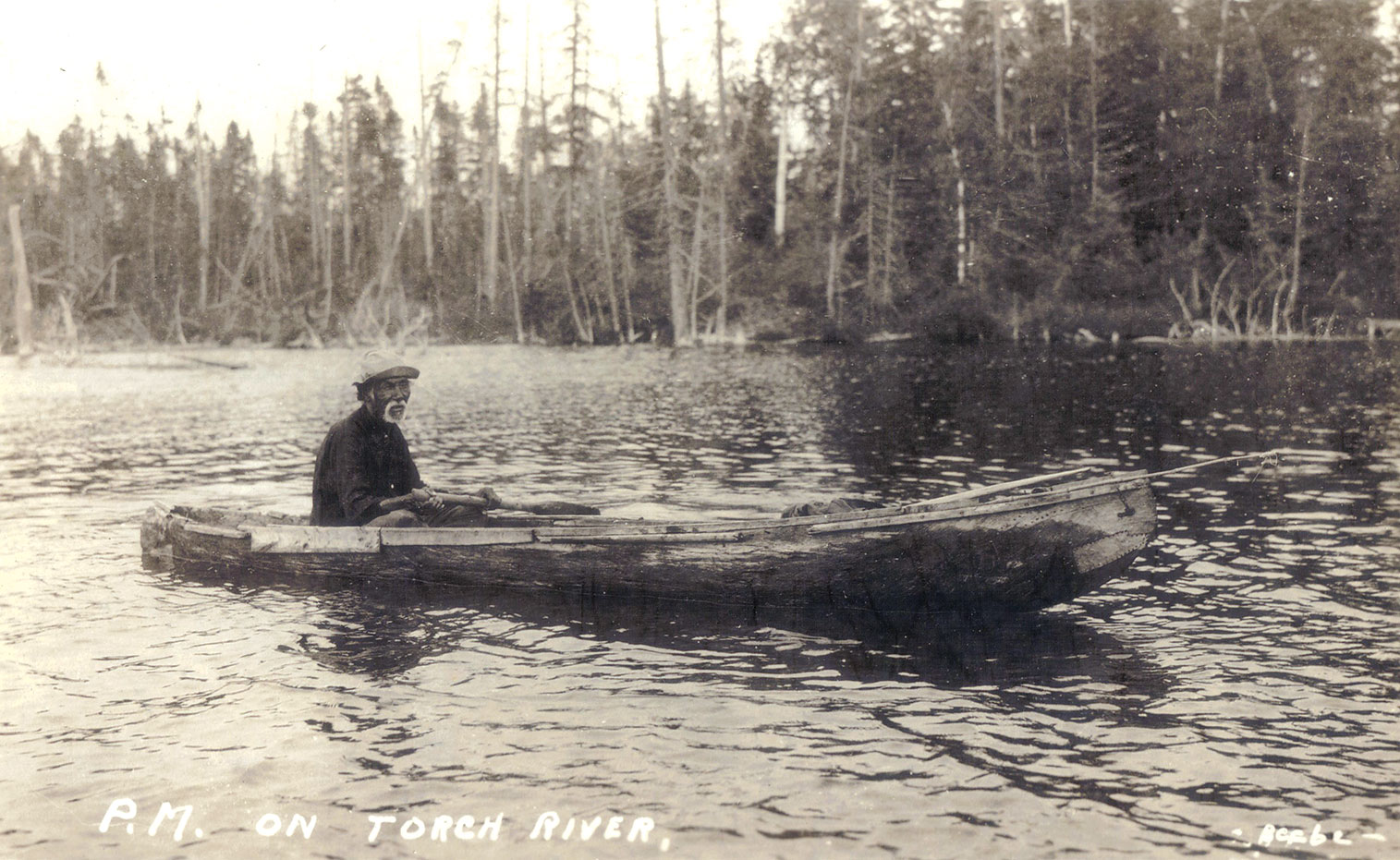 Not everyone on Torch Lake participated in the high times of a regatta in state-of-the-art watercraft. An elderly, poverty-stricken Native American named Peter Markus, known locally as “P.M.,” traveled the same waters his ancestors had known for centuries—and in the same kind of boat. This image, taken in about 1910, shows him making his way down the Torch River in what appears to be a dugout canoe with a plank-reinforced sheer. Much later, he was photographed on the same waterway in what was possibly a worn-out livery rowboat discarded in favor of a motor-powered craft.
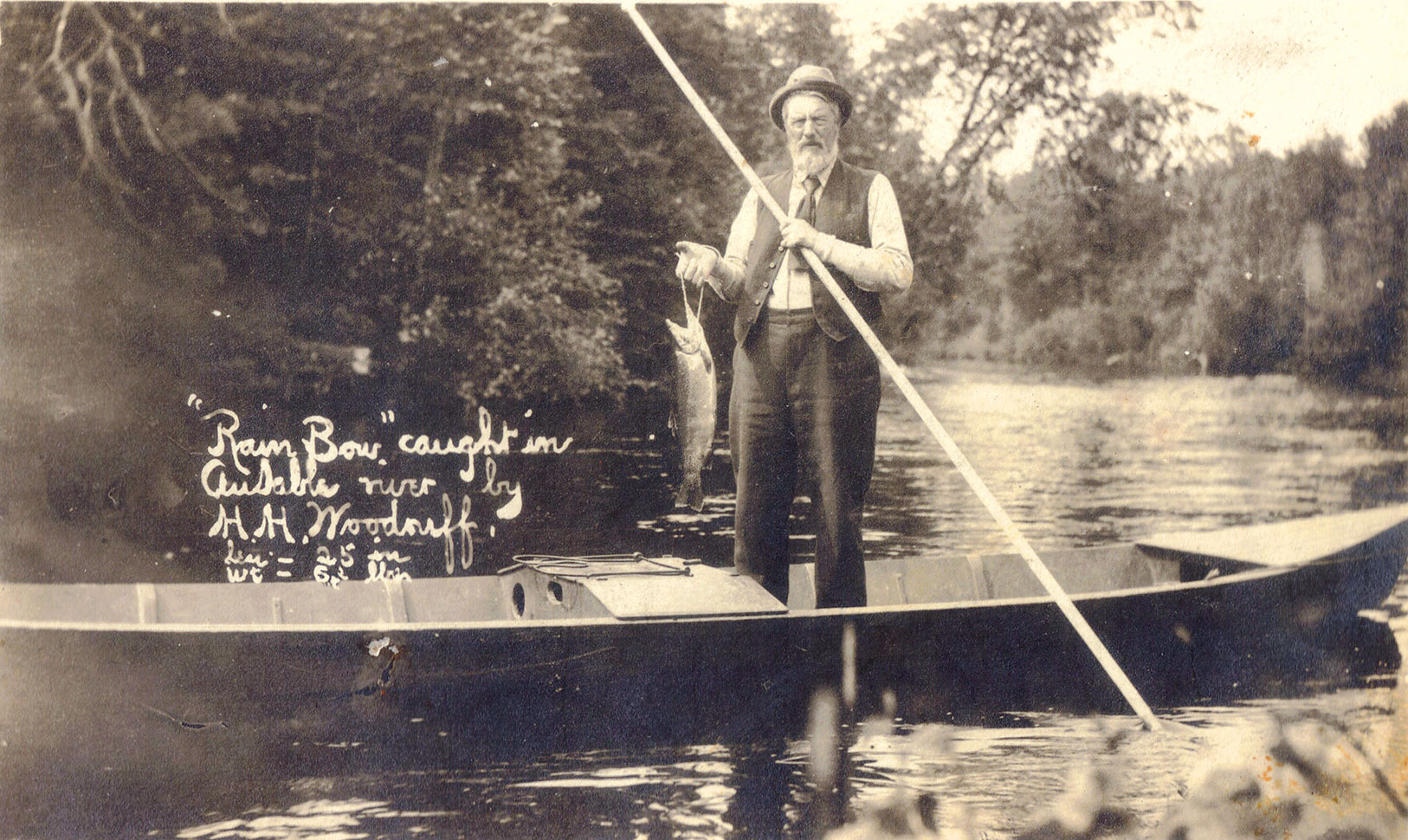 One of the few small craft indigenous to Michigan is a type that came to be known as the Au Sable River boat. Most were built at Grayling for the sole purpose of trout fishing on the river. Their history is obscure but is believed by some to derive from river boats used in the lumbering era. A few serious trout anglers on the upper Au Sable River are still using boats similar to the one shown, but few fishermen will ever see a 25″ trout like the one H.H. Woodruff is holding.
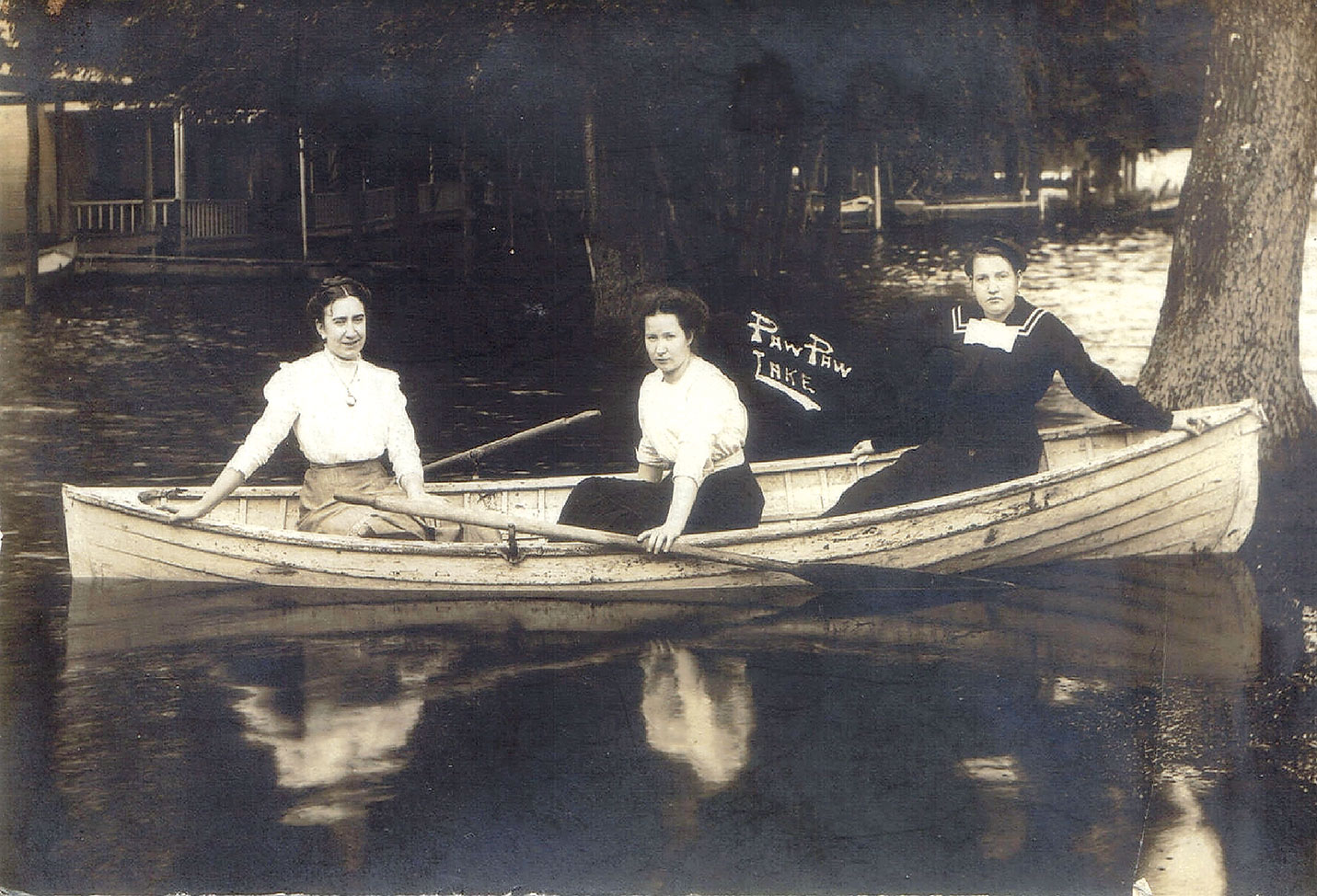 Floodwaters brought these ladies out in the early morning near Coloma, Michigan. Their boat was a common type in the area, similar to ones built by Truscott Boat Mfg. Co., and no doubt many others as well. Distinct from larger rowboats commonly rented by liveries of the time, these little 15-footers appear most often in early photos from the southern part of Michigan’s Lower Peninsula. They were ideally suited to the area’s hundreds of small inland lakes and its mom-and-pop cabin resorts.
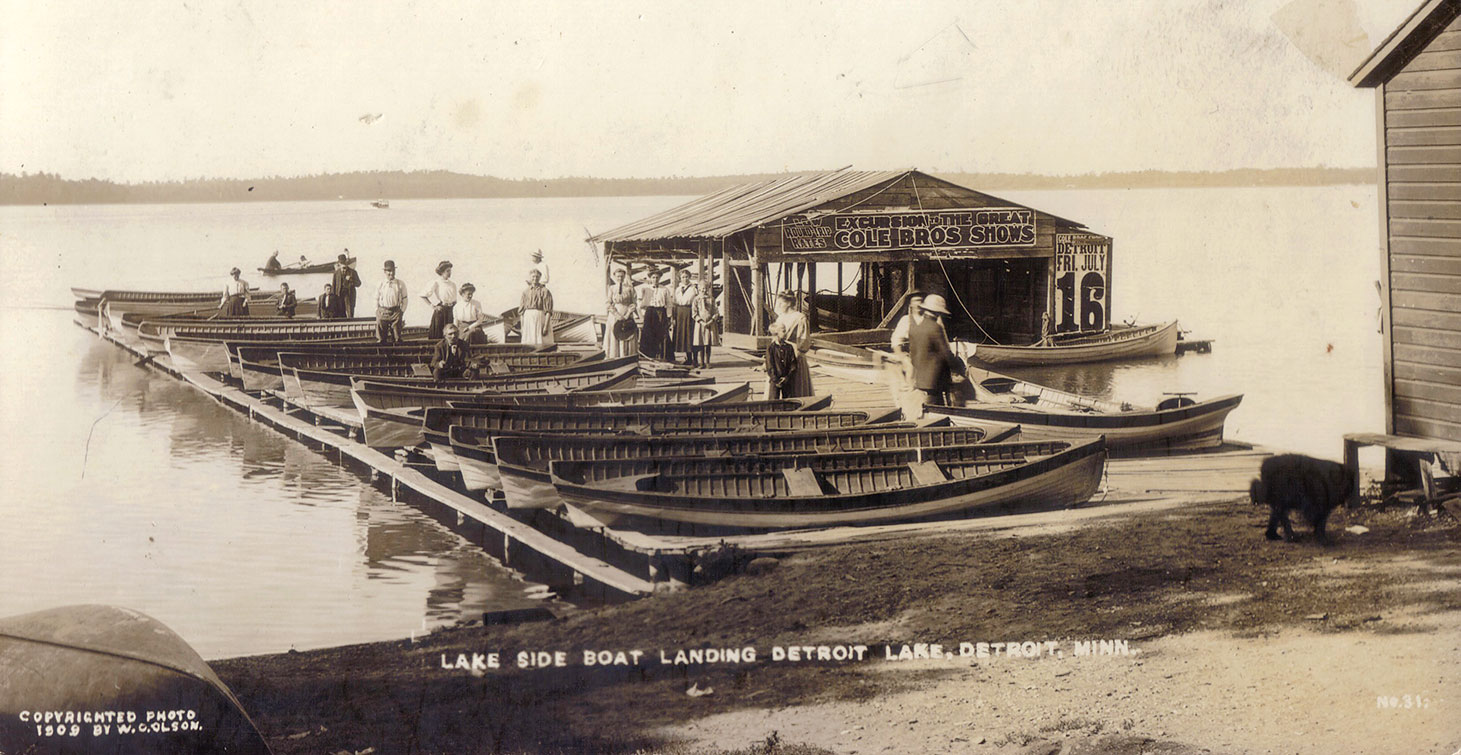 Minnesota has long been known as the “Land of 10,000 Lakes.” Judging from this photo of the Lake Side Boat Landing at Detroit Lakes, at least a few thousand rowboats must have served those sky-blue waters. Dr. Ann Merriman of Maritime Heritage Minnesota surmises that these craft might have been built at the Alexandria Boat Works, founded in 1885, but other possibilities are Joseph Dingle Boat Works, Moore Boat Works, or Ramaley Boat Works, all of which were based in the Twin Cities area. By 1952, the Alexandria firm alone had produced more than 15,000 wooden boats.
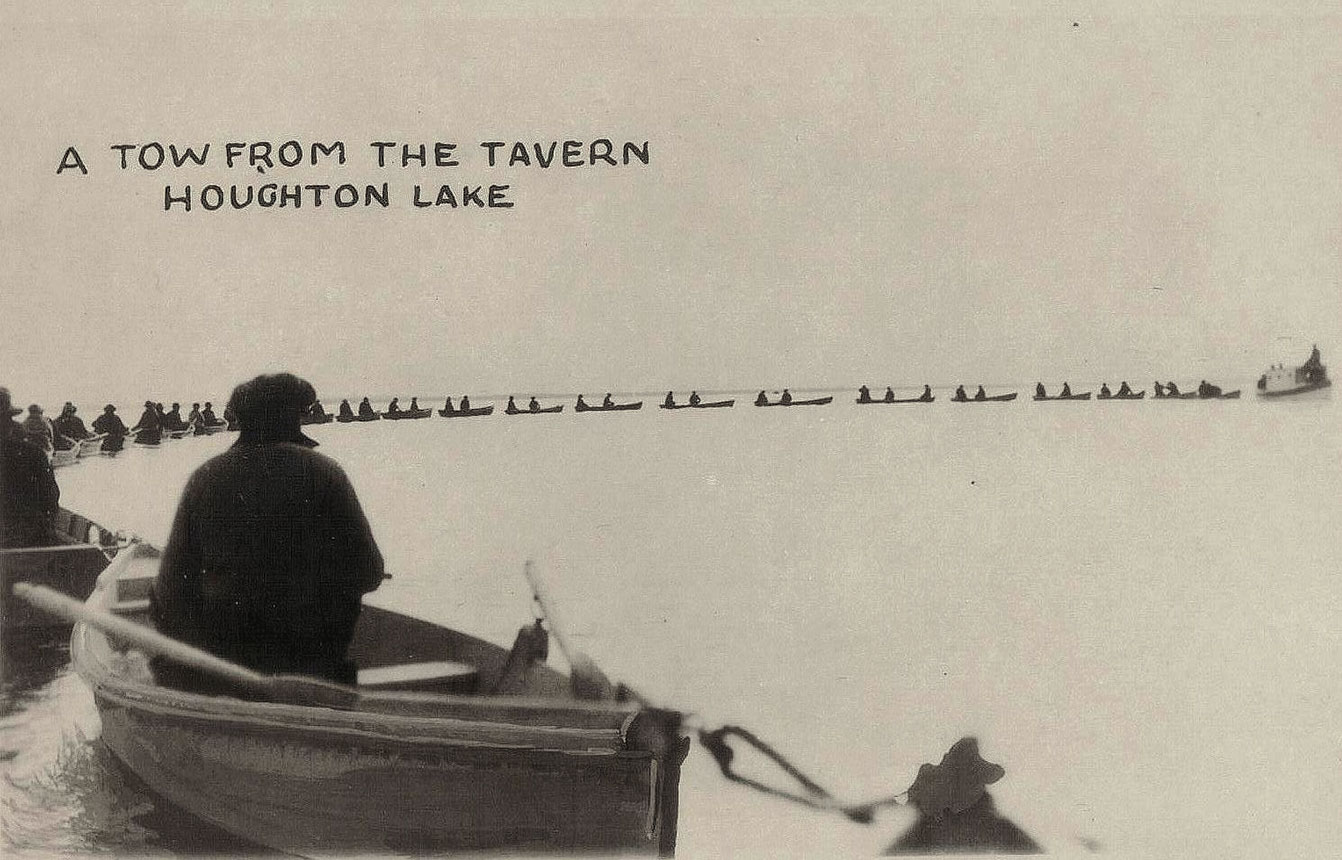 These flat-bottomed skiffs, shown in an early postcard, were towed in large strings to the best fishing spots on Houghton Lake, the largest inland lake in Michigan. Flat-bottomed skiffs were the most common craft in the less-affluent regions of Michigan’s inland lakes. The boat in the foreground is unusual in being double-ended; most flat-bottomed skiffs were transom-sterned.
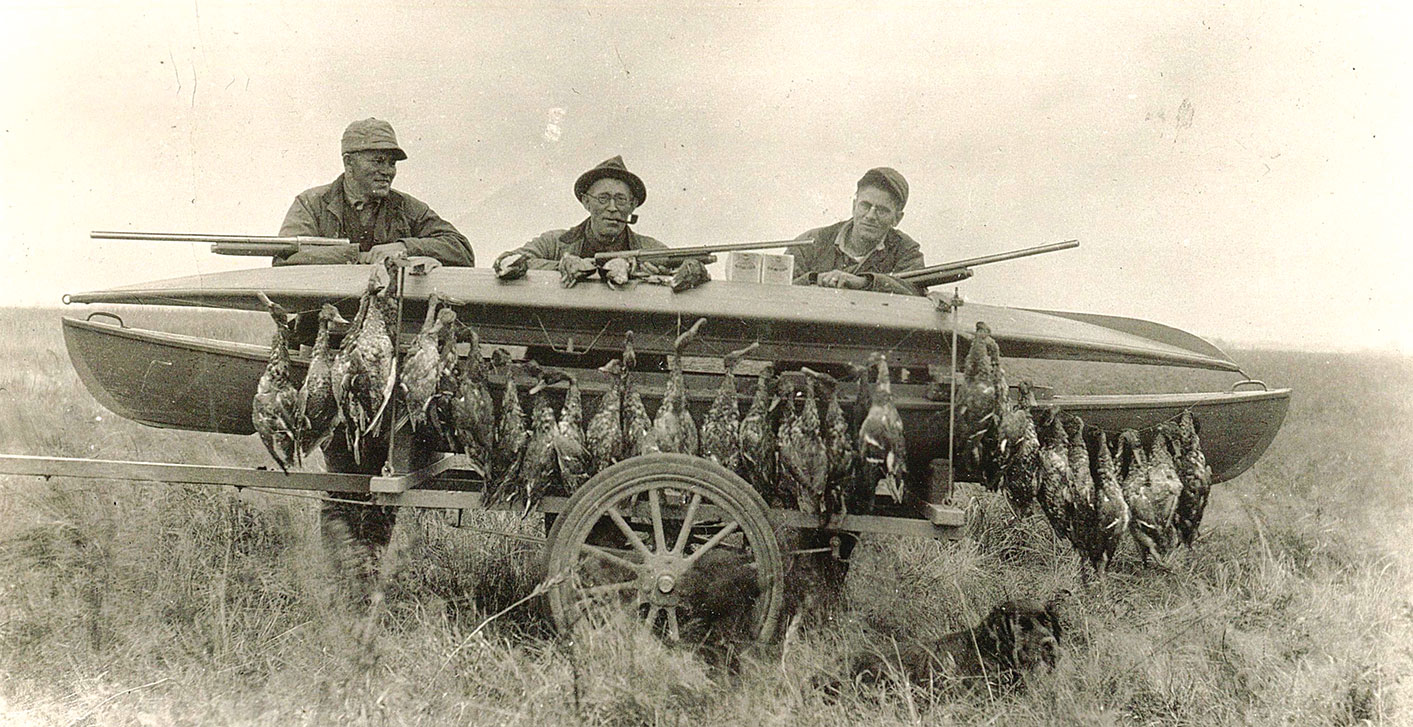 Midwestern builders of duck-hunting boats were experimenters and innovators, and they built boats using logs, wooden planks, wood-and-canvas, sheet metal, and later aluminum and fiberglass. Propulsion could involve poles, paddles, oars, sails, motors, or any combination of them. At Little Falls, Minnesota, Paul Larson designed and built his first “ducker” in 1913 when he was only 19 years old. Here he is pictured, at left, sometime between 1920 and 1930 with Dr. Fred Hoist, Fred Larson, and a harvest of waterfowl. The group has apparently stacked two boats on their trailer. Paul built his 14′ double-ender from white pine strip-planking over steam-bent white oak frames. He soon had another design success with the Game Warden Special, and after founding Larson Boat Works he went on to build a succession of snappy speedboats, the Falls Flyer being one of the earliest and most popular.
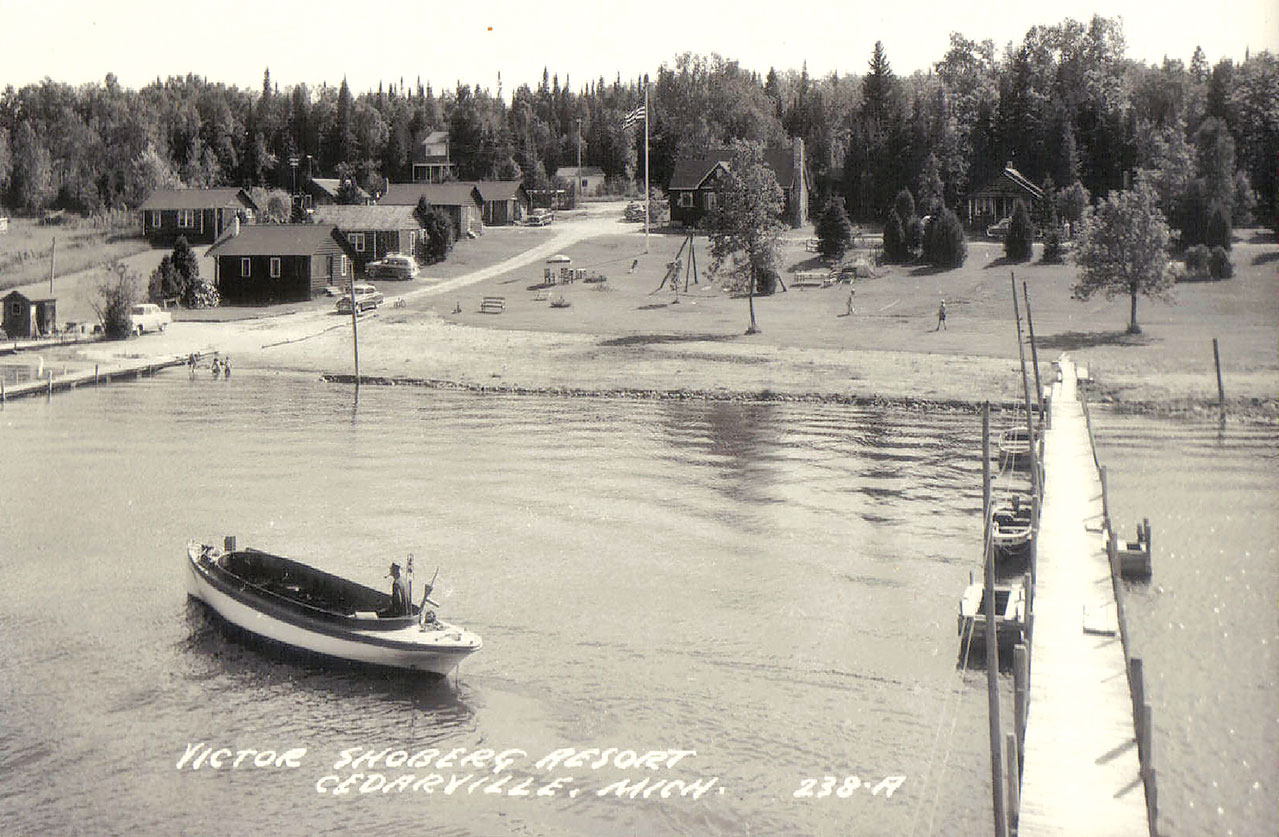 Victor Shoberg, a Swedish immigrant who settled in the Les Cheneaux Islands in Michigan’s Upper Peninsula, acquired his open 30′ Truscott launch in lieu of wages from the Islington Hotel, where he worked as a fishing guide. In this 1950s postcard photograph, he idles in front of his cabin resort near Cedarville. Shoberg is still remembered for this sportfishing wisdom: “If the fish are biting, you won’t need much bait. And if they’re not biting, you won’t need much either.”
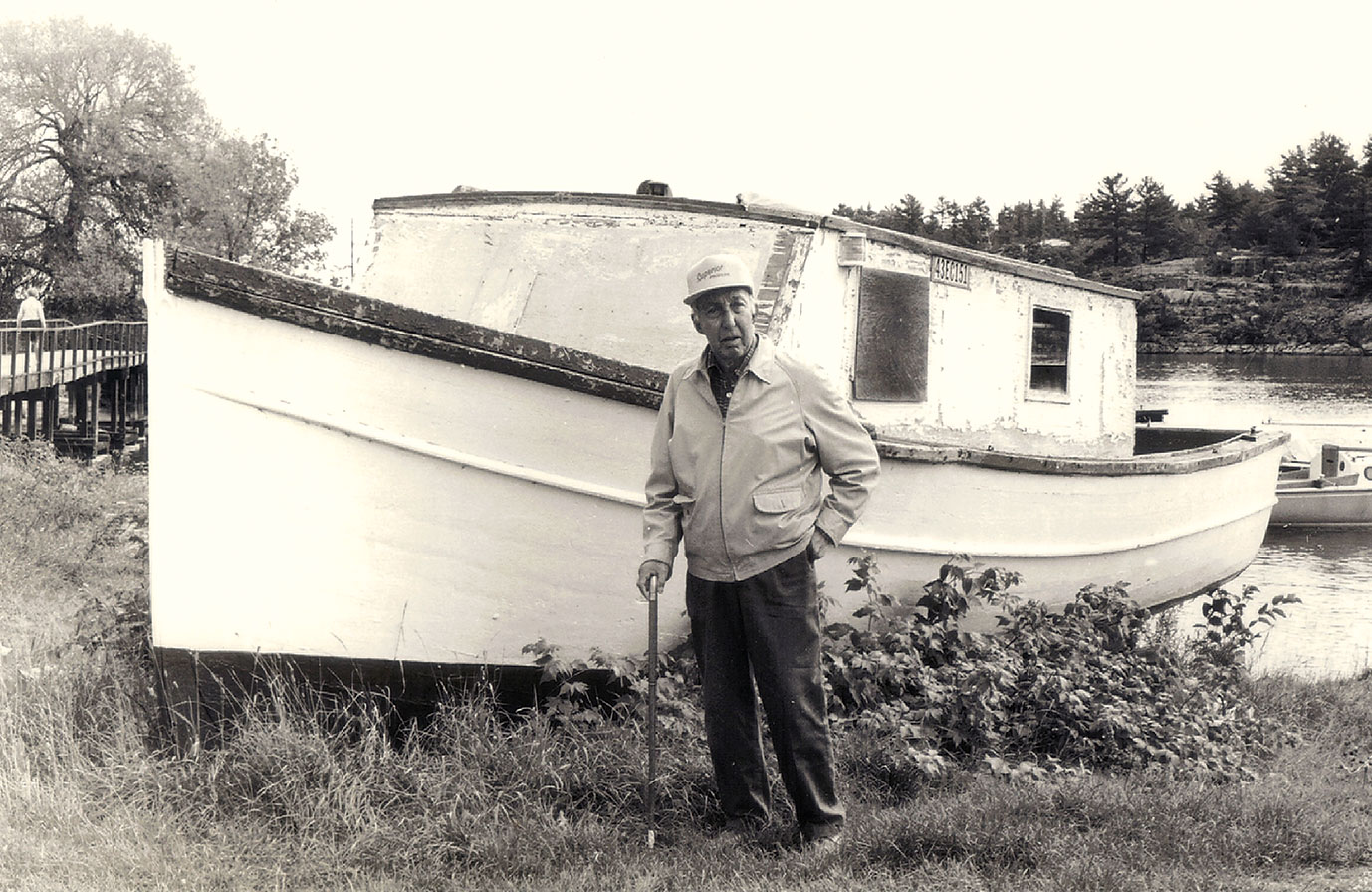 Gasoline-powered fishing boats eventually replaced sailboats in the commercial fishery of the upper Great Lakes. Such craft were especially popular among small operators, for whom large, steam-powered “fish tugs” were beyond the reach of one or two men trying to scratch out a living. Joseph Low is pictured here in 1992 at age 85 on the waterfront of Killarney, Ontario, where he built his own “gas boat.” While Low was fishing northern Georgian Bay with modern gear in this or another boat in the mid-1950s, he witnessed the last Canadian First Nations fishermen still hand-lining lake trout out of Mackinaw boats and selling them to Caucasian middlemen who had better access to the big-city fish markets.
Owen Cecil attributes his interest in traditional small craft to his family’s roots in northern Ontario and his early years in wooden boats. He has written numerous articles and papers on the subject.