
Measuring Tools
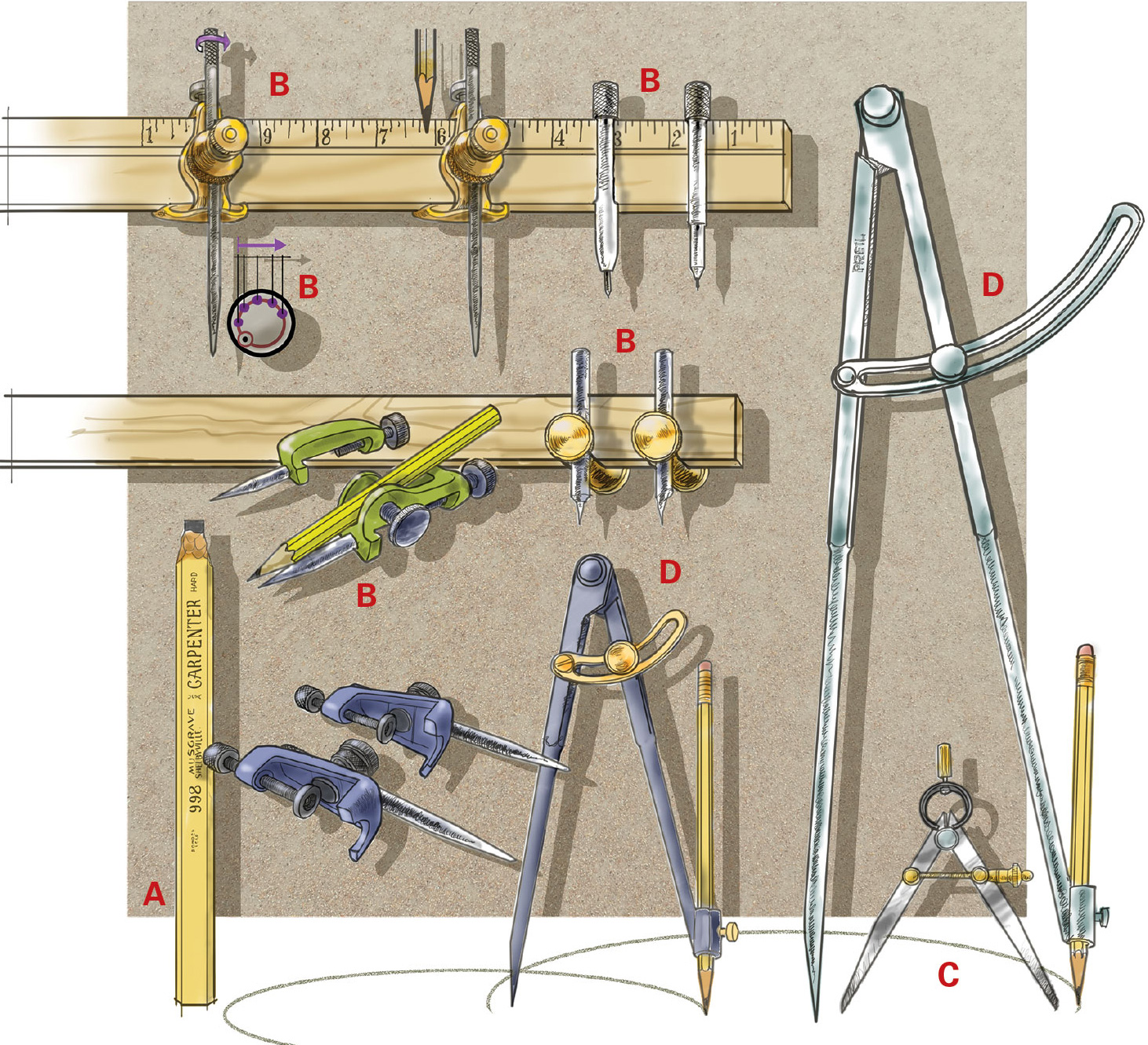
The carpenter’s pencil (A) at first glance seems like a crude tool for rough measures. But it is as underestimated as the framing square, which has multiple inch divisions and incised tables for abstruse joint angles and proportions. The easily sharpened No. 2 Ticonderoga pencil would seem to be a more modern and precise tool, but the venerable boxy wood butcher’s pencil has hidden virtues. Two obvious advantages: it fits behind your ear perfectly and it won’t roll off your bench. It’s also tough; it won’t break as easily as the thin Ticonderoga. The pencil, itself, is a tool. Nearly all box pencils measure ½″ × ¼″, which are useful dimensions, especially if you’re laying a deck and want a consistent seam gap; the ¼″ dimension is an ideal spacing. The distance between the broad side and the sharpened graphite tip should be close to ⅛″, so you can lay the pencil flat against a horizontal surface—say, a boat’s deck—and run the point along a vertical surface—say, a cabinside—to spile the cabinside to fit.