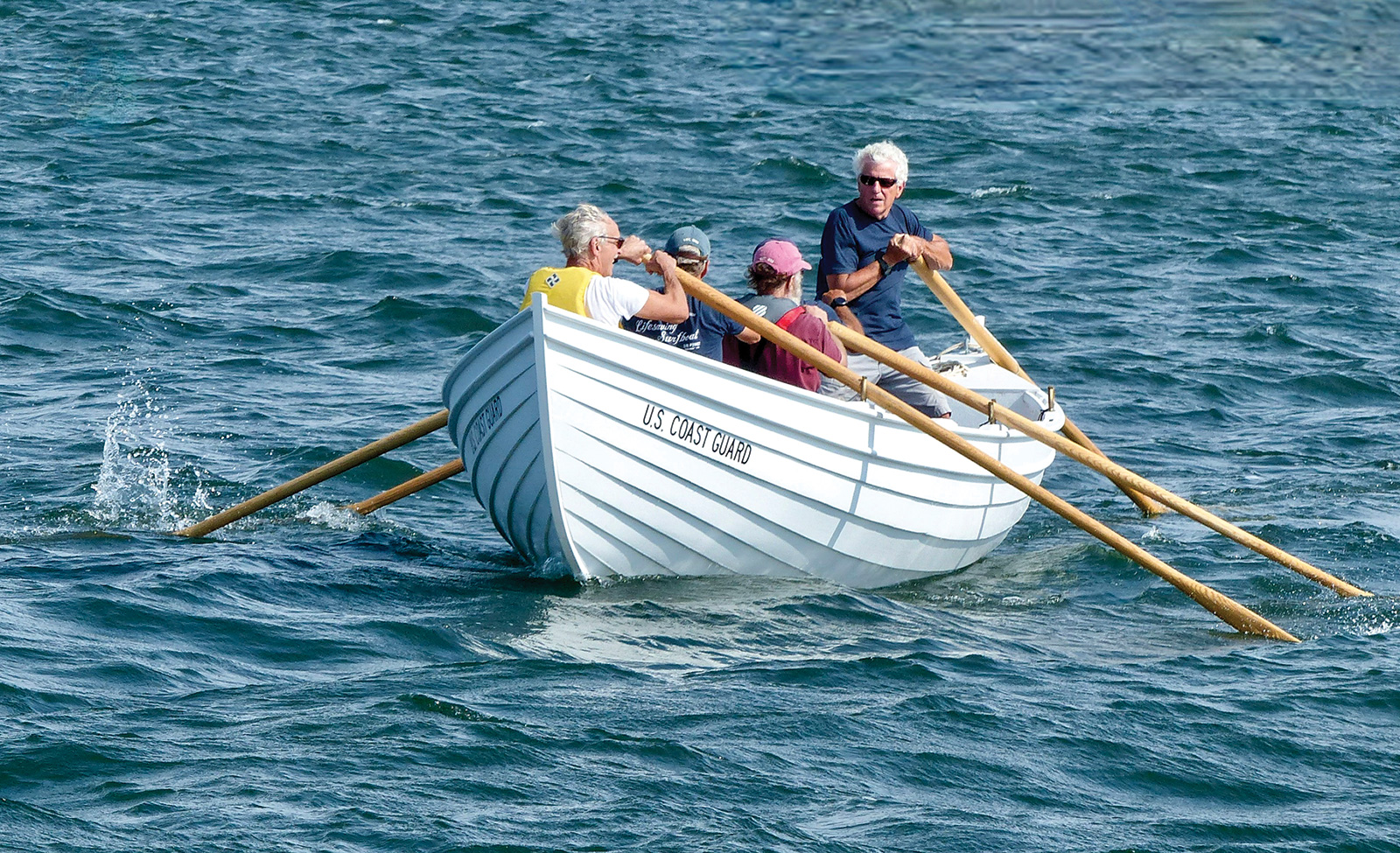
A 1944 rescue surfboat restored.

In 2025, a 1944 rescue surfboat restored in a years-long project at the Cape Cod Maritime Museum in Hyannis, Massachusetts, took to the water for the first time in 70 years, with a restoration volunteer, Bill Stirling, at the steering sweep and others at the oars.

A famous old adage, “Only cowards and fools leave a sinking ship,” was close to the heart of the life-saving surfmen of Cape Cod, Massachusetts, over a century ago. In those days, extensive shoals along the Atlantic coast of Cape Cod ran parallel to the beaches, and storms often caused sailing ships to run aground, sometimes after poor navigation left them trapped between sandbars. Their crews were most likely to survive if they stayed with the ship rather than attempting to negotiate the frigid and roiling surf to get ashore. It was far better for them to await rescue by the surfmen who patrolled the beaches day and night during winter months.

In December 1891, the lumber schooner DANIEL B. FEARING’s shrouds gave way in a northeaster off the coast of the Cape, and she grounded on the Outer Bar. When crews at the lifesaving station at Cahoon Hollow in Wellfleet spotted the ship, they knew from long experience that she was doomed. The surfmen readied their Cape Cod–style surfboat and—recalling their mantra, “You have to go, but you don’t have to come back”—headed to the crippled ship. The six rowers, under the mastery of skipper Dan Cole on the steering oar, battled breaking seas to reach the wreck. After loading the crew onto the boat, they learned that the cook was missing; he had gone to the galley to rescue his pet cat. The slight delay in waiting for the cook and his cat to board enabled the skipper to catch a perfect wave that carried the surfboat safely back to shore.

The Search for a Better Surfboat

The rescue of the DANIEL B. FEARING’s crew was successful even though the surfmen held a low opinion of their rescue craft. From the 1871 inception of the U.S. Life-Saving Service, which eventually had 13 stations on Cape Cod between Monomoy Island and Provincetown, that style of surfboat was the government-issued boat for inshore rescues. Among surfmen, however, the type’s difficult handling in rough surf—which they attributed to design flaws including a short waterline length, too little sheer height forward, and heavy displacement—made it widely unpopular. Their experience spurred the search for a better rescue surfboat. In Provincetown, surfman George Bickers of the Race Point Life-Saving Station worked with boatbuilder Charles Gardner in 1894 to design and build a prototype for a new boat, which became known as the Race Point type, 24′6″ long with more sheer forward and lighter displacement than the earlier type. Their design quickly gained favor and eventually replaced the Cape Cod boat as the surfboat of choice at rescue stations not only on the Cape but also across the United States.

By the 1920s, Charles Gardner had died, and the surfboats that had been built on Cape Cod were wearing out. The U.S. Life-Saving Service had merged with the U.S. Revenue Cutter Service in 1915 to form the U.S. Coast Guard, and as a result the responsibility for the construction of rescue surfboats was transferred to the U.S. Coast Guard Yard at Curtis Bay, Maryland. Until that change, surfboats had been built without plans, but in 1922 Ralph Winslow of Quincy, Massachusetts, drew up a proper set of plans along the lines of the Race Point type to make the construction molds for boats built at Curtis Bay. The boats were 24′6″ long with a beam of 6′2″ and displacement of 1,200 lbs. They were lapstrake-planked with cypress over oak frames. By 1931, the much-admired Race Point boat was standardized, and all future surfboats were built at the Coast Guard Yard; the last one of the type was constructed there in 1958.

The surfboat (left) moved into a covered workspace (right).

Above left—The surfboat had been displayed for years at the Cape Cod National Seashore’s Salt Pond Visitor Center in Eastham but was removed from public exhibition because of her deterioration, which was evident when Cape Cod Maritime Museum volunteers examined her. Above right—Because of the boat’s rarity, the volunteers agreed to take on the restoration and moved it into a covered workspace adjacent to the museum’s boatshop.

One of a Handful of Survivors

By the end of the 20th century, Race Point boats were rare. In 2005, Mark Wilkins and Cathrine Macort of the Cape Cod Maritime Museum (CCMM) in Hyannis learned of a 1944 Race Point surfboat that was stored uncovered in the woods on the grounds of the Cape Cod National Seashore’s Salt Pond Visitor Center in Eastham. She was surfboat 24467, which had been stationed at Cahoon Hollow. After years of enduring the elements, the boat was moved off exhibit due to her deterioration. When Mark and Cathrine saw her, the plank fastenings at the forward and after stems had failed. Planks were springing from the stems, especially forward. The stemheads and breasthooks forward and aft had rot pockets, which had also gotten into the sheer clamps, keel, and many plank hood ends. If something wasn’t done soon, she was sure to rot away, and her iconic history would be lost.

The CCMM staff was able to negotiate an agreement with the National Park Service to take the boat to their museum on loan and allow volunteers to shore up and preserve her shape until more extensive restoration work could start. She was one of seven known surviving Race Point surfboats, so restoring her would preserve the design of the boat and the history of lifesaving on the ocean side of Cape Cod.

In 2017, space became available to start the surfboat project, and I examined the boat to advise about what to do. I had not looked at her closely in 12 years; she was tucked away in a discreet outdoor storage location on the museum property. I found that there were now trees growing in her and all the planks had sprung from the rabbet. The keel and garboards had completely rotted. The stern was in better shape than the bow, and tighter, but rot was showing everywhere. At a board meeting, I reported that a restoration was not feasible. Instead, I proposed a “faux restoration,” which meant making her look seaworthy for display on land.

Plank hood ends sprung away.

Plank hood ends had sprung away from the stem forward.

That idea did not go over well with the museum’s board members, who were adamant that they wanted a seaworthy Race Point surfboat that could be used in the water to demonstrate this unique aspect of Cape Cod maritime history to the public. They again requested that I help, along with the other museum volunteers, to restore her to her original seaworthiness. I was not obligated in any way to agree to this seemingly impossible task, but the enthusiasm to restore a boat that represented such an important aspect of maritime history was irresistible. I agreed.

From the Start, a Sense of Commitment

On February 18, 2018, museum volunteers, led by board member Bill Stirling, who along with Jon Aborn managed the museum’s rowing and boatbuilding programs, gathered the crew—all retired men with a love of wooden boats and boatbuilding. Among the volunteers were an engineer, military personnel, an artist, an auto-body-shop owner, a contractor, a cabinetmaker, a tech executive, a salesman, an auto mechanic, and a schoolteacher. Together, we carefully moved the boat from her 12-year storage location on a shored-up cradle and into the museum’s outdoor, lean-to-style, roofed workspace, which was close enough to the museum’s boatshop to permit efficient work.

Making exterior station molds (left), A plumb bob assures alignment (right).Tony Davis (right photo only)

Left—The restoration plan involved making exterior station molds to restore and stabilize the hull’s shape. Right—A plumb bob assures alignment with the new keel’s centerline to work out the twist.

For an undertaking such as this to be successful, we needed a solid, step-by-step plan that we all agreed on before we removed anything from the boat. It was critical that we not lose any more of her original shape; her hull already had a very noticeable twist to port forward of amidships.

Our first step was meeting with Richard Boonisar, a New England expert on the Race Point surfboats. In 2007, Richard had Pert Lowell Co. of Newbury, Massachusetts, restore Race Point surfboat 24472 for display at his Life-Saving Station at Gurnet Point in Plymouth, Massachusetts. We visited the station and took notes and photos of Richard’s restored boat. He supplied us with an original set of plans and, in addition to being one of the volunteers, served as our in-house historian. Throughout the seven-year restoration, his guidance helped us keep every detail true to the original, ensuring that the result of our efforts would be authentic.

Steam-bent white-oak frames (left), and new laminated stems (right).

Left—Alan Reed steam-bent white-oak frames over bending jigs taken from the hull lofting. Right—He also fitted new laminated stems to the replacement keel.

Our next step was to inventory all hardware. Don Stucke, the museum’s curator and an artist, got started photographing and archiving the existing boat, which he continued to do through photos and notes throughout the project. Once we had photos and written inventory done, we started removing what we could save, including the floorboards and keelson. We kept the thwarts and thwart knees in place, because they, along with what was left of the full-width frames, were the only pieces holding the hull together from port to starboard. It was obvious that if we removed the thwarts and rotten frames, she would become impossible to restore.

At a February 2018 exhibitors’ party, which the museum hosted for the Boat Builders Show on Cape Cod, volunteers Alan Reed, Bill Stirling, Don Chapin, and I hatched the idea that instead of making molds to fit the inside of the boat, we would use the table of offsets and program Don’s CNC machine to cut the molds for the outside of the hull, factoring in the plank thickness plus 1″ to allow wedges to be driven where needed to nudge her back into shape. During this planning stage, we also discovered that on the topsides, only the hood ends of many of the cypress planks had rot, so we decided we would scarf-in new cypress lapstrake plank ends with the appropriate gains instead of replacing the entire planks. Finally, we knew we needed a new keel, forward stem, after stem, garboards, and broadstrakes, so we started hunting down the needed material.

Fitting a plank to the installed stem (left), and Jeff Silcox installs frames (right).

Left—New hood ends scarfed to the existing topside planks allowed much original planking to be saved. Here, the author is fitting a plank to the installed stem; Bill Stirling is at left and Peter Cross at right. Right—Jeff Silcox installs frames, which had been steam-bent over molds ahead of time.

Our last task was to create a work schedule for the volunteers. We decided to meet every Wednesday afternoon for four to five hours until she was done. While the exterior molds were being cut by Don, Bill, and Alan, the old keel and garboards were removed and a new keel was made in the Cook Boat Shop, along with the 2″-thick × 3½″-wide white-oak forward and after stems, which were steamed and bent on a jig we had fabricated from our lofting work, just as they were done originally.

Painting the interior (left) and fitting steam-bent thwart knees (right).

Left—After the watertight compartments forward and aft were built, Peter Cross (right) and Jeff Silcox (left) painted the interior forward and Whitney Wright painted the after end. Right—Ken Kolbe, (right) works with Whitney Wright to fit steam-bent thwart knees.

The dedication to this project persisted through six winters in a partially enclosed outdoor environment, at times dealing with cold and blowing snow, though it was not nearly as bad as the conditions the surfmen would have experienced at their coastal stations in winter. Whitney Wright was in charge of wedging the hull back into shape and getting her plumb fore-and-aft. The effort was to get her as close to her original offsets as possible, which were clearly marked on the molds. Alan Reed and Ray Ward fitted and fastened the new after stem to the new keel and began scarfing plank ends and fitting them to the now perfectly plumb after stem. Bill Stirling, Jeff Silcox, and Bruce Colvin did the same at the forward stem, which was a bit more difficult because we had to plumb the stem carefully in order to get the twist out of the hull. With these planks in place and acting as ribbands, the hull was held together.

Next, we needed to install as many new white-oak frames as possible, fitting and fastening them with copper rivets before we could roll the hull over to repair bottom planks, which we could not get to with the hull right-side up. Jeff Silcox was key in designing and building a jig that allowed us to eventually steam-bend the 32 white-oak frames and many of the 28 floors outside of the boat. After enough frames were in place and cross spalls were added, the hull was sound enough to roll over.

The boat is turned over to focus on the bottom planking.

Left—With the interior structure largely completed, the boat could be turned over to focus on the bottom planking. Right—First, the new keel was beveled to receive the garboard planks.

Persistence Equals Progress

Jeff Silcox and the team engineered a way to carefully roll the hull over so Jeff could spile and fit the new cypress garboards, which were cut from a 20″-wide, 100-year-old cypress plank that museum board member Craig Ashworth had set aside after completing a local barn restoration. With garboards in place, we now had her in position for the laborious task of finishing riveting all the new frames and floors to the lapstrake planking.

Years passed, but the dedication to meeting every Wednesday was consistent. Slowly, we could see our surfboat taking on a new life. Peter Cross became a riveting specialist, and he and others sealed all the new wood with thinned-down primer paint and red lead to prevent the wood from drying excessively in the summer sun.

Garboards were replaced and broadstrakes were also replaced.

Left—The original garboards were too far gone to be reused, so they were replaced. Right—New broadstrakes also replaced the deteriorated original ones.

When all the work was done in her upside-down setup, we carefully rolled her back over. Jeff spiled and fit the new cypress sheer planks, allowing us to set the final frame rivets, and Peter and the team installed hundreds of new rivets in the plank laps.

During the winter 2024–25, we could see that the end was in sight. I have always found that setting a launching date months from completion can help with motivation to get the project done. Therefore, we decided our launch date would be June 25, 2025, and we would debut our work at The WoodenBoat Show at Mystic Seaport Museum, Connecticut.

Garboard-seam caulking (left) and the repainted boat (right).

Left—Garboard-seam caulking was the last task before painting the bottom. Right—Fully repainted, the boat was ready for exhibit and relaunching.

Over the years, the team was never at odds over any particular task that needed doing. It was all seamlessly happening, tackling the annoying tasks and sharing the more fulfilling ones. Ken Kolbe, our newest volunteer, was a huge help with all the sanding, priming, and painting needed inside and out, along with countless additional hours of riveting that still needed to be done. Dick Hersey’s machine shop in Orleans volunteered their time and equipment to machine the bronze oarlocks we had cast. Peter and Whitney refitted four of the five original thwarts and made one new one that they skillfully weathered and stained to match the ones dating to 1944. The original keelson, which we were able to save, was sanded, sealed, and installed. The new oak thwart knees were all steamed on a jig and riveted in place and stained to match the 1944 look. We poured flotation foam into place before enclosing the forward and after water-tight air chambers. Lifting hardware was installed according to the specifications of our 1944 plans. Meanwhile, a Thursday-evening volunteer group led by Carl Lubelezyk with Phil Scholomiti, Dick Peterson, Liam Henry, and Jeff Ham built the four ash oars and the 20′ steering oar in time for the launching date.

We reached our goal; she became an award-winning entry at The WoodenBoat Show. The interest she received was gratifying, especially from retired and active Coast Guard men and women. Today, the successors to the Life-Saving Service surfmen are trained at the U.S. Coast Guard National Motor Lifeboat School in Ilwaco, Washington, on high-tech powerboats. Seeing their appreciation of this preserved history meant a lot to all of us.

The surfboat was relaunched September 5, 2025.

The dedication and persistence of a cadre of volunteers brought the restoration to a successful conclusion: the surfboat was relaunched September 5, 2025, after being shown at The WoodenBoat Show at Mystic Seaport Museum in late June.

On September 5, 2025, surfboat 24467 was relaunched for the first time in over 70 years. Despite a strong southwest breeze and rough conditions that day, we discovered after much anticipation that we had a sound and seaworthy surfboat with only shop dust in the bilge. To our knowledge, of the 143 Race Point surfboats built, she is the only one still seaworthy today.

I am very proud of all the 40 or more wooden boats I have built and restored at Arey’s Pond Boat Yard in South Orleans on Cape Cod over the years, working alongside great friends and colleagues. But this surfboat, now complete and ready to row, has been the most rewarding of all, not because we restored a boat that many boatbuilders, including me, initially said could not be restored, but because of the dedication of this volunteer group of very skilled craftsmen. They were new to a project of this complexity but never doubted it could be done and contributed great ideas on how to do it. The experience reminded me of that saying among surfboat men of a century ago: “Only cowards and fools leave a sinking ship.”  Article ends.


Tony Davis owns and operates Arey’s Pond Boat Yard in South Orleans, Massachusetts; see www.areyspondboatyard.com. Cape Cod Maritime Museum, 135 South St., Hyannis, MA 02601; www.capecodmaritimemuseum.org.

For further reading, see American Coastal Rescue Craft (University Press of Florida, 2009) by William D. Wilkinson and Cmdr. Timothy R. Dring, U.S. Naval Reserve, retired.