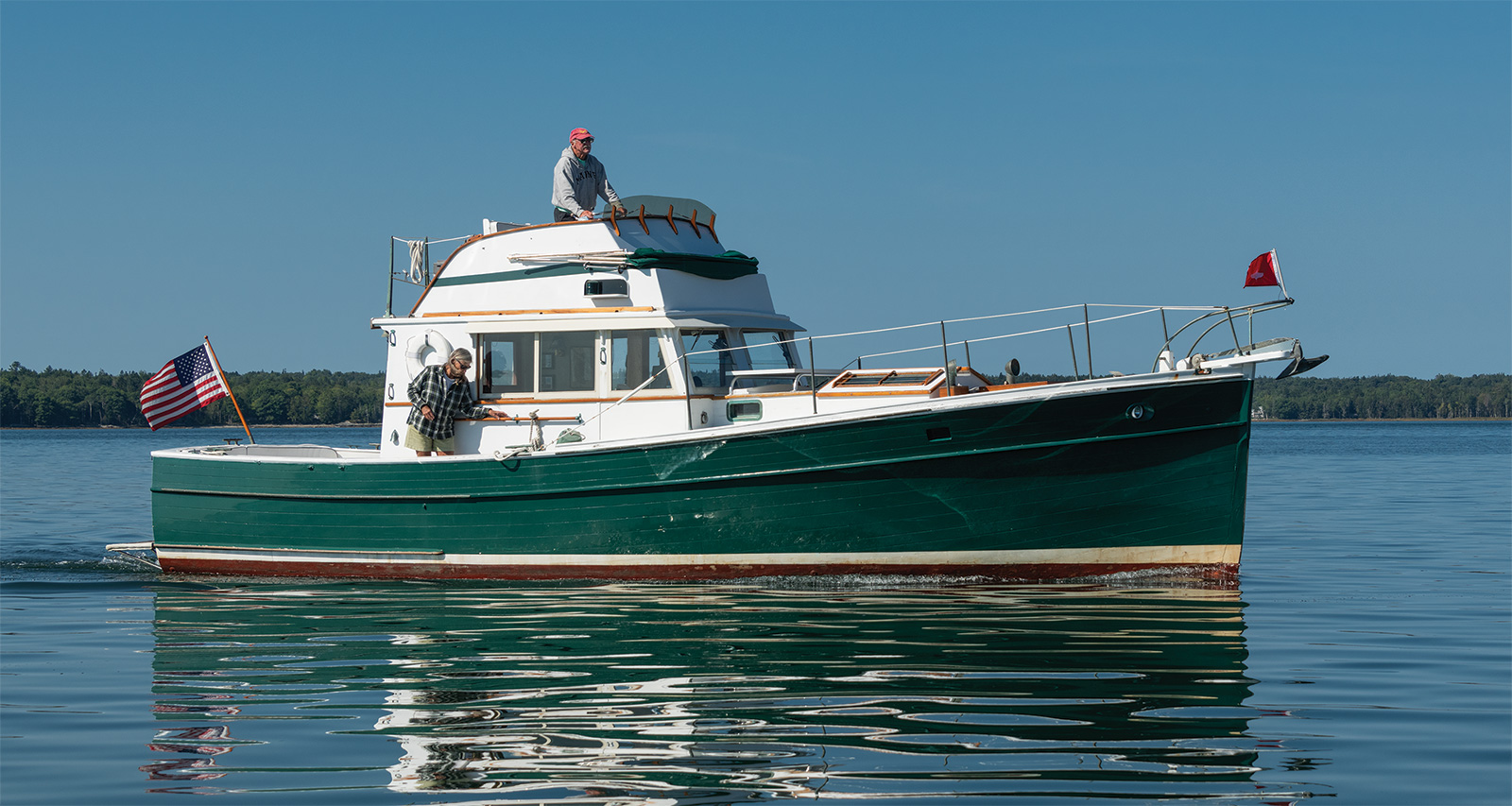
Benjamin MendlowitzEIDER is a 1961 Penbo that recently returned to Maine after a winter in the Bahamas. The boat is a “one-couple cruiser,” a label coined by her co-designer, Carl Lane. She measures 36′ LOA, 11′4″ beam, 3′4″ draft, and displaces 8 tons.
Penbo cruisers are unique in the annals of wooden yacht building. The company that built them, Penobscot Boat Works (aka Penbo) of Rockport, Maine, was founded by the father-and-son team of Carl and Bob Lane in the early 1950s to build wooden runabouts. At the time of the company’s founding, Carl was already well known as a writer of maritime fiction and nonfiction and an avid powerboat cruiser, and he brought to the boatbuilding endeavor a refined taste and sensibility for boats he liked to call “one-couple cruisers.” Bob distilled these ideas, doing the design work.
When the fiberglass revolution of the 1960s was causing many wooden-boat builders to either adapt to the new material or shutter their doors, Penbo took a different tack: they offered a line of semi-custom cruising powerboats. The hulls were similar, but the wooden-boat tooling allowed clients to customize their orders in ways that expensive and rigid fiberglass tooling could not. Thus, while each Penbo is unique, there is a distinctive New England workboat appearance to all of them, a look readily identifiable as “Penbo” by the experienced eye.
On a trip to Hope Town in the Bahamian island chain of the Abacos last February, photographer Benjamin Mendlowitz first encountered the 1961, 36′ Penbo cruiser EIDER when the boat was being towed into the harbor by a ferry due to a corroded and failed fuel-pump relay. Upon getting to know her owners, Andy and Cathy Washburn, Ben learned that they were neighbors of his on Eggemoggin Reach in Maine. In fact, EIDER’s Maine mooring was visible from Ben’s living room with a pair of binoculars. They resolved to reconnect in Maine in the summer.
Andy and Cathy returned to Maine in May. And on a sparkling early September day, they made the short trip across Eggemoggin Reach to visit with Ben and take a series of photographs of EIDER. A few days later, they made another early morning trip to WoodenBoat’s anchorage, where they gave me a tour of this gem of a cruising boat.
Helm Station
EIDER was originally equipped with only inside steering; the flying bridge was added in 1984. Andy and Cathy spend most of their underway time at the bridge station, which offers spectacular visibility. They use the inside station only in poor weather. The vintage wheel is from the Scottish steering-gear maker John Hastie & Co., Ltd.
A Yachting Legacy

Andy comes by his cruising inclinations honestly: his grandfather, Charles Edberg, who is depicted in the photograph beneath the chronometer, was the test captain for Trumpy Yachts, builders of legendary houseboats and power cruisers. Charles, a native of Sweden, was also the personal captain for the company’s founder, John Trumpy.
Dinette and Guest Berth
This simple dining table easily converts to a guest berth. The table lowers to be supported by lips along the edges of the seats, forming the berth flats, and the seatback cushions fill in the gap to create a continuous mattress. Andy says that the convertible berth is deliberately “a little too short and narrow for guests to stay for long.”
A “one-couple” Penbo cruiser
EIDER was originally equipped with only inside steering; the flying bridge was added in 1984. Andy and Cathy spend most of their underway time at the bridge station, which offers spectacular visibility. They use the inside station only in poor weather. The vintage wheel is from the Scottish steering-gear maker John Hastie & Co., Ltd.
Forepeak
The classic V-berth configuration includes a storage drawer and lockers. A filler piece can be added to create a more generous double berth.
Heater

The bulkhead-mounted, propane-fueled heater is an essential item for shoulder-season cruising in Maine; it allows for comfortable overnight outings in early May and well into October.
A New Engine
When Cathy and Andy acquired EIDER, the boat was driven by a 250-hp Yanmar diesel engine. Their first issue with that high-hours engine involved a corroded fuel-pump relay. Then came a bad starter, which they had rebuilt. Finally, a faulty cylinder leaking smoke into the cabin upon their return to Maine compelled them to repower with a new Yanmar of the same horsepower as the old one. The boat cruises at 8½ to 9 knots at 2,500 rpm while consuming 3 gallons of fuel per hour.
Penbo: A Legacy of Fine Cruisers
Penbo’s final year of full production was 1969, though they built a few more cruisers into the early 1970s before production ended and the yard changed hands. Many of the boats are still actively cruising. EIDER has had a succession of caring owners—and names. She was launched as FINALE II, and has also been called WHIMSEY, BULLDOG, GRIFFIN, and PANDA.
Swim Platform
Cathy and Andy take a moment in EIDER’s comfortable aft cockpit. The swim platform, in addition to being handy for its intended use, is a convenient place for landing a dinghy. EIDER is built of the classic Maine combination of cedar planking on oak frames, fastened with bronze screws.
New England Workboat Legacy
Bob Lane described Penbo cruisers as looking like Stonington, Connecticut, draggers above the waterline —a heritage evoked in EIDER’s green hull color—and Maine lobsterboats below. They are excellent sea boats that, with nearly flat V sections aft, maneuver easily in close quarters. EIDER swings a four-bladed 20“ × 17“ Michigan propeller on a 11⁄2“ stainless-steel shaft. ![]()
Matthew P. Murphy is editor of WoodenBoat.